Blogs
|
Hi, my name is Martha Meacham. I am a librarian at the Lamar Soutter Library, University of Massachusetts Medical School. We are always happy to help answer the many questions we receive about copyright. While this can be a complicated issue, it shouldn’t be scary. A little background understanding and due diligence will help guide you while navigating copyright.
Copyright is a set of exclusive legal rights granted to the creators of works that allows them to control the copying, reuse, redistribution, creation of derivatives, and performance of their works. While copyright allows creators to benefit from their works, particularly financially, it also has some important limitations that benefit the public. Just because something is copyrighted doesn’t mean it can’t be used; the proper steps just need to be taken.
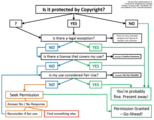
Hot Tips: It can be a challenge to determine if copyright needs to be taken into consideration. The Copyright Flow Chart below can help guide you through some questions to ask when considering if copyright is applicable.
Lessons Learned: You may need to do further investigation in areas like Creative Commons Licenses or fair use. Remember, you can always ask for permission. However, don’t wait until the last minute to start thinking about copyright. Finding answers and seeking permissions can take time. Avoid the temptation to ignore the issue, or use something questionable because time has run out to take the proper steps.
Rad Resources: There are many great ways to find materials where copyright is not an issue or has been explicitly addressed.
Anything produced for or by the government exists in the public domain (something belonging or being available to the public as a whole, and therefore not subject to copyright). For example, the NIH Photo Galleries, the CDC Public Health Image Library, and a database of U.S. Government Photos, all provide materials that exist in the public domain.
Other resources contain images that have Creative Commons Licenses. Sites like Flickr allow you to search by Usage (specific Licenses) or restrict to just Creative Commons Galleries. Additionally, almost all images found in WikiCommons have some sort of license that allows for their use. Regardless of resource, it is wise to double check the specific license for a specific image, and always give credit to the source.
Finally, the Lamar Soutter Library offers some great resources about copyright here. Also check out the Columbia University Libraries’ Copyright Advisory Office and Fair Use checklist and the Copyright and Fair Use page from Stanford University.
When in doubt ask for help. Copyright can be tricky but there are many guides. With a little practice, your copyright journey can be smooth sailing.
Do you have questions, concerns, kudos, or content to extend this aea365 contribution? Please add them in the comments section for this post on the aea365 webpage so that we may enrich our community of practice. Would you like to submit an aea365 Tip? Please send a note of interest to aea365@eval.org . aea365 is sponsored by the American Evaluation Association and provides a Tip-a-Day by and for evaluators.
AEA365
.
Blog
.
<span class='date ' tip=''><i class='icon-time'></i> Jul 27, 2015 11:56am</span>
|
|
Venturing into social media can be a daunting task since the various platforms are growing so quickly. Developing a checklist can be an easy way to get started in social media and organize your social strategy and routine.
I have outlined a few ways you can start developing your social media checklist.
Define your audience
Identifying your target audience on social media is important. It’s easy to say that you want to target anyone or everyone who is willing to give you a like or retweet, but is this really aiding your social media goals or purpose and is your content being used effectively?
By identifying who you want to target—whether that group is students, evaluation professionals, non-profit workers, or those focused in data—you can create targeted content that will be more valuable for your followers and result in a higher return on investment for your social strategy. You can start with the basic demographics questions: age, occupation and education. Then you can identify their interests.
Develop a content strategy
It’s important to develop some sort of content strategy when venturing into social media so you can stay relevant with your audience. This helps you stay on track and keeps you from sharing anything and everything. Once you have identified what your audience is looking for, you can develop posts that match their needs. Important questions to ask yourself when developing content are:
What is important to your audience?
What are their questions or concerns?
What do they want to learn more about?
Set up your check list for each channel
Once you are ready to start posting, you can set up your personal checklist and scheduling guide which will help you reach your activity goals. Below are a few examples:
Facebook
Publish 1 post each day
Dedicate two days each week to blog content from evaluation sources
Monitor and respond to comments once a week
Review insights at the end of every month
Twitter
Publish twice daily
Retweet relevant content to your followers twice a week
Follow 15 new and relevant users or organizations each week
Follow industry hashtags once a week
These are just a few examples. You can create a checklist that works with your schedule and social goals.
Do you have questions, concerns, kudos, or content to extend this aea365 contribution? Please add them in the comments section for this post on the aea365 webpage so that we may enrich our community of practice. Would you like to submit an aea365 Tip? Please send a note of interest to aea365@eval.org. aea365 is sponsored by the American Evaluation Association and provides a Tip-a-Day by and for evaluators.
AEA365
.
Blog
.
<span class='date ' tip=''><i class='icon-time'></i> Jul 27, 2015 11:54am</span>
|
|
From the report entitled The HR Roller Coaster Ride: Are Key HR Metrics Back to Prerecession Levels? by John Dooney All HR professionals have their own stories to tell about how their organization faced the Great Recession. After it began in December 2007, revenues fell more than 50 percent as the demand for goods and services dried up. Organizations slashed operating expenses, including staff and benefits costs, to stay afloat, leaving HR professionals wondering when the HR roller coaster ride—with its ups, downs, twists and turns—would end. The HR roller coaster...
SHRM
.
Blog
.
<span class='date ' tip=''><i class='icon-time'></i> Jul 27, 2015 11:54am</span>
|
|
My name is Melissa (Chapman) Haynes from the University of Minnesota’s Minnesota Evaluation Studies Institute (MESI). At MESI we have a strong interest in building evaluation capacity within the university and the community through university-community partnerships. We are trying to build this capacity in a sustainable manner, and in a way that builds upon the practice of professional evaluators and creates scholarship of the teaching of and professionalization of program evaluation. One of our signature activities is a spring evaluation training that MESI has hosted for the past 20 years. This week of posts will highlight a bit of the key learning, resources, and tools presented at our 2015 event!
Lesson Learned: Creating an inclusive community of evaluators is essential but we are an incredibly diverse field - what brings us together? Through the week of MESI the Program Evaluation Standards (Yarbrough et al., 2010) and AEA Guiding Principles were utilized in various contexts. In particular, as a frame of reference as we decide which evaluation projects we will engage in, as a guide to navigation and negotiation of situations where ethics are in question, and to elevate the profession of evaluation in various contexts. We can and should continue to use and explore how these guiding documents can further the professionalization of our field.
Hot Tip: Donna Mertens provided some wonderful examples of the art and power of questioning during her workshop and keynote address. During her workshop she gave some examples of how she uses questioning to negotiate with clients. For example, if a potential client asked you to frame an evaluation in a manner that did not jive with the Program Evaluation Standards or AEA Guiding Principles, one might tell the client something like "I will not do X, but let’s talk about how we might frame an evaluation that will continue to serve the population of interest."
Rad Resource: Some of the presenters have opted to share the information they presented on our website: http://www.cehd.umn.edu/OLPD/MESI/spring/2015/default.html
Rad Resource: A fun highlight of MESI is the annual "Top Ten" competition. For those new to MESI, Jean King develops a Top Ten statement - this year it was "How is program evaluation like interstellar space travel?" We had over 50 entries from MESI attendees - the Top Ten is located here. My favorite is #2 - "You’ve got to remember that YOU are the alien here."
The American Evaluation Association is celebrating MESI Spring Training Week. The contributions all this week to aea365 come from evaluators who presented at or attended the Minnesota Evaluation Studies Institute Spring Training. Do you have questions, concerns, kudos, or content to extend this aea365 contribution? Please add them in the comments section for this post on the aea365 webpage so that we may enrich our community of practice. Would you like to submit an aea365 Tip? Please send a note of interest to aea365@eval.org. aea365 is sponsored by the American Evaluation Association and provides a Tip-a-Day by and for evaluators.
AEA365
.
Blog
.
<span class='date ' tip=''><i class='icon-time'></i> Jul 27, 2015 11:54am</span>
|
|
Stop talking about the gender confidence gap! I keep hearing a lot about the "confidence gap". Premise: women are less confident than men. I believe those raising the issue are well intended, but I worry about the constant drum beat on this issue for three reasons: Are we not measuring confidence by what are more traditional "male" standards? Are we not mis-measuring the confidence of women as a result? Is not raising the issue reinforcing the stereotype in terms of confidence ? Rather than talking about the confidence gap, I recommend we talk about the gap in perceptions on how we...
SHRM
.
Blog
.
<span class='date ' tip=''><i class='icon-time'></i> Jul 27, 2015 11:54am</span>
|
|
My name is Donna M. Mertens and I am an independent consultant based in Washington DC; my work is both domestic and international. I had the honor of being the keynote speaker at the Minnesota Evaluation Studies Institute (MESI) in March 2015. The MESI theme was Social Justice amidst Standards and Accountability: The Challenge for Evaluation. The concept of social justice in the context of evaluation implies that evaluators can play a role in addressing those wicked problems that persist in society, such as violence, lack of access to quality education for all, poverty, substance abuse, and environmental pollution.
Lesson Learned: Wicked problems and Social Justice. Evaluators are concerned and involved in contributing to the solution of wicked problems. They also recognize the importance of bringing a social justice lens to this work. Michael Harnar conducted a survey of 1,187 evaluators and reported that 69% (n=819) either strongly or somewhat agreed with this statement: Evaluation should focus on bringing about social justice.
Rad Resource: Mertens, D.M. editorial: Mixed Methods and Wicked Problems, Journal of Mixed Methods Research, 2015, 9, 3-6. Abstract http://mmr.sagepub.com/content/9/1/3.extract
Harnar, M. (2014). Developing criteria to identify transformative participatory evaluators. JMDE. http://journals.sfu.ca/jmde/index.php/jmde_1/article/view/383
Lesson Learned: Social Justice Lens Leads to Different Evaluation Questions. Evaluators who work with a social justice lens are concerned with the question of program effectiveness and answering the impact question, Did "it" work? They are also interested in asking other types of questions:
Was "it" the right thing?
Was "it" chosen and/or developed and implemented in culturally responsive ways?
Were contextual issues of culture, race/ethnicity, gender, disability, deafness, religion, language, immigrant or refugee status, age or other dimensions of diversity used as a basis for discrimination and oppression addressed?
How were issues of power addressed?
Do we want to continue to spend money on things that don’t work?
Rad Resource: Native American Center for Excellence published Steps for Conducting Research and Evaluation in Native Communities that provides a specific context in which a social justice lens is applied in evaluation.
Lessons Learned: Social Justice Criteria for Evaluators. Evaluators who work with a social justice lens consider the following criteria to be indicators of the quality of the evaluation:
Emphasizes human rights and social justice
Analyses asymmetric power relations
Advocates culturally competent relations between the evaluator and community members
Employs culturally appropriate mixed methods tied to social action
Applies critical theory, queer theory, disability and deafness rights theories, feminist theory, critical race theory, and/or postcolonial and indigenous theories
Rad Resource: Reyes J., Kelcey J., Diaz Varela A. (2014). Transformative resilience guide: Gender, violence and education. Washington, DC: World Bank.
The American Evaluation Association is celebrating MESI Spring Training Week. The contributions all this week to aea365 come from evaluators who presented at or attended the Minnesota Evaluation Studies Institute Spring Training. Do you have questions, concerns, kudos, or content to extend this aea365 contribution? Please add them in the comments section for this post on the aea365 webpage so that we may enrich our community of practice. Would you like to submit an aea365 Tip? Please send a note of interest to aea365@eval.org. aea365 is sponsored by the American Evaluation Association and provides a Tip-a-Day by and for evaluators.
AEA365
.
Blog
.
<span class='date ' tip=''><i class='icon-time'></i> Jul 27, 2015 11:53am</span>
|
|
This is Jean King, professor of Evaluation Studies at the University of Minnesota and mother of the Minnesota Evaluation Studies Institute (MESI—pronounced "messy" because evaluation is that way). MESI began 20 years ago to provide high quality evaluation training to all comers: evaluation practitioners, students, accidental evaluators, and program staff and administrators. We are fortunate to have had Minnesotans Michael Quinn Patton and Dick Krueger as regular MESI trainers from the beginning and, with funding from Professor Emerita Mary Corcoran, guest sessions from many of our field’s luminaries. Over the years MESI has taught me a great deal. This entry details three learnings.
Lesson Learned: Structured reflection is helpful during evaluation training. Experiential educators remind us that merely having an experience does not necessarily lead to change; reflection is the key to taking that experience and learning from it. At MESI plenaries we regularly build in time when the speaker finishes for people to "turn to a neighbor" (groups of 2 to 4-no larger) and talk about what they took as the main ideas and any confusions/questions they have. The reflection is easy to structure, and people engage actively. If appropriate, the facilitator can ask people to jot down their questions, which can become the basis of Q&A.
Hot Tip: I never ask an entire large group, "Are there any questions?" At the end of sessions in large conferences/training sessions, the facilitator/presenter will frequently ask the entire group if there are any questions. In these situations there is often an awkward pause, sometimes lasting long enough that people start glancing nervously at each other or at the door, and then someone who can’t stand the silence thinks of a question, raises a hand, and is instantly called on. Everyone breathes a sigh of relief. When I facilitate a session, I instead use the "turn to a neighbor" strategy (briefly—just a couple of minutes) so that everyone can start talking and generate potential questions. You can even call on people and ask what they were discussing in their small group.
Cool Trick: Create Top Ten lists as part of a meeting or training session. Since MESI’s inception, attendees have participated in an annual tongue-in-cheek Top Ten competition where they submit creative answers to a simile that describes how evaluation is like something else (e.g., the state fair, baseball, Obamacare). We provide prizes for the top three responses, and I am continually impressed with people’s cleverness. This year’s topic compared evaluation to interstellar space travel, and the final list is posted at www.evaluation.umn.edu. The Top Ten is a useful activity because it spurs creativity and helps a group come together around a common, low-key cause.
The American Evaluation Association is celebrating MESI Spring Training Week. The contributions all this week to aea365 come from evaluators who presented at or attended the Minnesota Evaluation Studies Institute Spring Training. Do you have questions, concerns, kudos, or content to extend this aea365 contribution? Please add them in the comments section for this post on the aea365 webpage so that we may enrich our community of practice. Would you like to submit an aea365 Tip? Please send a note of interest to aea365@eval.org. aea365 is sponsored by the American Evaluation Association and provides a Tip-a-Day by and for evaluators.
AEA365
.
Blog
.
<span class='date ' tip=''><i class='icon-time'></i> Jul 27, 2015 11:52am</span>
|
|
I am Ravan Charles, an evaluation newbie from Omaha, Nebraska. I’m writing about how my personal experience at the 2015 Minnesota Evaluation Studies Institute (MESI) Spring Training will influence the way I do evaluation for the rest of my life.
I have to admit, I was skeptical when I saw the conference theme - ‘Social Justice Amidst Standards and Accountability: The Challenge for Evaluation’ with an emphasis on cultural competence. It is probably important to note that I am a black woman. I grew up in a world where cultural competence was for white people. Cultural competence meant the white lady facilitating my all-black tween girls’ group was able to code-switch fluently, or my sociology professor making sure to call on me whenever we talked about race in class (every day, it was a long semester). My perception was that cultural competency was something that white people were trained to be good at (by other white people).
When I walked into the conference, I instinctively scanned the room for other black and brown faces. I saw one… two… seven…. I lost count. Of the many trainings, conferences, and college classes that I have attended in my life this was the very first where I felt that there was adequate people-of-color representation. I had never realized how important racial diversity is to me until my need for it was satisfied. Once it was, I was able to notice and more deeply appreciate other types of diversity in the rooms. Furthermore, I was able to become more actively engaged and take ownership of the training.
Lesson Learned: When I was able to see myself across the room, in the lunch line, and even at the podium I no longer felt like a spectator. I realized that being culturally competent is about continuously learning from, sharing, and honoring our differences and using that knowledge to create things together. That is just as valuable to me as anyone else. Seeing myself in the room allowed me to see myself as an evaluator, and as someone who wants to be a good one.
I plan to use this experience inform my future work. For me, being culturally competent will mean that I not only strive to interact effectively with clients, I will also work at ensuring that every individual that participates will be able to see their self in every part of the work. My hope is that if every participant feels well-represented throughout they will feel the same sense of ownership and engagement I felt at MESI.
Rad Resources:
Cultural Competence in Evaluation: An Overview by Saumitra SenGupta, Rodney Hopson, Melva Thompson-Robinson
Humberto Reynoso-Vallejo on Cultural Competence and Cultural Humility in Evaluation
The American Evaluation Association is celebrating MESI Spring Training Week. The contributions all this week to aea365 come from evaluators who presented at or attended the Minnesota Evaluation Studies Institute Spring Training. Do you have questions, concerns, kudos, or content to extend this aea365 contribution? Please add them in the comments section for this post on the aea365 webpage so that we may enrich our community of practice. Would you like to submit an aea365 Tip? Please send a note of interest to aea365@eval.org. aea365 is sponsored by the American Evaluation Association and provides a Tip-a-Day by and for evaluators.
AEA365
.
Blog
.
<span class='date ' tip=''><i class='icon-time'></i> Jul 27, 2015 11:51am</span>
|
|
. . . shouldn’t stay in Vegas !! I just returned from the SHRM Annual Conference (SHRM15) in Las Vegas, Nevada. It was a great even from start to finish. I enjoyed the Bloggers Lounge, the Smart Stage, the SHRM Store, the vendor hall, the keynote speakers, Jennifer Hudson, the concurrent sessions, being on TChat with Kevin Grossman, Callie Zipple and Chanel Jackson, the No Kid Hungry Poetry Slam and especially meeting the great attendees throughout the week !! Tomorrow, I return to work and the great folks I get to be with most of the time...
SHRM
.
Blog
.
<span class='date ' tip=''><i class='icon-time'></i> Jul 27, 2015 11:50am</span>
|
|
I’m Mary Crave. Among the many roles I play as an extension education specialist in Wisconsin, Africa, and elsewhere are those of facilitator of and advocate for participatory evaluation practices that engage vulnerable persons - those who often don’t often have a voice in their community. At the University of Wisconsin I focus on programs that empower youth and women in international agriculture and also teach students who plan to work in community non-profit organizations. It wasn’t until the past few years that I consistently and consciously applied a social justice lens to my work in each of these roles. It was enlightening to see at MESI how others frame their work in social justice.
Hot Tip: Is social justice a goal of the programs you evaluate? While we may not think so at first, it may be. Is the goal of a program to make a change? Improve the common good? Transform people or an organization? Provide access to resources? Do the programs consider who is not involved?
Social justice is about power - who has it, who doesn’t. Therefore, as evaluators we need to understand our own sense of power and privilege as we enter into a community or program.
Rad Resource: Back Pocket Questions One intriguing breakout session at MESI was led by Leah Hakkola, University of Minnesota. Hakkola uses what she calls "Back Pocket Questions" for culturally sensitive evaluation.
A back pocket question is: a strategy we can use to examine privilege and its systemic consequences; a question we can ask ourselves to better understand dominant cultural norms, power dynamics, discrimination and expectations; and, a tool we can use as an entry point into difficult conversations we may need as an evaluator.
Some examples of back pocket questions from Hakkola:
Who would be disappointed if they were left out of the evaluation? The design? Evaluation funding? Program participation?
How much risk is associated with each group participating in this evaluation?
What power am I willing to concede to my stakeholders?
How might my actions be supporting systemic oppression or discrimination?
How might my actions be colluding with my privilege in this evaluation?
What are the unique consequences of my decisions with regard to each stakeholder group?
Whose stories and what methods am I privileging in this context?
These were adapted from an AEA 2014 session, "How can we identify, talk effectively about and address privilege and power in the practice of evaluation?" facilitated by Andrea Anderson-Hamilton and Sally Leiderman.
What questions are in your back pocket?
The American Evaluation Association is celebrating MESI Spring Training Week. The contributions all this week to aea365 come from evaluators who presented at or attended the Minnesota Evaluation Studies Institute Spring Training. Do you have questions, concerns, kudos, or content to extend this aea365 contribution? Please add them in the comments section for this post on the aea365 webpage so that we may enrich our community of practice. Would you like to submit an aea365 Tip? Please send a note of interest to aea365@eval.org. aea365 is sponsored by the American Evaluation Association and provides a Tip-a-Day by and for evaluators.
AEA365
.
Blog
.
<span class='date ' tip=''><i class='icon-time'></i> Jul 27, 2015 11:50am</span>
|