Blogs
|
Hello! We are Çigdem Meek, Bashar Ahmed, and Marissa Molina, PhD students at the University of Incarnate Word in San Antonio, Texas. As novice evaluators, we would like to share what we have learned from our experience of attending the 28th Annual Conference of the American Evaluation Association in Denver.
Lessons Learned:
Attending the conference as a group of PhD students from the same university eased our anxiety of being among expert evaluators. Plan with your peers to attend the next conference in Chicago!
Stay at the conference hotel (and make your reservation as soon as possible). You will not regret the networking opportunities it provides!
Attend pre-conference and post-conference workshops! Evaluation 101 is a great workshop to understand the basics of evaluation.
Join Topical Interest Groups (TIGS) business meetings. Meet with like-minded evaluators!
Look for volunteer opportunities, especially if this is your first time. This helps you meet with other evaluators with ease (and also helps with the registration cost).
Participate in panel discussions. This is an excellent way to meet and learn from other evaluators.
Do NOT miss the opportunities to learn from the best through panel discussions, workshops, and conference sessions! (i.e. Donna Mertens, Robert Stake, Stafford Hood, Rodney Hopson, Hazel Symonette, Jody Fitzpatrick, Michael Scriven, Michael Patton, Art Hernandez, Karen Kirkhart, and Cindy Crusto have facilitated excellent sessions and provided exceptional insights for novice evaluators).
Make sure you have your business cards (a lot) with you and exchange! Remember to take notes on cards you receive (I thought I could remember all!). In order to stay connected send them a brief email within 10 days after conference.
Take notes to review later during the sessions and reflect on what you learn. Remember, reflection is what makes learning meaningful.
Rad Resources: Check out these resources before attending the conference!
AEA Public Library
Read American Evaluation Association Guiding Principles For Evaluators
For culturally competent evaluation, review the American Evaluation Association’s Public Statement on Cultural Competence In Evaluation
We’re celebrating Evaluation 2014 Graduate Students Reflection Week. This week’s contributions come from graduate students of Dr. Osman Ozturgut of the Dreeben School of Education at the University of the Incarnate Word, along with students from other universities. Do you have questions, concerns, kudos, or content to extend this aea365 contribution? Please add them in the comments section for this post on the aea365 webpage so that we may enrich our community of practice. Would you like to submit an aea365 Tip? Please send a note of interest to aea365@eval.org . aea365 is sponsored by the American Evaluation Association and provides a Tip-a-Day by and for evaluators.
Related posts:
MNEA Week: Leah Hakkola on Making the Most out of Networking
#Eval14 Grad Students Reflections Week: Erica Roberts on Reflecting on Evaluation 2014: Perspectives of a Graduate Student
GSNE Week: A Rae Clementz on Planning Your Best AEA Annual Conference Experience
AEA365
.
Blog
.
<span class='date ' tip=''><i class='icon-time'></i> Jul 28, 2015 07:01am</span>
|
|
Hi! My name is Denise Ramón. I am a doctoral student in education at the University of the Incarnate Word in San Antonio, Texas and work at the Center for Civic Leadership that focuses on civic engagement and leadership. More specifically, I help to connect my university to the community. I am interested in Asset Based Community Development (ABCD).
Lessons Learned: While at the AEA 2014 Denver conference, I attended a session that was of particular interest to me, Altschuld, Hung, and Lee’s Getting Started in an Asset/Capacity Building and Needs Assessment Effort. Two dichotomous philosophical approaches were presented, needs assessment and asset / capacity building (A/CB). One of the main ideas stemming from this presentation was to create a hybrid framework between needs assessment and asset mapping. If evaluation is evolving to be visionary and sustainable, mixing traditional models, such as needs assessments, with newer ideas, such as capacity building and asset mapping, seems rather logical. This way, the best of both worlds can be extracted and can fill each other’s gaps, one can complement the other rather than being at odds. With this innovative notion, more research is needed to see if a model can really be developed and effectively implemented.
Coming to my second AEA conference enhanced my network system. I participated in most of the social events hosted by AEA, such as the TIG social events, the poster presentation session, and the silent auction. Getting to know others in the field gives me confidence to participate in more evaluation activities because I know I can ask for help and turn to other veterans with more expertise. Lesson learned: Jump in to AEA with confidence and an open mind. Reach out to others. Network.
Rad Resource: Using the AEA Public elibrary to find the presentations was so very useful for me. I was able to download the presentations and can now possibly use the document as a reference for my research. I highly recommend using the AEA e-library. You can also upload your own presentation and documents. It is another way to promote your work.
As a doctoral student and novice to the evaluation field, the mere experience of attending the conferences has enhanced my overall learning and understanding of evaluation. Not only have I learned about new resources to tap into, like the e-library, but I have been able to relate newly learned evaluation concepts to other parts of my professional and academic life and research. This has been in part to having made new connections.
We’re celebrating Evaluation 2014 Graduate Students Reflection Week. This week’s contributions come from graduate students of Dr. Osman Ozturgut of the Dreeben School of Education at the University of the Incarnate Word, along with students from other universities. Do you have questions, concerns, kudos, or content to extend this aea365 contribution? Please add them in the comments section for this post on the aea365 webpage so that we may enrich our community of practice. Would you like to submit an aea365 Tip? Please send a note of interest to aea365@eval.org . aea365 is sponsored by the American Evaluation Association and provides a Tip-a-Day by and for evaluators.
Related posts:
NA TIG Week: James Altschuld on Hybrid Vigor - It’s not just Needs Assessment or Asset/Capacity Building
Loraine Park, Carolyn Verheyen, and Eric Wat on Tips on Asset Mapping
NA TIG Week: Lisle Hites on Conducting a Needs Assessment on HIV/AIDS Issues in the South
AEA365
.
Blog
.
<span class='date ' tip=''><i class='icon-time'></i> Jul 28, 2015 07:00am</span>
|
|
Hello, my name is Jayne Corso. I am a Community Manager for the American Evaluation Association (AEA).
Pinterest is a wonderful tool for creating shopping lists and finding great DYI projects, but did you also know that it is a useful resource for finding interesting data visuals and info graphics? After all, Pinterest is a place to go to be inspired and to share ideas with others. In my initial post about Pinterest, I have listed some steps for starting your journey on the tool and finding ways to use Pinterest for motivation.
Rad Resources: How it Works
When you create a Pinterest profile, you have the ability to create boards that relate to your particular interests. Boards allow you to keep all of your related pins together and help you stay organized by subject matter. I’ve used my Pinterest profile below as an example:
Use the search bar at the top to search keywords focused on your interests. I suggest searching for data visualization, presentations, research, and evaluation. These keywords will pull images, info graphics, research examples, presentation tips, and much more, which have been pinned on Pinterest by other users.
When you find an image you like, pin it to a board! After you select pin, the site will prompt you to choose a board or create a new board. Now all of your related pins are in one place that you can easily reference.
Rad Resource: Follow others on Pinterest
Similar to other social media sites, you can look people up by their names and follow them. When you follow someone, you get notified when they add items to their boards and their activity is shown in your news stream. Some of your favorite evaluators are already pinning on Pinterest including Kylie Hutchinson, Ann Emery, Stephanie Evergreen, and Chris Lysy.
You can also follow boards. If you come across a Pinterest board created by a user that you find particularly fascinating, you can follow that board and you will be notified when something gets added.
Rad Resource: Be Inspired
The greatest aspect of Pinterest is that you can be inspired by the work of others and keep a keen eye on trends within evaluations, research, and presentation. Pinterest encourages you to think creatively and find the best format for your evaluation or data.
AEA is interested in joining Pinterest. Tell us in the comments if this is something you would enjoy and find as a useful resource for your evaluations and projects!
Do you have questions, concerns, kudos, or content to extend this aea365 contribution? Please add them in the comments section for this post on the aea365 webpage so that we may enrich our community of practice. Would you like to submit an aea365 Tip? Please send a note of interest to aea365@eval.org . aea365 is sponsored by the American Evaluation Association and provides a Tip-a-Day by and for evaluators.
Related posts:
Chi Yan Lam on Hidden Online Troves of Evaluation Resources
Dan McDonnell on Making New Friends and Mastering Lesser-Known Twitter Features Without Third Party Apps
Zita Unger on Assessing Board Performance: The Elephant in the Boardroom
AEA365
.
Blog
.
<span class='date ' tip=''><i class='icon-time'></i> Jul 28, 2015 06:59am</span>
|
|
My name is Roxann Lamar and I work in research and evaluation at the Center for Human Development, University of Alaska Anchorage. Our local AEA chapter, the Alaska Evaluation Network (AKEN) hosted a discussion on cultural competence, particularly relevant toNative cultures. About 19% of Alaskans have all or partial Native heritage.
The AEA’s statement on cultural competence in evaluation is comprehensive, covering a multitude of issues involved in working together in a diverse world. What is presented here is a perspective to think about - how people might respond to thelanguage we choose to use- not that any languageis universally right or wrong.
Lesson Learned: Our event was called, "Cultural Competence in Evaluation." Our panel of cross-cultural experts included persons of DegXit’an Athabascan, Gwich’in Athabascan, Navajo, and non-Native heritage. All had a lifetime of personal and professional experience with cultures indigenous to Alaska. They reminded usat the startthat the words we use are important and informed us they found the term "cultural competence" to be distasteful. Theyhighly encouraged us to use the term "cultural humility" and noted it is not a new idea.They also suggested"cultural relevance" as an acceptable alternative that makes more sense in some contexts.
Our panelists explained the problem with"competence"is that it implies we will reach a point where we can say,"We areculturally competent."That is what is inferredwhen people go to a workshop for a certain number of hoursand earn a certificate in cultural competence.Our panelists pointed out that these trainings oftendo more harm than good. For example, focusing on characteristics of specific cultures inadvertently encourages stereotyping.The panel’s audience was intrigued, and discussions among colleagues continued long after the event.
Hot Tip: In many places or contexts, a term like "cultural humility" is a respectful choice. Without a lot of explanation it conveys a humble posture of learning about self and others. It implies openness, equity, and flexibility in working with anyone.
Rad Resource: With a little looking around, I found Cultural Humility: People, Principles, & Practices. This is a 30-minute, 4-part documentary by Vivian Chávez (2012). It is focused on relationships between physicians and patients, but the principles can beappliedin other applications.
Do you have questions, concerns, kudos, or content to extend this aea365 contribution? Please add them in the comments section for this post on the aea365 webpage so that we may enrich our community of practice. Would you like to submit an aea365 Tip? Please send a note of interest to aea365@eval.org .aea365 is sponsored by the American Evaluation Association and provides a Tip-a-Day by and for evaluators.
Related posts:
AKEN Week: Amelia Ruerup on Understanding Indigenous Evaluation in an Alaskan Context
Humberto Reynoso-Vallejo on Cultural Competence and Cultural Humility in Evaluation
New Board Member At Large Corrie Whitmore on the Importance of Aim and Audience in Internal Evaluation
AEA365
.
Blog
.
<span class='date ' tip=''><i class='icon-time'></i> Jul 28, 2015 06:34am</span>
|
|
My name is Sharon Wasco, and I am a community psychologist and independent consultant. I describe here a recent shift in my language that underscores, I think, important trends in evaluation:
I used to pitch evaluation as a way that organizations could "get ahead of" an increasing demand for evidence-based practice (EBP);
Now I sell evaluation as an opportunity for organizations to use practice-based evidence (PBE) to increase impact.
I’d like evaluators to seek a better understanding of EBP and PBE in order to actively span the perceived boundaries of these two approaches.
Most formulations of EBP require researcher driven activity — such as randomized controlled trials (RCT) — and clinical experts to answer questions like: "Is the right person doing the right thing, at the right time, in the right place in the right way, with the right result?" (credit: Anne Payne)
In an editorial introduction to a volume on PBE, Anne K. Swisher offers this contrast:
"In the concept of practice-based evidence, the real, messy, complicated world is not controlled. Instead, real world practice is documented and measured, just as it occurs, "warts" and all.
It is the process of measurement and tracking that matters, not controlling how practice is delivered. This allows us to answer a different, but no less important, question than ‘does X cause Y?’ This question is: ‘how does adding X intervention alter the complex personalized system of patient Y before me?’"
Advocates of PBE make a good case that "evidence supporting the utility, value, or worth of an intervention…can emerge from the practices, experiences, and expertise of family members, youth, consumers, professionals and members of the community."
Further exploration should convince you that EBP and PBE are complementary; and that evaluators can be transformative in the melding of the approaches. Within our field, forces driving the utilization of PBE include more internal evaluators, shared value for culturally competent evaluation, a range of models for participatory evaluation, and interest in collaborative inquiry as a process to support professional learning.
Lessons Learned: How we see "science-practice gaps," and what we do in those spaces, provide unique opportunities for evaluators to make a difference. Metaphorically, EBP is a bridge and PBE is a Midway.
Further elaboration of this metaphor and more of what I’ve learned about PBE can be found in my speaker presentations materials from Penn State’s Third Annual Conference on Child Protection and Well-Being (scroll to the end of the page — I "closed" the event).
Rad Resource: I have used Chris Lysy’s cartoons to encourage others to look beyond the RCT for credible evidence and useful evaluation.
Do you have questions, concerns, kudos, or content to extend this aea365 contribution? Please add them in the comments section for this post on the aea365 webpage so that we may enrich our community of practice. Would you like to submit an aea365 Tip? Please send a note of interest to aea365@eval.org . aea365 is sponsored by the American Evaluation Association and provides a Tip-a-Day by and for evaluators.
Related posts:
Jane Davidson on Evaluation Reporting
CP TIG Week: Helen Singer, Sally Thigpen, and Natalie Wilkins on Understanding Evidence: CDC’s Interactive Tool to Support Evidence-Based Decision Making
Theresa Murphrey on Jing
AEA365
.
Blog
.
<span class='date ' tip=''><i class='icon-time'></i> Jul 28, 2015 06:33am</span>
|
|
I’m Ann Martin, an evaluator working with a team of science educators and outreach professionals in Hampton, VA. I frequently employ Google Formsfor evaluation and even other projects. Forms are free, simple, intuitive for users, and get the job done.
In the past, though, Google Forms had several notable limitations. If you found that Forms didn’t meet your needs in the past, you might not be aware of great new features that represent significant improvements. It’s worth taking another look at this free resource!
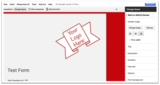
Hot Tip: Customize the visual look, feel, and branding of your survey! In September 2014 new Forms functionality allowed survey designers to add background and header images and to customize fonts and other display options. Before, theme options were limited. You can use this functionality to make your survey more readable and inviting. A custom header image with a logo may make your users feel more comfortable responding, or can make your survey a seamless part of a website in which you embed it. You can also embed images and videos within the body of the survey itself, which is handy for quizzes or assessments.
Figure 1 - Customization options range from a header image, page and form background, and fonts.
Cool Trick: Google Forms now support more complex survey design and administration options, including progress bars, data validation, logic/path branching, and randomizing the order of options in multiple choice questions. It’s also easier now to set up your survey’s questions. For instance, if you have a long list of options to include in a question, you can now copy-and-paste in a list from a word processor or spreadsheet table and automatically populate. (I wish that option had existed a few years back, when I created a drop-down with 200 alphabetized options!)
Cool Trick: New Add-ons enable even more behind-the-scenes functionality. The latest Add-ons includenifty widgets like Form Notifications, which will send automatic emails to your survey respondents, and Form Publisher, which will use survey responses to fill in a new document from a template.
Figure 2. Example Add-ons for Google Forms (screencapture from the Google Drive Add-ons Store).
Rad Resource: The Google Drive blog shares updates to Forms functionality so that you can always be aware of new features. I’m also more than happy to share tips if you contact me.
Do you have questions, concerns, kudos, or content to extend this aea365 contribution? Please add them in the comments section for this post on the aea365 webpage so that we may enrich our community of practice. Would you like to submit an aea365 Tip? Please send a note of interest to aea365@eval.org .aea365 is sponsored by the American Evaluation Association and provides a Tip-a-Day by and for evaluators.
Related posts:
Dreolin Fleischer on Organizing Quantitative and Qualitative Data
Dan McDonnell on Becoming an Amateur Graphic Designer with Canva
Audrey Roerrer on Google Tools for Multi-site Evaluation
AEA365
.
Blog
.
<span class='date ' tip=''><i class='icon-time'></i> Jul 28, 2015 06:32am</span>
|
|
Hi! I’m Josh Twomey, evaluation specialist at UMass Medical School’s Center for Health Policy and Research (in the Office of Clinical Affairs). As evaluators, we are often tasked with providing participants in our evaluations with individualized results. This can be challenging as results must be easy to interpret, display individual results in the context of the entire evaluation, and, where appropriate, show performance over time. My colleagues and I are concluding an evaluation of the Massachusetts Patient-Centered Medical Home Initiative focused on transforming traditional primary care into a more patient-centered care delivery model. Over the course of this evaluation, we faced the challenges above and found a basic, yet sometimes overlooked, solution to effectively communicate results to our participants.
Boxplots (aka: box and whisker plots) have the advantage of displaying a lot of valuable information within a simple easy-to-understand graphic. A variable’s mean, median, 25th percentile, 75th percentile, and highest/lowest values can all be assessed at a glance. Extreme values (i.e., outliers) can be highlighted as well. The bottom of the ‘box’ represents the 25th percentile of all values in your data, whereas the top represents the 75thpercentile. The median value is within the box and is displayed via a straight line. Extending from the top and bottom of the box are ‘whiskers’, representing the highest and lowest values of the distribution, respectively.
Hot Tip:
Boxplots are ideal when you must highlight a single participant’s results among participants’ results. Check out this example, where patient satisfaction from Dr. Smith’s office is shown in the context of other individual primary care practices.
Looking at the blue boxplot, notice that Dr. Smith’s patient satisfaction score (i.e., 68) hovers just above the 25th percentile of all the offices’ scores. Another advantage of boxplots is that data can easily be tracked over time. Here, Dr. Smith’s score improves from about the 30th percentile at baseline to the near 100th percentile by the final measurement.
Hot Tip:
Interpreting a boxplot is easy, after you’re shown how. When presenting boxplots, be sure to include some basic instructions on how to read one.
Cool Trick:
The end of the whiskers do not always have to represent the data’s highest/lowest points. Whiskers can be set to represent scores that are high/low, but not outliers. Outliers can be displayed by dots falling above/below the whiskers’ ends.
When constructing boxplots for numerous participants, macro variables can simplify production. Within your graphics generator, macro variables can simultaneously insert a single participant’s data and other information (e.g., participant’s name) into the boxplot. This technique allows you to generate graphs quickly and accurately, without manually entering data.
In total, boxplots can be a quick, clear, and effective way of providing participants with the information they need.
Do you have questions, concerns, kudos, or content to extend this aea365 contribution? Please add them in the comments section for this post on the aea365 webpage so that we may enrich our community of practice. Would you like to submit an aea365 Tip? Please send a note of interest to aea365@eval.org . aea365 is sponsored by the American Evaluation Association and provides a Tip-a-Day by and for evaluators.
Related posts:
Linda Cabral and Laura Sefton on So many to choose from: How to Select Organizations for a Site Visit
MA PCMH Eval Week: Ann Lawthers on Triangulation Using Mixed Methods Appeals to Diverse Stakeholder Interests
MA PCMH Eval Week: Linda Cabral and Laura Sefton on Participant Observation as a Data Collection Method
AEA365
.
Blog
.
<span class='date ' tip=''><i class='icon-time'></i> Jul 28, 2015 06:31am</span>
|
|
My name is Kylie Hutchinson and I’m an independent evaluator and owner of Community Solutions Planning & Evaluation. Each year, I adapt a Christmas carol to share with my evaluation colleagues and not-for-profit clients. Enjoy!
Hot Tip: Poems and songs are one way of communicating evaluation concepts in a fun and memorable way.
Rad Resource:
O Collective Impact
(sung to the tune of ‘O Come All Ye Faithful’)
O Collective Impact,
Joyful we triangulate,
Collect ye, collect ye thy same data,
Come and behold them,
Common outcome measures,
O come, let us adore them,
Much better than before when,
No one thought to ask for them,
Shared measurements!
O Common Agenda,
Mutually reinforcing,
See how evaluation’s now harmonized,
Give to your funders,
Impacts of the highest,
O come, let us adore them,
Much better than before when,
No one thought to ask for them,
Shared measurements!
Strategic philanthropy!
Simple, but not easy,
Even for projects with backbone support,
Yea though we greet Thee,
The only way forward,
O come, let us adore them,
Much better than before when,
No one thought to ask for them,
Shared measurements!
Rad Resource: You can find other Christmas carols on my website here.
For more information about Collective Impact, check out this short video, Tackling Complex Social Problems through Collective Impact.
Do you have questions, concerns, kudos, or content to extend this aea365 contribution? Please add them in the comments section for this post on the aea365 webpage so that we may enrich our community of practice. Would you like to submit an aea365 Tip? Please send a note of interest to aea365@eval.org . aea365 is sponsored by the American Evaluation Association and provides a Tip-a-Day by and for evaluators.
Related posts:
Kylie Hutchinson on It Came Upon a Systems Lens
Best of aea365 week: Cassandra O’Neill on Engagement for High Impact Collaboration
David Erickson on Measuring the Social Impact of Investments
AEA365
.
Blog
.
<span class='date ' tip=''><i class='icon-time'></i> Jul 28, 2015 06:29am</span>
|
|
Hello, I’m Katherine Haugh, an evaluator at Innovation Network—a nonprofit consulting firm based in Washington DC. What is the best way that you retain and recall information? Do text-heavy reports speak to you? Or do you prefer images, infographics and colorful fonts?
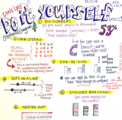
I recently attended AEA’s 2014 conference in Denver, Colorado. While I was there, I took notes during the panels, presentations and workshops that I attended and uploaded them on my Twitter handle and website. Some of you expressed interest in learning about how I take my notes. Below I’ve listed some "how to" tips for taking visual notes that can be customized to your own personal style.
Step 1: Find the right mix for you (and your audience)
There are many different techniques for taking notes. For me, a plain white sheet of paper with an equal balance of images and text allows me to quickly recall what I wrote down.
Hot Tip: Organization is key. No matter the format, the more organized your notes are—the higher likelihood that you’ll remember what you wrote. The goal is to keep your notes short, but have enough triggers in key words, images or symbols to jog your memory when you look them over.
Step 2: Get the right tools
The best way to learn what technique works for you is to try out different options. Test out different color combinations, spacing, and symbols. Maybe too much color is overwhelming for you or you prefer stars to arrows. I like to stick with a darker base color and add punches of bright color for important items.
Hot Tip: If you prefer hand-written notes, stay away from inky pens—they smear easily! You don’t have to be an artist to be a brilliant note taker. The most important thing is to create notes that capture what’s most important in an organized, succinct, and readable fashion.
Step 3: Make it personal
Without question, one of the most effective ways to retain information is to make it personally significant to you. For example, drawing a picture of swirl might indicate that you were confused by something covered in a presentation. This is helpful when you need to quickly scan through your notes to find the parts you want to pay the most attention to. I often incorporate dorky jokes into my notes to help me recall what I wrote.
Hot Tip: Write your own notes in your own words. Try to stay away from copying down verbatim from a PowerPoint slide. Ideally, you want your notes to supplement a presentation—not copy it.
Questions, suggestions or feedback? Please reach out. I’d love to hear from you!
Do you have questions, concerns, kudos, or content to extend this aea365 contribution? Please add them in the comments section for this post on the aea365 webpage so that we may enrich our community of practice. Would you like to submit an aea365 Tip? Please send a note of interest to aea365@eval.org . aea365 is sponsored by the American Evaluation Association and provides a Tip-a-Day by and for evaluators.
Related posts:
Scribing: Susan Kistler on Using Graphic Recorders
Kat Athanasiades on Get Graphic for Better Conversation Facilitation: Graphic Recording at Evaluation 2013
Rena Matthews on Getting Names Right
AEA365
.
Blog
.
<span class='date ' tip=''><i class='icon-time'></i> Jul 28, 2015 06:29am</span>
|
|
Hello Loyal aea365 readers! I’m Sheila B. Robinson, aea365’s Lead Curator and sometimes Saturday contributor with one question for you: What is it that YOU would like to read about on this blog?
Lesson Learned: AEA365 has been going steadily since January 1, 2010 with 1800+ contributions from hundreds of evaluators across the globe. We accept individual submissions at aea365@eval.org on a rolling basis, along with inquiries about sponsored or themed weeks. Posts are about any and all evaluation-related topics, and anyone with something to share with fellow evaluators is welcome to contribute! If you are interested in sharing a tip, please be sure to check out our contribution guidelines here.
2015 has been declared the International Year of Evaluation and we suspect we’ll be hearing quite a lot about that in the coming weeks and months. The aim of designating 2015 as the International Year of Evaluation is to advocate and promote evaluation and evidence-based policy making at international, regional, national and local levels.
As a key learning tool for evaluation, aea365 can also be a fabulous vehicle for promoting evaluation and evidence-based policy. With that in mind, we would like to include your voice as we head into the new year as our aea365 team considers inviting authors and groups to contribute.
Hot Tip: Let’s crowdsource some ideas for aea365 in 2015 and make it the best year ever.
Please let us know what you would like to see in aea365 by responding to these questions in the comments:
1. What do YOU want to read or learn more about on aea365 in 2015?
2. Who do YOU want to hear from on this blog?
Thanks very much for your input and your loyal readership.
Happy New Year!
Do you have questions, concerns, kudos, or content to extend this aea365 contribution? Please add them in the comments section for this post on the aea365 webpage so that we may enrich our community of practice. Would you like to submit an aea365 Tip? Please send a note of interest to aea365@eval.org . aea365 is sponsored by the American Evaluation Association and provides a Tip-a-Day by and for evaluators.
Related posts:
Sheila B Robinson on EvalYear: A Taste of 2015 and a bit of Alphabet Soup to Whet Your Appetite
Neha Karkara on the Evaluation Advocacy Toolkit
LAWG Week: Brian Yoder on Evaluators Visit Capitol Hill
AEA365
.
Blog
.
<span class='date ' tip=''><i class='icon-time'></i> Jul 28, 2015 06:29am</span>
|