Blogs
|
Improve employee engagement, productivity, and retention through criticism that’s actually effective
Finding the right way to offer commentary to your employees is vital. Get it right, and you can fix any number of problems in your business. Get it wrong, and you risk losing money, losing your employees, and losing your mind.
A Fable
Susan was a bright girl with a powerful intrinsic curiosity. In high school,
Read More
The post How to Kill With Criticism (It’s Easier Than You Think!) appeared first on renshicon.com.
Renshi
.
Blog
.
<span class='date ' tip=''><i class='icon-time'></i> Jul 28, 2015 07:14am</span>
|
|
Hello evaluation colleagues! We’re Rachel Albert, Vice President of Learning and Impact, and Laura Beals, Director of Evaluation, from Jewish Family and Children’s Service (Boston, MA). Our department is responsible for the internal evaluation of 44 programs, collectively serving over 17,000 people a year.
At JF&CS, we face two challenges in evaluation management. First, we have multiple external and internal stakeholders - including foundations, federal and state grantors, individual donors, agency leadership, program managers, and staff - each of whom has a different perspective on what sorts of data they need. Second, instead of grants dictating the evaluation resources available to each program, our department is funded by overhead. This means it’s up to us to apportion our department’s evaluation resources thoughtfully across all 44 programs for maximum benefit.
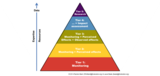
Lessons Learned: To meet this challenge, we developed a tool we call TIERS ("Tool for Intra-agency Evaluation Resource Sharing"). TIERS helps us leverage our resources on each program to answer the questions most relevant to its stakeholders.
As you go higher in the pyramid, you are looking for stronger and stronger evidence that your program is achieving its intended impact. The pyramid is intended to be both cumulative and sequential: a program should not go up a tier until it has a robust implementation of the previous tier in place.
Hot Tips:
This is not a race: It’s ok to stop at whatever the right tier is for a given program based on its evaluation needs and staff resources.
Higher tiers require more resources from both the internal evaluator and program staff.
Do not underestimate the difficulty of establishing even just a rigorous Tier 1 across a large agency!
We presented this tool in a demonstration session at Eval 14; check out the AEA e-library for our slides and handout.
Rad Resources: If you are looking for additional information about resource allocation for evaluation, here are a few places to start:
This TIERS framework was inspired by the evaluation theories and frameworks of others, including Michael Q. Patton’s Mountain of Accountability and Idealware’s "The Reality of Measuring Human Service Programs: Results of a Survey."
The Innovation Network’s "State of Evaluation 2012: Evaluation practice and capacity in the nonprofit sector," which includes their recommendation that "organizations should budget from 5% to 10% of the organization budget for evaluation costs" (p. 5).
State of the Nonprofit Sector Survey, by the Nonprofit Finance Fund, which includes data points on how often funders cover the costs of impact measurement (hint: 71% said "rarely" or "never").
A recent Markets for Good article by Laura Quinn on the cost of collecting data in nonprofit settings entitled "Forcing Nonprofits To Lie About Data."
The American Evaluation Association is celebrating Internal Evaluation (IE) Topical Interest Group Week. The contributions all this week to aea365 come from our IE TIG members. Do you have questions, concerns, kudos, or content to extend this aea365 contribution? Please add them in the comments section for this post on the aea365 webpage so that we may enrich our community of practice. Would you like to submit an aea365 Tip? Please send a note of interest to aea365@eval.org. aea365 is sponsored by the American Evaluation Association and provides a Tip-a-Day by and for evaluators.
Related posts:
Laura Beals on How Nonprofits can Support Academic Research Requests
Internal Eval Week: Kathleen Norris on the Internal Evaluation Boa
Internal Eval Week: Debbie Cohen on Electronic Health Records Data Tips
AEA365
.
Blog
.
<span class='date ' tip=''><i class='icon-time'></i> Jul 28, 2015 07:14am</span>
|
|
My name is Stanley Capela, currently Vice President for Quality Management and Corporate Compliance Officer for HeartShare Human Services of New York, a 140 million dollar multi-service organization.
As with most government funded organizations, we have to show we are compliant with regulations and at same time meet certain performance metrics. As a result, I am confronted with how to create a system that focuses on quality assurance that meets performance metrics and incorporates quality improvement process. Using graphs we identified a series of deficiencies and sites that had poor performance. Then we drilled down further identifying areas that were cited as repeat deficiencies by state auditors. With this information, we developed a series of trainings focused on those deficiencies. As a result, we reduced repeat deficiencies in developmental disabilities. The key was to graphically present the data in a way that we were able to pinpoint specific sites that had the problem and developed a plan to improve performance.
Hot Tip: When setting up an internal monitoring system, we focus and prioritize areas that require the program to be compliant with government agencies. We select five to ten items and develop performance metrics. For our child welfare programs we focused on a number of areas such as adoption finalizations, AWOLs, client contacts, service plan timeliness and length of stay. Next, we set up a dashboard with appropriate charts; convene leadership team; review reports; identify challenges; develop interventions; and review progress after three months. After reviewing data we pinpoint which sites fail to meet targets. Over time, program sees improvement and realizes data utilization can lead to positive change.
Lessons Learned: One major problem when using this approach is when you focus on too many areas you get bogged down and accomplish little or no improvement. Make sure everyone has clear understanding that we are a team and that we are not out to get you. Often program directors focus on placing blame as opposed to dealing with problem. The key is focusing on program staff owning the data and realizing there are successes as well as challenges. In other words, perceptions can make a difference on how you approach quality assurance and performance measurements as you create a quality improvement culture. The other major issue is making sure the facilitator and the individual preparing data is independent and separate from program.
Rad Resources: Quality Evaluation Template: How to Develop a Utilization Focused Evaluation System Incorporating QI and QA Systems by Stan Capela.
Council on Accreditation - look at the Performance Quality Improvement (PQI) standard.
Council on Quality Leadership and their method Personal Outcome Measures (POMS)
The American Evaluation Association is celebrating Internal Evaluation (IE) Topical Interest Group Week. The contributions all this week to aea365 come from our IE TIG members. Do you have questions, concerns, kudos, or content to extend this aea365 contribution? Please add them in the comments section for this post on the aea365 webpage so that we may enrich our community of practice. Would you like to submit an aea365 Tip? Please send a note of interest to aea365@eval.org. aea365 is sponsored by the American Evaluation Association and provides a Tip-a-Day by and for evaluators.
Related posts:
IE Week: Stan Capela on Tips from the Trenches: Building Your Brand as an Internal Evaluator
GOVT Week: David Bernstein on Top 10 Indicators of Performance Measurement Quality
OPEN Week: Elizabeth O’Neill on When not to evaluate
AEA365
.
Blog
.
<span class='date ' tip=''><i class='icon-time'></i> Jul 28, 2015 07:12am</span>
|
|
Improvisational comedy provides a framework for new horizons in corporate leadership
Improv is a form of live entertainment wherein the material is generated and riffed on live, in the moment. Sufficiently hilarious improv performers have gone from starring in the famed improv theatre scenes of Chicaco (Second City) and New York (Upright Citizens Brigade) to producing their own successful improv-based sketch television shows (Parks and Recreation, 30 Rock).
Improv is devised on the spot,
Read More
The post 4 Rules of Improv Every Business Leader Should Follow appeared first on renshicon.com.
Renshi
.
Blog
.
<span class='date ' tip=''><i class='icon-time'></i> Jul 28, 2015 07:12am</span>
|
|
My name is Megan Walker Grimaldi, and I work for the Research, Evaluation, and Innovation department of Communities In Schools. This year, I was happy to serve as the program chair for the Internal Evaluation TIG at the AEA conference in Denver.
Lessons Learned: One of my favorite things about the AEA conference is that it offers evaluators from all different backgrounds and fields to come together and share their experiences. As an internal evaluator, my favorite conversation by far was the conversation around the many hats that an internal evaluator wears, and how internal evaluators balance their desire to promptly assist their colleagues and their desire to focus on the evaluations for which they are responsible.
The conversation started during the Internal Evaluation TIG meeting. Someone mentioned the short timelines that internal evaluators often face. Because we are internal to organizations, our colleagues, who may be a desk away, often feel comfortable coming to us and saying, "Can you get this analysis to me by close of business tomorrow?" Not only are deadlines sometimes rushed, there are times when we can be asked to do things tangentially related to our work. For example, many evaluators are fluent in data analysis. For internal evaluators, some of our coworkers may not be sure how to use a spreadsheet; their specialties might be in working with constituents in the field, or marketing, or fundraising. With our specialized knowledge, our role of evaluator may quickly evolve into a role as a teacher or tech guru.
I brought this topic up in a fantastic presentation, Engaging Stakeholders in Internal Evaluation. Kristina Moster and Erica Cooksey from the Cincinnati Children’s Hospital, and Danielle Marable and Erica Clarke from Massachusetts General Hospital, presented on ways to engage various stakeholders in conducting internal evaluation. They helped me reframe my thinking around urgent or special requests. It’s actually positive that coworkers feel comfortable approaching us. In some organizations, people do not even realize that there is an evaluator to approach! And if the task is not exactly "evaluation," we can still turn the task into an opportunity to share ideas around evaluative thinking - and lay the groundwork for future evaluation projects. When you are an approachable internal evaluator, you build a rapport with your coworkers, and evaluation projects start to come your way. Communicating the parameters of your role will become easier once you have formed positive working relationships.
The American Evaluation Association is celebrating Internal Evaluation (IE) Topical Interest Group Week. The contributions all this week to aea365 come from our IE TIG members. Do you have questions, concerns, kudos, or content to extend this aea365 contribution? Please add them in the comments section for this post on the aea365 webpage so that we may enrich our community of practice. Would you like to submit an aea365 Tip? Please send a note of interest to aea365@eval.org. aea365 is sponsored by the American Evaluation Association and provides a Tip-a-Day by and for evaluators.
Related posts:
Internal Eval Week: Kathleen Norris on the Internal Evaluation Boa
Internal Eval Week: Pamela Bishop on Working as a New Internal Evaluator
Sarah Gill on the Atlanta-area Evaluation Association Spring Social 2012
AEA365
.
Blog
.
<span class='date ' tip=''><i class='icon-time'></i> Jul 28, 2015 07:11am</span>
|
|
Hello, my name is Jayne Corso and I am the Community Manager for the American Evaluation Association (AEA). Today, I will discuss the benefits of using Canva, a free online tool that allows you to create images and graphics. I mostly use Canva to create images for social media, but this tool is not limited to the digital medium, you can also create images that can enhance your presentations and research.
Hot Tip: Create graphics to emphasize your information
Canva makes it easy to create info graphics that support your report findings. Your first step is to choose your design format. This can be for social media, a presentation, poster, blog, business card, or presentation. Once you have decided, choose your background. You can choose from shapes, banners, buttons, and frames.
Next you can add text. Choose from the designated templates or make your own.
Finally, add some images! You can use the search box to find exactly what you need. Once you know what you want to add, drag the image onto your canvas.
You can then resize the image to fit within your background. Ta-da… you have just created your own info graphic! These images can visually represent your ideas and emphasis points you believe to be important for your shareholders.
Rad Resources:
You can also use Canva to create topic banners, emphasis important dates, create connections through lines and arrows, or find figures to demonstrate demographic data. All of the below images are free and can add great visual to your presentations.
With Canva, the possibilities are truly endless! When you are ready to export your work, just hit download in the top, right corner to export your graphic as an image or pdf.
Hot Tip: How to edit your image once exported from Canva
When you export the image from canva, it will be in an 8.5 x 11 format. This is great if you are exporting a full page of images, however, it you simply want to export a banner or button, I suggest opening your canva image in a basic design program such as paint. Here you can crop the canva image to isolate the button or banner you desire. You can also resize the image to fit your desired dimensions. This process can also be accomplished in word or PowerPoint.
Bonus tip: You can now create holiday cards on Canva! Just follow the steps above with the available holiday templates.
Do you have questions, concerns, kudos, or content to extend this aea365 contribution? Please add them in the comments section for this post on the aea365 webpage so that we may enrich our community of practice. Would you like to submit an aea365 Tip? Please send a note of interest to aea365@eval.org . aea365 is sponsored by the American Evaluation Association and provides a Tip-a-Day by and for evaluators.
Related posts:
Dan McDonnell on Becoming an Amateur Graphic Designer with Canva
June Gothberg on Creating Presentations Potent for All
p2i Week: Meredith Haaf on Applying p2i to Conference Posters
AEA365
.
Blog
.
<span class='date ' tip=''><i class='icon-time'></i> Jul 28, 2015 07:10am</span>
|
|
MSI Fellowship Week: Art Hernandez on AEA’s Minority Serving Institution (MSI) Fellowship Experience
My name is Art Hernandez and I am a Professor and Dean at Texas A&M University Corpus Christi.
I participated in one of the very early yearlong experiences as a Fellow and have served as the Director for several cohorts. I have served as evaluator and teacher or evaluation and am very interested in the processes of cultural competence in practice.
Lesson Learned: As part of my experience and exploration I have determined that cultural competence is a matter of process rather than product the dangers associated with assumptions related to determining competence.
Hot Tip: (Self-Reflection Guide)
Self awareness and a clear understanding of the potential of personal beliefs, values and perspectives to influence decision making especially in regards to the current focus of evaluation. This self-assessment must begin before the evaluation enterprise is begun and extend throughout.
Understanding of the purposes for which the evaluation is being conducted including the implications of roles and relationships between evaluators, evaluands, the "evaluation situated" community as a whole and the sponsors or initiators of the evaluation effort.
Appreciation for the language of the community, recognizing that "how" is as important as "what" people say to any interpretation of meaning.
Appropriateness of the methods and instruments to be used. This is in recognition of clear and obvious cultural differences related to the notion of norm as indicative of the "good" or the group as a whole, the adequacy and representativeness of sample, within culture heterogeneity and interpretation of outcomes of instrumentation.
Power differentials between those who initiate, implement and those who are subject to the evaluation enterprise.
Demography, history and religiosity are potential influences on judgments of cost, benefit, advantage and challenge.
Recognition that regardless of the purpose, in the end evaluation is or results in a value judgment.
Evaluative protocols and methods are an effort to standardize the proceedings and so to reduce "noise." However, regardless of approach, the findings of any evaluation are "snapshots" of a dynamic process from which predictions about the current or future states are made. Resist the tendency to reify research results.
Non-mechanical nature of human beings and human systems. As the failure of mechanistic thinking has been demonstrated in physics, astronomy, chemistry and other "physical" sciences, it should be clear that this thinking is not likely to apply to people.
Attention to unintended consequences.
Rad Resources:
Links to Resources on Cultural Competence in Evaluation
Annotated Bibliography: Multiculturalism and Cultural Competence in Evaluation, Select References 1995-2007
Sayre, K. (2003). Guidelines and best practices for culturally competent evaluations. Colorado Trust.
The American Evaluation Association is AEA Minority Serving Institution (MSI) Fellowship Experience week. The contributions all this week to aea365 come from AEA’s MSI Fellows. For more information on the MSI fellowship, see this webpage: http://www.eval.org/p/cm/ld/fid=230 Do you have questions, concerns, kudos, or content to extend this aea365 contribution? Please add them in the comments section for this post on the aea365 webpage so that we may enrich our community of practice. Would you like to submit an aea365 Tip? Please send a note of interest to aea365@eval.org. aea365 is sponsored by the American Evaluation Association and provides a Tip-a-Day by and for evaluators.
Related posts:
Cultural Competence Week: Dominica McBride on AEA 2013 and Spreading the Word on Cultural Competence
Cultural Competence Week: Melanie Hwalek on the Adoption of the AEA Public Statement on Cultural Competence in Evaluation - Moving From Policy to Practice and Practice to Policy
Cultural Competence Week: Karen Anderson on Cultural Competence in Evaluation Resources
AEA365
.
Blog
.
<span class='date ' tip=''><i class='icon-time'></i> Jul 28, 2015 07:09am</span>
|
|
My name is Ana R. Pinilla. I am a clinical psychologist and Associate Professor of Graduate Clinical Psychology at The Pontifical Catholic University of Puerto Rico. After finishing a year at the AEA Minority Serving Institute (MSI) Fellowship in October 2014, I am happy to share the lessons learned in teaching evaluation, through my experience at the fellowship.
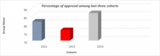
I have been teaching a Program Evaluation course for 15 years to students who do not have a broad knowledge about investigative and evaluative methodology. These students have great difficulty visualizing the pertinence of being evaluators in addition of clinicians. As a consequence, the performance of those students in Program Evaluation (PE) classes usually was poor. For example, only 78. 94% in 2011, and 78.75% in 2012 of students approved the PE course in my graduate clinical psychology program. In 2013, this percentage decreased to 44.44%. My individual project help me focus on particular elements in need of change, to make a difference in performance of my last session.
A new course design based on: The introduction of an adaptation of a competency based education model, modifications in content and methodology (Integration of an in class practice and a course syllabus reduction to the basics of evaluation), proved to be effective for this course cohort to improve from the 44.44 % approval rate for last year, to a 90.9% approval rate for the present year. These students also improved significantly their attitudes toward Program Evaluation (PE), ending 90.8% of students with attitudes favorable or very favorable and finally a 100% of the group, managed to articulate a theory of action and change and demonstrated capacity for the development of an Evaluation Plan. None of this achievements had been possible in previous years. The graphic below illustrates some of these changes.
Lessons Learned:
Students’ performance improves when a method that instills motivation and better attitudes toward PE is used.
The introduction of a Competency-based Education approach, seems a good alternative when students lack basic research tools and are facing the challenge of learning a new skill, identified as unrelated to their work.
Guiding them with this approach facilitates students’ acceptance of the subject matter, which contributes to better results in their academic achievement.
The American Evaluation Association is AEA Minority Serving Institution (MSI) Fellowship Experience week. The contributions all this week to aea365 come from AEA’s MSI Fellows. For more information on the MSI fellowship, see this webpage: http://www.eval.org/p/cm/ld/fid=230 Do you have questions, concerns, kudos, or content to extend this aea365 contribution? Please add them in the comments section for this post on the aea365 webpage so that we may enrich our community of practice. Would you like to submit an aea365 Tip? Please send a note of interest to aea365@eval.org. aea365 is sponsored by the American Evaluation Association and provides a Tip-a-Day by and for evaluators.
Related posts:
MSI Fellowship Week: Andrea Guajardo on the Minority Serving Institution (MSI) Faculty Fellowship Program Experience as a Non-Faculty Participant
MA PCMH Eval Week: Ann Lawthers, Sai Cherala, and Judy Steinberg on How You Define Success Influences Your Findings
Climate Ed Eval Week: Nicole Holthuis on Lessons Learned from Measuring Intermediary Outcomes
AEA365
.
Blog
.
<span class='date ' tip=''><i class='icon-time'></i> Jul 28, 2015 07:09am</span>
|
|
My name is Tamara Bertrand Jones and I am an Assistant Professor at Florida State University.
During the MSI Fellows program I evaluated an international professional development program for faculty and K-12 teachers. The program developers had designed the evaluation component and it was subsequently approved with the rest of the proposal by the funding agency. My involvement as the evaluator came after the program’s approval. Prior to this experience, I had been included in the design of the evaluation prior to its approval by the funder. So, coming in after the approval taught me a few lessons.
Lesson Learned: Involvement in program development and design is a luxury not all evaluators are afforded.
Lesson Learned: Implementing innovative evaluation tools requires additional time, planning, and most importantly piloting. In this evaluation I used iPad applications, photos, and journaling to gather data, in addition to traditional surveys.
Lesson Learned: Utilizing multiple technology applications can ease the difficulty of virtual data collection. Throughout the month of international travel participants had several journals to submit. Participants had access to an iPad with several apps pre-downloaded to help with data collection, including Pages, Dropbox, and Shutterfly Photo Story.
Hot Tip: Incorporate photos in your evaluation! Techniques like Photo Voice or Photo Elicitation use photos to add layers and nuances to evaluation findings. Learn more about them and ways these tools can improve your evaluation.
Rad Resource: Shutterfly PhotoStory
During the evaluation, participants created visual stories of their experience using pictures and narrative they had written. The photo books not only served as evaluation data, but were also personal mementos of the participants’ trip.
The American Evaluation Association is AEA Minority Serving Institution (MSI) Fellowship Experience week. The contributions all this week to aea365 come from AEA’s MSI Fellows. For more information on the MSI fellowship, see this webpage: http://www.eval.org/p/cm/ld/fid=230 Do you have questions, concerns, kudos, or content to extend this aea365 contribution? Please add them in the comments section for this post on the aea365 webpage so that we may enrich our community of practice. Would you like to submit an aea365 Tip? Please send a note of interest to aea365@eval.org. aea365 is sponsored by the American Evaluation Association and provides a Tip-a-Day by and for evaluators.
Related posts:
Susan Kistler on Sites for Free Photos for Great Presentations
Sherry Boyce on Using Photos in Evaluation Reports
Susan Kistler on Using Photos to Illustrate Evaluation in Complex Ecologies
AEA365
.
Blog
.
<span class='date ' tip=''><i class='icon-time'></i> Jul 28, 2015 07:09am</span>
|
|
We’re living in the age of exploding B2B marketing horizons. It seems like every robust business is assembling a top-notch marketing team, and even smaller businesses do their best to keep up via clever, ever-evolving web tools. Indeed, investing in a diversified arsenal of marketing tools and techniques is a must.
Of course, as with any investment, your eye should be on the ROI prize: marketing needs to yield the kind of results that more than pay for themselves.
Read More
The post Marketing Tools & Techniques: Are You Getting Results? appeared first on renshicon.com.
Renshi
.
Blog
.
<span class='date ' tip=''><i class='icon-time'></i> Jul 28, 2015 07:09am</span>
|