Blogs
|
Greetings! I’m Katrina Bledsoe and I’m a research director at the Missouri-based DeBruce Foundation. The Foundation is currently working on starting a research institute that addresses issues related to education, community, and economic development. In my years of working with and in communities, I’ve found that qualitative inquiry is a foundational tool in being able to provide a good overview and to help tell a solid, systematic and robust story. I use the theory-driven evaluation (TDE) approach quite a bit and so have learned how to really make use of qualitative inquiry within that particular approach.
Hot Tip #1. Meeting with Stakeholders is Part of the Qualitative Inquiry Process. Many folks use meetings as a way to keep in touch, update funders and stakeholders, hammer out the contract and scope of work of the evaluation, and get a sense of the organization. But interactions and regular meetings with stakeholders also provide valuable qualitative information that can be used in the analysis of the data. They’re also great for developing the program theory. Meeting notes can demonstrate an overall picture and describe key players, key concerns, and provide a qualitative baseline by which change can be tracked.
Hot Tip #2 and a Rad Resource. The ubiquitous logic model has morphed and changed over time. Now the logic model can and is designed to represent the complex systems in which the programs, etc. operate. The linear logic model is becoming a bit 20th century; now the trend is to show multiple levels, multiple inputs, and multiple outcomes all in one system. My colleague and AEA member Tarek Azzam of Claremont Graduate University has some great models that are more interactive, see http://interactiveconcepts.info/files/LACOE_Logic_Model_try_2.swf for an example.
Hot Tip #3: Norms and Values Undergird Any Theory-driven Evaluation and A Good Graphic Facilitator Can Help Tease Them Out! Norms and values are really at the heart of an evaluation and the TDE approach is often used to articulate the qualitative and descriptive norms and values of the community, the context, and the program itself. Strategies that can get stakeholders to work on a more descriptive and qualitative level can guide them to develop more accurate outputs and outcomes. Because people often operate visually, we’ve been using visual/graphic facilitation to visually create the values and norms that one holds. A Rad Resource I’ve recently come across is Image think, a group devoted to understanding visual facilitation, and providing resources and services.
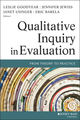
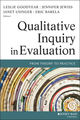
Rad Resource: Bledsoe, K. (2014). Qualitative inquiry within theory-driven evaluation: perspectives and future directions. . In Goodyear, L., Jewiss, J., Usinger, J., & Barela, E. (Eds.), Qualitative inquiry in evaluation: From theory to practice. Jossey-Bass, pp. 77-98.
The American Evaluation Association is celebrating Qualitative Evaluation Week. The contributions all this week to aea365 come from evaluators who do qualitative evaluation. Do you have questions, concerns, kudos, or content to extend this aea365 contribution? Please add them in the comments section for this post on the aea365 webpage so that we may enrich our community of practice. Would you like to submit an aea365 Tip? Please send a note of interest to aea365@eval.org. aea365 is sponsored by the American Evaluation Association and provides a Tip-a-Day by and for evaluators.
Related posts:
QUAL Eval Week: Leslie Goodyear, Jennifer Jewiss, Janet Usinger and Eric Barela on Qualitative Inquiry in Evaluation
Christopher Moore on Structural Equation Modeling for Theory-Driven Evaluation
Charles Gasper on Logic Models
AEA365
.
Blog
.
<span class='date ' tip=''><i class='icon-time'></i> Jul 28, 2015 06:23am</span>
|
|
Hello, I’m Norma Martinez-Rubin, a public health practitioner, program evaluator, and occasional trainer. Work projects that integrate opportunities to learn about the people for whom they are designed excite me. Hence, I find qualitative inquiry quite fitting. Focus groups and semi-structured interviews have been primary data-collection methods on evaluation studies I’ve led, guided, or to which I’ve contributed. They’ve yielded candid remarks and surprising insights about mainstream topics. At times, too, once guarded opinions have become less so when moderated discussions foster honest expression intended for project improvement.
How does one go about identifying the best course of inquiry? What methodological decisions must be made to maximize use of limited time and funding to produce maximum results? How, in a culturally appropriate way, does one acknowledge study participants’ involvement? Is there a necessity to balance the evaluator role differently when taking a consultative approach as a new, external evaluator?
Lesson Learned: Much planning, discussion, drafting protocols, redesigning, and renegotiating occurs before implementing an evaluation study. Whether working solo or collaboratively with study sponsors and other colleagues, one has to establish and foster working relationships to carry out an evaluation that yields useful findings.
Lesson Learned: Transitioning from one professional approach to another, from internal to external evaluator or vice versa requires taking stock of one’s professional strengths and using them as levers. (Quashing those strengths serves no one.)
Lesson Learned: Evaluation requires a knack for relationship building. Introverts’ inquiring minds and predilection for reflection are advantageous attributes in qualitative inquiry. They are usable when moderating discussion groups and for the focus required when doing data analysis.
Hot Tip: Quickly building rapport serves to trigger rich discussions. Never mind the misplaced argument for maintaining a sense of objective neutrality. Cold, calculated exchange is simply that: cold, calculated exchange, not genuine communication or inquiry.
Rad Resource: The editors of Qualitative Inquiry in Evaluation (Jossey-Bass, 2014) compiled authors’ research and experiences that illuminate the theory, purpose, and application of qualitative inquiry. The editors write of their own discoveries in the process of producing the book. They also invite the reader to examine what constitutes quality in qualitative inquiry.
Rad Resource: The chapter titled, Balancing Inside-Outsider Roles as a New, External Evaluator in Qualitative Inquiry in Evaluation: From Theory to Practice (Jossey-Bass, 2014) illustrates how personal curiosity, professional training, and personal experiences can function as levers when designing and implementing protocols for focus groups and semi-structured interviews.
The American Evaluation Association is celebrating Qualitative Evaluation Week. The contributions all this week to aea365 come from evaluators who do qualitative evaluation. Do you have questions, concerns, kudos, or content to extend this aea365 contribution? Please add them in the comments section for this post on the aea365 webpage so that we may enrich our community of practice. Would you like to submit an aea365 Tip? Please send a note of interest to aea365@eval.org. aea365 is sponsored by the American Evaluation Association and provides a Tip-a-Day by and for evaluators.
Related posts:
QUAL Eval Week: George Grob on Qualitative Evaluation for Policy Makers
QUAL Eval Week: Leslie Goodyear, Jennifer Jewiss, Janet Usinger and Eric Barela on Qualitative Inquiry in Evaluation
QUAL Eval Week: Laurie Stevahn and Jean King on Essential Competencies for Effective Qualitative Evaluators
AEA365
.
Blog
.
<span class='date ' tip=''><i class='icon-time'></i> Jul 28, 2015 06:22am</span>
|
|
Hello, my name is Jayne Corso and I am the community manager for American Evaluation Association. From my past posts, you can see that I love social media. I see these platforms as never-ending conferences, where you can meet and share ideas with people with similar interests. Although I have a tendency to favor social platforms such as Facebook and Twitter, one must not forget the importance of the blog.
Even the most robust social media presence cannot substitute the benefits of an active and engaging blog. Social media platforms come and go—do you remember Myspace, Friendster, Geocities? Blog domains are stable and are always available giving you firm control over your online publishing.
Rad Resource: Blogging Creates Creditability
Sharing advice through blogs establishes you as an industry expert or a subject matter expert. It presents your name to other professionals as a trust-worthy resource. Blogging also gives you the opportunity to establish your own brand—which includes writing style and design.
Rad Resource: Make connections through blogging
The evaluation field is filled with bloggers. This opens many opportunities for cross-blogging. Cross-blogging occurs when bloggers with similar interests become guest writers on each other’s blogs. This introduces your blog to new audiences within the field and further shows your credibility on the subject matter.
Blog posts are also very easy to share on social media outlets. Most blogs have a share button that generates a post for you. If others find your blog post helpful, this posting tool can help create a lot of engagement.
Hot Tip: Keep your blog up-to-date
Your blog is only as strong as its content—so keep your blog active and up-to-date. Blogs should be updated very frequently. I would recommend creating a new post at least once a week to keep people interested in what you have to say. I would also recommend dating all of your blogs so your readers have a sense of relevance and context.
Rad Resources: Here are some great evaluation blogs to follow and learn from.
Ann K. Emery Data Analysis +visualization
BetterEvaluation
EVALBLOG: John Gargani’s blog about program design and evaluation
Eval Central
EVALUSPHERIC PERCEPTIONS Reflections of an everyday evaluator/learner/educator exploring the evalusphere
Evergreen Data
Free-range evaluation
Fresh Spectrum
The Listening Resource
Find more bloggers on the AEA website and stay tuned for Bloggers week coming soon on AEA365!
Do you have questions, concerns, kudos, or content to extend this aea365 contribution? Please add them in the comments section for this post on the aea365 webpage so that we may enrich our community of practice. Would you like to submit an aea365 Tip? Please send a note of interest to aea365@eval.org . aea365 is sponsored by the American Evaluation Association and provides a Tip-a-Day by and for evaluators.
Related posts:
Susan Kistler on Profiling Your Blog on aea365
Susan Kistler on Learning From Evaluation Bloggers
Bloggers Series: Melissa Cater on eXtension Evaluation Community Blog
AEA365
.
Blog
.
<span class='date ' tip=''><i class='icon-time'></i> Jul 28, 2015 06:21am</span>
|
|
Anne Cullen Puente and April Bender on 6 Ways to Sharpen Your Evaluation with Mindfulness Principles
Hi, we’re Anne Cullen Puente and April Bender, evaluators at the Fetzer Institute in Kalamazoo, Michigan. We were really excited by Michael Quinn Patton’s June 2014 article in the American Journal of Evaluation where he encouraged evaluators to develop our self-reflexivity and deeply consider our own thinking patterns. We couldn’t agree more, and believe that mindful evaluation could be helpful for doing just that.
Mindfulness can be thought of as a theoretical construct, a type of awareness, and/or specific meditation practices. Some people approach mindfulness through meditation; others by simply adopting a lens of curiosity. The underlying thread is awareness of the present moment. The now.
Mindful evaluation isn’t a specific method, but rather an invitation to be deeply aware and present in all stages of the evaluation process. When we do so, we no longer operate on autopilot but give thought to what we are doing, why we are doing it, and how we are doing it.
Hot Tips: Here are six tips for building the self-reflexivity Patton advises:
Set an intention to be more mindful. Research shows that outcomes correlate with intentions, so having a personal vision for what you want to get out of your mindfulness practice is important.
Bring full attention. Mindfulness is all about cultivating attention to thoughts, feelings, and actions. One easy way to do this is to minimize distraction. Whether writing a report or analyzing data, do just that. Avoid multi-tasking, don’t work with 20 browsers/windows open, etc….
Become aware. People who practice mindfulness report greater insight into their mental processes and emotions. Ask questions like, What am I thinking? What am I feeling? What does this remind me of and why? What are my intended goals?
Practice deep listening. When you listen to others, do so with genuine curiosity. Often our training in social science methods kicks in automatically. We start to analyze what we’re hearing while the other person is talking. This can be helpful in reducing the amount of time we spend analyzing later, but it interferes with our ability to truly listen.
Stay curious and open. Have fun and experiment. Don’t operate on autopilot. Try to stay open to novel ideas, approaches, opportunities, and differing perspectives.
Suspend judgment. Evaluation is all about judgment—evaluative judgments based on quality evidence and standards. But people tend to make opinions based on biases and preconceived ideas. Consider a more mindful approach: examine your motivations, recognize that you have an opinion and set that opinion aside, seek alternative hypotheses, ask clarifying questions, gather evidence, and THEN make an evaluative judgment.
Rad Resources:
Center for Investigating Healthy Minds
The Center for Contemplative Mind in Society
Fetzer Institute blog
Do you have questions, concerns, kudos, or content to extend this aea365 contribution? Please add them in the comments section for this post on the aea365 webpage so that we may enrich our community of practice. Would you like to submit an aea365 Tip? Please send a note of interest to aea365@eval.org . aea365 is sponsored by the American Evaluation Association and provides a Tip-a-Day by and for evaluators.
Related posts:
Claire Tourmen on Introducing Evaluation
Cultural Competence Week: Lisa Aponte-Soto and Leah Neubauer on Culturally Responsive Evaluation 101
OPEN Week: Erin Stack & Lindsey Patterson on Successfully Transitioning from Student to Professional
AEA365
.
Blog
.
<span class='date ' tip=''><i class='icon-time'></i> Jul 28, 2015 06:20am</span>
|
|
I’m Aimee White, new Board Member At Large. Thank you all who elected me, I will strive to represent you well. I live in Washington State but have roots from the southeastern part of the US. I own and serve as Principal Evaluator for Custom Evaluation Services, an independent evaluation consulting firm specializing in Collaborative, Participatory, and Empowerment Evaluation principles and practices. We deeply value and respect the contexts and complexities within which our nonprofit clients serve their communities, and strive to provide exemplary evaluation services. I’m honored to be serving you and urge you to reach out to me to share your thoughts about how we can improve.
I began my evaluation practice in service to the tiniest nonprofits. It was critical that I engage the staff in all aspects of my work, they were the evaluation resources! I find unique ways to involve as many people as I can in the evaluation design process, data collection, and reporting. I do this knowing that many in social and human service agencies are overworked, not trained evaluators, and have no time for one more thing to do.
Lessons Learned: I’m grateful for Social Work training, I learned the phrase "meet people where they are". It is critical that no matter how "expert" you are, in whatever method or process of evaluation that you are hoping to use, if you cannot meet the clients on their level of understanding the project will go nowhere. It is critical, as a community-based evaluator, that you find ways to challenge your own use of jargon, and seek to use the language of the clients. The goal is always to walk together through the learning process we call evaluation.
Rad Resource: In the high tech and overly complex world of today I take a risk by offering an incredibly "low tech" idea. I created something called "one line logic model" that can be used at program, management, and even coalition levels. Take "one line" out of a logic model and put it before staff/leadership for some small period of time. The front line staff are looking at the "activities" and intentionally studying and improving their performance, possibly looking into implementation guides and improving fidelity for Evidence-Based programs. The data person is pulling the data for that line, checking the input processes among the staff, and improving reporting or visualization processes around that set of data. Management is checking to see that resources and activities are accurately and appropriately linked, and that outputs and outcomes are emerging from that work. I’ve found that this takes what can be an inactive document and make it alive and meaningful. Try making your evaluation processes more usable!
Do you have questions, concerns, kudos, or content to extend this aea365 contribution? Please add them in the comments section for this post on the aea365 webpage so that we may enrich our community of practice. Would you like to submit an aea365 Tip? Please send a note of interest to aea365@eval.org . aea365 is sponsored by the American Evaluation Association and provides a Tip-a-Day by and for evaluators.
Related posts:
NA Week: Sue Hamann on Including Intended Service Recipients in Needs Assessment and Program Planning
APC Week: Rhonda Schlangen on Joint Evaluation Strategies for Advocacy and Services
Jacquelyn Christensen on Wordle and Survey Anchors
AEA365
.
Blog
.
<span class='date ' tip=''><i class='icon-time'></i> Jul 28, 2015 06:19am</span>
|
|
I’m Jennifer Grove, Prevention Outreach Coordinator at the National Sexual Violence Resource Center (NSVRC), a technical assistance provider for anti-sexual violence programs throughout the country. I’ve worked in this movement for nearly 17 years, but when it comes to evaluation work, I’m a newbie. Evaluation has been an area of interest for programs for several years now, as many non-profit organizations are tasked with showing funders that sexual violence prevention work is valuable. But how do you provide resources and training on a subject that you don’t quite understand yourself? Here are a few of the lessons I’ve learned on my journey so far.
Lesson Learned: An organizational commitment to evaluation is vital. I’ve seen programs that say they are committed to evaluation hire an evaluator to do the work. This approach is shortsighted. When an organization invests all of its time and energy into one person doing all of the work, what happens when that person leaves? We like to think of evaluation as long-term and integrated into every aspect of an organization. Here at the NSVRC, we developed a Core Evaluation Team made up of staff who care about or are responsible for evaluation. We contracted with an evaluator to provide training, guide us through hands-on evaluation projects, and provide guidance to the Team over the course of a few years. We are now two years into the process, and while there have been some staffing changes that have resulted in changes to the Team structure, efforts have continued without interruption.
Lesson Learned: Evaluation capacity-building takes time. We received training on the various aspects of evaluation and engaged in an internal evaluation project (complete with logic model, interview protocol, coding, and final report). According to the timeline we developed at the beginning of the process, this should have taken about eight months. In reality, it took over 12. The lesson learned here is this: most organizations do not have the luxury of stopping operations so that staff can spend all of their time training and building their skills for evaluation. The capacity-building work happens in conjunction with all of the other work the organization is tasked with completing. Flexibility is key.
Hot Tip: Share what you’ve learned. The most important part of this experience is being able to share what we are learning with others. As we move through our evaluation trainings, we are capturing our lessons learned and collecting evaluation resources so that we can share them with others in the course of our technical assistance and resource provision.
Rad Resource: Check out an online learning course developed by the NSVRC, Evaluating Sexual Violence Prevention Programs: Steps and strategies for preventionists.
Do you have questions, concerns, kudos, or content to extend this aea365 contribution? Please add them in the comments section for this post on the aea365 webpage so that we may enrich our community of practice. Would you like to submit an aea365 Tip? Please send a note of interest to aea365@eval.org . aea365 is sponsored by the American Evaluation Association and provides a Tip-a-Day by and for evaluators.
Related posts:
Liz Zadnik on Bringing passion and enthusiasm to program evaluation
Sheila B Robinson on Introducing our Newest aea365 Team Members
CP TIG Week: Helen Singer, Sally Thigpen, and Natalie Wilkins on Understanding Evidence: CDC’s Interactive Tool to Support Evidence-Based Decision Making
AEA365
.
Blog
.
<span class='date ' tip=''><i class='icon-time'></i> Jul 28, 2015 06:19am</span>
|
|
I am Anna Douglas and I conduct evaluation and assessment research with Purdue University’s Institute for Precollege Engineering Research; also known as INSPIRE. This post is about finding and selecting assessments to use in evaluation of engineering education programs.
Recent years have seen an increase in science, technology, engineering, and mathematics (STEM) education initiatives and emphasis on bringing engineering learning opportunities to students of all ages. However, in my experience, it can be difficult for evaluators to locate assessments related to learning or attitudes about engineering. When STEM assessment instruments are found, oftentimes they do not include anything specifically about engineering. Fortunately, there are some places devoted specifically to engineering education assessment and evaluation.
Rad Resource: INSPIRE has an Assessment Center website, which provides access to engineering education assessment instruments and makes the evidence for validity publicly available. In addition, INSPIRE has links to other assessment resources, such as Assessing Women and Men in Engineering, a program affiliated with Penn State University.
Rad Resource: ASSESS Engineering Education is a search engine for engineering education assessment instruments.
If you don’t find what you are looking for at the INSPIRE, AWE, or ASSESS databases, help may still be there.
Lesson Learned #1: If it is important enough to be measured for our project, someone has probably measured it (or something similar) before. Even though evaluators may not have access to engineering education or other educational journals, one place to search is Google Scholar with keywords related to what you are looking for. This helps to 1) locate research being conducted in the similar engineering education area (and they may have used some type of assessment) and 2) locate published instruments, which one would expect has a degree of validity evidence.
Lesson Learned #2: People that develop surveys, generally like others to use them. It’s a compliment. It is ok to contact the authors for permission to use the survey and validity evidence collected, even if you can not access the article. At INSPIRE, we are constantly involved in the assessment development process. When someone contacts us for use of an instrument, we view that as a "win-win"… the evaluator gets a tool, our instrument gets used, and with the sharing of data and/or results, we can get further information about how the instrument is functioning in different settings.
Lessons Learned #3: STEM evaluators are in this together. Another great way to locate assessment instruments is to post through the STEM RIG in LinkedIN, or pose the question to the EvalTalk listserv. This goes back to Lesson Learned #1: most of the important outcomes are being measured by others.
Do you have questions, concerns, kudos, or content to extend this aea365 contribution? Please add them in the comments section for this post on the aea365 webpage so that we may enrich our community of practice. Would you like to submit an aea365 Tip? Please send a note of interest to aea365@eval.org . aea365 is sponsored by the American Evaluation Association and provides a Tip-a-Day by and for evaluators.
Related posts:
Hui-Hui Wang on Assessing STEM Education
STEM Week: Alyssa Na’im on Using Culturally and Contextually Responsive Practices in STEM Education Evaluation
Tina Phillips on Evaluating Public Participation in Science Research (PPSR) Projects
AEA365
.
Blog
.
<span class='date ' tip=''><i class='icon-time'></i> Jul 28, 2015 06:19am</span>
|
|
Hey there. My name is Kath McNiff and I’m an online community manager at QSR International (the makers of NVivo).
Lessons Learned: We’re heading into a brand new year of evaluation (actually, THE year of evaluation). Oh, the joys of a clean slate! A chance to right the wrongs, sharpen the tools, clear the decks and morph into the best 2015 version of ourselves.
Here are some resolutions to consider:
Do an Inbox detoxIs your cluttered inbox making you feel overwhelmed and out of control? Vital details can easily slip through the cracks as you flounder around in the digital debris. Get yourself a copy of How to be a Productivity Ninja and follow Graham Allcott’s simple steps for getting your inbox to zero.
Decide on your Digital Strategy Have you been following the same old tweeters for the past two years? And what about those cobwebs on your LinkedIn profile? It’s time to make sure your digital footprint is polished and professional. If you’re looking at social media as a rich reserve of qualitative data, you need to make decisions about platforms, data collection and ethics.
Get the right tools Seriously consider using the free version of Evernote. While you’re out in the field you can use your phone or tablet to record interviews, take field notes, snap photos and clip relevant content from the web. Then, back at your desk you can synch notebooks and have easy access to all your material (and then bring it into NVivo for analysis).
Develop good NVivo habits Bring your research design documents into NVivo and refer to them regularly as you analyze your data. Start a project journal in NVivo and write, write, write - remembering to link to the data that supports your emerging insights. Then, when a client demands to know how you reached your conclusions - you can turn to your journal (complete with charts, word clouds and models). Check the QSR website for details about pricing.
Well, that should get us to February at least. Start the year feeling in control of your virtual world so you can spend more time celebrating in the physical one :
Hot Tip: Take a fresh look at the tools you use everyday. Are you missing out on some really useful feature because you always follow the same well-worn path? In the case of NVivo, spend some time watching the YouTube videos or read the help - and explore features you haven’t used before (framework matrices anyone?).
Rad Resources: If you want to get your ToDo list under control, try these free apps: Todoist or Trello
Do you have questions, concerns, kudos, or content to extend this aea365 contribution? Please add them in the comments section for this post on the aea365 webpage so that we may enrich our community of practice. Would you like to submit an aea365 Tip? Please send a note of interest to aea365@eval.org . aea365 is sponsored by the American Evaluation Association and provides a Tip-a-Day by and for evaluators.
Related posts:
Anna Jo Perry and Jens J. Hansen on Computer Aided Evaluation Reports
Käri Greene on NVivo
Bob Kahle on Practical Strategies to Leverage Technology for Deeper Insights
AEA365
.
Blog
.
<span class='date ' tip=''><i class='icon-time'></i> Jul 28, 2015 06:18am</span>
|
|
My name is Petra-Chambers-Sinclair and I’m a devout evaluation nerd and Biohacker from Victoria, British Columbia. Fellow evaluators understand when I explain that, as a Biohacker, I apply evaluative thinking to my personal life with the goal of maximizing my well-being. I run nutritional and lifestyle experiments, and then use data to fine-tune the strategies I use to achieve my goals.
Hot Tip: An evaluative mindset is all that Biohacking requires.
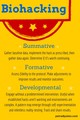
Summative Evaluation
Biohackers use summative evaluation when following an established dietary protocol or a lifestyle hack, such as one aimed at reversing autoimmune or improving sleep quality. Biohackers first gather data for the baseline, then engage with the protocol as prescribed, and gather data again at the end. As with any summative evaluation, the final stage is determining if it’s worth continuing with the hack.
Formative Evaluation
If, after engaging in a nutritional or lifestyle hack for a reasonable length of time, desired interim results aren’t being realized, biohackers assess fidelity to the protocol. If fidelity is perfect, formative adjustments can be implemented and subsequent results monitored.
Developmental Evaluation
Developmental Biohacking enables learning and engagement when there is no predetermined intervention; when conditions are complex and causality is hard to track. It enables biohackers to develop an intervention inside the mess of real life. Biohackers go developmental when nothing else seems to be working and when environments both inside and outside the body are unpredictable, such as with health issues that no one can explain or offer effective treatment for. Gradually, through self-experimentation and relentless reality-testing, an intervention might emerge that can be evaluated formatively or summatively. In the meantime, developmental evaluation allows for interaction, observation and adaptation.
The internet has allowed people who are innovating in this way to communicate the results of their experiments with each other, enabling Developmental Biohackers to accelerate learning & pattern-finding, thereby creating highly effective and scaleable interventions, such as the Autoimmune Protocol. Biohacking blogs remain a primary source of developmental information.
N=1
An N=1 is an experiment with one participant.
The assumption inherent to N=1 in the Biohacking world is that universal solutions to complex health problems have limited effectiveness, as we each have unique histories, genetic profiles, environments, and patterns of responding.
We are complex systems living in complex systems.
And an evaluative mindset is all we need to leverage this complexity on behalf of increased health & well-being.
Rad Resources:
A Beginners Guide to Biohacking by Mark Moschel https://www.bulletproofexec.com/beginners-guide-to-biohacking-101/
And another one, if it’s not considered self-promotion:
Biohacking: the ultimate New Year’s Resolution (because it’s not too late to make one!) http://petra8paleo.com/2014/12/26/biohacking-the-ultimate-new-years-resolution/
Do you have questions, concerns, kudos, or content to extend this aea365 contribution? Please add them in the comments section for this post on the aea365 webpage so that we may enrich our community of practice. Would you like to submit an aea365 Tip? Please send a note of interest to aea365@eval.org . aea365 is sponsored by the American Evaluation Association and provides a Tip-a-Day by and for evaluators.
Related posts:
DE Week: Michael Quinn Patton on Developmental Evaluation
Tom Archibald and Jane Buckley on Evaluative Thinking: The ‘Je Ne Sais Quoi’ of Evaluation Capacity Building and Evaluation Practice
Systems Week: Glenda Eoyang on Complexity Demands Simplicity
AEA365
.
Blog
.
<span class='date ' tip=''><i class='icon-time'></i> Jul 28, 2015 06:18am</span>
|
|
Greetings loyal aea365 readers AND authors! I’m Sheila B Robinson, aea365’s Lead Curator and sometimes Saturday contributor. A couple of weeks ago, I wrote this post asking readers what they would like to read about on aea365 in 2015.
Many thanks to those who offered their comments with ideas for posts and responses to each other. Now, I’m writing to ask YOU to consider contributing a post on one of these suggested topics, or any other evaluation-related topic.
Lesson Learned: Here’s what our readers said they would like to see:
Some comments on developing, sharing, and storing lessons learned from evaluations.
A post, or series of posts about evaluation from the perspective of practitioners for whom their primary job is not evaluation. Perhaps tips on how to best integrate evaluation into the myriad of other, seemingly more pressing, tasks without pushing it to the back burner.
More about observational studies and the best practices in using secondary data sources.
More of other evaluators’ ideas for how to make evaluation more useful for finding solutions to social problems and building a better world.
Evaluators doing research on evaluation - what are they studying and what are they learning?
More on collective impact and experiences in evaluation of partnerships.
Hear from evaluators of all ages and those working with diverse communities
More about how private consultants deal with the cost of SPSS…it causes a lot of angst. The other stat packs aren’t user friendly if you have always used SPSS.
Case studies with operational survey questions and instruments.
Hot Tip: We’d love to hear from YOU! Do you have something to share on any of these or other evaluation-related topics? Please send us a draft post for consideration.
Hot Tip: You don’t have to be an expert to contribute! Notice that none of the comments ask for "expert" opinions. Many readers want to hear from everyday evaluators working in the field. You don’t need to be doing something unusual, or cutting edge, or revolutionary. Tell us how a strategy has worked for you in evaluation. Tell us what you’re learning about and experimenting with. Tell us about a lesson you have learned recently and are now applying in your work. Tell us about a book you have read, a course you took, or an experience you had that gave you new insight. What small lesson can you offer to teach others?
Cool Trick: Please follow contribution guidelines! You can find the link right up there…yes, just look up to the top of your screen and there it is! We can only publish posts that adhere to these simple guidelines.
Get Involved: It’s time to share YOUR insights with aea365 readers! We rely on the hundreds of generous authors who have contributed (many multiple times!) over the past 5 years to keep this daily blog going. As you can imagine, collecting 365 posts each year is no small task.
Is this the year you decide to contribute? We certainly hope so, and look forward to hearing from you soon.
Do you have questions, concerns, kudos, or content to extend this aea365 contribution? Please add them in the comments section for this post on the aea365 webpage so that we may enrich our community of practice. Would you like to submit an aea365 Tip? Please send a note of interest to aea365@eval.org . aea365 is sponsored by the American Evaluation Association and provides a Tip-a-Day by and for evaluators.
Related posts:
Best of aea365: Sheila B. Robinson on Joining the aea365 Author Community
Sheila B. Robinson on Joining the aea365 Author Community
Sheila B Robinson on Calling all aea365 readers: What do YOU want to read more about?
AEA365
.
Blog
.
<span class='date ' tip=''><i class='icon-time'></i> Jul 28, 2015 06:17am</span>
|