Blogs
|
Limited Time Offer Ten Habits of Bloggers that Win is one of my most popular posts of all time. Ten simple habits have helped me grow this blog. Since I wrote that post in 2006, it needed an update. It grew into an ebook. Eventually, I’ll sell it on Amazon. For now, I’m giving it away to a group of readers — you.
Just sign up for one of my mailing lists. It’s yours!
Why Am I Doing This?
I have three reasons.
1. Publishing has changed
First, there’s a new way to publish books. It is where people crowdsource a book. That audience gives feedback. The author includes the audience in future revisions. The first set of readers are called alpha readers. That’s you.After the book is revised, then it is released. Many people have done this. I’m trying it now.
After you read the book, email me. Feedback. Stories. Ideas for improvement. Pictures. Some of you will shape the future of this book. Hey, I could even use a better cover.
2. My loyal readers deserve benefits
Second, I want to give benefits and freebies to those who trust me with their inbox. This is the first of more to come.
3. Because school is about to start
Third, lots of people want help with blogging. School is about to start on Monday. If I don’t share it now, it will sit on my computer getting old. I’ll improve it as feedback comes in. I figured I’d try out this alpha reader thing. I’ve been wanting to do it.
Sign Me Up and Send Me the Book
I have two mailing lists:
The Cool Cat Teacher Blog Mailing List - 2-3 Times Per WeekGet this blog in your inbox. When I update the blog, the next day it will come to you.
Social Media Success Newsletter - 2 Times a month Get social media tips and tools.
After you sign up, you’ll receive the email with the link. Click on the book and click download.
NOTE: This is not for you to share, distribute, or publish. It is for you to read. If your friends want it, they can sign up and get their own copy.
This work has come a long way from the original blog post.
Thank you to my friend Sylvia Duckworth who previewed the book and put in a sketchnote!
Sylvia is the first person who has mashed up this book and helped it improve. This is exciting. I have no idea what will happen with this. So, now, I’m clicking publish.
Remember, this is for a limited time. When I get enough readers and feedback coming in and start revising, I’ll move on and share another freebie. Don’t worry, I’ll always share the freebies with those on my email list.
The post FREE BOOK: 10 Habits of Bloggers that Win by Vicki Davis appeared first on Cool Cat Teacher Blog.
Vicki Davis
.
Blog
.
<span class='date ' tip=''><i class='icon-time'></i> Aug 18, 2015 11:06am</span>
|
|
An Every Classroom Matters Episode on Building Parent-Teacher Relationships sponsored by Bloomz
First-rate teachers value parents. Jumpstart positive parent partnerships from day one. Show parents how much they matter. Principal Amy Fadeji and Superintendent Joe Sanfellipo have a collection of simple ideas.
Important Takeaways
How to Connect. Four ways Amy encourages teachers to connect with parents. (Check out our show sponsor Bloomz too!)
First contact. First-rate teachers value parents. Jumpstart positive parent partnerships from day one. Show parents how much they matter. Principal Amy Fadeji and Superintendent Joe Sanfellipo have a collection of simple ideas. Joe stresses the first contact with the parent should be positive. He has a method that seemed like more work the first time they did it. Now teachers do it willingly. It makes a huge difference.
Fab Fridays. How Joe ends every Friday on a positive note with five important phone calls.
Helping Parents Love Phone Calls from the Principal. Amy has a fantastic idea. Her teachers give her information that lets her make positive phone calls to parents. Parents don’t dread a phone call from the principal now.
Make Social Media Work for You. How to use social media to help improve perception of your school in the community.
I made some of the best quotes into images at the bottom. Take them to share on social media.
More solutions…
Don’t just plan lessons. Plan for positive parent relationships. Set up communications. Two-way. Pave the way with positivity. Take time to be kind. Share this show with superintendents, principals, and teachers. If isn’t the start of the year for you, it is never too late to start again.
Educator Resources
Audioboom
Amy Fadeji’s YouTube Channel for Her School
Joe Sanfelippo’s district website
Joe’s Podcast: BrandEd
Interview Links
@mrsfadeji
@joesanfelippofc
Sponsor
Bloomz is your one-stop solution for parent-teacher communications. More than just connecting with their cell phones, you can send long or short messages. You can send pictures and links. You can even coordinate volunteer schedules, donations, and parent teacher conferences. I’m using Bloomz in my classroom.
Set up Your Bloomz Classroom today
You can subscribe to the podcast on iTunes or elsewhere, get the RSS feed, or listen via the media player above.
Join the Every Classroom Matters Awesome Educators Network on Facebook
The post 10 Ways to Build Powerful Parent Partnerships from Day One appeared first on Cool Cat Teacher Blog.
Vicki Davis
.
Blog
.
<span class='date ' tip=''><i class='icon-time'></i> Aug 18, 2015 11:06am</span>
|
|
The Teacher as a Talent Scout Good schools don’t just teach you subjects. Good schools teach you about yourself. A focus on strengths is the secret to a better school. We want students to be leaders, but we never let them lead. Let’s change that! Here’s how.
Do you want your teachers to be six times more engaged in teaching? Do you want your students 30 times more likely to be engaged in school? Would you like to triple your teachers’ quality of life? Then, focus on strengths, not weaknesses.
Recently, I sat down with, Dr. Brad Johnson on Every Classroom Matters. He says
"When you combine student talents with their passion you’ll find their purpose."
We must move the emphasis from standards to strengths. Sure, we need to help kids with their weaknesses. Most people need basic math, reading, and writing. But when we hyper-focus on weaknesses, we forget to nurture talent.
If Baryshnikov was born to dance, why should he die in trigonometry?
While I’ve already written up the show that inspired this post, I’ve been thinking about three of the ways Brad says we can focus on student strengths and make our schools stronger. (Read more, in his book What Schools Don’t Teach.) Here are some thoughts on what all of our schools should be doing.
1. Encourage teachers need to bring their talents to their teaching.
Figure out a way to teach with what you love. You’ll be more excited. Your students will too.
Richard Spencer is a dancing science teacher. (See video above.)
Trish Cloud uses Minecraft with Common Core Standards.
Monica Evon uses apps aligned with Common Core.
Jed Dearybury sings with his fifth graders.
Tinashe Blanchet used filmmaking to teach math.
Jacques duToit tweets with his history class.
Scott Allen teaches math with sports.
Marsha Harris taught French with app programming.
If you want to be more exciting, be excited. Think of what you love. Use it to teach.
2. Help students enjoy and appreciate their strengths and the strengths of other students.
A grade is not a measure of value as a person. Everyone matters or no one matters. (Hat tip Harry Bosch.)
Sadly, ask a student about where they stink, and they’ll answer.
Ask them about their strengths, and they’ll shrug.
What’s wrong with this picture? Don’t we give genuine compliments? And we only focus on the weaknesses? If a parent did that, we’d say they were a bad parent. Why are some schools getting away with it?
3. Create leadership positions for students.
Instead of giving strict instructions, we should be appointing leaders. Brad says,
We want students to have a leadership, but we never let them lead. @DrBradJohnsonPowered By the Tweet This PluginTweet This
Here are some of the job titles from my classroom this past year:
Project Manager (PM)
Assistant Project Manager (APM)
Lead Graphic Designer
Production Coordinator
Lead Programmer
Database Auditor
Audio Engineer
In my classroom, if there’s a job we create a title for it. Jobs have a responsibility. If there is responsibility, there is accountability. Accountability and responsibility cause incredible learning activity.
To teach leadership, we have to have leadership positions. Yes, it changes our classrooms. It makes us more of a coach. But that’s the way it should be.
Let students lead. Give them responsibility. Don’t be a dictator.
How Do You Measure Up?
Do you give tests to help students find their strengths? (I do.) Are you only looking for weaknesses you can "fix"?
A 2007 neuroimaging study by Arnaud D’Argembeau of Belgium found the forward most region of the medial prefrontal cortex is important in
"Helping a person reflect on their traits and abilities versus those of others."
How do we help students know themselves? Look for their strengths first.
Strength-finding is part of the brain that we can develop. We can shift from standards to strengths, from standardization to personalization, from weakness to wonderful.
As we look for strengths, we’ll build stronger schools.
As I started this year, I showed a picture of an uncut diamond to my students. I asked them what it was. Most didn’t know. I said it was valuable, but sometimes didn’t look like it. I said it represented them and it was an uncut diamond. My job this year is to help them find their talent. We might only find a few facets but that we’d look for it. I will know I have succeeded when I have told every parent and student something truthful that I’ve noticed that student does well.
The mentality of looking for strengths instead of deficits changes everything. The classroom becomes a place where we rejoice in talent. We celebrate talent. Students point out strengths of each student. I would daresay, it even makes class more fun.
How do you look for talent? How do you spot strengths? How do you communicate such a mindset to your students? Empower students with hope, don’t crush them with their incompetence. We can do this. We can help students find their talents. If you look at people who tell stories about great teachers, it was almost always those teachers who saw something in the student they didn’t see in themselves.
Be that kind of teacher. Be the noble teacher. Be a talent scout.
The post Want kids to love school? Stop telling them they stink and find their strength. appeared first on Cool Cat Teacher Blog.
Vicki Davis
.
Blog
.
<span class='date ' tip=''><i class='icon-time'></i> Aug 18, 2015 11:06am</span>
|
|
August 17, 2015
Language learning is one of the key areas exponentially enhanced by the widespread of Internet technologies and mobile connectivity. Anyone now can easily start learning a language...
....read more
Educational Technology and Mobile Learning
.
Blog
.
<span class='date ' tip=''><i class='icon-time'></i> Aug 18, 2015 11:05am</span>
|
|
August 17, 2015
Teaching students how to conduct smart search queries online is an important part of cultivating a digital citizenship culture within your classroom. Smart searching goes beyond...
....read more
Educational Technology and Mobile Learning
.
Blog
.
<span class='date ' tip=''><i class='icon-time'></i> Aug 18, 2015 11:05am</span>
|
|
This afternoon I was talking with someone who said that she wants to write more blog posts but feels like "everything I've written has been said already." I hear that a lot from new bloggers. My response is often based in the advice of Derek Sivers who says that "what's obvious to you, might be amazing to someone else." For a full explanation of this idea, watch the short video embedded below.
Applications for Education
This message needs to be shared with our students too. One of the ways you can do this is by having students write a weekly reflective blog post. They don't have to write complex blog posts, just a short summary of their learning and observations that week will do. In this way students can learn from each other. Even if they don't pick up anything brand new from this process, they will at least be reminding each other of what they have learned that week.
This post originally appeared on Free Technology for Teachers
if you see it elsewhere, it has been used without permission.
Related StoriesHow to Quickly Create Vocabulary Lists from a DocumentRiddle Adds More Features Teachers Will Like for Creating Online Quizzes5 Tools Students Can Use to Keep Track of Assignments This Year
Richard Byrne
.
Blog
.
<span class='date ' tip=''><i class='icon-time'></i> Aug 18, 2015 11:02am</span>
|
|
This is a guest post from Kate Wilson (@KateWilson13) of EdTechTeacher, an advertiser on this site.
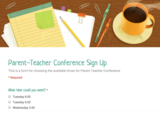
Google Forms can be one of the best tools in the classroom for data collection and assessment as well as a great resources for teachers to use in order to get information from parents. In this Back-to-School season, you may need to coordinate times for parent-teacher conferences or the donation of shared classroom school supplies. While Google Forms offers a simple solution, teachers still need to spend time sifting through all the various responses - particularly when parents are trying to select a time or sign up for a single resource.
What if there was a way to eliminate choices from a question so as not to have sign-up conflicts? There is!
Choice Eliminator is a Google Forms Add-On that removes options from a Google Form as they are selected by users. Need more than one quantity of an option? Advanced options allow Form creators to set the number selections available.
Implementing this function requires just a few steps. The first time you want to use this Add-On with Forms, you must give permission for your Google Account to use the Choice Eliminator by going to "Get Add Ons" under the Add-Ons menu. Search for "Choice Eliminator" and select the "+Free" button. You will get a permission pop up. Be sure to hit "Accept."
Next, you need to create a form with options such as Multiple Choice, Drop Down, or Checkboxes. Once you have all your custom options, select "Start" under the Choice Eliminator menu under the Add Ons.
This will open a sidebar application within the form. Select each question you wish to customize and check "Eliminate choices." If you would like a choice to disappear only after a certain quantity has been selected, select "Choice Options" to set the quantities.
Every Google Form automatically generates a Google Sheet, so once responses start filling in, your appointment book or sign-up sheet is automatically created. Now that the information is in your Sheet, you can use the arrow buttons for each column to sort the data. With just these few steps, you can create an efficient and easy way to coordinate with your parents and students.
Looking to learn more for Back to School? EdTechTeacher is hosting a FREE Back-to-School Webinar Series. They also have a number of great resources about working with Google Apps for Education on their site.
This post originally appeared on Free Technology for Teachers
if you see it elsewhere, it has been used without permission.
Related StoriesShare What's Obvious...It Might Not Be Obvious to EveryoneHow to Quickly Create Vocabulary Lists from a DocumentRiddle Adds More Features Teachers Will Like for Creating Online Quizzes
Richard Byrne
.
Blog
.
<span class='date ' tip=''><i class='icon-time'></i> Aug 18, 2015 11:02am</span>
|
|
The National Archives Experience Digital Vaults is one of the resources that I almost always share in my workshop on teaching history with technology primary sources. The Digital Vaults offers good tools that students and teachers can use to create content using images and documents from the National Archives. In the video embedded below I demonstrate how students can create digital posters and movies in the National Archives Experience Digital Vaults.
Applications for Education
Creating a short video featuring artifacts from the National Archives could be a great way for students to summarize a topic or theme in US History. When I've used it with students in the past I have asked them to demonstrate an understanding of the connections between the artifacts that they chose to use in their videos.
Please note that the Digital Vaults website loads a lot of media when you visit it for the first time. Give it ten seconds or more to load everything before you start to create and investigate. It also helps to be using an updated browser (Chrome or Firefox are best).
This post originally appeared on Free Technology for Teachers
if you see it elsewhere, it has been used without permission.
Related StoriesRiddle Adds More Features Teachers Will Like for Creating Online Quizzes135 Practical Ed Tech TipsA Quick Way to Access a Countdown Timer on Your Computer
Richard Byrne
.
Blog
.
<span class='date ' tip=''><i class='icon-time'></i> Aug 18, 2015 11:02am</span>
|
|
Last week Padlet launched an iPad app to complement the outstanding web tool that they've offered for years. This morning someone on my Facebook page asked about an alternative that students could use if they didn't have email addresses. I replied with a short explanation of how Padlet can be used by students without using an email address. To further that explanation, I created the short video that is embedded below.
I've added this video to my playlist of Practical Ed Tech Tips and my playlist of Padlet tutorials.
This post originally appeared on Free Technology for Teachers
if you see it elsewhere, it has been used without permission.
Related Stories135 Practical Ed Tech TipsHow Students Can Create Movies and Digital Posters With Artifacts from the National ArchivesRiddle Adds More Features Teachers Will Like for Creating Online Quizzes
Richard Byrne
.
Blog
.
<span class='date ' tip=''><i class='icon-time'></i> Aug 18, 2015 11:02am</span>
|
|
Creating Student-Centered Learning Profiles: What Great Teachers Know About Their Students
by TeachThought Staff
For Professional Development or consulting around this or other ideas you read about on TeachThought, contact us.
This is part 2 of our #iteachthought series (because we refuse to say "back to school"-well, except for just then). Part 1 looked at classroom design, specifically offering alternatives to rows of desks. Today, we’re going to help you create smarter, student-centered learning profiles.
What Great Teachers Know About Their Students
If you’re creating a learning profile, what kind of information should be included? What’s the point of such a profile? How will it be used? Most learning profiles are quick glances of academic data. Something like this at the classroom level.
And there’s nothing wrong with this-it’s quick., useful, and basic.
But it’s also limited. To take another approach, as Grant Wiggins might suggest, let’s work backwards. And further, let’s do so from a single big idea that unifies everything. Specifying a single idea that’s broad and accessible enough to be useful may be a challenge, but let’s try, starting with a few underlying assumptions.
1. Teachers plan learning experiences for students.
2. Different students have different needs. This implies a need for differentiation of instruction, personalization of curriculum, or both.
3. In this way, teachers are like designers. The data teachers use to make these kinds of design decisions varies.
4. An additional challenge? Teachers have a finite ability to process data, which implies a need to be selective with the data that is sought out and adjusted for.
5. At the classroom level, data is broadly considered in terms of content and performance.
6. Another way of thinking about this is to consider data quality-and not quality as it relates to accuracy or reliability, but rather what sort of information do I need about students to help them learn?
Though I disagree with what might be the fundamental premise that this post rests on-that teachers alone are responsible for the miracle of learning, and can even begin to know everything about every student-the idea here has to do with rethinking how we see students and how they relate to curriculum, and then designing both curriculum and learning models that fit these personalized learning needs.
What Good Teachers Know About Their Students
1. Native language
2. Critical medical needs
3. IEP/504s/Giftedness, and other services
4. Living Situation", including religious beliefs, safety, food, family, access to books, technology, etc.
5. Grade Point Average & academic strengths
6. Favorite subjects
7. Reading levels & reading habits
8. How they respond to accountability
9. Relative strengths and weaknesses as a student
10. Classroom citizenship habits
11. Academic expectations (inc. difference between own goals and those of family)
12. How to "motivate" them
13. Trend of general academic progress over last 1-3 years
14. Progress towards mastery of power standards/data from relevant standardized assessments
15. How to help them do well in your class
What Great Teachers Know About Their Students
1. Critical thinking habits
2. Ideal learning environment & circumstances
3. Which challenges they’ll respond to most powerfully
4. Their personal histories (e.g., what they’ve overcome)
5. Personal strengths
6. Insecurities about school
7. How they respond to structure
8. How they respond to open-endedness
9. What "school" means to them
10. Digital citizenship habits
11. Intellectual and human affections
12. How to help them find their own motivation
13. View of self as a reader, writer, and a person
14. Progress towards mastery of personal goals (creative, professional, familiar, or other)
15. How to help them succeed as people
*Age appropriate
Additional Reading
How-tos Of Differentiation Lesson Planning
Learning Profile Cards
Learning Profile (embedded above) by Jessica Winston
Creating Student-Centered Learning Profiles: What Great Teachers Know About Their Students
The post What Great Teachers Know About Their Students appeared first on TeachThought.
TeachThought Blog
.
Blog
.
<span class='date ' tip=''><i class='icon-time'></i> Aug 18, 2015 11:01am</span>
|