Blogs
|
We created the eLearning Atlas to be an ideal tool to easily find the proper solutions. Jena and I have tried to speak to every company in the Atlas, and we continue to seek those that we’ve missed. This process provides a valuable pool of data. Rather than hoard this information, I thought it would be nice to share.
Let’s take a graphical look at some of the interesting conclusions I’ve drawn. The following graphs only include traditional products that can implement standards (Authoring Tools, LMSs, LCMSs and Content Libraries). Here we can see the haves and the have-nots:
eLearning Atlas Products That Support At Least One Standard:
A look at the Haves:
So, what does this all mean? For the majority of the industry, SCORM works, but there are lots of eLearning products out there that don’t play nicely with one another. The creation and delivery of content is a hard problem to solve, without a common standard or model… it’s really hard to solve. When developers try to fit a unique course into a unique learning system… things get complicated. When eLearning gets complicated, things get expensive.
The eLearning Atlas proves that there are thousands of possible companies who can create, manage and deliver eLearning, some doing it without any claimed support for standardization. For some companies, the expense of stepping outside their branded box of solutions, locks a customer in for life. We think SCORM frees people to choose the best fit. The eLearning Atlas can help users easily filter out the noise of companies who are not interested in playing nicely with one another, and make connections with products that want to work together.
To look at it another way, we’ve currently found 219 Authoring Tools, some being used by 360 Custom Content Creators to make training that will be delivered using 655 LMS/LCMSs… that’s 51,640,200 possible combinations. Trying to fit all those pieces together, each time, is a daunting task and the exact pain ADL created SCORM to solve. SCORM (and other standards) help eLearning providers play nicely with one another; the eLearning Atlas can help users find the products and services that will play nicely with the systems they already use.
Mike Rustici
.
Blog
.
<span class='date ' tip=''><i class='icon-time'></i> Sep 05, 2015 02:52am</span>
|
|
Brought to you by SCORM.com, the e-learning standards experts.I answer a lot of SCORM questions ranging from the basic to the extravagant, and I actually like it. A huge part of what I do is teaching about SCORM.
Sometimes, though, I get questions that make me laugh. Today, I feel like I need to share this one because it isn’t the first time I’ve gotten a question like this one.
What is Scorm Compliance?
OK, good question. I get this one a lot, so I have a sense of where it’s headed. My answer:
Is this what you’re looking for? The distinction between compliance and conformance? Or something more like this, a basic description of SCORM?
The response (slightly rephrased):
Yes both are good. There is a training specialist job interview question? "Which of the following best describes your experience with Scorm Compliance?" (Then # years and months choice) So what does experience with Scorm Compliance mean in this context?
Let’s cut to the chase. The answer is none. You have no experience if you don’t know what it is.
Funny, yes. Uncommon? Not entirely. People think, or more accurately hope, that their products are SCORM conformant. Let me put it simply… if you haven’t tried, or worked at it, your product simply is not SCORM conformant, or IMS BLTI compliant, or AICC conformant. These things take effort. And so does acquiring SCORM experience as an individual.
Brought to you by SCORM.com, the e-learning standards experts.
Mike Rustici
.
Blog
.
<span class='date ' tip=''><i class='icon-time'></i> Sep 05, 2015 02:49am</span>
|
|
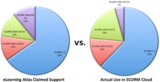
Brought to you by SCORM.com, the e-learning standards experts.When looking through the eLearning Atlas, I wondered if the versions of SCORM that companies claim to support are closely matched to what we see being used in reality, via SCORM Cloud. Let’s check it out:
Versions of Claimed SCORM Support in the eLearning Atlas vs. Use in SCORM Cloud:
When I last reviewed our SCORM Cloud stats, I noticed just how closely the actual use of different standards mapped to the claimed support. Obviously SCORM 1.2 is the most popular and has nearly identical use in our SCORM Cloud. However, many may claim to support SCORM 2004 4th edition, but few actually generate courses using it. I realize SCORM 2004 isn’t always easy and it can create some confusion, could this be the reason for the difference? Maybe the 3rd edition was widely implemented and some became weary of another upgrade. It’s also possible that some of the 4th edition experts out there have no need to test content on SCORM Cloud. I’ll continue to pick at this, but the exact answer is unknown to me.
Whatever the reason for 4th’s variance, it’s comforting to know that the standards we mapped in the eLearning Atlas closely match the real-world behavior in the SCORM Cloud. As we continue to develop both tools, what other correlations or discrepancies do you expect to find?
Brought to you by SCORM.com, the e-learning standards experts.
Mike Rustici
.
Blog
.
<span class='date ' tip=''><i class='icon-time'></i> Sep 05, 2015 02:48am</span>
|
|
Brought to you by SCORM.com, the e-learning standards experts.Most people think buzzwords are annoying, trendy and overused words that pop up everywhere. Buzzwords serve one purpose: to drum up excitement around an idea, product, or event. That’s why people use them.
While Chris and I worked through the Atlas, we kept an eye on words that came up to see if we could find any trends in the industry. I’m not one for graphs and charts, that’s more Chris’s speed. What I’m into are trends and patterns. (If you were wondering, I have an affinity for plaid, houndstooth and ikat patterns).
After months of observation, one of the trends we saw was a move in the industry towards social learning.
Everyone has different meanings for what "social learning" is and what it does. For some, it means collaborating with others while creating or viewing content. For others, social learning means simply the integration of social media, like blogs, wikis, Twitter or Facebook into traditional eLearning. For me, social learning is both of these things.
A few months ago, I added Cookie Intern to my resume here at Rustici Software. A match made in heaven, as I love to bake and the Rusticians love to eat.
All of the sudden, every batch of cookies started tasting like soap. I couldn’t figure it out. I changed pans, mixing bowls, spatulas, everything. I took my questions to Facebook and Twitter, begging my friends to provide suggestions, hints, anything that would vanquish this soapy situation. They posted helpful links and speculations, and finally I got my answer. Baking soda.
Old, old baking soda that began its journey with me as a high school senior, watched me matriculate at Alabama, witnessed the glory of our 2009 National Championship (Roll Tide), smiled at my graduation, and travelled with me to my new home in Nashville. Who knew that old baking soda made cookies taste like soap, right?
Anyways, my point is that I could have Googled the answer myself but I used my community, where my friends and family could brainstorm with me and the group came to the final conclusion, together. This is what social learning is all about: making connections to people and what they know.
Chris and I have been fortunate enough, through working with the Atlas, to discover companies who are integrating different forms of social learning into their solutions. Take a look at all of the different companies in the eLearning Atlas that are making the move towards social learning.
So keep your eyes open, eLearning world. We’ve only scratched the surface of what social learning is capable of.
Brought to you by SCORM.com, the e-learning standards experts.
Mike Rustici
.
Blog
.
<span class='date ' tip=''><i class='icon-time'></i> Sep 05, 2015 02:48am</span>
|
|
Brought to you by SCORM.com, the e-learning standards experts.I’m that kid. When you talk about the new kid around the office, the one with a phone practically glued to her hand, constantly texting (I sent over 1,650 last month alone!), the aptly named "digital native", you are talking about me.
When it comes to mobile technology, when you aren’t talking about kids like me, you’re talking about mobile learning. But the weird thing is, you all mean different things when you talk about mobile.
Mobile means different things to different people. Instead of spouting out my thoughts about what mobile is and what it does, I will stay neutral and point you to the eLearning Atlas instead. We’ve uncovered a lot of really great companies making waves with mobile learning, so take a look and see what they mean when they say mobile. If you are looking for a mobile solution, this is definitely the place to start. We’ve got over 100 platform providers, authoring tools and content creators working with mobile learning in a variety of ways.
Whether you are creating stellar mobile content or new ways to access it, if you aren’t a part of the Atlas, pretty please let me know. I’m running low on text messages for the month, so get in touch via smoke signal or email me at jena.lawing@scorm.com this time around. Thanks!
Brought to you by SCORM.com, the e-learning standards experts.
Mike Rustici
.
Blog
.
<span class='date ' tip=''><i class='icon-time'></i> Sep 05, 2015 02:47am</span>
|
|
Brought to you by SCORM.com, the e-learning standards experts.It’s the start of a new year and almost impossible to escape the idea of resolving to do something different (travel more!), better (exercise everyday!), or not at all (no more pizza!). Given our love of cookies and ice cream, chances are slim that diets are high on anyone’s list around here. So rather than focus on deleting things from our daily lives, we’ll take the ‘do something better’ angle.
First up in 2012 is adding some new features to SCORM Cloud.
SCORM Cloud does many things, but at its core, it delivers training. Until now, you could import courses, share them with learners and track the results. SCORM Cloud even lets you send your content to another LMS (but that’s another story).
We thought it would be kind of cool to include a couple of tools that let you add SCORM content within SCORM Cloud. Check out what we came up with:
ScoTube- -Want to use video in your training? ScoTube automagically wraps your video with all of the SCORMy stuff needed. You can use a video from YouTube, or upload your own video file. Either way, one click delivers a SCORM course that’s ready to play in SCORM Cloud. We’ll even let you export it to use outside of SCORM Cloud, if you really want to.
Quizzage- Need an easy-to-use tool that creates simple quizzes and surveys? Quizzage is just that. Create your questions (there are 5 types to pick from), set your scoring and learner feedback options, and you’re ready to go. You can deliver your quizzes right from SCORM Cloud. Or even export them from SCORM Cloud if you must.
So far, I have created quite a training curriculum for my friends and family- "How to Wash a Cat", "Cha Cha Slide 101", "Playing the Ukelele" and "Mastering Flip Turns". Feel free to check them- just click on any of the titles, to go right to the training.
I also thought it might be fun to build a quiz to test your knowledge on some of the cool things SCORM Cloud can do. Try it here and see what you know.
Want to give it a try? Just go over to SCORM Cloud. In less than 5 minutes you can build your courses and even share them with your learners. And since it’s through SCORM Cloud, you can even build your own and try it out for free.
Brought to you by SCORM.com, the e-learning standards experts.
Mike Rustici
.
Blog
.
<span class='date ' tip=''><i class='icon-time'></i> Sep 05, 2015 02:46am</span>
|
|
When SCORM Cloud outages happen, we drop everything until service is restored. A few of us go into "let the world know that we’re working on it" mode, and the SCORM Cloud developers glue their eyes to their screens and wrists to their desks until the outage is resolved. That’s what happened yesterday.
SCORM Cloud relies on a few third-party systems to do what it does. Yesterday, a problem was exposed by an outage of one of these systems and SCORM Cloud services were unreliable for about an hour.
Typically if a server is unavailable, it will send a "server unavailable" message that we handle appropriately and with no SCORM Cloud outages. Yesterday, the server wasn’t sending anything to SCORM Cloud, not even a "server unavailable" message.
We didn’t have anything in place to handle this particular instance, so SCORM Cloud kept trying to connect to the server, opening too many connections and causing failures.
We now have code in place so that if the server ever stops responding again, SCORM Cloud will handle it as a "server unavailable" situation — one that we can handle with no problems at all.
Our developers don’t have any direct control over how others handle their servers and systems so we can’t directly prevent errors. What we can do (and what we’ve done) is make it so that SCORM Cloud is able to handle a wider range of errors. This translates to more SCORM Cloud up time.
If you ever need to see the status of SCORM Cloud (including up time data,) check out our Cloud Status page. You can also follow @SCORMCloud on Twitter for SCORM Cloud news and updates.
Mike Rustici
.
Blog
.
<span class='date ' tip=''><i class='icon-time'></i> Sep 05, 2015 02:45am</span>
|
|
A few days ago, a Pyrex dish filled with orange-chocolate chip cookies arrived in our office. In our world, a Pyrex dish means one thing: we’ve been graced with treats from Tim’s wife. As we sampled the offerings, Tim told us about his wife’s new endeavor. She was turning their kitchen into a test kitchen and would repeat a recipe until she had made it better and simplified the process. Her treats don’t last long in the office, so unfortunately we can’t share with you.
Luckily, we have a test kitchen of our own. We’re always testing new features in SCORM Cloud to create a better user experience. Our latest concoction makes it easier for you to upload your courses into your Apps using SCORM Cloud. Enjoy!
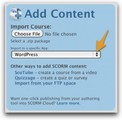
As you might have seen, we’ve integrated SCORM Cloud in a few places, including WordPress and Google Apps. The way we see it, SCORM Cloud is much like a switchboard. Content comes in from all over the place and SCORM Cloud sends it out to different locations, including other Apps. While you still have the option to upload your courses directly to your App, you can also upload to your App using SCORM Cloud.
Uploading your content directly into Cloud gives you a few benefits. You can test your content using your Test Track Sandbox to see how your users will experience it. You can also launch your courses directly from Cloud. Have you created a Quizzage or ScoTube course you want to share? No problem, you can push those directly to your App too!
To upload to your Apps using SCORM Cloud, just follow these easy steps and you’re done before you know it. If you need to share your content outside the API, check out dispatch.
We’re always looking for ways to make SCORM Cloud better, so send us your ideas. I’m sure that you can come up with things we’ve never even considered.
Mike Rustici
.
Blog
.
<span class='date ' tip=''><i class='icon-time'></i> Sep 05, 2015 02:44am</span>
|
|
We’re hiring a Juggler. No, we don’t need circus skills, but we do need somebody who can keep a lot of balls in the air.
Project Tin Can is generating an enormous amount of opportunity and we need somebody to help us keep moving it forward. The job involves bits of product management, project management, sales, marketing and entrepreneurship.
We’re also looking for one or two more developers.
Start here if you’re interested.
Mike Rustici
.
Blog
.
<span class='date ' tip=''><i class='icon-time'></i> Sep 05, 2015 02:43am</span>
|
|
Birthdays are fun around Rustici Software. We all get ice cream- and not just a scoop from a big bucket of vanilla or chocolate. Each person gets to order their very own combination from Cold Stone Creamery (shameless product placement for free ice cream). Given the choice, we each end up with a cup custom made just for each of us. Whether it’s Mike’s Cookie Doughn’t You Want Some™ with Cake Batter ice cream, or Jena’s choice (which usually entails her picking out some of the toppings she ordered), it’s a personalized cup that has the flavors and toppings for each taste.
We like to offer the same choices to our customers too. We understand that one platform does not suit everyone. That’s why we built many SCORM Cloud integrations- to meet different tastes and needs. Some flavors we offer include WordPress, Google Apps, Moodle, and now Drupal.
The newest addition to the line up, the SCORM Cloud Drupal integration, is one that we are particularly excited about. The module is the result of a collaborative effort between a driven client, a knowledgeable developer within the Drupal community, and our own SCORM Cloud experts. Much like Cold Stone, Drupal offers endless customization options with over 2,000 modules to pick from, letting you build a site that meets all of your needs. You have probably seen Drupal in action as it runs millions of sites, including my favorite, The Onion.
Looking for a way to sell access to your courses hosted on SCORM Cloud? The Ubercart module in Drupal offers shopping cart capabilities that now make this a reality. Want to customize the SCORM Cloud player? You can apply your own style sheet through the Content Creation Kit (CCK). Don’t see what you’re looking for? Reach out to the active Drupal community to develop even more functionality.
Since we can’t share our ice cream tradition with you (as much as we’d love to), we can offer more flavors of SCORM Cloud. Don’t see your flavor listed here? Just ask us- the combinations are endless.
Mike Rustici
.
Blog
.
<span class='date ' tip=''><i class='icon-time'></i> Sep 05, 2015 02:43am</span>
|