Blogs
|
We put a lot of effort into making scorm.com a useful and informative site. We want to be THE place that people go to for help with SCORM, be they paying customers or not.
Last month, we published some stats from SCORM Cloud showing the thousands of people who use it to test SCORM content every day.
Today we noticed a metric that’s even more fun…since we started tracking visits in Google Analytics, scorm.com has served over 1 Million visitors!
Thanks to everybody for stopping by!
Mike Rustici
.
Blog
.
<span class='date ' tip=''><i class='icon-time'></i> Sep 05, 2015 03:06am</span>
|
|
We get asked all the time, "What is an LMS?" So, here’s a challenge… express it as simply, as elementally as you can. Here’s my effort:
A tool that authenticates students, connects them to a topic, as well as each other, and provides the tools to efficiently deliver, track and assess the learning process.
- (Think you can do it better using only 140 characters? Step up and leave a comment…)
We’ve been pondering different applications and how they apply to that definition. And I can’t stop coming back to Facebook as a great candidate for an LMS of the future.
A tool that authenticates students…
…connects them to a topic…
…as well as each other…
This is where SCORM Cloud comes in. Courses could be hosted on SCORM Cloud and delivered via Facebook.
…and provides the tools to efficiently deliver, track and assess the learning process.
Assessments and tracking could also be integrated:
Thinking about what could be is something we do a lot… Lately several of us have often discussed what SCORM Cloud + Facebook could be. I thought it’d be a good idea to expand the discussion and bring our followers into the mix.
Apps in Facebook are nothing new, and they’re the future of the platform:
The next five years will be defined by apps and the depth of social engagement.
-Mark Zuckerberg at F8 2011
The social learning platform has created thousands of successful virtual farms and Vills. While many of the popular apps currently on Facebook are games, the Facebook population seems to be underutilized for eLearning. Students and Facebook have a healthy relationship — the site’s popularity was born from college students. I’m willing to make the argument that the blend of eLearning and the Facebook environment would be a useful marriage.
Facebook advantages:
800+ million users (and growing)
Easy to manage people and groups
Users are loyal, familiar and comfortable with Facebook
Streamlined registration and management process
Frequent log-ins, easily accessible across platforms and devices
Every month, more than 500 million people use an app on Facebook or experience Facebook Platform on other websites
More than 7 million apps and websites are integrated with Facebook
By using Facebook to facilitate learning with students and instructors, developers could create a fast and intuitive way to group students and deploy courses. Learning within Facebook provides a platform students are comfortable and familiar with. Relationships formed via a Facebook-based experience could continue past the life of the course, creating a more genuine social experience than traditional eLearning has been able to give. The possibilities of a Learning App within Facebook are exciting to imagine and one I think could become the next big movement of eLearning.
Arguably, this rush to manage learners within Facebook will start soon, and I’m excited to see it begin. We’ve built our SCORM Cloud to be flexible and adaptable with this scenario in mind. We’ve seen several integrations of our SCORM Cloud. So far it has been blended into Moodle, Sakai, Dokeos, Ilias, WordPress and Google Apps. Instead of reinventing the learning platform, just plug our SCORM Cloud into Facebook and move on.
Facebook is the next step, and one we’re excited to see someone take. Our SCORM Cloud can relieve the pain of hosting content, managing courses, tracking assessments and reporting grades. Facebook will manage students — all a developer needs to do is plug the two together. We’re open to ideas on how we can make this process easier.
Group discussions, wall posts, notifications, real-time chat with classmates, leader boards… the Facebook platform offers plenty of elements that can be combined to create something cool. What could be within this solution keeps my mind racing. I hope that some momentum for this develops soon.
So the logical question is, "If an e-learning Facebook app is such a great idea, why not do it yourself?" We have built the toolkit that can make this app possible… we’ve got a lot of development projects in cue. We’ve made it obvious we’re hiring, great ideas like SCORM Cloud + Facebook are why. If this sounds cool and you’d like to jump in and create a Facebook integration, go for it. Where it goes from here is up to you. Are you willing to take the leap and become the first to navigate these waters?
We know this process takes time and effort. We’re willing to lend a hand, let’s discuss what that could look like by dropping a comment. If you’re interested in working with us to make this happen, email me — chris.tompkins@scorm.com.
Some images from: benstein & FindYourSearch
Mike Rustici
.
Blog
.
<span class='date ' tip=''><i class='icon-time'></i> Sep 05, 2015 03:04am</span>
|
|
There’s a new TV show "Around the World in 80 Ways" that challenges 2 guys to use 80 different modes of transportation to circumnavigate the globe. We’re not trying to do that, but we do want to see our SCORM solutions adopted around the world and eliminate the hurdles that come with internationalization.
Shortly after we launched SCORM Cloud, we began to get questions from our friends in Europe about whether we were Safe Harbor compliant. As the requests grew, it prompted us to do 2 things- find out what the heck the European Commission’s Directive on Data Protection is and why we need to be safe from it, and to take a closer look at where our customers are located. Here’s what we found:
In a nutshell, Safe Harbor certification ensures that U.S. companies comply with the EU directives on the protection of personal data. We take data security and privacy very seriously- regardless of where our users are, so going through the certification process was a no-brainer. And as of last week we are officially certified as Safe Harbor compliant. For more details, check out our privacy policy and Safe Harbor compliance.
Looking at where our customers are and the ways we support them uncovered some interesting stats. We were surprised to have so many friends around the world- 82 countries represented. Below is a breakdown of where most of our SCORM Cloud users live.
Supporting a global customer base can be challenging- especially when you consider language complexities. We recently updated our website to support 17 translations, and our SCORM Engine now supports over 16 languages. Chinese? Yep- 2 versions.
So, the world of SCORM continues to grow and the complexities on delivering our services grow too. We’re up for the challenge and invite you to join us in our travels.
Mike Rustici
.
Blog
.
<span class='date ' tip=''><i class='icon-time'></i> Sep 05, 2015 03:00am</span>
|
|
Once upon a time, well, that’s not exactly how this starts. This story actually started about 7 months ago when Chris and I first started working here, at Rustici Software. We were hired to embark on a journey together to find all of the eLearning companies and highlight them in a neutral environment, so you all could find one another.
This was the birth of the eLearning Atlas, a comprehensive map of the eLearning industry and all the products available on the market. The genius of our pairing is that we complement each other. Chris is level headed, pensive, deliberate, and I’m just…not. We found thousands of possible companies, supporting a wide variety of standards. So off we went and these are our stories…
Jena’s Journey:
Photo from Wikipedia
The Atlas is my Jabberwocky and I am Alice. During my journey through the Atlas, I learned more about myself, about the companies listed, and the eLearning industry as a whole. At the beginning, I was terrified of the companies put in front of me. There were over 3,000 companies to reach out to, with the list growing everyday. Chris and I split up the list and I went to tackling these companies, one by one.
The Atlas was still a creature looming in the distance, one day I would have to face it, but for the time being, I was only learning. Learning about how the industry is moving, changing, evolving. Companies moving into the unknown to push the boundaries of what learning is and how it was accomplished. The list began to shrink, albeit very slowly, and I became more comfortable speaking about complex concepts, standards and the companies themselves. In a sense, I grew stronger, more capable.
All of the learning, conversations, and time, have been leading up to this. The moment I slay my Jabberwocky. And I am proud to say that finally, the Atlas is ready. Well, at least Phase 1. The Atlas is an ever-evolving project, we will add companies as we find them. So if you are out there and not on the Atlas, please let us know.
Chris’s Take:
To translate, we’ve mapped all the companies on our radar. We’ve discovered some interesting trends and noted the use of the various standards. Completion of the eLearning Atlas is a moving target, there’s plenty of work left to do. If we’ve missed a product, let us know. If you see something we could have done better, tell us. If you are a talent management tool, you’re up next.
I’m currently looking into the patterns we’ve collected, exploring what standards are used throughout the industry, comparing adoption rates and analyzing trends among products. The Atlas is designed to be a useful way to find products that compliment one another, or fit a specific need. We’re building a community that is focused on helping eLearning companies work together, sharing courses and systems. We’re keeping it free, because free is good. I hope you’ll get involved and join the conversation. We’ve built a commenting tool into each product in the eLearning Atlas. So go ahead, comment away, tell our community about your experience using the products we’ve found.
Have some ideas on how we can help the eLearning industry play nicely with one another? Interested in the trends the Atlas shows? Have questions about eLearning products or standards? Want to join Jena and fight imaginary creatures? Drop us a line, we’ll be happy to help.
Check out our Press Release for more information.
Mike Rustici
.
Blog
.
<span class='date ' tip=''><i class='icon-time'></i> Sep 05, 2015 02:59am</span>
|
|
My Atlas Haiku
How to use Atlas
Enter search criteria,
browse, select, repeat.
Not the world’s greatest haiku, but you get the picture. Sure, you can search and find what you are looking for no problem, but you can do so much MORE. The great thing about the eLearning Atlas is you can tailor it to fit your needs. If you are looking for career development content, chances are we have quite a few to choose from. If you are looking for something a little more obscure, like cat noises, well, that’s precisely why we integrated Google Site Search. Here are some of our favorite things to do with the eLearning Atlas.
Search Criteria
We think variety is the spice of life, (well that and attacking the net in ping pong), so we’ve given you some options when it comes to how you search. Whether users type in products, vendor names or keywords, their search will pull up the most relevant entries for them. Keywords can be any number of things, ranging from specific to extremely vague. For example, say a user is looking for K-12 content, their search would look something like this:
If you’re more like Chris and decide "cat noises" is what you’re into, type it in and it will look like this…
(Someone please ask Chris why he is always typing this in the Search bar.) It amazes me every time that we even have search results for the most obscure keywords! This is where Google Site Search becomes a great tool. If we don’t have a tool that offers exactly what you are looking for, we bring in Google results that mention whatever you are seeking.
Users can also change how the results are displayed, depending on the types of entries they are looking for, making each search a unique experience. Each search can be sorted by Relevancy, Product Name or Description as well as Vendor Name or Description or Powered by Scorm.com (that’s us!) Pretty cool, huh? We think so too.
Filter Options
Who has time to search through the thousands of entries we have available on the Atlas? For the more discriminating Atlas user, have we got news for you. You can filter the results for exactly what you are looking for. Just select the options that are most important to you, anything from Product Type, Installation or even by tags, we have over 100 to choose from. You really can have it your way, so give it a whirl!
This ain’t your Grandma’s map
We have been saying since before we started the Atlas, that we were going to ‘map’ the eLearning industry and we’ve done just that. Literally, we made a map. You can now see that eLearning isn’t just concentrated in one region, it is spread across the entire globe. We have companies representing every corner of the world, minus Antarctica of course. So take a look, see who is in your neck of the woods. Just click Browse the Map on the Atlas homepage.
Mike Rustici
.
Blog
.
<span class='date ' tip=''><i class='icon-time'></i> Sep 05, 2015 02:58am</span>
|
|
The best company you can have, in a strange place, is a map.
-MacGyver
I’ve seen every episode of MacGyver… most more than twice. When thinking about the best way for users to get what they want out of our eLearning Atlas, MacGyver’s advice came to mind.
As each of you will undoubtedly recall in "The Gauntlet," the opening sequence has Mac stealing the bad-guy’s evil-plan-map. Without a weapon at hand, he fashions the map into various tools to aid his escape. He finds no fewer than five ways to use the map, getting away unscathed and saving the day.
I’ll never skip an opportunity to watch MacGyver, here’s the clip:
[sniplet macguyver]
While escaping, Mac explains,
The great thing about a map, it can get you in and out of places in a lot of different ways.
That’s the great thing about the eLearning Atlas, it can get you to the right solution, in a lot of different ways.
In no real order, here are some quick ways to fashion our map into a useful tool:
Moodle: There are plenty of products and services built around the platform. This is a good example of how our tags quickly point towards a group of products.
Rustici customers: We often get asked to provide a list of our customers. Until now, we really didn’t have a list to point people to. While not all the products using our software behind the scenes want to be known, this search gives you a good look at the many places you can find our stuff. You can find our stuff in all sorts of places, here are the commercially available products that fit in the Atlas. Use any of these knowing you have the best SCORM support available (That’s my biased opinion… I’m a paid representative).
LMS products powered by SCORM Engine: SCORM Engine is behind the scenes of LMSs everywhere.
Products that use SCORM Driver to create content: Some of the best content out there is made with SCORM Driver.
Products running SCORM Cloud: Our API allows companies to use our scalable SaaS product to handle the deployment of courses.
iOS: Check out all the entries that are taking learning to the iPad and iPhone. By selecting a tag and adding keywords, you can find specific products quickly.
Cloud-based solutions: We’re not the only ones building learning solutions in the cloud.
Facebook: I’ve discussed it before, Facebook is a cool place to learn. Here’s a place to start seeing how others have begun to use the tool for learning.
Collaborative Authoring: Want to work together to create a course? This list combines a tag with a product type to display Authoring Tools that can be used in a team environment.
Have you MacGyver-ed the Atlas in ways I haven’t thought of? Leave a comment and share.
As we point out at the bottom of every page on the eLearning Atlas, we mess up sometimes. If we’ve mixed up some tags or need to optimize a few entries to make sure they land on the right custom search, let me know.
As any fan knows, MacGyver episodes always end with a parting piece of advice. In this sequence Mac concludes with,
Just goes to show ya, a good map will always get you where you want to go.
I couldn’t agree more.
Mike Rustici
.
Blog
.
<span class='date ' tip=''><i class='icon-time'></i> Sep 05, 2015 02:57am</span>
|
|
"we made this chart and it just looked dumb so we changed it"
-Mike Rustici
We recently decided to change the way we represent the different account options on the SCORM Cloud sign up page. We made a nice looking table that would allow users to do side-by-side comparisons of the different account levels. It looked great except for this one place in the middle where there was just too much text.
"The Big" plan wasn’t as straightforward as the others. Instead of just one price for all overage registrations, the price was discounted after a certain threshold was met. Evidently the additional code to handle the pricing complexity wasn’t enough to make us want to simplify. Likewise, explaining the pricing to users didn’t clue us in, either. But such a glaring blemish on an otherwise streamlined table just wouldn’t do.
The solution? Remove the extra text by simplifying the price structure.
Now The Big plan has one price for each overage registration. At 33 cents per overage, The Big plan is cheaper for all "The Big" plan users.
We like the way the new pricing table looks, and apparently our vanity can save you some money.
Mike Rustici
.
Blog
.
<span class='date ' tip=''><i class='icon-time'></i> Sep 05, 2015 02:56am</span>
|
|
If you’ve been paying close attention, you may have noticed a prerelease of our latest SCORM Cloud feature, support for IMS BLTI plus Simple Outcomes.
BLTI provides a simple way for LMS users to incorporate remote tools into their system. Think of it as a super-simple plugin architecture.
Used mostly by academically-oriented LMS’s, BLTI provides a way to authenticate users from an LMS into a tool offered by another vendor. Simple Outcomes is an informal extension to BLTI that allows for very basic results reporting from the tool back to the LMS.
People love SCORM Cloud for it’s ease of integration, but we’re constantly looking for ways to make integration even simpler. BLTI is step along that path.
SCORM is underutilized in the education market. This is partly because academically-oriented LMSs have historically had weak SCORM support and partly because the tracking that SCORM provides hasn’t always been valued in academic circles the way it is in corporate circles.
With greater emphasis on assessment and measurement in education, we believe that detailed tracking will be increasingly important. We hope SCORM Cloud’s BLTI integration will help bring the power of SCORM and the vast quantity of SCORM conformant content to this important segment.
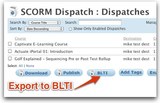
The BLTI export can be found in the SCORM Dispatch section of Cloud. To expose a SCORM course as a BLTI tool, simply create a Dispatch, click on the BLTI button and then copy the provided credentials into your BLTI LMS. That’s it. Your LMS will now be able to launch the SCORM Course. SCORM Cloud will maintain all of the detailed tracking data on the course and report back a score to the host LMS.
Special thanks to Dr. Chuck for helping us put this together. To see a list of other products that support BLTI, check out the LTI list on eLearning Atlas.
Mike Rustici
.
Blog
.
<span class='date ' tip=''><i class='icon-time'></i> Sep 05, 2015 02:54am</span>
|
|
A car salesman’s credibility is quickly lost when he guesses what size engine is under the hood or what the gas mileage could be. Claiming a car has "good" gas mileage is not the same thing as knowing it’s 40 mpg. A 6-cylinder engine can come in a variety of flavors… in-line or V, turbocharged or naturally-aspirated, these details create some machines that are much faster than others. With cars, more is not always better, sweating the details creates vehicles that keep "car guys" debating for hours. People who care nothing for cars will make generalizations that make me cringe, but nobody wants a guessing salesman to help choose the perfect vehicle.
How do car specs relate to eLearning standards? SCORM 2004 comes in three flavors, 2nd edition, 3rd edition and 4th edition… it can be confusing. Nearly 75% of the products in our eLearning Atlas that support SCORM 2004, don’t specify which edition is implemented. While I’m sure the development team behind these companies understands the differences in the standard, the customer-facing side generally has no clue. Most don’t even bother to guess or publish it on their website. SCORM 2004 is powerful, but all editions are not created equal, most editions do not play nicely with one another.
The generalization of SCORM 2004 sometimes creates compatibility issues that can be a source of frustration for customers. In order to truly understand if a piece of content and a LMS will easily work together, it’s crucial to know that they speak the same language, er, SCORM edition. I’ll quietly challenge those that generalize to express the details they support, even it’s not presented prominently. The eLearning Atlas provides an easy way to find the companies that know exactly which edition of SCORM 2004 they support. However, if a generalization of the standard is all that a user really needs, the eLearning Atlas has that covered as well.
Mike Rustici
.
Blog
.
<span class='date ' tip=''><i class='icon-time'></i> Sep 05, 2015 02:54am</span>
|
|
Ever since we came up with the idea of the eLearning Atlas, we’ve been thinking about ways to make it better for our users.
What we realized was, as great as we are, we can only do so much. So we started thinking about what to bring to the Atlas next. We are proud to say that Craig Weiss of eLearning 24/7 has graciously agreed to share his professional insight on some products listed on the Atlas. How’s that for exciting! What we love so much about Craig’s product reviews is he takes a non-biased, no BS approach. Craig will be adding comments in the Atlas to the products he has reviewed and providing links to his full reviews.
"I am absolutely thrilled to work with eLearning Atlas and being able to provide an independent assessment of each product. As a reader you can expect the same approach I use on my blog - right to the point without any fluff. Plus you will be able to gain additional insight with direct links to an extensive product review."
- Craig Weiss
We can’t thank Craig enough for the great addition to the eLearning Atlas. We built the Atlas to bring the eLearning community together and form a community. We hope that Craig is just the start, join the discussion by adding your own comments on the products and companies you love!
Mike Rustici
.
Blog
.
<span class='date ' tip=''><i class='icon-time'></i> Sep 05, 2015 02:53am</span>
|