Blogs
|
In thinking about how L&D needs to shift to accommodate this new day and age, I started thinking from the perspective of why the term Learning & Development (let alone Training & Development) bothered me, and it’s because I believe we need to shift from thinking about learning to think about performance. My first take was that training and development wasn’t enough. Even learning & development isn’t enough; we need to focus on developing individual and team skills and contributions, but where does performance support fit?
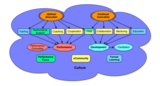
As another way to think about it, I started with the combination of Optimal Execution and Continual Innovation, and worked backwards. I was trying to find the elements that contribute to each. What are the components we can use technology to improve individual and group contribution to optimal execution? What can we do to similarly improve continual innovation?
For execution, we have training, performance support, performance coaching, assistance from others by cooperating, and self-designed or acquired support as part of personal knowledge management (PKM). For innovation, we want self-development by personal knowledge management, collaboration amongst individual, mentoring to develop individuals and ideas, and education to introduce new skills ideas. Elements of those components fall variously under formal, performance focus, or eCommunity.
Underpinning this is a culture where cooperation and collaboration can flourish. Note that there are opportunities for support of those component skills, like developing coaching and mentoring skills, that cut across the areas, but this seemed to be a manageable way to look at it.
Going further, when I look at what contributes to execution, it ends up being about performance. When the focus is supporting innovation, we can call it development. What we can, and should, be focusing on is both supporting performance in the moment and developing individual and team capability over time. The skills are performance consulting, and facilitation of development and innovation. Thus, the field, to me, is really about performance and development.
This is a first cut, and I’m willing to consider improvements. There are layers below this that are being glossed over to focus on the top level, but I really do think that we need a broader focus, and this seems to capture the way my thinking is going. So, what am I missing?
Clark
.
Blog
.
<span class='date ' tip=''><i class='icon-time'></i> Nov 22, 2015 05:50am</span>
|
|
I was talking to the ADL Mobile folks about mobile design processes, and as usual I was going on about how mobile is not the sweet spot for courses (augmenting yes, full delivery no). When tablets are acting more like a laptop, sure, but otherwise. I had suggested that the real mobile opportunities are using sensors to do contextual things, and and I also opined that we really don’t have an instructional design model that adequately addresses taking context into account. I started riffing on what that might involve, and then continued it on a recent trip to speak in Minneapolis.
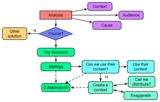
Naturally, I started diagramming. I am thinking specifically of augmenting formal learning here, not performance support. In this diagram, when it’s not a course you head off to consider contextual performance support, if indeed the context of performance is away from a computer.
When, however, it is a course, and you start embedding the key decisions into a setting, the first thing you might want to do is use their existing context (or contexts, it occurs to me now). Then we can wrap learning around where (or when) they are, turning that life event into a learning experience. Assuming, of course, we can detect and deliver things based upon context, but that’s increasingly doable.
Now if you can’t use their context, because it’s arguably not something that is located in their existing lives, we want to create a context (this is, really, the essence of serious game design). It might be fantastic (some conspiracy theory, say) or very real (e.g. the Red 7 sales demo, warning: large PDF), but it’s a setting in which the decisions are meaningfully embedded (that is, real application of the model and of interest to the learner). It might be desktop but if possible, could we distribute the experience into the learners’ world, e.g. transmedia? Here we’re beginning to talk Alternate Reality Game. (And we use exaggeration to ramp up the motivation.)
As an aside, I wondered when/how collaboration would fit in here, and I don’t yet have an answer: before setting, after, or in parallel? Regardless, that’s definitely another consideration, which may be driven by a variety of factors such as whether there are benefits to role-play or collaboration in this particular instance.
This is still very preliminary (thinking and learning out loud), but it has some initial resonance to me. For you too, or where am I going off track?
Clark
.
Blog
.
<span class='date ' tip=''><i class='icon-time'></i> Nov 22, 2015 05:49am</span>
|
|
During my presentation in Minneapolis on future-looking applications of technology to learning, the usual and completely understandable question came up about how to change an organization to buy-in to this new way of acting in the world: to start focusing on performance outcomes and not courses. I’m sensitive, because I have claimed that the change is needed. So I riffed off a couple of answers that I’ll offer for discussion:
For one, the question was how to start. I suggested making small changes in what was being done now: push back a bit on the immediate request for a course, and start really diving into the real performance problem. Then, of course, designing a solution for the real problem. I also suggested starting to chunk content into finer granularity, and focusing on the ‘least‘ that can be done. I didn’t add, but should’ve, that bootstrapping some community would be good, and I’d also suggest that you have to be ‘in it to win it’ (as the lottery would have it). You have to keep experimenting yourself.
I added that you should simultaneously start some strategic planning. That is, be looking at the larger picture of what can be done and where an organization should be, and then figure out what steps to take towards that in what order. When I run my elearning strategy workshops or for clients, some folks might need to start working on performance support, others might best benefit from initial efforts in social, and some might better start on improving learning design. And that’s all good, it’s what is right for them and where they’re at. But you won’t get there if you don’t start planning.
One of the attendees started asking further, and was already doing some prototyping, which triggered another response from me. Start prototyping different approaches. Web (including mobile web) is a really good way to follow on from choosing the early adopter to work with, finding an area where a small intervention can have a big impact, and get some initial measurable improvements to leverage. Iterate quickly.
As a final suggestion, I added that there likely is a need to ‘manage up’, that is educate your bosses and up about the need for the change. It’s really Org Change 101: you need to create a vision, get buy-in, spread the message (the benefits of change, as as Peter de Jager suggests, make it a choice), support and reward the change, get some early success, and leverage that going forward.
This seems like some sensible top-level approaches, but I welcome additions, revisions, improvements.
Clark
.
Blog
.
<span class='date ' tip=''><i class='icon-time'></i> Nov 22, 2015 05:49am</span>
|
|
Rob Hubbard organized a suite of us to write chapters for a use-focused guide to elearning. And, now it’s out and available! Here’s the official blurb:
Technology has revolutionised every aspect of our lives and how we learn is no exception. The trouble is; the range of elearning technologies and the options available can seem bewildering. Even those who are highly experienced in one aspect of elearning will lack knowledge in some other areas. Wouldn’t it be great if you could access the hard-won knowledge, practical guidance and helpful tips of world-leading experts in these fields? Edited by Rob Hubbard and featuring chapters written by global elearning experts: Clive Shepherd, Laura Overton, Jane Bozarth, Lars Hyland, Rob Hubbard, Julie Wedgwood, Jane Hart, Colin Steed, Clark Quinn, Ben Betts and Charles Jennings - this book is a practical guide to all the key topics in elearning, including: getting the business on board, building it yourself, learning management, blended, social, informal, mobile and game-based learning, facilitating online learning, making the most of memory and more.
And here’s the Table of Contents, so you can see who wrote what:
So What is eLearning? - Clive Shepherd
Getting the Business on Board - Laura Overton
Build In-House, Buy Off -the-Shelf or Outsource? - Jane Bozarth
Production Processes - Making it Happen! - Lars Hyland
Making the Most of Memory - Rob Hubbard
Blended Learning - Julie Wedgwood
Informal and Social Learning - Jane Hart
Facilitating Live Online Learning - Colin Steed
Mobile Learning - Clark Quinn
Game-Based Learning - Ben Betts
Learning Management - Charles Jennings
If you’d like to purchase the book, VBF11 is the promotion code to get 15% discount when you buy the book at www.wiley.com, or you can get it through Amazon as a book or on Kindle. I look forward to getting my copy in the mail!
Clark
.
Blog
.
<span class='date ' tip=''><i class='icon-time'></i> Nov 22, 2015 05:49am</span>
|
|
Every year I have much to be thankful for, but right now as I work to finish my latest screed (hence the lack of posts last week), I have some specific things to be grateful for.
A book is an endeavor that draws upon many people. You always have several editors: an acquisition editor, then a copy editor, and ultimately a marketing editor. I’m still at the stage where I’m working with my acquisition editor, but he’s provided much guidance and support. He’s also arranged a relationship with a major society for support, and they’ve been very forthcoming with assistance.
If you do it right, and I try, you also are dependent on some colleagues who’ve stepped up to provide case studies or interviews for you. I’ve been fortunate that I have several individuals in both categories. You also find yourself very grateful for other colleagues who’ve provided guidance in various ways about the book writing process, strategic input, and offers for support upon release.
A book can’t cover everything, and it’s a benefit to know that colleagues have written other books that you can point to. Having those other thoughts to incorporate the gist of, and point to for further depth, helps keep the effort focused.
And, of course, you almost always end up having the deeper support of friends and colleagues who step up to take up some slack, or answer quick questions, or even just cheer you on. And you’re lucky they are there to assist, but also ask the tough questions and keep you from going off the rails.
Finally, you typically have family who support you in a variety of ways, physically, mentally, and emotionally. And I’m fortunate to acknowledge that I do.
So there’s much to be appreciative for this endeavor, and of course in general. So I have thanks for all of the above, and to you for taking the time to read this. Wishing you the best to you for this time of year, and hoping you get to have quality time with friends and family, and have much to be grateful for as well.
Clark
.
Blog
.
<span class='date ' tip=''><i class='icon-time'></i> Nov 22, 2015 05:49am</span>
|
|
Technology is supposed to support our goals, and, when well-written, it does. So for instance, when I write, I use particular features to make my writing process better aligned with my thinking. I’m working on a book (as you’ve seen hints of and some resultant interim thoughts), and I’m finding that now that it’s time to deliver, I’ve got a conflict. Let me explain.
My writing is not just a process of sitting down and having the prose flow. At some point it is, but even with my first book that had gestated for years, I had a structure. Subsequent exercises in screed generation have really relied on my creating an overarching structure, that lets me tell a story that incorporates the things I need to cover. And I use outlines as my structuring tool.
Even this isn’t linear: structure and then write. As I write, I have ideas that I will either put later in the structure, or go back and add into the prose. One of the things that regularly happens is that, as I write, I find things flowing in a different way than I originally expected, and I rearrange the outline to achieve a structure that captures the new flow.
To do this, I use the outline feature hugely. I don’t just restructure, but move chunks to different places using these capabilities. While I have not been a fan of Microsoft in general, I learned Word to write my PhD thesis, and have used it consistently ever since. For instance, while I love Keynote, I haven’t been able to adopt Pages because it hasn’t had industrial-strength outlining. This also means I inherently use styles. I like styles. A lot. For instance, it makes me crazy when people format by hand on something that might need to be reformatted.
The reason I mention this is because I’m now faced with an externally-induced dilemma. Having a deadline, and finally having crafted my prose, I now look at their submission requirements. And they’re antiquated. Here’s the requirement from my publisher:
Our production process requires minimal file formatting; do not use formatting such as fields and links, styles, page headers or footers, boxed text, and so on.
No auto-indexing, no auto-table of contents, nothing. And yes, I faced this before, but it’s still hugely frustrating. The dilemma I’m in: I’ve had to use styes to write a well-structured book. Now I’m faced with the onerous task of removing all the file formatting created by the outline styles that I needed to use to give my best effort. And I have to do it by hand, as there’s no way to systematically go through and manually format all the headings.
This is nuts! I mean, it is almost 2014, and they still need me to use hand-formatting. Um, people, this is why we have technology: to support us in working smarter, not to go to a last-century (or worse) manual process. These instructions are essentially unchanged since 2005, when I wrote my first tome! (Ok, they no longer require a floppy disk version, and I talked them out of the 3 paper copies. Ahem.) I managed to create camera-ready material for my thesis (with library restrictions where they’ll take out the ruler to make sure the measurements meet the criteria) in Word back in 1989; I bet I could create camera-ready page-proofs to meet their requirements today. As you can infer, I’m frustrated (and dreading the chore). The irony of using last century production processes to tout moving L&D into the 21st Century is not lost on me.
Please, if your processes are still like this, let’s have a conversation. I will be having a fight with my publisher (which I will lose; they can’t change that fast), but I hope you can do better.
Clark
.
Blog
.
<span class='date ' tip=''><i class='icon-time'></i> Nov 22, 2015 05:48am</span>
|
|
It occurs to me that we are too busy designing for learning, and that’s not what it’s about. It’s not about learning, as I often say. What is it about? It’s about doing. It’s about performance. So what does that mean?
My backwards design process suggested looking at the desired performance, and then working backwards. This comes from a good analysis of the performance gap and determining the root cause of the difference between the existing performance and the desired one. The solution then is determining what can be in the world, and what has to be in the head.
Another way to be thinking about it is looking at how people really perform in the world. We need to be looking at when and how people need support, and figure out how we can bring support. People would rather not have to discover the answer if possible, and rather find it. Ideally, we are supporting finding the answer, but there are times when we haven’t anticipated the need, or it’s too unique to be worth investing.
The point here is that these ways of thinking about the problem come from thinking about meeting organizational needs, not about delivering learning services. They come from focusing on the doing, not the learning. And that’s a perspective organizations need.
We do, however, need to be thinking about a broader picture. It’s not just doing the work, but it’s also about doing innovation, and continual capability development. So it’s not just putting in place elements that support optimal execution, but it’s also about putting in place the elements that support cooperation and collaboration.
The overall focus has to be supporting the needs of the organization. We need to be thinking about supporting the do, not just the learn. Are you designing for doing?
Clark
.
Blog
.
<span class='date ' tip=''><i class='icon-time'></i> Nov 22, 2015 05:48am</span>
|
|
Somehow, I forgot to farewell one of the finest minds to cross our paths. (I was sure I had, but searching this morning found no evidence. Mea culpa.) Last night, I had the privilege of attending a Festschrift for Doug Engelbart, who passed last July, with speakers reciting the trajectory and impact of his career. And I was inspired anew by the depth of his vision.
Doug is widely known as the inventor of the mouse, but that was just an implementation detail in his broader view. His mission manifested further in the ‘mother of all demos‘, where he showed collaborative work, video conferencing, and more, working with a mouse, keyboard, and graphic display. In 1968. And yet this too was just the tangible output of a much larger project.
At a critical juncture early in his career, he took a step back and thought about what he could really contribute. He realized that the problems the world was facing were growing exponentially, and that our only hope was to learn at a similarly exponential rate, and decided that helping humans accomplish this goal was a suitable life’s work. His solution was so all-encompassing that most people only get their minds around a small bit of it.
One component was a knowledge work environment where you could connect with colleagues and collaborate together, with full access to articulated knowledge sources. And yes, this foresaw the internet, but his vision was much richer. Doug didn’t see one editor for email, another for documents, etc, he wanted one work environment. He was also willing for it to be complex, and thought using inadequate tools as riding tricycles when we should be riding road bicycles to get places. His notion was much closer to EMACS than the tools we currently use. The mouse, networks, and more were all just developments to enable his vision.
His vision didn’t stop there: he proposed co-evolution of people and technology, and wanted people developing systems to be using the tools they were building to do their work, so the technology was being built by people using the tools, bootstrapping the environment. He early on saw the necessity of bringing in diverse viewpoints and empowering people with a vision to achieve to get the best outcomes. And continual learning was a key component. To that end, he viewed not just an ongoing reflection on work processes looking for opportunities to improve, but a reflection on the reflection process; sharing between groups doing the work reflection, to collaboratively improve. He saw not just the internet, but the way we’re now seeing how best to work together.
And, let’s be clear, this isn’t all, because I have no confidence I have even a fraction of it. I certainly thought his work environment had to high a threshold to get going, and wondered why he didn’t have a more accessible onramp. It became clear last night that he wasn’t interested in reducing the power of the tools, and was happy for people to have to be trained to use the system, and that once they saw the power, they’d buy in.
To me, one of the most interesting things was that while everyone celebrated his genius, and no argument, it occurred to me to also celebrate that time he took to step aside and figure out what was worth doing and putting his mind to it. If we all took time to step back and think about what we could be doing to really make a dent, might we come up with some contributions?
I was fortunate to meet him in person during his last years, and he was not only brilliant and thoughtful, but gentle and kinds as well. A real role model. Rest in peace, Doug.
Clark
.
Blog
.
<span class='date ' tip=''><i class='icon-time'></i> Nov 22, 2015 05:48am</span>
|
|
It has become clear that one of the things that is needed is a shakeup of Learning & Development (L&D). My simple version is that L&D isn’t doing all it could and should be doing, and what it is doing it is not doing well. The flaws are myriad
What we see are courses as the only tool in the toolbox. The LMS, rapid elearning tools, virtual classrooms, and of course the omnipresent F2F training sessions are the rule. Organizations are not doing root cause analysis or aligning with business metrics, but instead are serving as ‘order takers’. Organizations are not looking to using performance support even though it’s likely a better value than courses, let alone looking to the network as a systematic component of the solution. Worse, the courses that are being offered are largely knowledge dump/test.
And you’ve heard me go off on this before. So what more can I do? How about write a book laying out the case in more detail? Let’s say I:
document the problems with evidence
point to the things about learning and organizations that we are not paying attention to
show what it could be like if we were doing what we should be (with case studies), and
lay out a road map forward
Would that be helpful?
Well, as I’ve hinted, that’s what’s been my project for the past months. It’s gone into production, with a target date of May 2014. The title, slightly unwieldy but capturing the necessary thoughts, has been finalized:
Revolutionize Learning & Development: Performance and Innovation Strategy for the Information Age
I aim to spark the revolution, and I hope you’ll join me!
Clark
.
Blog
.
<span class='date ' tip=''><i class='icon-time'></i> Nov 22, 2015 05:47am</span>
|
|
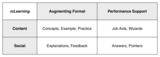
In thinking about mlearning, I have characterized the possibilities of mobile as augmenting formal, performance support, social, and contextual. It occurs to me, as I continue to think mobile, that there is another way to view it.
The realization came from the fact that you can use social for both augmenting formal learning and performance support, just as you can with content (both media files and interactive experiences). Which leads to a different way of characterizing the space. Thus, social versus content is a different cut through mobile than is formal learning versus performance support.
An interesting other cut is that you can do something contextual for any or all of these areas as well: you could provide a contextually relevant or local directory of mentors for formal social or collaborators for performance support. For formal content, you could leverage contextual elements with associated content, or even create an alternate reality game playing off the context. And for performance support, you might customize job aids to point to local resources, or provide augmented reality to annotate the world.
What I’m doing here is revising the way I cut through the space. Social plays a role in both formal and performance support, as does content. Contextual is really a third dimension in addition to the other two dimensions.The older characterization was useful for thinking through design, but I think this is conceptually cleaner.
I’m always trying to get better, and this seems more accurate. So, does it make sense to you? More importantly does this help, or only confound the space from the point of view of doing good mDesign?
Clark
.
Blog
.
<span class='date ' tip=''><i class='icon-time'></i> Nov 22, 2015 05:47am</span>
|