Blogs
|
One of the very first things that I say to a new PhD student is that they need to have fun! This is not quite as counter-intuitive as it might at first seem. Usually I say first that actually stamina is at least as importance as intelligence in completing a doctorate by research. I have known several very clever people who, for one reason or another, could not manage to finish the PhD that they started. This is not as surprising as it might appear, because a PhD is, almost by definition, a hard thing to complete. If you do not have the staying power when the going gets tough, the temptation to thrown-in the towel and go off to do something more interesting with your life, becomes very enticing. This is why the student (and the supervisor!) needs to really enjoy the subject that they are studying in such depth. When data and competing concepts get confusing and complicated (as they inevitably will) it is worth a lot to be able to enjoy the difficulties of the subject, even to relish them. If the topic surrounding your research question does not make you want to really absorb yourself in the fun of finding out more, then you are probably doing the wrong job. A regular "safety-valve" is helpful, whether this is a change of task - (such as spell of fieldwork) or a routine that allows a healthy balance between reading, writing, sport, family, and socialising with friends - the contented student should be able to take a short break and return to the academic battle the next day with just as much (or more) enthusiasm as when they first started. At sporadic intervals I often send my research students a link to a funny story, or a cartoon, such as can be found at www.phdcomics.com to poke fun at some aspect of the PhD research process. This website has hundreds of cartoons on almost every aspect of the PhD experience, and some of them ring so true that they are almost painfully funny. It certainly helps if we can laugh at ourselves and see things in perspective, but by far the best solution is to spend a lot of initial thinking-time considering exactly what is the best wording of the research question (and sub-questions) so that at the end of the studies both student and supervisor can honestly say that, whatever else, they had a lot of fun in the process!
Frank Rennie
.
Blog
.
<span class='date ' tip=''><i class='icon-time'></i> Dec 03, 2015 07:14pm</span>
|
|
Although the main research supervisor normally has the most contact with a research student, the role of the Second Supervisor also provides a useful balance. Normally the second (and perhaps third) supervisor has a limited contact with the student, perhaps as little as three or four discussions per year, but the input they provide is also valuable. It might be because the two supervisors cover different aspects of the same research problem and so can give different suggestions to cope with problems, or they may favour slightly different research methods and emphasis in the investigation. Even when the advice is similar from both supervisors, it can provide a reassurance that the student is on the right (or the wrong!) track. Research has indicated that the way that we supervise research students is often heavily influenced by the manner in which we were supervised ourselves. Some supervisors prefer a distant role, only making contact through formal meetings to check that the research is progressing well. They expect their research students to independent-minded and self-motivated and see a supervisor’s role as a combination of safety-net (for consultation in times of trouble) and manager (ensuring that all the key stages of development and reporting are taken care of). At the other end of the spectrum there are supervisors who seek to micro-manage the PhD project. Resist this temptation! Although the supervisor has a strong self-interest in ensuring that the student’s research project is successfully completed, the work needs to be done by the student, including making the mistakes, false starts, and the hours of working out the best way forward. The relatively light touch provided by the second supervisor can easily be provided via Skype or other such distance-shrinking audio-visual technology. If it is done on a regular basis, perhaps with some periodic face-to-face meetings, this can also be an option for the main supervisor. A benefit of this is that the supervisory team can be brought together on the basis of the skills and enthusiasm that they provide, not simply because they happen to be co-located in the same building or campus. Gone are the days when a PhD student needs to be based just along the corridor for their main supervisor - and anyway, many research students who were residentially based near their supervisor’s office will tell you that their supervisor was so busy globe-trotting to conferences and fieldwork that they hardly saw them for months at a time. Although the UK universities insist upon an external PhD examiner from a different university to ensure the equivalence of the level of the degree, it’s a pity that there is so much emphasis attached to individual institutions as this would seem to be a great opportunity to bring together cross-institutional expertise at the supervision stage, as well as at the final viva voce.
Frank Rennie
.
Blog
.
<span class='date ' tip=''><i class='icon-time'></i> Dec 03, 2015 07:13pm</span>
|
|
One of the very first things that I say to a new PhD student, and I repeat this on several future occasions just to make sure that the point is well made, is that this research study is their project, not mine. This might seem obvious, but there are good reasons for reinforcing this realisation early in the research student-supervisor partnership. It is to be expected that any supervisor has a vested interest in getting their student(s) successfully through the PhD process. By definition, the research topic that the student becomes immersed in is of common interest to the supervisor(s), who may already have spent many years of their lives researching into similar or allied topics. In addition, supervising successfully a number of research students to gain their doctorates is looked upon as a merit-worthy academic enterprise, and success will reflect well on the career aspirations of the supervisor. Finally, although there may be other benefits, the new ideas, new ways of thinking and the "original contribution towards knowledge" of the research topic which, by definition is the mark of the PhD, should also stimulate, inspire, and breathe fresh life into the academic thinking of the supervisor(s). So, all round, there are lots of justifiable reasons why it is in the supervisor’s best interests that the research student (whom the supervisor presumably had a say in appointing) is bright, vibrant, innovative, and successful in the completion of their PhD.
There are limits, however. Although the supervisor wants the research student to write well, s/he will not write the dissertation for the student. Although the supervisor can recommend, guide, discourage one activity and encourage another, when the student walks into the final viva to defend their thesis, the student must be able argue their own case and justify their own decisions and conclusions. Some supervisors may get too close to the research topic of the student, resulting in a wish to influence it, or steer it very firmly in a different direction, and to a point this is natural. One associate of mine eventually parted company with his supervisor because the new research evidence of the student was indicating that it was beginning to undermine the views held by the supervisor over a long career. Rather than embracing the change, the supervisor sought to influence a different interpretation; the research student resisted, and was awarded his PhD in due course.
My job as a supervisor, with every student, is to listen to the thoughts of the student on the research topic, make suggestions, discuss the latest academic reading, bounce ideas off, encourage experimentation and exploratory thinking, encourage them to write down their ideas and their results, and to work together as a team to analyse what these results actually mean. I give feedback verbally, and in a written form, and while I expect the student to listen to what I have to say, I do not expect her/him to necessarily agree with everything. The final decision on what to include and what to omit from the dissertation, on how many samples or how many interviews are needed, must be the decision of the research student. They are the ones who will need to defend their decisions to the academy, not me.
The path of study for a PhD is much more about learning the process of research, and hoping at the conclusion there will be some good results which might make a difference. Above all the role of a supervisor is to help the research student learn the rules and tools of the trade, and to be supportive in the process - even if that support requires some rather blunt advice which the student does not initially welcome and means that more hard work is required!
Frank Rennie
.
Blog
.
<span class='date ' tip=''><i class='icon-time'></i> Dec 03, 2015 07:13pm</span>
|
|
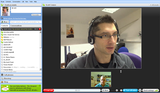
Over the past few years my colleagues and I have been experimenting with the use of videoconferencing for conducting tutorial discussions with PhD students. There are several reasons for this. Firstly, in a geographically distributed institution like the University of the Highlands and Islands, we are not all conveniently located in the same building, or even the same part of the country. Both staff and students who are participating in the tutorial might be at widely dispersed locations and may rarely meet face-to-face. It used to be the presumption in most universities that the research student would be based in a room just along the corridor, or somewhere convenient within the department, convenient that is for the main supervisor. With the increasing number of part-time research students and the benefits of communications technology, I would argue that this is no longer necessary, and possibly no longer even desirable.
The advantages of using videoconferencing are several, whether it is the high-definition system which the UHI is available at the UHI, or the quick-and-easy Jabber connections for less formal meetings. The use of Skype and Facetime is also common, and can be extended into non-work activities. Firstly, although it is not always imperative to see the person to whom you are talking, the ability to see facial cues does give an extra quality that is not available in simple telephone conversations. In the same way that co-location in the same room allows speakers to see the body-language of their audience, the video presence enables participants to see their colleagues smile, nod their head in agreement, or simply watch their eyes glaze over! I have found this very useful to observe when people actually realise when I am joking and when I am not!
Secondly, probably the most convenient advantage of vc is the ability to connect people from almost anywhere. A regular meeting between the main supervisor and the research student at a distant location can be joined by another supervisor at a third location. This provides the best opportunities for networked support, regardless of where the expertise is based. Meetings can be a highly structured discussion with a formal agenda, or a quick, ten-minute focus on a specific point of deliberation. The participants can join from home, or work, or even from the field, and the media is sufficiently simple and easy-to-use that even short, ad hoc, meetings to discuss the wording of a single paragraph, can be arranged at the drop of a hat.
Thirdly, most video communications services have the ability to record the meeting. This is probably not going to be very useful on every occasion, but for key presentations, or for intense sessions of very complex discussions, the participants have the advantage of being able to replay the meeting, analyse the dialogue, and take notes at their convenience.
In many institutions, whatever the official rhetoric, the contact time between the research students and the main supervisors can be precious little, not to say sporadic. The ability to video-link with the supervision team at prearranged times, wherever they are in the world, is a great tool to give meaningful and networked support to the research student, and to provide quality time when it is most needed.
Frank Rennie
.
Blog
.
<span class='date ' tip=''><i class='icon-time'></i> Dec 03, 2015 07:12pm</span>
|
|
Most PhD students start out with at least a superficial knowledge of the key issues in their chosen research topic. They will already have completed a relevant undergraduate degree to a high standard (usually a first-class or a 2:1) and may also have done a Master’s degree in a related area. The working title of the student’s research topic, and probably the primary research question, will also have been discussed. So where does the student actually start working? Quite frequently, the student exhibits one of two contrasting behavioural states. Either s/he is a bit stunned to find themselves actually doing a PhD and a bit overwhelmed by the task ahead, so they do not really engage with anything very constructive; or else s/he is so enthusiastic with the idea of research that they want to go out immediately start collecting samples, or interviewing, or running an experiment! As is so often the case in life, the reality needs to be somewhere in between these two extremes.
As it is unlikely (possible, but unlikely) that your research student will invent a whole new epistemological discipline, a whole new branch of science or humanities, the supervisor needs to direct the student to obtain a good knowledge about what is already known about their research topic area. There are several ways of doing this, which I will come to later, but the guiding principle is firstly, to read widely and deeply. Starting with a few of the most important papers which have been published in the academic literature, the student needs explore the subject, follow leads (some of which will be a blind alley) and take notes of the salient points. The temptation is to read a few papers then rush out to gather new data, but this would be a mistake. Many research students are surprised (some are delighted) when I tell them to spend the first three or four months (at least) doing nothing but reading and taking notes of what they have read. Slowly, with a systematic approach, a picture will begin to build up. The student will develop a deeper understanding of the subject area, probably discovering whole new areas of subtle variations to consider, and by elimination discovering the important areas of the subject that are less well-known.
This reading is not just for pleasure, and while it should start to tail off as the student becomes familiar with the academic landscape, keeping up-to-date with the literature is essential right up until submission of the dissertation. The first six months are the most crucial, as the seminal papers are identified, read, and critically summarised. This information forms the backbone of the literature review, which in turn is the foundation of the introduction to the research topic. Some subject areas like to start the dissertation with a short background chapter and then the literature review, but for others the literature review is the introduction to the topic, so it needs to be well-considered, well-structured, and reasonably comprehensive. Getting research students to begin their studies by immersing themselves in the literature for months at a time is actually no soft option; systematically done, it’s a lot of hard but essential work.
Frank Rennie
.
Blog
.
<span class='date ' tip=''><i class='icon-time'></i> Dec 03, 2015 07:12pm</span>
|
|
I was discussing this topic with a couple of students at the UHI Post-graduate research students’ conference this week. It sounds like a trick question, but in the same way that a long walk, or a marathon, begins with the first step, so does the literature review begin with the first academic paper that the student reads. Normally, when starting out, the supervisor will direct the research student to three or four good papers which are especially relevant to the research topic under consideration. The student will read these, take notes, and then turn to the reference list at the end. As a guiding rule, the researcher should follow-up any and all of the references cited in the text of the paper which are in any way interesting, challenging, or crucial to the argument being made. From these first few papers, the research student will possibly discover half-a-dozen or more references in each paper which need to be read. At this level of study there is an expectation that if the researcher is going to quote anything, or even make a reference to previous academic work in context, they really need to have read the original article. It is not enough to say, "As was noted (Bloggs in Somebodyelse, 2015) it is clear that…" because it may be that the way that Somebodyelse used the idea(s) of Bloggs was wrong, or not how Bloggs intended that data to be used. There is always the danger of misinterpretation. The student needs to reach their own understanding.
So, over a period of time, the student will read a lot of academic articles, track down the evidence which is cited in these articles, then read these follow-up articles too. And so on. From an initial 3 or 4 papers, the lines of follow-up investigation spread out like the roots of a tree. One of the signs that will tell the student when they are coming to the end of their required reading, is when they start to see the same papers starting to crop up again and again. There will undoubtedly be some blind alleys, when the reading slips off in one particular direction or another which is not really useful to the current research project. It might be because the papers referred to are old and the knowledge has been surpassed in later years (this will vary between subject areas, such as fast-moving subjects in science, computing, or e-learning). In some subjects it will be necessary to reference much older publications, either because they set a marker in the development of the subject, or because you want to contrast them with contemporary methods and disciplinary thinking).
Another good idea is to visit the college library collection of previous PhD dissertations for a similar or related subject area. My preference is to search the online index of theses to which my university subscribes. This gives me access to every PhD abstract that has been produced in the UK, and an opportunity to order a copy if I find a particularly interesting match. The object of seeking out a similar PhD is not simply to read about the subject area (which you will extend and surpass anyway) but also to get a feel for the structure of the PhD dissertation, and to get a fast-track on the references that have been used to provide the evidence for this thesis. In the old days, people used to talk about students "reading for a degree in X" rather than studying it, and it is certainly true that the more effort that is initially spent on reading the background and the latest information on the subject, the better placed the student will be to make informed decisions when they begin to gather research data.
Frank Rennie
.
Blog
.
<span class='date ' tip=''><i class='icon-time'></i> Dec 03, 2015 07:12pm</span>
|
|
There are plenty of reasons to believe that multiple-choice and true-false tests are among the worst ways to measure whether learning is successful; in the best of circumstances, they tend to measure only the lowest levels of learning achieved, and in the worst of situations they leave respondents without any acceptable responses from which to choose. Yet we seem to remain tone deaf to concerns and criticisms voiced by educators for decades and continue to rely on them.
From Skley’s Flickr photostream at http://tinyurl.com/machqej
The multiple-choice/true-false approach is pervasive in much of what we encounter day to day within and outside of the world of learning. Surveys often incorporate these methods to make tabulation of the results easy—after all, it can easily be argued, we can’t afford to engage in more personalized labor-intensive methods of collecting data (e.g., reading short- or essay-length responses)—although there are signs that mechanizing the testing and grading process in ever-more sophisticated ways is increasingly becoming possible.
But relying on mechanical methods so obviously produces mechanical results that I believe we need to question our own assumptions, be honest about what those assumptions are producing, and seek better solutions than we so far have managed to produce.
A couple of recent experiences helped me understand the frustrations and weaknesses of multiple-choice/true-false testing at a visceral level: taking two very good and very different massive open online courses (MOOCs), and responding to a survey that relied solely on multiple-choice responses which, because they were poorly written, didn’t provide any appropriate responses for some of us who would have been very willing to participate in the project to which the survey was connected.
Let’s look at the MOOCs first: #etmooc (the Educational Technology & Media MOOC developed and facilitated by Alec Couros and his wonderful gang of "conspirators" earlier this year) and R. David Lankes’s "New Librarianship Master Class" (a MOOC developed and delivered under the auspices of the University of Syracuse School of Information Studies). #etmooc, as a connectivist MOOC (where learning, production of learning objects including blog posts and videos demonstrating the skills that learners were acquiring, and online connections between learners were among the central elements and testing was nonexistent) nurtured development of a community of learning that continues to exist among some of the participants months after the course formally ended. The New Librarianship Master Class, grounded in the more traditional academic model of documenting specific learning goals, relied more on standardized testing to document learning results and offered less evidence that learners were using what they were learning.
The frustrations that some of us mentioned after struggling with standardized questions that didn’t really reflect what we had learned and what we would be capable of doing with that newly-gained knowledge resurfaced for me last night as I was trying to complete in an online research survey. Facing a series of multiple-choice questions, I quickly realized that whoever prepared the options available as responses to the survey questions had underestimated the range of experiences the survey audience had—was, in fact, tone deaf to the nuances of the situation. Opting for results that could be scored mechanically rather than requiring any sort of human engagement in the tabulation process, the writer(s) forgot to include an option for "other" to catch any of us whose experiences didn’t fit any of the options described among the possible multiple-choice responses—which, of course, meant that at least a few of us who might otherwise have been willing to provide useful information abandoned the opportunity and turned to more rewarding endeavors. (And no, there wasn’t an opportunity to simply skip those questions-without-possible-answers so we could stay involved.)
Abandoning a potentially intriguing survey had few repercussions other than the momentary annoyance of being excluded from an interesting project. Being forced to respond to standardized tests that don’t accurately document a learner’s level of mastery of a subject is obviously more significant in that it can affect academic or workplace advancement—and it’s something that is going to have to be addressed in those MOOCs that don’t take the connectivist approach—which raises a broader question that need not be answered within the confines of pre-specified options on a multiple-choice test: why are we not advocating for more effective ways and resources to encourage and document learning successes in both onsite and online settings? Expediency need not be an excuse for producing second-rate results.
Paul Signorelli
.
Blog
.
<span class='date ' tip=''><i class='icon-time'></i> Dec 03, 2015 07:11pm</span>
|
|
The sight of flashing numbers on digital timepieces throughout our house yesterday afternoon was obvious evidence of a power outage while I had been away earlier in the day. But it wasn’t particularly distressing. I knew that PG&E, our local utility company, had been doing major work a block away from where I live, so I assumed the outage was over, reset the clocks, then went into our backyard to do a little gardening before joining the Week 2 live online session that would connect me to the training-teaching-learning colleagues I’m meeting through the five-week Exploring Personal Learning Networks (#xplrpln) MOOC (massive open online course) that Jeff Merrell and Kimberly Scott are currently facilitating under the auspices of the Northwestern University Master’s in Learning & Organizational Change Program.
Approximately 15 minutes before the session was scheduled to begin, I was about to step back into the house to log into the Adobe Captivate space where #xplrpln colleagues were to meet, but noticed something strange: the water in our fountain had stopped flowing. Wondering whether it had become clogged, I turned off the pump, turned it back on, then recognized the problem: the power had gone out again.
In an extended in-the-moment response that unexpectedly continues up to the time when I am writing—and you are reading—this piece, I begin considering options to fully participate in that live online session—and think about the importance of back-up plans. My desktop is clearly not an option since it’s reliant on a flow of electricity that is no longer available. My laptop, running on its fully-charged battery? Also not an option: it relies on a wireless router that is no longer functioning because of the power outage.
Then it hits me: my Samsung Galaxy tablet has a fully-charged battery. And 3G connectivity. So I fire it up, follow the link from my email account to the Exploring Personal Learning Networks session, and discover another barrier: I don’t have the free Adobe Connect app on my tablet. Following a link to the Google Play Store—all the time thinking "This isn’t play. This is serious!"—I tap the "install" button in the hope that the download will be quick and that I won’t face a high learning curve to be able to use it.
With moments to spare, the download is completed. I plug in a set of headphones as the PowerPoint slides for the session appear legibly on the seven-inch screen, and am hearing a stream so clear that it feels as if I’m in the same room that session facilitators Jeff Merrell and Kimberly Scott are occupying—which, in an appropriately visceral and virtual way, I am.
Curious as to whether the full range of interactions available via a desktop or laptop computer exist on the tablet, I struggle with the on-screen keyboard to enter a chat comment letting colleagues know that I may not be fully participating in the session because of the tech challenges. And it goes through, making it visible to them and to me.
They respond audibly and via the chat to say how impressed they are. I respond by telling them how relieved I am that it’s actually working. And we all walk away with another example of the power and increasing ubiquity of m-learning (using mobile devices to augment our learning opportunities and experiences), personal learning networks, and the levels of creativity that adversity inspires.
P.S. - Using a fountain pen to write the first draft of this piece the morning after the session ends, I face another tech challenge: the fountain pen runs out of ink. The fact that I have a back-up fountain pen with me moves me past this final tech challenge, and further confirms the importance of having effective back-up plans in place whenever we step into the wonderful intersection of technology, learning, and collaboration in our well-connected communities of learning.
N.B.: This is the fourth in a series of posts inspired by Connected Educator Month and participation in #xplrpln (the Exploring Personal Learning Networks massive open online course).
Paul Signorelli
.
Blog
.
<span class='date ' tip=''><i class='icon-time'></i> Dec 03, 2015 07:10pm</span>
|
|
When we move into the four- to five-year horizon (time frame) of the latest Higher Education Edition of the New Media Consortium (NMC) Horizon Project reports, we are at the dreamiest expanses of this annual review of key trends, significant challenges, and developments in educational technology—which is just where trainer-teacher-learners need to be.
It’s a lovely area, where we find an intriguingly new kind of virtual assistants—ed-tech tools rather than the current human beings working from a distance to meet employers’ needs: "The latest tablets and smartphones now include virtual assistants…Apple’s Siri, Android’s Jelly Bean, and Google Now…Students are already using virtual assistants in their personal lives, yet most institutions have yet to explore this technology’s potential outside research settings" (p. 46).
Stepping beyond the virtual pages of the Horizon Report, we find a variety of resources already exploring where we may be going with virtual assistants: "7 Pros and Cons of Using Siri for Learning" from TeachThought; "Does Apple’s Siri Belong in the Classroom?" from Concordia University Online; and "How to turn Google Now into a powerful personal assistant" from CiteWorld.
Moving into the other element explored in that Horizon Report four- to five-year horizon, we find people looking for the quantified self based on data that their tech toys provide them: "…the phenomenon of consumers being able to closely track data that is relevant to their daily activities through the use of technology…these large data sets could reveal how environmental changes improve learning outcomes" (pp. 44-45 of the report). Most importantly, we see visions of where learning, creativity, and technology may be intersecting in significant ways in the not-too-distant future.
If we’re inclined to think the quantified self and these redefined virtual assistants are the latest pre-fad incarnations of technology that offers little to trainer-teacher-learners and those we serve, we need to look back only a few years to remember a period when tablets had not become a standard item in much of our learning environment. A time when massive open online courses (MOOCs) were barely a topic for discussion, and wearable technology was not on the cusp of mainstream adoption in learning via Google Glass. Then think about how quickly we have moved along adoption horizons.
Many of us have come to value our tablets as magnificent access points to information and learning resources—a form of mobile library in the palm of our hands—and can already imagine Google Glass and other forms of wearable technology becoming part of that learning environment. (Imagine John Butterill incorporating Google Glass into his virtual photo walks and you can already see the potential.) We are beginning, as Associate Instructional Design Librarian John Schank suggested during a panel discussion at the American Library Association Midwinter meeting in Philadelphia last month, to see MOOCs—particularly connectivist MOOCs—as a new form of textbook (a comment that, much to my surprise, seemed to receive little attention from anyone at the session but which strikes me as an incredibly perceptive and right-on-target observation as to one of the many roles MOOCs are assuming in training-teaching-learning). And we’re also seeing MOOCs as ways to inspire as well as evolve into long-term sustainable communities of learning providing ongoing experiential learning opportunities.
We really have never seen anything quite like this because we’ve never had the combination of technology tools and platforms (Twitter, Facebook, and Google+ Hangouts) we now have to create extended in-the-moment flexible learning environments that can facilitate just-in-time learning and create another way to sustain communities of learning long after a course formally ends.
And now we’re looking at the possibility of quanitifed self technology that could provide important information, filtered through learning analytics tools, to make real-time course adjustments to enhance learning experiences. We’re looking at virtual assistants that might be programmed to anticipate and respond to learners’ information and learning needs to the benefit of everyone involved.
If we connect learners through their tools and through collaborations between learning organizations (K-12, higher education, museums, libraries, and workplace learning and performance), we see the potential to further create, foster, and sustain the sort of onsite/hybrid/online lifelong learning that the New Media Consortium inspires and supports through the Horizon Project and its other innovative offerings. It’s a great example of how a learning organization not only provokes thought, but also provokes us to take the actions necessary to create the world of our dreams.
NB: This is final set of reflections in a six-part series of articles exploring the latest Horizon Report.
Paul Signorelli
.
Blog
.
<span class='date ' tip=''><i class='icon-time'></i> Dec 03, 2015 07:09pm</span>
|
|
The potentially fruitful intersection of massive open online courses (MOOCs), Open Educational Resources (OERs), and libraries is nicely explored in a newly released environmental scan and assessment released under the auspices of the Association of College & Research Libraries, a division of the American Library Association.
Written by Carmen Kazakoff-Lane, a librarian at Brandon University (Manitoba), the report should be useful to trainer-teacher-learners within as well as outside of libraries as we all continue exploring the ways that MOOCs, Open Educational Resources, and libraries contribute to our lifelong learning environments.
"Libraries can and should support open education…." Kazakoff-Lane suggests in the opening paragraphs of Environmental Scan and Assessment of OERs, MOOCs and Libraries: What Effectiveness and Sustainability Means for Libraries’ Impact on Open Education, "[b]ut before libraries do so, it is useful to understand the open education movement as a whole, including some of the key challenges facing both OERs and MOOCs…"—a suggestion I believe applies equally to many outside of libraries, for the more we viscerally understand MOOC and OERs through first-hand experience, the more likely we are to find creative ways to address the training-teaching-learning challenges we face.
OERs, she maintains, "are a natural outcome of several social trends" including open-content movements, "the evolution of a society where individuals actively share information and where many people collaboratively develop and improve knowledge," Web 2.0 technology that supports the tradition of sharing ideas among colleagues, and increasingly "global access to education via the Internet."
MOOCs, in a similar vein, are "an evolutionary outgrowth of two major trends," she maintains: online learning and other innovations including flipped classrooms, and the Open Educational Resources movement itself.
Among her suggestions to her library colleagues are to address the need "to engage with the OER movement" and explore ways that they can support learners and learning facilitators interesting in using MOOCs as part of their learning landscape. Again, those of us who also work outside of libraries have plenty to gain through similar explorations as well as through explorations of where we might create partnerships with our library colleagues—particularly those who, by working in academic libraries, are clearly in the middle of well-established learning environments.
Our library colleagues, she notes, are in a great position to "provide important intellectual property services and advice" about copyright issues related to OERs and MOOCs; facilitate use of restricted materials; and help learners make successful transitions from being information consumers to being "a community of information sharers."
While there is much to admire in the report, there are also points where caveat emptor is an appropriate warning. Her assertion that MOOCs "are a largely experimental undertaking that has yet to demonstrate its effectiveness as an educational tool" suggests that she has not yet had the positive experience of participating in an effective connectivist MOOC such as #etmooc (the Educational & Technology MOOC that produced tangible learning successes and produced an ongoing community of learning) or #xplrpln (the Exploring Personal Learning Networks MOOC that helped participants expand their PLNs while studying the topic).
Her presentation overall, however, is well balanced and reminds us that in spite of criticisms about low-completion rates among those registering for MOOCs, those facilitating learning through large-scale MOOCs, are "able to educate more students in one class than he or she otherwise would in an entire career."
As she brings the report to a close, she leaves us with a recommendation well worth considering: "Libraries can and should play a central role in either [MOOCs or Open Educational Resources], and in so doing ensure that their institutions and users are best served by a sober look at the pros and cons of different models of openness for learners, educators, institutions, and governments, not just in the immediate future, but in the long term as well."
It’s great advice for those working with and served by libraries, and it’s great advice for anyone involved in any aspect of our continually evolving concepts of lifelong learning.
Paul Signorelli
.
Blog
.
<span class='date ' tip=''><i class='icon-time'></i> Dec 03, 2015 07:09pm</span>
|