eBooks, Guides, Templates and White Papers
|
As a training manager, your time and resources are spent developing others, and your own development is likely to be pushed to the side. But making time for your own development can help improve the effectiveness.
In this eBook, you'll learn the skills you need to take your program management to the next level.
You'll also learn:
Characteristics of top training programs
How to conduct a needs assessment to align training needs to organizational goals
Tips for conducting data analysis to identify training trends
|
|
Few can dispute that the Covid-19 pandemic has revolutionized the workplace. Before the pandemic and according to a Gallup poll conducted in August 2020, the average American worker averaged 2.4 days of a 20-workday month telecommuting; during the pandemic, the average American worker is averaging 5.8 workdays telecommuting (Jones, 2020). One in four U.S. workers now works completely from home. While only 51 percent of Chinese employees work from home, 69 percent of U.S. workers do (Liang, 2020). After the pandemic has been vanquished, many workers will prefer to work at home either full-time or part-time (Courtney, 2020). Employers that offer work from home opportunities will enjoy advantages in attracting and retaining star talent.
Download this paper by Dr. William J. Rothwell & Cho Hyun Park to learn their ideas on how to manage and improve on how virtual coaching can provide some effective solutions.
|
|
The role of L&D professionals is rapidly changing. Now is the time to evolve.
Yesterday, "Agile" development was the exclusive territory of software developers. Today, new tools and resources are making it possible for learning professionals to easily deliver content on demand, in modern formats that are proving to be more effective in eliciting dramatically improved results.
Download this eBook to discover how learners’ expectations of content and delivery have changed, and how you can leverage that change to deliver stronger results to your organization.
|
|
Emerging from the COVID-19 pandemic, many (if not all) companies are hyperfocused on boosting sales. A Google search for "sales enablement" yields millions of results—and a variety of conflicting definitions.
Clearly, sales enablement can mean different things to different people. To some, it’s tools, tactics, and training. To others, it’s all about strategy, data, and analytics.
To us, it includes all those things—but it always starts with the story.
Like any good book, your sales story should be a page-turner—keeping prospects hooked by engaging, inspiring, and making powerful emotional connections with them.
But too often, the stories sales teams tell are fragmented, overly focused on product specs and features, or misaligned with marketing.
The right story can make all the difference. And because research suggests that 50% of leads are qualified but not ready to buy, telling that story in the right ways at the right stages of the sales funnel is essential for converting new prospects into loyal customers.
But an effective sales story involves more than delivering certain keywords to drive awareness, consideration, and decision as prospects move through the funnel. It should be a holistic, consistent thread that runs through all your communications to prospects—and one that’s laser-focused on the value you offer and the problems you can solve for them.
Here are three critical steps to ensure that your sales team is telling a clear and compelling story about what you offer and why people will want to engage with your brand.
|
|
Once you have defined the learning need—the Who?, the What?, and the Why?—there are 12 additional considerations when designing virtual classroom experiences.
Click Download for the 12-point checklist that will help ensure your success. (Thanks to LEO Learning for this job aid.)
|
|
Teaching as a Design Science
Blended learning has traditionally been thought of as a combination of digital and face-to-face learning components. However, as we move towards a greater dependence on technology, the definition of blended learning is changing.
An effective blended learning program simply needs to contain a variety of learning elements. These can include virtual or in-person workshops, eLearning modules, learning games, and components that sit outside of all of these, like line manager check-ins and coaching sessions.
The work of Professor Diana Laurillard is central to our blended learning design process. In her book 'Teaching As a Design Science1', she discusses how various learning approaches may be supported by technology. We’ve created a blended learning methodology inspired by her work which we use to create blended solutions for a range of clients.
This ebook will talk you through the five key elements of effective blended learning design—from understanding how learning works through to the technologies we can use to enhance it. We’ve also included some stories from real projects we’ve worked on to help add some context.
|
|
In the past two years, organizations and educational institutions have broken out of the classroom and into the world of digital learning. Discover the lessons they learned and the challenges they encountered on the road to transforming teaching and training for the new normal.
Topics in the eBook include:
How to boost engagement in distance learning
The future of upskilling and reskilling
How to build emotional intelligence in your organization
Developing relationships digitally
How gamification is transforming training
|
|
Onboarding is an opportunity to make a strong impression on your new hires, immerse them in your culture, and set them up for success from day one. But how can you accomplish all of that virtually? Onboarding can be an overwhelming experience in person, and the same is true through a screen. The key is to create an experience with enough structure to keep new hires engaged while also allowing plenty of independent work and break time.
In this guide, you'll get tips on putting together an engaging and effective virtual onboarding experience.
You'll learn:
What you can do in advance for a stress-free first day
How to leverage technology without causing screen fatigue
Tips for getting employees invested in their own development right away
|
|
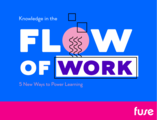
In 2021, workplaces are all about swift skill building at scale, with 80% of CEOs saying employees need new skills for today. However, digital learning for businesses is failing to keep up when employees need knowledge most — in the flow of work. The result is lost productivity:
This eBook is for learning leaders leading the quest for a better, more purposeful learning experience that impacts the bottom line. Read the eBook and discover:
80% of knowledge is almost immediately lost due to lack of practice and retention
One entire day a week is lost by employees looking for answers to questions
15 weeks of productivity are lost each year by subject matter experts (usually your best employees) helping people learn
Employers need to power up knowledge in the flow of work. Get the eBook to find out the 5 ways to power up productivity with knowledge at work.
|
|
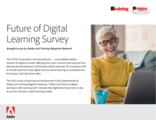
The COVID-19 pandemic has had profound—and probably lasting—impacts throughout society, affecting how users consume learning and how learning and development (L&D) teams deliver it. The necessary shift to remote work has made digital and live online learning an invaluable tool for learners and L&D teams alike.
The 2021 survey of 1,276 L&D professionals by Adobe and Training Magazine Network, "What is the future of digital learning in 2021 and beyond?" found that 42 percent of respondents envision using more digital options this year, indicating that digital learning is here to stay as part of a dynamic, hybrid learning model. This will involve a blend of live online, digital self-paced and face-to-face learning aimed, most often, at internal employee upskilling. As blended delivery grows, companies are looking to modern platforms and features to increase personalization in ways that make learning more robust and more effective.
Click below to download the white paper.
|