Blogs
|
Over the next few weeks, we’re going to be sharing a great deal of detail from our Project Tin Can interviews. Some of you would be overwhelmed by this level of detail (on our main blog) so we’re going to segregate it for you.
If you’d care to keep up with it, you can do that at http://scorm.com/project-tin-can-blog/ or through an RSS feeder (at a url to be provided in the future.)
Rustici Software
.
Blog
.
<span class='date ' tip=''><i class='icon-time'></i> Dec 06, 2015 05:08am</span>
|
|
Over the past couple of months, I’ve had the privilege of talking to many of you about your ideas for what should be done beyond SCORM, and reading ideas and comments from even more of you. Thank you!
I’m sure there are many of you out there, who have ideas about the future of learning, who will be impacted by the decisions made in this project, who have yet to speak up. And to you I say: now is the time. In March we’ll be moving on to solving the problems and use cases that have been raised in phase 1. We’ll still want your input, but we’ll be looking for how instead of what and why.
So if it’s been a while since you’ve looked at our forum, or if you haven’t yet, please drop by and make your voice heard. There is still time to talk too — whether we haven’t talked yet, or if there is just something you want to follow up on. Please also have a look at the interviews we’ve started to post, they might spark some thoughts you want to share.
Rustici Software
.
Blog
.
<span class='date ' tip=''><i class='icon-time'></i> Dec 06, 2015 05:07am</span>
|
|
We’re winding down the requirements gathering phase for Project Tin Can, and have been making some decisions on what scenarios or requirements are in, and what’s out. If you’ve posted to the Project Tin Can forum, you may have started to get email about ideas that are "planned" or "declined".
Planned? Declined?
Note that "planned" does not mean that Project TinCan will directly address an idea, nor does "declined" mean there is to be no improvement in that area. It’s a matter of focus. Ideas that are planned will be goals for the new API to address, sometimes directly, sometimes we will just ensure the API leaves enough room for content or tracking system developers to solve the problem on their own. Ideas that are declined will not be goals for the new API, though they may still be considered while developing the API.
Why?
When looking at the ideas to include, we consider:
can it be addressed with an API? Or as part of CMI 5 (data model)?
level of interest (rank on forum, plus feedback in interviews)
is this idea going to be more important in the future?
previously collected ADL list of DoD needs for the Future Learning Experience project
does it fit well with other planned ideas?
our assessment of ideas impact on: adoption, complexity, or the -ilities
Is that final?
We will be delivering the entire list of ideas to ADL, so even those ideas that are not included in Project Tin Can can be considered for the Future Learning Experience project.
These decisions are not yet final, but nor are they expected to change. We are still conducting a few more interviews and reviewing transcripts from prior interviews. We expect those interviews to help refine what we’ve already planned, but it’s possible we could hear something that would change these decisions.
What’s Next?
As we move into the technical solution & prototype phase, we’ll be looking for your thoughts on how to implement these ideas, and for volunteers to try out or write prototypes. This phase will continue for the rest of the project, until the start of October - then we’ll hand off a final prototype API to ADL.
Rustici Software
.
Blog
.
<span class='date ' tip=''><i class='icon-time'></i> Dec 06, 2015 05:07am</span>
|
|
LMS’s and content creators benefit from one another. It’s a symbiotic relationship. The problem is that it’s not always (and usually isn’t) clear who will play nicely together. Our latest project is making it easier for you all to find each other and work together.
We’ve been compiling a massive list of e-learning companies to see who is likely to play well together. We quickly realized that our unique position (think Switzerland) in the industry means we can share this list with the world and create a valuable resource for everyone.
We’re not just publishing a list. We’re providing a searchable, filterable database that makes it easy to find what you want.
We’re not going to tell you which vendors you should partner with. It’s not our style. Instead, we’re giving you the most comprehensive data set of e-learning products and vendors available, and the tools to make it useful.
When we say "comprehensive data set", we mean it. There are more of these vendors out there than any of you realize. You’re welcome to submit your guesses at eLearningAtlas.com.
We’ve hired people to help us do this. They’ll be reaching out to everyone. If you don’t want to wait, email us about your product right now.
Rustici Software
.
Blog
.
<span class='date ' tip=''><i class='icon-time'></i> Dec 06, 2015 05:07am</span>
|
|
We get asked all the time, "What is an LMS?" So, here’s a challenge… express it as simply, as elementally as you can. Here’s my effort:
A tool that authenticates students, connects them to a topic, as well as each other, and provides the tools to efficiently deliver, track and assess the learning process.
- (Think you can do it better using only 140 characters? Step up and leave a comment…)
We’ve been pondering different applications and how they apply to that definition. And I can’t stop coming back to Facebook as a great candidate for an LMS of the future.
A tool that authenticates students…
…connects them to a topic…
…as well as each other…
…and provides the tools to efficiently deliver, track and assess the learning process.
This is where SCORM Cloud comes in. Courses could be hosted on SCORM Cloud and delivered via Facebook.
Assessments and tracking could also be integrated:
Thinking about what could be is something we do a lot… Lately several of us have often discussed what SCORM Cloud + Facebook could be. I thought it’d be a good idea to expand the discussion and bring our followers into the mix.
Apps in Facebook are nothing new. The social learning platform has created thousands of successful virtual farms and Vills. While many of the popular apps currently on Facebook are games, the Facebook population seems to be underutilized for eLearning. Students and Facebook have a healthy relationship — the site’s popularity was born from college students. I’m willing to make the argument that the blend of eLearning and the Facebook environment would be a useful marriage.
Facebook advantages:
800+ million users (and growing)
Easy to manage people and groups
Users are loyal, familiar and comfortable with Facebook
Streamlined registration and management process
Frequent log-ins, easily accessible across platforms and devices
By using Facebook to facilitate learning with students and instructors, developers could create a fast and intuitive way to group students and deploy courses. Learning within Facebook provides a platform students are comfortable and familiar with. Relationships formed via a Facebook-based experience could continue past the life of the course, creating a more genuine social experience than traditional eLearning has been able to give. The possibilities of a Learning App within Facebook are exciting to imagine and one I think could become the next big movement of eLearning.
Arguably, this rush to manage learners within Facebook will start soon, and I’m excited to see it begin. We’ve built our SCORM Cloud to be flexible and adaptable with this scenario in mind. We’ve seen several integrations of our SCORM Cloud. So far it has been blended into Moodle, Sakai, Dokeos, Ilias, WordPress and Google Apps. Instead of reinventing the the learning platform, just plug our SCORM Cloud into Facebook and move on.
Facebook is the next step, and one we’re excited to see someone take. Our SCORM Cloud can relieve the pain of hosting content, managing courses, tracking assessments and reporting grades. Facebook will manage students — all a developer needs to do is plug the two together. We’re open to ideas on how we can make this process easier.
Group discussions, wall posts, notifications, real-time chat with classmates, leader boards… the Facebook platform offers plenty of elements that can be combined to create something cool. What could be within this solution keeps my mind racing. I hope that some momentum for this develops soon.
So the logical question is, "If an e-learning Facebook app is such a great idea, why not do it yourself?" We have built the toolkit that can make this app possible… we’ve got a lot of development projects in cue. We’ve made it oblivious we’re hiring, great ideas like SCORM Cloud + Facebook are why. If this sounds cool and you’d like to jump in and create a Facebook integration, go for it. Where it goes from here is up to you. Are you willing to take the leap and become the first to navigate these waters?
We know this process takes time and effort. We’re willing to lend a hand, let’s discuss what that could look like by dropping a comment. If you’re interested in working with us to make this happen, email me — chris.tompkins@scorm.com.
Some images from: benstein & FindYourSearch
Rustici Software
.
Blog
.
<span class='date ' tip=''><i class='icon-time'></i> Dec 06, 2015 05:06am</span>
|
|
A few days ago, a Pyrex dish filled with orange-chocolate chip cookies arrived in our office. In our world, a Pyrex dish means one thing: we’ve been graced with treats from Tim’s wife. As we sampled the offerings, Tim told us about his wife’s new endeavor. She was turning their kitchen into a test kitchen and would repeat a recipe until she had made it better and simplified the process. Her treats don’t last long in the office, so unfortunately we can’t share with you.
Luckily, we have a test kitchen of our own. We’re always testing new features in SCORM Cloud to create a better user experience. Our latest concoction makes it easier for you to upload your courses into your Apps using SCORM Cloud. Enjoy!
As you might have seen, we’ve integrated SCORM Cloud in a few places, including WordPress and Google Apps. The way we see it, SCORM Cloud is much like a switchboard. Content comes in from all over the place and SCORM Cloud sends it out to different locations, including other Apps. While you still have the option to upload your courses directly to your App, you can also upload to your App using SCORM Cloud.
Uploading your content directly into Cloud gives you a few benefits. You can test your content using your Test Track Sandbox to see how your users will experience it. You can also launch your courses directly from Cloud. Have you created a Quizzage or ScoTube course you want to share? No problem, you can push those directly to your App too!
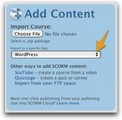
To upload to your Apps using SCORM Cloud, just follow these easy steps and you’re done before you know it. If you need to share your content outside the API, check out dispatch.
We’re always looking for ways to make SCORM Cloud better, so send us your ideas. I’m sure that you can come up with things we’ve never even considered.
Rustici Software
.
Blog
.
<span class='date ' tip=''><i class='icon-time'></i> Dec 06, 2015 05:05am</span>
|
|
Thirteen years ago, a collection of like-minded folks gathered to find a better way for eLearning systems to work well together. Philip Dodds, Claude Ostyn, and many others gave their time to solve problems like resuability and interoperability. They looked at the best technology and standards of the day, they imagined how people would use eLearning content over the coming years, and they created SCORM.
Over those thirteen years, SCORM has been a massive success. Thousands upon thousands of courses have been exchanged between systems that didn’t play well together prior to SCORM’s creation. Thousands upon thousands of dollars have been saved by companies that bought a piece of content once and used it in many contexts. And many, many business have been created.
So I’ll just say it. Thanks to those of you who imagined, built, and nurtured SCORM.
Rustici Software
.
Blog
.
<span class='date ' tip=''><i class='icon-time'></i> Dec 06, 2015 05:05am</span>
|
|
Bathroom etiquette is a semi-frequent discussion topic around the office. It’s becoming a running joke that Tim and I care way too much about people remembering to replace an empty toilet paper roll.
On the surface it’s lighthearted, but you know what, I really care. Actually, I care a whole helluva lot.
It’s not about the toilet paper (we’re all smart enough to look before we sit), it’s about an attitude that cuts straight to the core of who we are and where I want to work.
Changing the roll is just one of those things that needs to get done. It’s not anybody’s responsibility. It’s not in anyone’s job description, but its just gotta happen. Somebody’s gotta do it.
The person who replaces the TP is the person who is going to answer a customer’s question about something well beyond the scope of what we do, just to help them out.
The person who takes out the overflowing trash can is the person who is going to make a quick bug fix, even if that code technically belongs to another team.
The person who puts a stray glass in the dishwasher is the person who will take 20 minutes to help a struggling peer, despite an overflowing to-do list of his own.
A company filled with people who change the toilet paper is a company that delights its customers. It’s a company that respects its employees. It’s a company that can avoid a lot of structure, process, management and unnecessary BS because amazing people are filling in the cracks. A company that changes the TP, doesn’t have to fill out TPS Reports.
The post Want a Great Place to Work? Change the Toilet Paper appeared first on SCORM - .
Rustici Software
.
Blog
.
<span class='date ' tip=''><i class='icon-time'></i> Dec 06, 2015 05:05am</span>
|
|
The floodgates are open. It’s time to celebrate. The Tin Can API, version 1.0, is here today.
It was almost three years ago when ADL asked the e-learning community to help them with research to create a new, simpler, more powerful e-learning standard. E-learning standards are what we do, so of course we jumped at the opportunity.
The result was Project Tin Can, which resulted in the Tin Can API. We wrote the first version of the API, version 0.8, then handed it over to ADL and a vibrant open community.
Today it looks like a few guys in Nashville, TN (and a few stragglers up North) managed to transform our slice of the world.
Learning isn’t going to be tracked the same way that it has been. You want to know more about learners than just "someone completed a course" or "someone scored 98% on an test". You want to be able to track activities that take place outside of an LMS, like serious games, mobile apps, group projects, conferences, simulations and so much more. You want to be able to correlate real-world performance with training data. And, you want all of this learning and performance data to live in one system.
The Tin Can API makes all of this a reality.
Already about 60 products/companies have adopted beta versions of the spec. Now is the time when the rest of the industry joins in.
The post The World Just Changed appeared first on SCORM - .
Rustici Software
.
Blog
.
<span class='date ' tip=''><i class='icon-time'></i> Dec 06, 2015 05:04am</span>
|
|
mLearnCon 2013 is happening right now, and we thought this would be a good time to write about some related topics:
Mobile learning. M-learning. Native apps. Tablets. Smart phones. Offline e-learning. HTML 5.
These are all terms that we’ve been hearing a lot about in the e-learning community, but where do we really stand with all of these different things, especially when talking about trackable and standards-conformant learning?
Many of our customers have a large catalog of SCORM content, and some of them have particular needs like being able to do offline learning or delivering their content via a native mobile app.
In the past, this had only been done by a few people and in limited contexts, but about six months ago we figured out a really good way to make it work. This is a huge development in the world of SCORM. You can learn more about how it works here, or just just email or give us a call. We’d love to chat up some mobile/offline SCORM with you.
Another option, and a more forward-thinking, future-proof alternative, is to use the Tin Can API. With Tin Can, you just enable your learning content/activities to send Tin Can statements to any LRS (or multiple LRSs). Configure your app to store the statements locally, and then send them when a network connection is present.
Almost 40% of exhibitors at mLearnCon 2013 have adopted the Tin Can API, which has only been formally released as 1.0 since late April of this year. That’s pretty amazing, isn’t it?
You can even use Tin Can to track things like games and location-based activities, both of which are commonplace on mobile devices.
If you happen to be at mLearnCon 2013, right now, this is the perfect opportunity for you to come by and talk about mobile SCORM and the Tin Can API with us. Just go find Andy and/or Tammy in booth 108, and they should be able to answer any questions that you have. If you’re not at the conference, send an email to info@scorm.com or give us a ring.
You might be tired of seeing this line, but we love saying it (and we mean it) — we love talking to people about this stuff!
The post Mobile learning…what’s the deal? appeared first on SCORM - .
Rustici Software
.
Blog
.
<span class='date ' tip=''><i class='icon-time'></i> Dec 06, 2015 05:04am</span>
|