Blogs
|
Jason Hand's blog post was featuredThe IT Culture War: The Struggle to Adopt DevOpsAt the surface, DevOps might be easier defined by looking at what DevOps is not. DevOps isn’t tools or services that you download from the cloud, the title you give a newly hired engineer, or something you can purchase or find on a balance sheet. I can go on and on about what DevOps is not, but the three statements above are common myths and misconceptions, so it’s important to point them out early when trying to help others understand DevOps.DevOps is better defined as an ideology, a culture of collaboration and sharing aimed at bringing the software development and operations teams together to help eliminate constraints and decrease time-to-market. But, there’s a clash happening inside of organizations today that is preventing the full adoption of this culture to be realized.In the following article, I will look at a shift taking place within companies -- a change that impacts IT. The culture of IT is moving in lock step with the changes happening in the larger workplace, but the discussions around this change are harder to find than those discussions about the overall transformation of the modern worker. The culture within IT is shifting dramatically, positively, and that has everything to do with DevOps.Historically, lines of business (e.g. marketing, IT, operations, etc.) were siloed, not interacting with other business units until absolutely necessary. This separation was typically created by perceived responsibilities and the lack of a desire to work outside of these drawn lines. As a result, there have been naturally formed groups of people that don’t talk to each other yet are working toward the same goal - delivering a better product, creating value in their market, solving problems for people.This is the culture in many businesses and it becomes even more noticeable when you start looking closely at IT departments. Traditionally, IT was an isolated group. Engineers write code and build the product and "throw it over the wall" to a different set of engineers for quality and testing, then it makes it’s way to a production environment managed by a team that has little-to-no knowledge about the code residing on their infrastructure. Marketing and sales then take over and start the promotion and selling side of the equation. Rarely do the groups collaborate with full transparency and respect for each other’s roles. They certainly interact, but it’s the collaboration piece that is often much more difficult.We are now seeing the internal structure of businesses evolving. There are traditionalists happily working within boundaries of responsibilities and modernists that want to be plugged into what everyone is doing. Another way to look at this is generational -- Gen Xers or Baby Boomers historically like well defined roles and responsibilities while millennials traditionally seek out roles that have more loosely defined responsibilities.We are hearing more about DevOps because of this evolution. DevOps shifts the tradition of how IT is organized, how engineers interact. It brings a set of best practices that guides how engineers and IT works that is markedly different than a traditional set of principles. It’s a culture of automating, measuring, and sharing in the name of increased efficiencies throughout the software development life cycle.One of the primary principles of DevOps is empathy. Empathy from developers toward the system administrators (i.e. Operations), Operations for the developers, and even empathy across non-technical teams of the company. In most organizations the mandate of a developer is merely to produce a piece of software that works -- if it worked within an engineer’s development environment, then someone else must be able to make it work in production, right? Ideally, developers must care how secure their apps are, how hard they are to deploy, how hard they are to keep running, because our colleagues on the Ops side are typically paying the price for issues once the product is released to the public, not the developers who built it.Having more empathy for each other’s role in delivering better products and solving problems is the destination DevOps is driving forward for organizations. Until that point, DevOps adoption faces real challenges. A cultural war of sorts.DevOps represents cultural change. Whether it’s the change of resistant engineers that don’t want to be on-call or the change of Operations teams to have more empathy towards their counterparts writing code, to the willingness of executives to embrace a culture of automation, measurement and sharing. Organizations must overcome the culture war to be able to approach the agility and productivity that organizations following a DevOps model gain. The faster they can get there, the faster these organizations can take the competitive edge away from traditional enterprises.Jason Hand is a DevOps Evangelist at VictorOps, organizer of DevOpsDays - Rockies, and author of "ChatOps for Dummies."See More
Jeff Fissel
.
Blog
.
<span class='date ' tip=''><i class='icon-time'></i> Jul 14, 2015 08:38am</span>
|
|
Earlier this year, Emily Esfahani Smith wrote an article in The Atlantic titled, "There’s More to Life Than Being Happy." Now, I’m not ready to throw in the towel on my pursuit of happily ever after… but it’s hard not to take note of the frequent mention of ‘meaning’ in articles, books, and other works of thought leaders.
Gary Hamel counsels managers to see themselves as "entrepreneurs of meaning." In Good Business, Csikszentmihalyi dedicates significant energy to the "making of meaning." AndMcKinsey Quarterly ran an article last month dedicated to "Increasing the Meaning Quotient of Work."
According to psychiatrist/neurologist/Nazi concentration camp survivor Viktor Frankl, "Man’s search for meaning is the primary motivation in life." Given the central role of work in modern-day existence, it makes sense that the search for meaning plays out on the job.
Does Meaning Really Matter at Work?
If you don’t buy the whole ‘primary motivation in life’ argument, perhaps you’ll be swayed by Richard J Davidson, PhD from the University of Wisconsin-Madison. According to Dr. Davidson, "The positive emotions accompanying thoughts that are directed toward meaningful goals is one of the most enduring components of well-being."
And Daniel Pink confirms that having a sense of purpose and contributing to a greater good improves performance, motivation, and personal satisfaction.
So, meaning clearly matters… perhaps to the point that wise leaders may want to consider elevating it to the same level of attention that job satisfaction, culture, and employee engagement currently enjoy in many organizations.
But I’m Just a…
Let’s be honest. We’re not all researchers dedicated to finding cures for debilitating diseases. Or inventors of new technologies and solutions for worldwide threats. Most of us do something considerably less dramatic and more mundane.
Yet, there is meaning in all of the work that is done each day… if we choose to seek it out and honor it.
Is Meaning Playing Hide and Seek with You?
Are you wondering where the meaning might be in your work? Consider one or more of the following strategies to root out the significance and importance of your 9-5 existence.
Identify and consciously use your unique strengths, talents, and gifts. No one else can do quite what you can. Understanding that underscores a purpose that only you can fulfill - at work and in life.
Put values into action. Intentionally living a set of values elevates all that you do. Bringing integrity, respect, or positivity to all that you do profoundly affects others and your outcomes.
Connect your contribution with the big picture. Understand and remind yourself of how your work feeds into and supports a greater whole. You’re not a cog in a wheel, but rather an essential component whose absence would leave things incomplete.
Serve others. Helping others meet their needs and achieve their goals creates lasting meaning. When others flourish as a result of your efforts, you succeed as well.
Influence the organizations to do good. You’re in a powerful position to magnify your meaning as you help your organization take action that contributes to a better world - whether it’s through company-sponsored volunteerism or simply influencing constructive decisions.
Take time to reflect on actions, successes, and learning. Take a pause to let the results of your activity and effort sink it. Through reflection, you can make sense and find meaning in all that you experience.
Seek out challenges that make a difference. Stretch yourself deliberately and in directions that yield improvements. You’ll find meaning in your own development as well as the outcomes that it can yield.
In the workplace, meaning will likely not come knocking on your office doors or cubicle walls every day. We need to search it out, consciously and actively finding the significance behind the sometimes mundane tasks that we perform.
And leaders need to help others find meaning in their work by modeling and teaching these strategies.
What could it mean to operate in an environment committed to everyone finding meaning at work? I’m not sure… but I’d sure like to find out.
This post originally appeared at Lead Change Group.
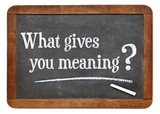
Image: © Marekuliasz | Dreamstime.com - What Gives You Meaning ? Photo
The post Meaning Matters appeared first on Julie Winkle Giulioni.
Julie Winkle Giulioni
.
Blog
.
<span class='date ' tip=''><i class='icon-time'></i> Jul 14, 2015 08:37am</span>
|
|
Two nights ago after work, I wandered over to the State Library of Victoria, a place I hadn’t visited for some years. It was looking a bit worse for wear in my opinion or maybe I was just becoming a grumpy old woman for noticing the dirt and rubbish that side of town.
Photo Source: http://commons.wikimedia.org/wiki/File:Vic_State_Library_Facade_Pano,19.07.06_edit1.jpg
It was early evening and Melbourne workers were scrambling to get home while students sat on the steps outside the library munching on fast food before they went back in to continue their studies.
A lone seagull desperately flew around the head of one of the statues trying to land on its head.
I was here to attend a Melbourne Knowledge Week panel of people who created start-ups around community learning events called Learning In the City.
In its fourth year, Melbourne Knowledge Week has various programs and events around the city. Our city is home to infrastructure and key organisations which are thought to characterise a knowledge city. You can find out more about it on the website here.
The panel consisted of community learning providers who were all start ups and have been providing learning in some form or another.
We Teach Me
I have had the pleasure of connecting with We Teach Me through my work to see if their product can have some corporate application for peer-to-peer learning programs. The platform allows anyone who has a subject matter expertise to plan, co-ordinate and conduct courses on any topic. Teachers can use this product to easily create, manage and promote courses. Similarly, learners can enrol, connect and create their own curriculum of learning based on their own personal needs.
In fact, last night, I did my first We Teach Me Course on Evernote 101 run by Megan Ilema (@Megsamanda) so I guess I not only learned about Evernote but I got to trial We Teach Me dashboard on a real event.
At the Evernote 101 Workshop playing with Skitch
The Creative Performance eXchange
Peter Spence talked about the events they offer at the Creative Performance eXchange. It’s an inter-generational forum where people talk and share ideas. Although I hadn’t been to any of these forums, I understood these to be a gathering of people from all walks of life, of all experiences, from a wide industry and background who get together to talk and in so doing, learn from each other. On the panel, Peter talked about how left brain we all are nowadays and how we have a lot to learn from children, women and the arts. My understanding of his message that in today’s society we are simply too busy, too structured and focused and as a result we have lost our humanness, creativity and connections.
Laneway Learning
I chatted with Mark who was one of the founders of Laneway Learning and found that we had a connection over organic chemistry. We regaled stories of white lab coats, beakers and morphine derivative compounds (Please, no Breaking Bad jokes). Studying towards a PhD and doing this on top of their studies, they founded this group that runs short after-work classes in Melbourne that are cheap, accessible and by the looks of it, fun.
Although I haven’t done a workshop yet, it’s on my list to do one of these - or even bring along a group of work colleagues one night. Rather than go for a drink after work at a bar, why not go and do a fun class together?
I complained that I couldn’t get on a 3D printing class online on Twitter and thankfully, they offered another suggestion with The Robots Are Coming.
I was sold on the name. What a brilliant name for the business AND they have a night where you can print Dr Who themed artwork! I quickly shot an email to my brother, the left brained electrical engineer as something like this would appeal to his nature so now we’re talking about doing a class together!
(The last time we were in school together would have been in primary and high school but I reckon these classes would be a lot more fun than our childhood school days).
School of Life
School of Life "Good Ideas for Everyday Life" is based on Alain de Bottom’s School of Life where you learn how to deal with the hard hitting questions in life. This scared me admittedly but I know it’s something I will need to face.
Questions like, "How to Have a Better Conversations", "How to Be Confident", "How to Face Death"…yeichs.
School of Life reminds me of the conversations that we have around our family dinner table. They say that one must never talk about sex, politics or religion at the dinner table but it seems that for Greeks this is certainly not the case. Everything is up for grabs and it makes for exciting dinner conversation where people yell, complain, cajole, argue, laugh, cry, moan about these topics over a moussaka and plenty of retsina. However, somehow I don’t think the School of Life presents their information in such as robust and loud way as I have been accustomed to. Regardless, they provide a place where people can be comfortable discussing these heavy subjects.
Overall, my main take on this panel and my experience of community learning events is that they provide a great way for people from all backgrounds to get together and learn something new and from each other. Courses aren’t long, expensive or convoluted. There is no accreditation, certification or qualification. The factors that made these events popular was that people were learning from each other, they were actually ‘doing something’ and the teachers were passionate.
Stephen Heppell had written about what makes the Best Learning Moments and it seems that community learning events follow these.
Last of all, another start up was mentioned and they were Smiling Mind . As someone who loves to meditate (simply as a way to calm my mind), we chatted about their product and service which provides mindfulness meditation.
I went home, downloaded their app, listened to their meditation and promptly fell asleep. Clearly, a real winner for me.
Just so you know, I’m not being paid to mention these products and services - just like to share because they may be of interest to you.Filed under: Development
Helen Blunden
.
Blog
.
<span class='date ' tip=''><i class='icon-time'></i> Jul 14, 2015 08:37am</span>
|
|
Tim Porter, Larry Heller, Andy Wojewodka and 7 more joined Innovation Insights
Jeff Fissel
.
Blog
.
<span class='date ' tip=''><i class='icon-time'></i> Jul 14, 2015 08:37am</span>
|
|
Guest Post By Sharon Jordan-Evans and Beverly Kaye
I’m delighted to host this guest post from my co-author, Beverly Kaye, as she and Sharon Jordan-Evans launch their latest book, Hello Stay Interview, Goodbye Talent Loss. With retention of key talent a challenge for most organizations, this book is literally the ‘manager’s playbook’ on how to keep employees engaged… and how to keep them period!
What prevents you from asking your talented people what will keep them engaged and on your team? Are you afraid you will be unable to deliver on their requests? Try using these four steps the next time they ask for something you may not be able to give:
Acknowledge the requests and restate how much you value your employees.
Tell the truth about the obstacles you face in granting their requests.
Care enough to look into their requests and to stand up for them.
Ask "What else?" — and keep asking. You’ll eventually get something you can work with!
Managers have told us they have other worries, too, and that some of those concerns prevent them from conducting stay interviews. Check out these what ifs. Do any of them feel familiar?
What if You Ask What They Want and They Say, "I Don’t Know"?
Remember that this is not an interrogation . . . it’s a conversation, and hopefully one in an ongoing series of conversations. It’s okay not to know. Some people will be surprised by your questions and need some time to think about it. Let them think, schedule another meeting, and set the stage for an ongoing dialogue about your employees’ wants, needs, and career goals.
What if You Fear Putting Ideas into Employees’ Heads?
Seriously? As if they never thought about leaving on their own?
What if They Question Your Motivation?
Be honest. If you’re not in the habit of having dialogues like these, it could feel strange—for you and perhaps for them. If they smile and ask, "What book have you just read?," tell them that yes, you did read a book or attend a course, and you did it because they matter to you.
What if It’s Just Not Your Style to Ask?
Banker: [From the audience] If I asked my employees questions like this, they’d fall over in a dead faint. I don’t even say hi in the hallway.
Us: Well—you might want to ease into this, then. Maybe start with hi in the hallway.
What if You Actually Hope They Will Go?
Manager: [At a leadership conference] I have a very poor performer on my team. I’m trying to imagine telling him how important he is to me and to the team—and then asking what will keep him here. It seems disingenuous. How am I supposed to have a stay interview with him?
Us: You definitely need to have a chat with him—but it’s a performance chat, not a stay interview.
Us: [Qualifying a bit] On the other hand, maybe he’s not performing because you’ve never held a stay interview with him. Might he perform better in a different role, with different tasks or teammates—or with a different boss?
What if Cultural Differences Make You Nervous about Asking?
How do cultural differences play out in this crucial, foundational engagement strategy—the stay interview? We asked colleagues and clients around the globe, and the majority said that it works just as well in their regions as in the United States. However, asking questions may not always be encouraged, especially in more hierarchical cultures.
If you manage others in a culture where asking is not accepted or recommended, you’ll need to find a work-around. Some managers have used anonymous surveys or tasked someone else with the "asking." However you seek to learn about what your talented employees really want, it is crucial that you do gain that information.
What if They Are Younger (Older), Introverted (Extroverted), or Smarter than You?
This is about all those other differences we worry about. Stop worrying and start exploring the preferences and unique characteristics of each of your treasured people. Get to know them better and customize your approach to each individual.
What if It Really Is All about the Money?
If employees see compensation as noncompetitive, unfair, or simply insufficient to sustain life, their dissatisfaction levels will go up. They will become vulnerable to talent theft or will begin looking around for something better, especially in a favorable job market. But here’s the rub: although inadequate pay can be a huge source of dissatisfaction, even fair pay won’t retain people who are unhappy in other key areas. If your talented people do not feel challenged or developed or cared about, a big paycheck will not keep them for long.
It is true that some people are motivated primarily by money. If that’s the case, you might honestly have trouble hanging on to some of them. One senior leader said he’d learned that it is pointless to try to hang on to talent with money alone, because there is always a higher bidder. Pay fairly and competitively and then focus on the stay factors you can influence.
Some managers have said they lost sleep over holding stay interviews with their talented people. Then they did it; they held the conversation and it worked out great. Their employees thanked them for taking the time and caring enough to ask what would keep them engaged and on the team.
*Content adapted from Beverly and Sharon’s new book, Hello Stay Interviews, Goodbye Talent Loss, Berrett-Koehler, 2015.
BEVERLY KAYE is the founder of Career Systems International (www.CareerSystemsIntl.com), a global leader in delivering innovative talent management solutions. SHARON JORDAN-EVANS (sharon@jeg.org) is a sought-after executive coach and popular keynote speaker for Fortune 500 companies. They are the authors of five editions of Love ’Em or Lose ’Em, as well as Love It, Don’t Leave It.
The post What If? - Reasons Managers Don’t Have "Stay Interviews" appeared first on Julie Winkle Giulioni.
Julie Winkle Giulioni
.
Blog
.
<span class='date ' tip=''><i class='icon-time'></i> Jul 14, 2015 08:37am</span>
|
|
After four weeks of participating in the Exploring Personal Learning Networks cMOOC, it has come to this.
Our pitch to the CEO on the value of personal learning networks. In fact, through the various readings, discussion and activities of the previous three weeks, we have been building up to this point to undertake the following activity:
Your CEO (or equivalent organizational leader) just heard about PLNs at a cocktail party and is excited about gaining a competitive advantage (or improving impact on mission) by leveraging PLNs for the organization’s success. But, she/he knows little about PLNs or what to do with them to support organizational success and strategy. Is the organization set up to benefit from and support PLNs, so it is more than just an individual thing? She/he is going away on vacation for one week, and upon return wants you to explain what PLNs are and to provide guidance for what to do. You have a one-hour meeting to facilitate a conversation.
First Thoughts
My first thoughts when I read this paragraph was that this is going to be a simple task. When you believe in something, it’s not hard to influence others to see what you’re seeing. Or is it? My second thought was that we have a full hour with the CEO. Usually it takes a long time to get into their diary and set up a meeting so with a full hour with them, it indicates that they’ve taken this topic seriously and really want to hear what you have to say.
My Worlds Collide
While participating in this cMOOC, there were things happening in my real life at work that linked the theory of what we were learning to the real life practicalities of working in a corporate environment. For example, I was invited to be a part of a working group to inspire more users of our division onto Yammer (I think mainly inspired because of what I did at the People Day event) and secondly, every day I would have requests from people to "ask your networks what I knew about x and y" or "what do your networks say about a, b and c".
That is, word was getting out there that I was someone who was connected. I can get answers for the questions they were asking quickly.
Something didn’t sit right with me with that.
All of a sudden what was my PERSONAL learning network, the network that I built, created, maintained, nurtured and trusted could be up for exploitation by others who don’t have any.
So this assignment wasn’t going to be as easy as I thought. If PLNs were going to be used in the organisation like this, why would I want to share mine with others?
Now I was considering doing a runner.
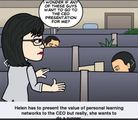
Go on. You knew there would have been a BitStrips cartoon in my blog post somewhere.
A Supportive PLN and G+ Community Understood The Dilemma
We discussed this concept with a small group of participants on the Explorer Personal Learning Networks MOOC. You can see it here.
The group debated the following questions:
Why does the CEO in our problem want to leverage PLNs?
Why does he/she think PLNs will help with company success?
Why do we think we need to place a structure on PLNs?
Why are some organizations successful with internal PLNs?
Why do other organizations fail?
What transpired was robust conversation to structure our thinking and make a logical case (whether for or against) on the value of personal learning networks.
So What Did I Do?
I came to the conclusion that I had to look at the organisation and its leaders and see how ready it was for social learning. That is, it was obvious that the CEO may have thought that this was either going to be another fad or simply, a technological solution that needed to be implemented to get people to be social.
My aim was to dispel these myths and tackle the organisational culture first.
So in effect, I’m not presenting a case either FOR or AGAINST personal learning networks, simply pointing to the current organisational culture and inspiring a dialogue so that they can see for themselves whether they are ready or not for this cultural shift.
I saw my role as someone who presented the facts that got them thinking and reflecting. I wanted them to see what they had to do for themselves.
Maybe I could guide them through the process but they had to make the hard decisions for themselves because I wanted them to see that they had a major role to play.
This was not something that they could mandate.
I created a fictional corporation called Personal Banking Corporation (and no, it’s nothing like the organisation I’m working for) and decided present slides to the CEO and the Leadership Team with the themes:
Where we are today
Where we want to be tomorrow
Define Peer Networks
View a Personal Learning Networks video
View a personal story of how a peer network helped colleagues in their lines of work
Use an example of a business problem and how we could solve it if we used a peer network and without (and present data and findings). This is where I used my recent example of how I asked my PLN to provide me with any sources on onboarding and induction programs for my job.
Talk them through Harold Jarche’s post on the Knowledge Sharing Paradox and Seek, Sense, Share Model
Spend some time looking at why peer networks will have its challenges with the current organisational structure - note how my first dot point is that "knowledge sharing is explicitly stated as a core enterprise behaviour" (I wanted to call this slide: "Why Peer Networks Will Fail at PBC" but thought it was too hard-hitting as it was self evident from these points that they’d have other things to address first)
Open discussion on slides presented so that CEO and leadership team can see for themselves that it’s not as simple as they thought.
The Value of Personal Learning Networks - The CEO Pitch from Helen Blunden
What Are The Tactics I Used?
First of all, I decided to call them "Peer Networks" - I removed the word "learning" as my intention was to remove any preconceived ideas about learning. I wanted to create a sense that it was just "part of the way we do business - in the workflow".
Calling it out may have put negative connotations into their minds. I also didn’t want it to have any connection with the Learning & Development department for fear of them having the concept packaged into a programmed event, formalised, structured, implemented, measured and evaluated.
Also, my assumption was that I was speaking to a CEO and a Leadership Team who were "Cautious Testers", people who are "pessimistic but understand the need to collaborate because they can see the benefits of involving a greater circle of people. These people don’t have much hands-on experience with social technologies, but they have some - enough to see the advantages of open leadership, but not quite enough to abandon their command-and-control practices" (1)
Secondly, I decided to use personal stories of people in my PLN. I asked both Jasmine Malki (@JMalki) and Costas Sotidis (@LearnKotch) to video their personal experiences of how a PLN helped them in their respective role. I thought personal stories of people outside the organisation would be believable and make them see that this is happening everywhere.
Costas, in particular focusses on the need to nurture, respect and share in order to maintain and retain a personal learning network because in doing so, we help with different ideas and alternative options in our new roles as knowledge workers. He makes it clear that PLNs are something that we all have - not just the few.
How PLN has helped your role by Jasmine Malki (@JMalki)
How PLN has helped your role by Con Sotidis (@LearnKotch)
Thirdly I decided to use a real business problem to explain how peer networks may help in solving them. In particularly, I used my current role as a developer of Induction programs. I am in the process of designing a new Induction Program for Store Managers and I asked the question to my PLN on whether they had an good sources of on-boarding and induction programs. I wrote about it in my blog post Exploring Personal Learning Networks To Help Me in My Job.
I wanted to demonstrate two methods of gaining responses and information. In the traditional way, we may have generated a survey, collated responses, measured the data and written reports that may have been costly and taken time to develop. However with social media, we get instant feedback, personal stories, real life examples, people offering other connections, resources and networks - the interaction is richer and provides dialogue and conversations to occur that generate new and alternative ideas that we may not have considered for our induction problem.
In effect, as Maureen Crawford said in her blog, "the strength of a PLN is that nonlinear interactions and engagement results in emergent competence that is distributed across the network". (2)
Fourthly, I wanted to add the current organisational cultural challenges into the mix so that they could see that there was a disconnect between a networked organisation and an organisation that did not value sharing and collaboration and provided examples such as:
Knowledge sharing isn’t explicitly stated as an enterprise behaviour
Senior leaders don’t use Yammer
Technology does not allow access to external social media sites
High turnover of staff in many areas raises questions of why would anyone want to share when they know they’ll be leaving?
The aim of these challenges is to get the CEO to think that there’s a disconnect and that he/she needs to address organisational culture first before becoming a networked organisation.
And it starts with the CEO.
Lastly, I added the last slide because I envisaged that the hour would have bamboozled the CEO and the Leadership Team with a quiet realisation like the one I had at the start of this assignment, "it’s not as easy as I thought".
The intention was to generate discussion and come up with some ideas to work on the organisational culture first, to discuss what they themselves were prepared to give up or not - and to question their role in the entire process.
Where To From Here?
Although this MOOC has still one week to go before it finishes, I have found it to be valuable and worthwhile in my learning because I could directly apply it to my daily work. Connectivist MOOCs have been one the most instrumental and critical personal development activities I’ve ever completed but I think it’s because I’m a self-directed and willing learner.
If people in organisations could be more like this, we wouldn’t be answering the question, "what’s the value of personal learning networks."
Recently, it seems my online and real life worlds are colliding.
I sit in a role of "Design Consultant Induction Programs" but I’m being called upon to use my other skills in the social learning space to teach others in the organisation how to use the technology to create and build learning networks.
Many of these requests are coming from outside my own Learning and Development function because I’m active on Yammer.
Last week, I applied for an internal role in our organisation called "Future Skills Strategy Capability". I saw it as an opportunity to be in a role that could shape the skills and capabilities needed for a workforce to face the future.
I guess in the new world of organisational change, I’m trying to see where I ‘best fit’ - maybe there is no fit anymore?
The problem is I don’t have experience in this nor have I shaped strategy in previous organisations. All I had to go by is my own application, experience and actions I have done in the last few years around performance consultancy.
So I needed to make an impact. I needed to get creative.
I used our company’s recent More Give and Less Take Marketing Campaign to structure an animated video with voice over using photos from our campaign to create "What Do We Need More and Less Of" and included that in my job application using the application Shadow Puppet to create it.
My gut tells me I won’t get the job but that’s okay because I’m seeing signs that we’re on the right track.
Why?
Because we are not like the fictitious company in my MOOC assignment.
If you haven’t already seen the RSA Animate Video on The Power of Networks:
Thank you to my PLN:
Thank you to both Jasmine and Con for their support and assistance when I asked them to do these videos for me. It’s hard to believe that over a year ago, our paths had not crossed but with Twitter and by sharing our learning, showing our work and talking about our passion for what we do and how we can inspire others, what started as being part of our own PLN, I can count them as my friends now. Thank you.
Thank you also to the Google+ community, in particularly our small group in the Explorer Personal Learning Networks cMOOC who bantered, discussed and deliberated ideas for how we would approach our respective CEOs.
References:
(1) Christensen, Karen (2012): Open Leadership: A New Paradigm Emerges and Interview with Charlene Li Available at http://hbr.org/product/open-leadership-a-new-paradigm-emerges/an/ROT156-PDF-ENG
(2) Crawford, Maureen: Non-Ownership, Outcomes and Competencies Available at http://xplrpln.blogspot.ca/2013/10/non-ownership-outcomes-and-competencies.html
(3) "Online Jam Spreads Information Mix", Financial Business Review, 17 April 2013 Available at: http://www.afr.com/p/national/work_space/online_jam_spreads_information_mix_7lcYBbjvqZlH6W8Zydj22I
(4) Kamerer, Eric: Introducing Personal Knowledge Management to a Corporate Audience Learning Solutions Magazine, 30 October 2013. Available At https://www.learningsolutionsmag.com/articles/1296/introducing-personal-knowledge-management-pkm-to-a-corporate-audience
(5) Hart, Jane: How Do We Deal with Unwilling Corporate Learners? Available at: http://www.c4lpt.co.uk/blog/2013/09/22/how-do-we-deal-with-unwilling-corporate-learners/Filed under: Development, XPLRPLN Tagged: 2013, CEO Pitch, Exploring Personal Learning Networks, November, November 2013, XPLRPLN
Helen Blunden
.
Blog
.
<span class='date ' tip=''><i class='icon-time'></i> Jul 14, 2015 08:37am</span>
|
|
Bradley McCredie, Tim Porter, Larry Heller and 8 more joined Innovation Insights
Jeff Fissel
.
Blog
.
<span class='date ' tip=''><i class='icon-time'></i> Jul 14, 2015 08:36am</span>
|
|
Photo source: http://www.flickr.com/photos/missrogue/142628346/
Well the time has come for me to have my own domain name and I will transfer this WordPress site to a WordPress.Org site (let’s see how that goes) on www.activatelearning.com.au over the coming days.
Please feel free to follow me there. Thank you for reading my blog!
HelenFiled under: Uncategorized Tagged: Final Post, November 2013
Helen Blunden
.
Blog
.
<span class='date ' tip=''><i class='icon-time'></i> Jul 14, 2015 08:36am</span>
|
|
Max Lytvyn's blog post was featuredThe Doomed Donkey Versus the Ever-Hungry Pac-ManEntrepreneur and author Gary Vaynerchuk has a simple trick to keep himself motivated. He tells himself that he’s failing, even when he’s at his most successful. This counterintuitive mind-hack is meant to discourage complacency."I play a trigger game with myself to make me believe that I’m losing," says Vaynerchuk. "I’m at my worst even though I’m at my best."For a while—longer than I’d like to admit, actually—I bought into this philosophy. If I kept myself hungry, I reasoned, then I’d keep pushing myself to perform better and reach even greater heights of achievement and success. There was only one problem: I was absolutely miserable.Despite a number of successes in both my personal and professional life, including launching Grammarly, I constantly felt like a failure. I worked diligently to convince myself that I was falling short of the mark, and the effort wore me out. Even when others patted me on the back, I kicked myself for not doing better, more, and faster.The problem with negative motivation is that it doesn’t work in the long run. If you force your brain to move in circles—to chase a carrot that is perpetually out of reach—your brain catches on to the trick and stops responding in the way you want it to. As soon as you come up with an idea, you’ll also devise reasons why the idea isn’t good enough and will never work. You will become a self-fulfilling prophecy.If you believe that you’ll never achieve your goals, then you won’t. So I decided to change my thinking.I began looking to progress and achievement to motivate me. To get rid of the baggage I created with the "failing" trick, I started setting my goals higher. I stopped focusing on thinking about what I should do and focused more on what I could do. Now, my philosophy is to shoot for the moon every time. Even if I fall short, I’ve still gone farther than I would have ever dared dream in my doom-and-gloom days of negative motivation.Instead of plodding along like the proverbial donkey, "wearily in a circle round a gin" (D.H. Lawrence), always chasing that carrot that is just out of reach, I decided to be more like Pac-Man. Both the donkey and Pac-Man make progress, but Pac-Man gets bursts of small rewards along the way. Those rewards encourage him—and me—to work faster, harder, and smarter. That’s the essence of gamification."A good gamelike experience measures and rewards small accomplishments in addition to big ones," says Business Tech Expert Robert Strohymer. "When you reward people for making incremental progress toward larger goals, you encourage them to keep going."If you aim so high that a relative failure is the most likely outcome by all standards, failing and negative pressure become irrelevant. All that’s left is rush of excitement from those moments when you actually hit the moon—or at least, like Pac-Man, eat all the pellets in your path.Max Lytvyn is co-founder and head of product strategy for Grammarly.See More
Jeff Fissel
.
Blog
.
<span class='date ' tip=''><i class='icon-time'></i> Jul 14, 2015 08:36am</span>
|
|
Career development consistently appears at the bottom of most organizations’ climate and engagement surveys. Employees routinely express their displeasure with the options, possibilities, and moves available to them… as well as the organization’s overall commitment to their growth. And managers are no happier. They lament the time they must find - generally deep into their nights and weekends - to support the development of those who report to them.
If you find yourself in either camp, it’s likely that a large source of the problem - and your unhappiness with career development - traces back to one of the pernicious 4 Ps. These Ps have inserted themselves in our work lives and psyches. They masquerade as development and play games with our minds. They shift our attention and expectations in ways that can only lead to disappointment and frustration. And we let them do it.
So, it may finally be time to shed some much-needed light on this pervasive workplace problem… and in the process, elevate the engagement and growth of employees and managers alike.
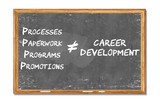
Processes, paperwork, programs, and promotions are not career development.
Over the years, we’ve let these 4Ps confuse us. We’ve developed complex processes and systems to ensure that each employee received career development attention and that the organization had the data for manpower, succession and other planning. Yet these processes have taken on a life of their own, voraciously devouring precious time and delivering disproportionate value for the investment made.
Then there’s paperwork, processes’ second-cousin. It was originally invented to simply memorialize conversations - to overshadow people-work. Too frequently we think that once the boxes have been checked, the forms have been completed and submit has been clicked, development is done. And nothing could be farther from the truth. Documenting is not developing.
And training programs have also added to the confusion around career development. How many times have you looked at an individual development plan that looked a lot like a course catalogue. Training is important, but too frequently we over-simplify development. An employee can attend every course available and still not be growing and developing. It takes more. It takes:
Attending the right courses
Receiving feedback
Engaging in appropriate development activities
Ongoing coaching
Collaboratively unpacking learning and refining development plans over time
Mentoring, networking, and job shadowing
The fourth P may be the hardest to address and banish. Promotions have become synonymous with career development… despite the reality that organizations are meaner, leaner and more delayered than ever before. Changing business realities and demographics have conspired to result in dramatically fewer promotional opportunities. Yet our expectations have remained unchanged: If we’re not moving up, then we report on the survey that career development is not happening.
Just naming these 4Ps is the first step toward beginning to diminish their power. Framing processes and paperwork as artifacts of development - tools that support our ability to do it with some level of consistency across the organization - helps enormously. Helping managers and employees alike think more creatively about how they can develop the skills and capacities they need will help put programs in their place. And actively exploring lateral and in-role development opportunities can demote promotions and introduce viable possibilities for vibrant development.
So, if we want to promote more career development - and more satisfaction with it - it’s time to actively wage war on these pernicious 4Ps.
What about you? Which Ps are undermining career development satisfaction in your organization?
The post The Pernicious 4Ps that Undermine Career Development Satisfaction appeared first on Julie Winkle Giulioni.
Julie Winkle Giulioni
.
Blog
.
<span class='date ' tip=''><i class='icon-time'></i> Jul 14, 2015 08:36am</span>
|