Blogs
|
Great article on How to Create Great Teachers. It's focused on K-12 education primarily, but there is wisdom in the discussion relevant to workplace learning.Here's the major points I take away:
Great teachers need deep content knowledge.
Great teachers need good classroom-management verbalization skills.
Great teachers need their content knowledge to be fluently available to them in the context of typical classroom situations. To get this fluency, they need to practice in such situations---and practice linking actions (especially their verbal utterances) to specific classroom situations.
Will Thalheimer
.
Blog
.
<span class='date ' tip=''><i class='icon-time'></i> Jul 15, 2015 02:29pm</span>
|
|
Great article in the Economist on the Information Explosion.This has huge implications for human learning and performance.Here's what Bob Cialdini wrote in his masterful book, "Influence: Science and Practice."More and more frequently, we will find ourselves in the position of the lower animals---with a mental apparatus that is unequipped to deal thoroughly with the intricacy and richness of the outside environment...The consequence of our new deficiency is the same as that of the animals' long-standing one: when making a decision, we will less frequently engage in a fully considered analysis of the total situation. In response to this "paralysis of analysis," we will revert increasingly to a focus on a single, usually reliable feature of the situation...The problem comes when something causes the normally trustworthy cues to counsel us poorly, to lead us to erroneous actions and wrongheaded decisions. (p. 232)As learning professionals, our clients---our fellow workers---will be more and more confused and duped by information overload. To be successful, we'll have to figure out ways to help them fight their way through the accelerating storm of information.Again, read the Economist article.
Will Thalheimer
.
Blog
.
<span class='date ' tip=''><i class='icon-time'></i> Jul 15, 2015 02:28pm</span>
|
|
I'm thinking some of us bloggers ought to learn from journalists.Here's a whole group dedicated to citizen journalism. AND, they have a book available to help us learn how to do it.
Will Thalheimer
.
Blog
.
<span class='date ' tip=''><i class='icon-time'></i> Jul 15, 2015 02:28pm</span>
|
|
Nice review of Diane Ravitch's new book on schools, schooling, and the importance of good teachers.Seems like it shows just how hard it is to find easy answers.
Will Thalheimer
.
Blog
.
<span class='date ' tip=''><i class='icon-time'></i> Jul 15, 2015 02:28pm</span>
|
|
How Games Help Students Learn and Teachers Teach Infographic
Traditional classroom structures can leave many students unmotivated and disengaged. Moreover, traditional assessment through homework and exams provides limited information on specific areas where individual students need more help. However, a high percentage of students and teachers enjoy games. The use of games in the classroom is booming. But they provide more than just a fun, interactive, multimedia-driven way for people to learn and explore - they can also improve teachers’ ability to assess their students’ progress and provide targeted support. The How Games Help Students Learn and Teachers Teach Infographic illustrates the benefits of games on teachers as well as children.
How Learning Games Can Help Students and Teachers
Students are digital natives: Today’s students enjoy using games and technology as part of their daily lives - the familiarity and interactivity helps learning integrate seamlessly with assessment.
Immediate feedback: Automated and instant feedback helps students understand not just where they need to improve but how, saving time and effort by allowing targeted interventions.
Promote fairness: Data analysis within games can help to ensure the integrity of an assessment by spotting irregular behaviour patterns and randomizing questions.
Encouraging repeat attempts: Game points and rewards give a sense of ongoing progress and achievement, encouraging repeated play and ingraining learning.
Enhancing understanding: Unlike static learning, the interactivity and immersion of narrative-based games can help students to explore how various approaches to new concepts can lead to different outcomes, moving from abstract to practical, real-world understanding.
Via: www.pearsoned.comThe post How Games Help Students Learn and Teachers Teach Infographic appeared first on e-Learning Infographics.
eLearning Infographics
.
Blog
.
<span class='date ' tip=''><i class='icon-time'></i> Jul 15, 2015 02:27pm</span>
|
|
Michael Lewis's new book, The Big Short: Inside the Doomsday Machine, sounds fascinating---and important.
Brad Pitt bought the movie rights, so it's clearly got an interesting story to tell.
Michael Lewis tells the story of the folks who first figured out that the financial disaster was coming (the one that caused our current Great Recession). Lewis shows how these oddball stock traders figured out how Wall Street was making huge mistakes---when no one else could see it coming.The following two interviews are must reading if you want to know how we got into the economic mess we are in. They're also riveting storytelling for the most part.Learning professionals should listen to the interviews---and read the book too---for two themes: (1) How do people's mental models make it hard for them to understand the changing landscape, (2) How attempts at persuasion often fail in the face of these mental models. You might also find it fun to consider how you would "train" the citizenry to have a better understanding of how its government and Wall Street tycoons failed, how financial markets work, etc. Finally, note how Michael Lewis (and the interviewers) set up the dialogue to make a very difficult topic understandable. Great stuff!!Interview with Terry Gross of Fresh AireAbout 40 minutes.Interview with All Things ConsideredAbout 9 minutes.
Will Thalheimer
.
Blog
.
<span class='date ' tip=''><i class='icon-time'></i> Jul 15, 2015 02:27pm</span>
|
|
You gotta just love it when you can cross an item off of the never-ending "bucket list"—right? Well, today marked one of those times for me. Those of you who visit Edutech for Teachers know that I am committed to providing as many "cool tools" as I possibly can to my fans and followers. However, since transitioning from a part-time to full-time technology integration specialist position in January, I haven’t had as much time to create the amount of new content I would like.
That’s why the accomplishment of reaching 100,000 visitors to this blog has been extremely significant to me. According to my site statistics, I’m not only getting repeat customers, but the number of new visitors each day continues to grow. Despite the crazy busy mind-boggling schedule—which is actually a good thing—this data provides me with the inspiration to continue trying to find the time to share edtech resources and integration ideas that will be useful in the classroom. So, keep checking back for the latest and greatest apps, tools, digital media and infographics designed for the 21st educator.
Most importantly, thank you for being part of this professional journey with me!
A special shout out to Clustrmaps for providing bloggers like me with a nifty counter widget and geotracking tool that shows locations of all visitors as well as a cumulative total of visitors to any site. Learn more about how this tool can be utilized in the educational setting here.
And last but certainly not least, thanks to my Tech Club students—especially Simply Aubree—for being my most loyal followers! You rock, GG!
Edutech for Teachers team
.
Blog
.
<span class='date ' tip=''><i class='icon-time'></i> Jul 15, 2015 02:27pm</span>
|
|
Charley Morrow, assessment guru, opens his new blog with a brilliant analysis of one of the biggest issues in today's workplace: Employment Handcuffs (my term--don't blame Charley). More than at almost any other time, today's workers feel stuck where they are. Figuratively, they are handcuffed to their current companies, positions, and bosses.Charley's got hard data on this, but I've seen this too. I've seen people who hate their bosses who just can't find a job when they are competing with five other applicants (there are six applicants for every job available in the United States). Employment Handcuffs leads to depression, anger, sabotage, lack of effort, productivity decline, etc.These handcuffs also puts managers further into the dark then they already are.Management Blindness Worse Than EverManagers are always in the dark about their own leadership performance. The only people that can tell them how well they are doing as leaders are the people they're leading, their direct reports---and their direct reports are scared/inhibited/hesitant to tell the truth about their boss's leadership performance. But now it's worse than ever. Workers are scared to death of losing their jobs. They've seen their friends and colleagues out of work for months or years. They've seen friends, family, or neighbors' houses go into foreclosure. They've heard stories about how people lose their health care insurance after the Cobra has unwound itself. These smart workers won't do anything to upset their bosses---the people who are most likely to fire them. How this Hurts Organizational PerformanceThis hurts manager performance and hurts the productivity and performance of all the employees who have bosses. It's a spiraling down effect. From a CLO's perspective, you better be doing something to improve your managers' performance in this time of employment handcuffing!! Contact me here for consulting advice.How Managers Can See the Light
Managers have to ask for feedback from a place of authenticity. They have to want to improve their own performance. Ya just can't fake it.
Managers have to listen to any feedback they get.
Managers have to make changes/improvements in what they do.
Managers have to avoid being defensive---even when the feedback is harsh, cutting, or wrong.
Managers have to thank those who give them feedback.
Managers have to be patient. Your folks don't trust that you're not going to retaliate. It will take time to build that trust.
Managers have to ask for feedback routinely, not just at performance-review time.
Managers have to be available. So many managers are just too busy to be available. Stop going to all those meetings with folks senior to you!! Your job is to get work done through your direct reports---you need to be there for them.
Managers may benefit from multi-rater 360-degree assessments or other assessment-like interactions. Ask Charley about this stuff.
And again, Charley's great blog post is worth the read.Thanks Charley!! And welcome to the Blogosphere!! Glad you're here.
Will Thalheimer
.
Blog
.
<span class='date ' tip=''><i class='icon-time'></i> Jul 15, 2015 02:27pm</span>
|
|
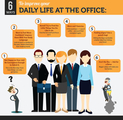
6 Ways to Improve Your Daily Life At The Office Infographic
The 6 Ways to Improve Your Daily Life At The Office Infographic offers a unique view on the subject of how to improve the daily life at the office!
1. Not Happy on Your Job? Be Courageous Enough to Admit It!
This is the first step. From here things can only get better.
2. Want to Feel More Confident? Impress them With Your Body Language!
Look at your co-workers in the eyes. Stretch that back. Start shaking hands.
3. Bored? Try to Find the Little Things You Do Like to Do!
Find the fun stuff and focus on it.
4. Worn out? Exercise!
A few pushups + 1 cup of coffee - and you’ll feel energized again.
5. Feeling angry? Use a punch bag!
Hitting the bag is probably a better idea than hitting your boss!
6. Don’t Be Shy — Ask for a Raise!
Bigger salary will make you feel better
Via: onthespottitleloan.comThe post 6 Ways to Improve Your Daily Life At The Office Infographic appeared first on e-Learning Infographics.
eLearning Infographics
.
Blog
.
<span class='date ' tip=''><i class='icon-time'></i> Jul 15, 2015 02:26pm</span>
|
|
Check this out (I can't say more):
Will Thalheimer
.
Blog
.
<span class='date ' tip=''><i class='icon-time'></i> Jul 15, 2015 02:26pm</span>
|