Blogs
|
Here's a holiday gift for you!Click the link to access a crossword puzzle that tests your knowledge of e-learning terms. E-Learning Queen's Crossword Puzzle (created by Seth Lynch)Click the link below for the answer key:Answer Key to E-Learning Queen's Crossword Puzzle (created by Seth Lynch)2012
Susan Smith Nash
.
Blog
.
<span class='date ' tip=''><i class='icon-time'></i> Jul 16, 2015 10:09am</span>
|
|
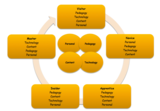
Online Learning: More Faculty Are Engaged ... And SkepticalThe New Media Consortium has identified the "evolution of online learning" as a key trend that will accelerate adoption of ed tech in higher education for the next one to two years. Meanwhile, a recent study by Inside Higher Ed shows that while the number of higher ed faculty teaching online is increasing, many remain skeptical about whether online learning is effective. Improving faculty attitudes about online teaching is important to students and the future.In general, attitudes are mindsets that inform a person's behavior. Attitudes are complex and are theorized to be comprised of three components: feelings, thoughts or beliefs, as well as actions. Our attitudes influence our choices and guide our behavior. An online instructor with a poor attitude toward online learning is less likely to be dedicated to creating an engaging, student-centered learning experience. Given the correlation between attitudes and behavior, we should be pondering the impact that skeptical faculty have on the future of high quality online learning. Institutions should be making an effort to explore ways to improve faculty attitudes about online teaching and learning. To change a person's attitude, one must be engaged at both a cognitive and emotional level. For example, if you wish to convince me that I need to exercise every day, you'll need to provide me with information, as well as engage me emotionally by making connections between this new behavior and the things that are important to me. Just telling me to exercise because it is good for me will not be enough to sustain a change in my attitude.Supporting the Emotional Aspects of Becoming an Online InstructorThe work of Rena Palloff and Keith Pratt discusses a need to cultivate a "phased approach" to faculty development to support the shifting needs of faculty as they move through the stages of Visitor (one who is contemplating teaching online) to Novice, Apprentice, Insider, and Master. The four core facets of the online faculty development experience, according to Palloff and Pratt, include: personal, pedagogy, content, and technology.What's intriguing is how faculty prioritize these four facets differently as they move from the visitor to the master phase. Copyright: Rena Palloff, 2014Of particular interest is how the need for support with the "personal" element of online teaching becomes a top priority at the novice phase, while it moves to last at the other four phases. Palloff and Pratt note that the types of personal support needed by faculty at the novice phase include reassurance and help overcoming "any fears about online teaching" (Palloff & Pratt, 2011, p. 25). Novice online instructors need support with improving their confidence about their ability to transition from the face-to-face to online environment. They need to experience how to foster a presence online. New online faculty frequently need to understand how to convey a sense of who they are online -- without being physically present with their students. Many desire to learn how to convey their sense of enthusiasm for their discipline through an online course. Others need to explore their teaching style and develop an online teaching philosophy, as well as improve their confidence in their ability to use technology. How to Humanize Your Online CourseIn my role as Instructional Technologist for Online and Blended Learning at CSU Channel Islands, I have had the opportunity to develop and facilitate an Online Teaching Preparation Program for new and experience online instructors. The program was launched in the Spring of 2014 and is comprised of three fully online 2-week courses. Faculty may take all three courses to complete the program or select to take courses a la carte. The outcomes of the courses are aligned with the CSU Quality in Online Learning & Teaching (QOLT) framework and are anchored in fostering of student engagement, human presence, student-student and faculty-student interactions, and At CSU Channel Islands, our program begins with the class, "How to Humanize Your Online Course" and is followed by "How to Design Your Online Course" and "Designing Engaging Online Activities."Courses two and three reflect typical courses you will likely find integrated into most online faculty preparation-type programs. The Humanizing course, however, is unique. It is designed to provide the type of personal support Palloff and Pratt identify as a priority to novice online instructors. In the 2-week class, faculty engage faculty in a meaningful, experimental, and supportive experience that involves investigating and reflecting on research about the role of social presence in improving online student learning. Through the course, faculty participate in asynchronous VoiceThread conversations (in voice or video), share content they have created with a tool of their choice from the Tool Buffet, and create a humanized online course action plan in which they reflect on the particular behaviors and strategies they will utilize to improve instructor presence. The course is supported with a Google+ Community (where faculty share a course introduction video and their humanized course action plans in written or video format) and ends with an optional Google+ Hangout. Changing Faculty Attitudes through Immersive Faculty DevelopmentAs the facilitator of the courses, I realize the critical impact I have on each faculty member's attitude about online teaching. The course design is critical, but being an active, supportive, flexible, and empathetic facilitator is essential. As online learners themselves, faculty experience the challenges of figuring out how to navigate an online course, how to use new technologies, identify elements of a course that support their needs as a learner, and feel the value of an instructor who provides flexibility with due dates when a crisis surfaces.Perhaps the thing that is most unique about the Online Teaching Preparation Program at CSU Channel Islands is the fact that I work remotely. Not only do faculty in the program learn to teach online through the lens of an online student, but most of them have not met me face-to-face at the start of the program. This is important because they can reflect on how technology can be effective at establishing a relationship at a distance.We have just wrapped up the first year of the program. The presentation shared below showcases some of the data we captured through anonymous faculty evaluations at the end of each course. As I reflect on this data, I am excited to see evidence of improved attitudes about online teaching from novice instructors. One faculty shared that the Humanizing course is "a must take course for faculty ... who think online learning is nothing more than a glorified correspondence school." Another noted, "I am heartened by the approach of starting first with humanizing the online experience. It helped alleviate my major fears about teaching online, by being able to get right to what worries me the most and see that there are tools and strategies and people who care about the topic. I see the possibilities so much better now." CSU Channel Islands' Online Teaching Preparation Program: Annual Review What do you think? Is it important to immerse higher education faculty in an online experience to experience cognitively and emotionally how effective online learning can be? What strategies are taken at your institution to achieve this goal? ReferencesPalloff, R. M. & Pratt, K. (2011). The Excellent Online Instructor: Strategies for Professional Development. San Francisco, CA: Jossey-Bass.Palloff, R. M. (2014) Promoting Excellence Online: How to Develop Excellent Online Instructors. Inside Higher Ed webinar. Retrieved from: https://www.insidehighered.com/audio/2013/12/12/promoting-excellence-online-how-develop-excellent-online-instructors
Michelle Pacansky-Brock
.
Blog
.
<span class='date ' tip=''><i class='icon-time'></i> Jul 16, 2015 10:09am</span>
|
|
Using art and art therapy to reach at-risk students and to help achieve academic goals is an extremely important strategy. Not only does it allow freedom of expression, it is also motivating and it helps develop self efficacy. Welcome to an interview with Shawn Alyea, who develops approaches using different types of art and expressive media to develop innovative instructional programs. You can
Susan Smith Nash
.
Blog
.
<span class='date ' tip=''><i class='icon-time'></i> Jul 16, 2015 10:09am</span>
|
|
I believe student stories hold potential to dispel some of the myths that of shape the mental models that undermine change in higher education. One of my own online community college students recently shared his story with me. As I read it, I am reminded of so many others that have inspired me over the past 10+ years of community college teaching -- a student who was severely burned in an accident, several students with cancer, an online student awaiting an organ transplant, a student completing her college degree online to avoid being stalked by her ex-husband, a student with epilepsy who was fighting to complete her first college class, and countless online students who gave birth during the semester.The student story I share below is now part of me. I will carry it with me and allow it to remind me why I love teaching at a community college and advocate wholeheartedly for their support. As you read this story, I encourage you to reflect on your own perceptions about community colleges and online learning and discover if this story challenges or supports them. Enjoy!The following story is shared with permission from a former online student who will remain anonymous."I attended Brigham Young in Utah for 2 semesters as a freshman in college. In my family, attending BYU wasn't so much a matter of "if" but rather a matter of 'when.' My family is deeply rooted in the Mormon faith, so as a High School Senior who secretly didn't share the same faith, I was conflicted but I went to BYU anyway. After my freshman year of college, everything reached a boiling point when the pressure came to serve on a 2-year Mormon mission. I knew I couldn't preach something I didn't believe myself, so I used the opportunity to finally be truthful with my parents. I did not share their faith, I was leaving Brigham Young and I was gay. This marked the beginning of a bittersweet period in my life. On one hand, I was free to live a life of my own. On the other, I was left without financial or emotional support to continue my education. After about 6 months of dead end jobs and living on my own to support myself, I knew I had to make a change. As I researched schools to transfer to, I became distraught at the staggering cost of college, expenses I would have to come up with on my own. One day, a family friend told me about how she was attending a local community college and was able to afford it with financial aid and scholarships. I enrolled and began taking classes while working full time. When I arrived on the community college campus, I was ashamedly surprised. In High School, community college has a reputation as the place where "dropouts go" or "a dead-end". However, I saw something very different. I saw a handful of professors that were deeply passionate about their topics and teaching. I saw an opportunity to explore many different disciplines that interested me throughout the humanities and social sciences. I saw a diverse group of students from all walks of life working to overcome adversity and build their futures. I enrolled in the Honors Enrichment Program, and took classes that felt on par (and sometimes more rigorous) than the ones I took at a prestigious private university. Also, I made an important choice that made all the difference while in community college; I sought out leadership roles. Being engaged in student leadership, clubs and extracurricular activities weaves you into the fabric of an institution in ways not possible otherwise. (Sidenote: I'd like to see more opportunities like this for "distance learners". I'm curious how it could be made possible.) After 3 great semesters at the community college, I still had little idea of a major or career path. So I embarked on a 2 year adventure with AmeriCorps NCCC, a national service program that sends 18-24 year olds to serve their country building trails, reconstructing homes and doing disaster relief. The federal program awards a scholarship for every term of service (10 months), and is equivalent to a pell-grant (approx. $5,700). I decided to put online education to the test during my service. With a rigorous and demanding schedule, I was nervous I wouldn't be able to keep up. I was also worried that Online Learning just simply wasn't a suitable environment to learn. This is what I discovered: the online classroom has the potential to teach, inspire, and engage in ways I had previously deemed impossible. However, not all online classes are this way. I took two classes last semester, one from an ENGAGED professor and one from a DISENGAGED professor. One utilized new tech, creative assignments, and fostered a learning community while the other used outdated content and did little to nourish a community of student learning (One sign of this may be that I cannot remember even a single name of my peers in that class, whereas in my ENGAGED online class, I remember many names and personalities). After completing my service with AmeriCorps in late November, I have returned to Southern California to finish the courses I need for transfer. I am returning to the physical campus with a new understanding and faith in online learning. In many ways, being in online classes while traveling across the Southeastern United States kept me engaged in learning and familiar with the habit of studying and deadlines. All in all, I have been incredibly grateful for my time at the community college, whether on campus or online, because it has allowed me to create an affordable liberal arts education for myself that feels much less like a "dead end" and more like the beginning of something pretty awesome."
Michelle Pacansky-Brock
.
Blog
.
<span class='date ' tip=''><i class='icon-time'></i> Jul 16, 2015 10:09am</span>
|
|
What do you think? Share your own story (post a comment).Click here for the orginal graphic, with an interesting op-ed piece:http://www.onlinedegree.com/infographics/teacher-salary Teacher Salary Infographic created by Online Degree
Susan Smith Nash
.
Blog
.
<span class='date ' tip=''><i class='icon-time'></i> Jul 16, 2015 10:08am</span>
|
|
Last week, I had the pleasure to attend the NMC Black Swan Ball. I had been looking forward to this event for months. It's not often that I get invited to spend a few days at a 4-star resort to contemplate the impact of emerging technologies on higher education along with about 100 rock stars from around the world. Um, actually, this was the first time that's ever happened to me. :)The New Media Consortium organized this retreat in support of the Horizon Report, an annual publication that identifies major technologies anticipated to impact formalized learning institutions. The first Horizon Report was published in 2004 and since then, the reports have taken a multidisciplinary approach by looking at the topic through the lens of higher education, K12, museums, and libraries in international contexts. I think I read my first Horizon Report in 2007. After that, I'd look forward to each one like a big geek.At the Black Swan Ball, we were tasked to contemplate a series of technologies or technological concepts and examine them in ways that stretched our thinking. Taking a page from Taleb's book, our goal was to challenge ourselves and move our conversations into unexpected contexts, seeking and exploring ideas through our multidisciplinary experiences the highly improbable, or black swan. This approach was initiated to try to move away from a centrist way of locating impactful technologies, which is really the outcome of bringing a series of people together to discuss "what we expect to happen" in edtech. In other words, if we only discuss what we expect to happen, we are risking the discovery of something amazing.One of the topics we discussed during the retreat was The Quantified Self. This was a topic that resonated with me in some pretty unexpected ways. Yes, I have a Jawbone Up that counts my steps and buzzes each time I am idle for 45 minutes. Yes, I have lived in horror of my scale -- the displayer of those damn numbers that mean so much (especially to a woman) in our society. But I've also experienced a number of medical procedures in my life that have placed me front and center with quantified reflections of my experience as a human. And they leave me empty.I have written here and here previously about a journey I had in 2006 with open heart surgery. After a routine echocardiogram on my heart (for a congenital heart disorder), I had learned that I had an aneurysm in my aorta. Aneurysms in aortas are bad, let's just say that. In a whirlwind two week span, I had a series of tests, each more invasive than the last, and each one resulted in a quantified measurement of my aorta. I heard "4.2 cm" and then "4.8 cm" and then, finally, "5.2 cm." During this time, I met with a surgeon who said, "We typically want to operate at 5.0 cm, because that's when risk of rupture is highest." Fun times.Here's the thing though. When I was in the recovery room after the last procedure that discovered the 5.2 cm measurement, I was also shown an image of my aorta that was taken during the procedure. That blurry, black-and-white image changed everything for me.I heard to the data. But I felt the image. When I had the opportunity to "see" the bulge in my aorta, I could simply relate to what was happening in a different, more connected way. The way I felt about the surgery that was ahead of me changed. I looked at it as something that I must do, as opposed to something I wanted to find a way out of. A sense of commitment came upon me that is difficult to explain. No, the fear did not go away, but I related to the journey ahead of me in a very different way.Now, my background is in art history. I've taught visual classes for more than a decade. Yes, I have a bias about images and the importance of them in our lives. But sometimes it's really important to look back on our history. Before we could write, we would draw and paint and sculpt. Images are in us. Images impact us as humans on an entirely different level than numeric data.Images are powerful. Images tell stories. Images make us feel. Images are like qualitative data.I am engaged in quantifying my experiences. But I will never let go of my qualified self and I hope you won't either. (Credit for these reflections goes to my "Wolverine" superhero group members: Jason Rosenblum, Malcolm Brown, Terra Graves, Joan Lippincott, and David Thomas. Check us out on Twitter @NMCWolverine.)
Michelle Pacansky-Brock
.
Blog
.
<span class='date ' tip=''><i class='icon-time'></i> Jul 16, 2015 10:08am</span>
|
|
This post was first shared at CI Teaching & Learning Innovations blog.I started teaching online in 2003 and as I grew into the role of an online instructor a lot of things began to change for me. My teaching (both online and face-to-face) became more active, placing my students at the center, and my views about how people learn also began to change. Last spring, I accepted a position at CI that provides me with the opportunity to support faculty with their own journeys into online teaching.Shortly after I started at CI, I facilitated our first Online Teaching Preparation Program, which has been completed by 17 in the first two offerings. The fully online classes that make up the program place faculty in the role of an online learner, providing an authentic experience to relate to the array of challenges and unique opportunities that their own students will encounter. Additionally, faculty create and share reflections about their journey at different points in the program. I enjoy reading these reflections immensely.Stacey Anderson, a full-time Lecturer in English and First Year Composition Coordinator, shared a poignant reflection that, to me, captures so much of the transformative aspects that can be intertwined with "becoming" an online instructor. Stacey has given me permission to share her reflections below. I hope you enjoy them as much as I have.A New Beginning," by Stacey Anderson "In the summer of 2012, my family and I made the first of what will be many visits to the Cook Islands. The population of the entire country is about 11,000 residents, comprised primarily of Maori natives and New Zealand transplants. It is a rustic and amazing place to lose and/or find yourself.On the tiny island of Aitutaki (population 2000), our favorite spot to eat, shop and hang out was the Koru Café, owned by an energetic, adventurous couple who left their familiar lives in New Zealand to return to the culture of their ancestors.The koru symbol was everywhere in the café, including the stylish business card that was attached to every purchase, and I asked the owner, Trina, what it meant. She said it symbolized "a new beginning," which signified what starting up a new business in a small island country meant for her and her family. In that moment, I visualized everything they had risked, what they had left behind, and how they had to adapt, and would continue to do so, to embrace this new life - a life that discarded the creature comforts to which they had become accustomed but offered a whole new world of simpler pleasures, as well as challenges. I purchased the necklace pictured above for myself and the women in my family as a remembrance of what I had learned and experienced.Throughout our trip last year, and in the time since, the koru has been a powerful symbol for me. The symbol itself is based on the "fiddleneck" frond of a fern before it has unfurled. A bit of internet research reveals that that its circular, cyclical shape "conveys the idea of perpetual movement" as well as "a return to the point of origin" - in other words, "a metaphor for the way in which life both changes and stays the same" ("Mountain Jade").The koru provides an apt metaphor of my transition into online teaching, exemplifying Michelle Pacansky-Brock’s call for us to "be true to" who we are "while embracing the full potential of" the "online learning landscape." This is a process of continuous unfurling, reaching forward, growing, while always hearkening back to where I began, and what matters to me as an educator in any learning environment.Teaching online is truly a "new beginning," for me personally as well as on a larger scale. The transformation that these three classes have precipitated for me has been more profound than I ever would have anticipated. Like the owners of the Koru Café, I am embracing a new adventure that is filled with risks but also great rewards. Hard work lies ahead. But it is also meaningful work, work that is helping unfurl potential I didn’t know I had. I am so hopeful and optimistic that I can help my online students experience a similar transformation and embrace a "new beginning."I am immensely grateful to everyone who has participated in this extraordinary journey with me. This process has been unexpectedly cathartic, inspiring me to take risks in ways I never could have in a less trusting, supportive environment. I hope we can all continue to turn to one another as we strive to put what we learned into practice. I would happily share a cup of tea or glass of wine with any of you - either here stateside, or at the Koru Café. In the meanwhile, as they say in Maori, Kia Orana (‘be well’)!"
Michelle Pacansky-Brock
.
Blog
.
<span class='date ' tip=''><i class='icon-time'></i> Jul 16, 2015 10:08am</span>
|
|
Today, I've been experimenting with Piktochart, a super tool for creating infographics (for free). Here is my first creation and the context for its creation.I work with college faculty who are just getting started with teaching online or are looking for ways to revitalize their existing online class. Video has changed dramatically in recent years, providing simple tools that enable video creation from webcams and mobile devices. Locating a tool that aligns with your instructional goals is important. However, there is a handful of "tips" I find myself sharing over and over again. I attempted to capture them using Piktochart so I can share them in a more visual and engaging way. Of course, I hope you will find them useful and share them as well! It is shared with a CC-BY graphic so feel free to re-use as you'd like.Here is the direct link to the graphic: https://magic.piktochart.com/output/4669055-5tipsandtoolsforrecordingvideo
Michelle Pacansky-Brock
.
Blog
.
<span class='date ' tip=''><i class='icon-time'></i> Jul 16, 2015 10:08am</span>
|
|
I'd like to extend a warm invitation to you to view a Hangout on Air I will be moderating tomorrow -- I think you will love it! I will be facilitating a conversation with Jaimie Hoffman, Lecturer and Instructional Technologist at CSU Channel Islands in California, and Mario Perez, of Asia Pacific University in Beppu City, Oita, Japan. Jaimie and Mario will be discussing an innovative teaching experiment they collaborated on together that brought together Jaimie's students in California with Mario's students in Japan to learn about diversity in groups. Jaimie and Mario selected VoiceThread as the tool to facilitate the active learning experience for their students.Jaimie has written a fabulous reflection about the project (including lessons learned) on the VoiceThread blog. Check it out!Then join us tomorrow at 4pm Pacific/7pm Eastern for the Hangout on Air. Click here to view live HoA on Wed, 2/25 at 4pm PT (the Q&A feature is enabled so feel free to submit your questions during our conversation!)View the archive of the HOA on YouTube here: http://youtu.be/Xap0vpanrZg
Michelle Pacansky-Brock
.
Blog
.
<span class='date ' tip=''><i class='icon-time'></i> Jul 16, 2015 10:08am</span>
|
|
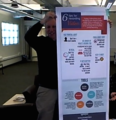
Recently, I shared a post about an infographic I created using Piktochart. The infographic is titled, "6 Tips for Recording Video" and I put it together really as an experiment with Piktochart. Well, today I was on a video call with some of my colleagues at CSU Channel Islands and Michael Berman said, "Hey, Michelle, look what we made!" He held up a giant poster of the infographic, which our Teaching and Learning Innovations team will display on the walls in the Faculty Innovations in Teaching (FIT) Studio on campus.What a great idea! The quality looks pretty good too, which was surprising. I just had to share!Here is the direct link to the graphic: https://magic.piktochart.com/output/4669055-5tipsandtoolsforrecordingvideo Below is the embedded version.
Michelle Pacansky-Brock
.
Blog
.
<span class='date ' tip=''><i class='icon-time'></i> Jul 16, 2015 10:08am</span>
|