Blogs
|
Are you outgrowing your webinar capacity? Do you need more flexibility, lower cost, and more control? Open source may be a great solution for you, particularly as solutions evolve and popular opensource learning solutions such as Moodle offer convenient and relatively easy-to-implement plug-ins. There are open source solutions for many organizational needs (college, university, association,
Susan Smith Nash
.
Blog
.
<span class='date ' tip=''><i class='icon-time'></i> Jul 16, 2015 10:19am</span>
|
|
Science Teaching with Moodle 2.0 addresses an urgent need. Teaching science as well as health courses can be a challenge in the average online course, due to specialized vocabulary, symbols and annotations, applied math, flow charts, graphics, and charts. For example, courses on organic chemistry, environmental science, earth sciences, zoology, anatomy, teen health, and more can be very dynamic
Susan Smith Nash
.
Blog
.
<span class='date ' tip=''><i class='icon-time'></i> Jul 16, 2015 10:18am</span>
|
|
© 2012 Bryan Mills, Flickr | CC-BY | via WylioMichael Berman (whom I am fortunate to work with at CSU Channel Islands) has been blogging about "LMS Futures," a topic he presented on at BbWorld in Las Vegas this month. For those of you unfamiliar with the term LMS, it stands for Learning Management System and refers to the application used by nearly all colleges and universities to administer and teach online/blended classes, as well as organize digital content for face-to-face classes (examples of the most popular LMSs include Blackboard, Desire2Learn and Moodle).The post Michael shared yesterday got me thinking more deeply about the "closed" nature of the LMS. When I say "closed," I am referring to the way the activity and content within an LMS is disconnected from the open web. I understand the development and adoption of the closed LMS is intertwined with compliance of FERPA policy. Yes, that's part of the conversation but, as we know, priorities guide change. And currently, there are important social shifts that are ignored when efficiency and compliance of policy become our guiding lights. I am writing this blog post in an effort to try to encourage awakening in those who use LMSs and may not be part of the usual conversation. And to understand that the act of implementing a closed LMS within an organization and constructing policies around it, as well as teaching within a closed LMS constructs a "mental model" about using social media that positions social technologies as threatening and bad. That, I believe, is the wrong direction for us to be headed as college educators situated on the brink of a new social era.Constructing and Reinforcing Mental Models A mental model refers to ideas, descriptions, and beliefs that guide one's actions. Mental models may exist within a broad culture, a company, or a broader organizational context (like higher education). Individuals are extremely committed to mental models, as they are guide us through our actions at an unconscious level. When mental models are challenged, one's first reaction is to act defensively. This is one reason why we must be critical of how the technologies used at a systemic level can foster status quo attitudes, which can become intensely difficult to change over time.Leading Through Change: Inspiring Awakening - by Michelle Pacansky-BrockCreated with Haiku Deck, presentation software that inspiresThrough my social media interactions, conference attendances, and presentations over the years, I have noticed a generalized difference in attitude between K12 and higher education educators on social media about teaching with social media (again, this is anecdotal). I blogged about this observation in 2011 after attending the annual CUE Conference, a large (and awesome) ed tech conference attended largely by a K12 audience. Essentially, over the years, in K12, there seems to have been rising consensus of teachers who demand access to social technologies for learning. While, in higher education, where more than 30% of students took at least one online class in 2013, the story is somewhat different.K12 leaders have advocated for access to social media for learning, arguing that, "Knowing how to build successful communities of learning and how to integrate social connectivity within a learning environment is a much more needed outcome than finding a way to control and monitor specific users and content." I wonder how this difference in attitude toward social media in K12 is informed by the lower LMS use. I realize FERPA is a big player in the conversation in higher education -- but, come on, in K12, we are dealing with users who are younger than the permitted age on the Terms of Use for the technologies being references. The point is, our actions are driven by our mental models.Closed for LearningImage by Michael BermanWhile there are many innovators in higher ed (whom I am grateful for and I learn from every day in my PLN), and there are colleges/universities that have made the jump to create social media guidelines that foster understanding and stress the value of openness, what I feel concerned about is how the mainstream integration of the closed-LMS system across higher education is constructing and enforcing a mental model in college and university faculty ("Here is your shell, go teach with it.") that undercuts values graduates need to succeed in the workplace today. According to a 2014 report from ECAR about LMSs in Higher Ed, 99% of higher education institutions report use of the LMS is ubiquitous. These values -- community, sharing, relationship building -- are the very values employers expect college graduates to have mastered and demonstrate within the workplace, which is becoming more and more social each year. "The social network is the new production line."The world has been deeply transformed by globalization and technology. As college graduates enter the workplace today, they are expected to demonstrate how they are unique from others and in what ways their contributions set themselves apart from others. One's digital footprint is an opportunity to do be one step ahead in life at graduation. And the continuous reliance on the closed-LMS environment continously constructs a mental model for faculty, instructional designers, administrators, all members of higher education that using social media is, in essence, the wrong thing to do. Moving forward, the mainstream use of closed LMS environments is creating yet another digital divide.As I discussed in an earlier post, Gartner predicts that by 2016 many large companies will begin to replace the use of phones and email with social networks. Ginni Rometty, the CEO of IBM, noted in 2013 that "the social network is the new production line." Value in the social era is cultivated around openness, collaboration, shared visions, and transparency. Individuals who demonstrate their ability to foster relationships through social technologies (which is very different from simply having accounts on or using social media) will be one step ahead of the rest.
Michelle Pacansky-Brock
.
Blog
.
<span class='date ' tip=''><i class='icon-time'></i> Jul 16, 2015 10:18am</span>
|
|
E-Learning Queen is excited to launch a new series of course plans, E-Learning Queen OpenPlans, that can be used / adapted / adopted for your use in creating e-learning and m-learning courses. A core goal is to facilitate continual process / quality improvement of elearning courses, programs, and content. For that reason, E-Learning Queen OpenPlans are most likely to be of interest to course
Susan Smith Nash
.
Blog
.
<span class='date ' tip=''><i class='icon-time'></i> Jul 16, 2015 10:18am</span>
|
|
Tackk.com/educationTeaching online in higher education requires most instructors to use an LMS (Learning Management System; i.e. Blackboard, Moodle, Desire2Learn, etc.). According to ECAR, 99% of higher education institutions report LMSs use as ubiquitous on campus. Understanding how an expensive LMS displays content on mobile devices (used more and more by students to access content -- as well as a huge opportunity increase interactions with and among our students) and ensuring the user experience of a course designed with an LMS is up to par with user experience created with free, more social, and easier-to-use technologies that are surfacing like wildfire these days in the edtech startup arena are important topics for higher education administrators, instructional designers, and faculty to remain aware of.I shared some of other thoughts LMSs in a recent post (to be fully transparent) and will reserve those for the moment, as my reality for today is the same as that of many other faculty -- I can use external tools but I also have to use an LMS. So, how the question becomes we bring these two worlds together in design that makes sense for our students? And, most importantly, what can the LMS community and edtech startup community learn from our experiences as educators? I hope this post will illuminate a few insights for both communities, as well as for faculty who share my own interests.Life as a Hacker TeacherOften we hear about new tools and their potential for learning. That may mean they create more visually engaging content than the content within our LMS, which can be flat and simply boring. It can also mean a tool could inspire new options for engaging with students including opportunities for content creation, which can be clunky and even down right impossible with some LMSs.But then there is the somewhat uncomfortable introductory moment...when you must figure out how to integrate that awesome new tool with your LMS in a way that creates a fluid experience for your students. If you can't do that, it's not worth it. And, to me, this can be the most difficult part. I often tell people, teaching with Blackboard has taught me some pretty impressive hacking skills.This week, I am experimenting with Tackk.com/education. I learned about Tackk after follwing the ISTE feed this year. There was much awesome chatter about it! Then yesterday, my good friend and colleague Anna Stirling shared a post on Facebook about it, which nudged me to take another look. It was enough to get me to spend the day exploring, thinking, and wanting to redesign much of my class.What I Learned:What I learned (view the 9-minute video above for a visual tour!):Tackk's user interface is simple and intuitive.Tackk offers cool features including a simple URL paste option for plugging in online videos and a nice RSVP feature that allowed me to ask my students if they're planning to attend my online orientation. The content items on a Tackk can be moved up or down with a simple arrow (similar to Blackboard's drag/drop feature).The overall design of a Tack is more coherent and visually appealing than content designed using Blackboard. I've tried for years to create content with Blackboard that is visually appealing and I have simply given up. I'm not a web designer and neither are more than 99% of college instructors. Creating content should be simple and intuitive, and it should look beautiful. Period.I also learned that the YouTube videos I have manually embedded into my Blackboard course do not render on either my iPad or iPhone. This was disappointing, to say the least, considering that the majority of my students own these devices (a fact I know because I've surveyed them for years). Each of my learning units includes a welcome video that I have taken the extra time to record and YouTube videos that demonstrate complex photographic processes. Does this gap prevent students from viewing the content? Or at the very least create a missed opportunity for reaching my students (that I wasn't even aware of)?The very same videos render beautifully in a Tackk embedded into Blackboard.While a Tackk can be embedded into Blackboard, there are only three embed code options provided by Tackk and the largest one is tiny. It does not render a visually appealing experience in Blackboard. I edited the HTML code (to 800 wide x 1200 tall) and it then it rendered well in both Firefox and on an iPad. Tack needs more embed options that play well with LMSs.The embed code created a scroll bar, which resulted a double scroll situation in Blackboard. This is a problem that also needs to be resolved.There is no option to add alt-tags to images in a Tackk. Alt-tags are critical additions when creating web-based content because they are read by screen readers (accessible devices used by blind students when navigated the web) and are a necessary element for creating accessible web content. This needs to be resolved on Tackk's end (and I would add, nearly all ed tech startup tools I experiment with).Moving forward This semester, I'm considering using Tackk for some of my content in my online class. I'd like to hear from Tackk about some of the suggestions I offered above to see if they could be implemented. Next semester, I'm considering having my students create visual learning journeys with Tackk. I think it's a promising learning tool!
Michelle Pacansky-Brock
.
Blog
.
<span class='date ' tip=''><i class='icon-time'></i> Jul 16, 2015 10:18am</span>
|
|
History Teaching with Moodle offers instructors, instructional designers, and SMEs a clear, step-by-step guide to building a medieval history course which can be used as a point of departure for online college classes, online history degree programs, in addition to secondary-level courses such as advanced placement for history. Author John Mannion uses attention-getting and engaging content
Susan Smith Nash
.
Blog
.
<span class='date ' tip=''><i class='icon-time'></i> Jul 16, 2015 10:18am</span>
|
|
An online faculty development offering for CSUCILast March, I was hired by CSU Channel Islands to support faculty with the exciting journey into online and blended teaching and learning. Between March and June, I worked furiously to develop a series of online courses for the small, creative, and entrepreneurial campus. If that sounds like an unsual way to describe a public institution of higher education, you're right. And that's one of the things I love so much about this institution -- and why I decided it was right for me to work here. :) It has a vibrancy and sense of curiosity about learning that makes me feel very at home.Risky BusinessMe Hanging Out with my CSUCI colleagues,Jill Leafsted and Michael McGarry.The simple fact that CSUCI was willing to hire me to work remotely to support faculty in this endeavor says a great deal. I know, I know -- how can hiring a remote employee have a "humanizing" effect? What am I, nuts?Well, on the one hand, it really makes a great deal of sense. One of my major tasks is developing online trainings, facilitating these trainings entirely remotely, supporting the vetting of emerging technologies for the campus, and working with faculty (which I do through asynchronous and synchronous technologies). For example, I participate in one-on-one and group meetings with my colleagues via Google+ Hangouts. This process has been an enriching learning experience on both sides, I believe, as many individuals on campus have had the opportunity to learn experientially about the humanizing effect of technology without being explicitly told that's what their learning.I don't want to come across as one who is advocating for the virtualization of brick-and-mortar campus employees. But I think there is something to be said about considering the option in certain scenarios when it makes sense. That requires a leader to do something against the grain of what's typical in higher ed tradition and that can be immensely difficult and scary. Roselind Torres would say this is a characteristic that defines a 21st century leader.The CoursesThe three courses I've developed for faculty are each two weeks long. We offered the first full series of the courses in the Spring (May-June), as I was developing the final course. The feedback has been extremely positive...but, yes, these are the early adopters so it's more likely to see positive reactions to online learning, in general.The courses include:How to Humanize Your Online ClassHow to Design Your Online CourseDesigning Engaging Online Activities EDUCAUSE Learning Initiative and we are discussing the possibility of offering the Humanizing course as an multi-week online session in May through ELI. Details will be shared as they come into focus!
Michelle Pacansky-Brock
.
Blog
.
<span class='date ' tip=''><i class='icon-time'></i> Jul 16, 2015 10:18am</span>
|
|
This OpenPlan will help you identify and develop the materials you need for training on equipment and processes. Fast-track development of technical training requires a very clear look at the "must-have" instructional elements as well as a very clear sense of learning objectives and outcomes.For example, let's say that you would like to be able to remotely monitor and even operate your oil and
Susan Smith Nash
.
Blog
.
<span class='date ' tip=''><i class='icon-time'></i> Jul 16, 2015 10:18am</span>
|
|
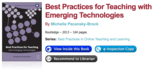
Routledge has made my book, Best Practices for Teaching with Emerging Technologies, available online for free through the month of August.Many other great books are also available to check out here also through the end of August.Enjoy!
Michelle Pacansky-Brock
.
Blog
.
<span class='date ' tip=''><i class='icon-time'></i> Jul 16, 2015 10:18am</span>
|
|
How do you value training when your core business is, in essence, built on and around new products and services that involve ongoing training? For example, what do you do if you provide hosting services, cloud hosting, webinars, or learning management systems?
It requires an entirely new way of looking at education in the organization. Training and education used to be the first budget items to
Susan Smith Nash
.
Blog
.
<span class='date ' tip=''><i class='icon-time'></i> Jul 16, 2015 10:18am</span>
|