Blogs
|
Five and a half years ago, I attended the first Sloan-C International Symposium for Emerging Technologies (ET4Online) in Carefree, Arizona. It was an awesome event -- I fondly recall the energy and conversations wrapped around hot new technologies like the Flip camera, Second Life, open educational resources, podcasting, and iTunes U. I shared my reflections in a blog post here.Since then, technologies sure have changed! That first event was actually before the release of the first iPhone. Who could have imagined how quickly hand held, internet connected computers equipped with collaborative, enticing apps would reshape the way so many of us communicate, the experience life, complete simple tasks, validate data, organize groups, document the world, and, of course, rearticulate who we collaborate with.I have attended every one of the six ET4Online symposiums and I am thrilled to be the Chair-Elect for the 7th Annual Sloan-C/MERLOT International Symposium for Emerging Technologies which will be held in Dallas, TX on April 9-11, 2010 at the Sheraton. The ET4Online Call For Proposals is now open until November 1st This date will not be extendedThe tracks for this year's conference include:Learning EnvironmentsOpen EducationEvidence-based LearningFaculty and Student DevelopmentInnovative Media and ToolsVisit the CFP site for more details! Whether you consider yourself a novice, intermediate or expert in this area, I hope to see you in Dallas. In the field of emerging technologies, there are so many opportunities for us all to learn from one another to understand how today's new technologies are impacting online teaching and learning.
Michelle Pacansky-Brock
.
Blog
.
<span class='date ' tip=''><i class='icon-time'></i> Jul 16, 2015 10:55am</span>
|
|
Welcome to a roundtable discussion with Tadeja Toppolnik, a teacher from a Slovenian school, OŠ dr Ivan Prijatelj Sodražica, which participated in a competition revolving responding to a book, Good Deeds Society, and thinking about how children and the community could collaborate in a good deeds society.What is your name, your position, and your involvement with your school?Tadeja Topolnik ,
Susan Smith Nash
.
Blog
.
<span class='date ' tip=''><i class='icon-time'></i> Jul 16, 2015 10:55am</span>
|
|
Hybrid learning can involve more than a blend of face-to-face and web-based courses. They can also involve mobile devices combined with traditional books -- for example, all-weather field notebooks, digital pens, and mobile devices with GPS. With that in mind, welcome to an interview with Ryan McDonald, "Rite in the Rain" All-Weather Writing paper, which can be used in conjunction with digital
Susan Smith Nash
.
Blog
.
<span class='date ' tip=''><i class='icon-time'></i> Jul 16, 2015 10:54am</span>
|
|
If you identify yourself as part of higher education, I expect you agree that preparing students for a successful job search is one of your priorities -- not the only one, but certainly one of them. Just like so many of aspects of life, looking for a job is an entirely different reality today than it was just a few years ago. And, no, I'm not referring to the economy in this post.More Companies Using Social Media The use of social media by Fortune 500 companies has increased significantly in recent years, leading to transformed relationships with customers and more transparent communications with leaderships. Use of corporate blogs increased from 16% to 38% by F500 companies from 2008-2013 (UMASS Dartmouth, 2013). In 2013, 77% of these companies had corporate Twitter accounts, 70% had Facebook accounts, 69% had YouTube accounts, 35% were present on Google+ (none had a presence a year ago), 9% had Four Square and Pinterests accounts, and 8% were using Instagram. Why is this important to college educators? Well, it's important to us because this sharp increase in the value of social media to major corporations is, first, reshaping many concepts that underpin our disciplines but, secondly, and more broadly, the increased use of social media identifies a need for college graduates to have a developed their own mastery of using these very same networks to build their own professional brand. Some of you may be thinking to yourself that this trend is very industry specific and, well, you have a point that certain industries are certainly different than others. For example, we all know that academics aren't going to be hired based upon their Twitter followers. But what I believe is so important and precious is the fragility of preserving the openness of where one is headed in life at graduation. To presume that one will thrive in a particular industry and ignore the opportunities of flourishing in others may be a missed treasure. I graduated with an undergraduate degree in Art...I'm still trying to figure out where I fit into this miraculous world (and loving every minute of it). Why Social Recruitment is on the RiseA recent survey of 1,600 human resources professionals by Jobvite found that 94% of recruiters use or plan to use social media in their search for new employees and 78% of them have hired at least one employee through social media. The survey revealed that Facebook, Twitter and LinkedIn are primary sources for locating talent; however, what's more interesting is how recruiters are learning from what they find online about prospective employees. By locating an individual with a particular skill set on LinkedIn, for example, a recruiter may further validate that individual's presentation, industry-related presence, overall expertise within a field, or even cultural fit by clicking over to her YouTube channel and viewing videos she has uploaded or examining the number of Twitter followers, as well as their own social worth within the particular field. Blogs provide deeper validation of an individual's writing ability, as well as one's ability to negotiate and interact with others who may leave comments that challenge the views represented in the post. All in all, social recruitment can provide much more context about a person's skillset and fit within a company than a resume. And in today's competitive job market, wouldn't you want to set yourself apart from others? That's not to say resumes are dead, however. Rachel Louise Ensign at the Wall Street Journal argues, "a paper resume can make or break a bid for a job" because hiring managers still want to review a resume on paper before meeting a candidate in person. Preparing our StudentsPerhaps, the question is, "What are the odds of getting that interview without a professional presence on social media?" And, more importantly, how is are experiences students have in college preparing students to cultivate this presence? Integrating social media into our teaching and learning landscape holistically fosters an effective and professional use of tools like Twitter, Facebook, blogs, even Pinterest is being used in college. Today LinkedIn shared the video below which lucidly points out simple ways students can build a presence on their site. I'm going to share this video with my students -- I hope you do too! And while you are at it, take a few moments to explore Pathbrite, another new, open, free ePortfolio site which provides robust integration services for those who are interested. Pathbrite is a great way to have students create ePortfolios for a class, program, or institution that are easily "taken with" students after graduation and even embedded directly into LinkedIn. I have my own Pathbrite ePortfolio embedded on my LinkedIn page. That's another way we can teach our students -- by leading by example. :) I would love to hear from some of you about how you and/or your institutions are preparing students for success in the social job search. Please share!
Michelle Pacansky-Brock
.
Blog
.
<span class='date ' tip=''><i class='icon-time'></i> Jul 16, 2015 10:54am</span>
|
|
Game-based e-learning for students in grades 4 through 8 is an effective way to teach health education. Wisconsin-based BlueKids.org is both popular and effective, and provides courses in injury prevention, wellness, self-esteem, drug education, and more. Welcome to an interview with Bridget Clementi, executive director of Children's Health Education Center. What is your name and your
Susan Smith Nash
.
Blog
.
<span class='date ' tip=''><i class='icon-time'></i> Jul 16, 2015 10:53am</span>
|
|
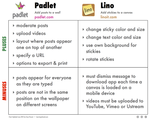
Communicate, Collect & Collaborate with Sticky Notes from Tony Vincent on Vimeo.I just viewed this excellent video by Tony Vincent (@TonyVincent) of Learning in Hand that explains the relevance of Padlet (formerly Wallwisher) and Lino, sticky note apps, in student learning. Padlet and Lino are both free apps, available for iOS and Android, that also work on standard web browsers, require an instructor account but do not require students to have accounts. Tony's 15-minute video is thorough, well-paced, easy-to-follow and a transcript is available here.Instructors use one of the apps to create a "wall" or "canvas" to which students individually (or in pre-designated colors for small groups) add sticky notes. The notes can include a simple word, a phrase or sentence, a link, an image, or video! With padlet, instructors have the option to moderate the sticky notes as they are submitted or allow them to appear synchronously.The collaboratively produced wall of sticky notes could reflect brainstorm results, responses to a critical inquiry prompt, links to resources about a topic, links to projects created by students (in Haiku Deck, Google Presentations/Slides, Slideshare, YouTube, etc.), a collection of images that represent a particular time period or event that could then serve as a visual backdrop for an introduction to a new course topic. Since laptops and mobile devices are supported with Lino and Padlet, there are lots of great ways these tools could activate classtime and, of course, they would be fabulous for blended and online learning, as well.Take 15-minutes to view Tony's video (above or here) and also check out the very, very helpful image below which compares the features of Padlet and Lino. Thanks, Tony, for the great resources!by Tony Vincent CC-BY-SA
Michelle Pacansky-Brock
.
Blog
.
<span class='date ' tip=''><i class='icon-time'></i> Jul 16, 2015 10:52am</span>
|
|
Welcome to an interview with Petra Zigon, journalist who writes for the largest magazine in Slovenia dedicated to a demographic that includes teen, tween, and pre-teen girls. Her work takes her to interesting places and conversations, where she finds out what the latest trends and beliefs are in the world of teens, tweens, and pre-teens.Hi Petra -- It is a pleasure to talk to you about your work
Susan Smith Nash
.
Blog
.
<span class='date ' tip=''><i class='icon-time'></i> Jul 16, 2015 10:52am</span>
|
|
To those of you who will be in or around the St. Louis area on Thursday, October 24-Friday, October 25, consider attending Focus on Teaching and Technology, a St. Louis regional conference held at the University of Missouri, St. Louis.I am grateful that the conference committee has selected me to keynote the event along with Amy Collier of Stanford University. My keynote is titled "Humanizing Learning with Emerging Technologies" and it will be followed by an advanced VoiceThread workshop, "Tips and Strategies for Flipping Your Classroom with VoiceThread." The two-day event is packed with fabulous sessions covering topics from infographics, GoAnimate, social media and FERPA compliance, using digital media in the ESL classroom, the flipped classroom and more! I am looking forward to connecting with the higher ed communication in St. Louis in October!Registration information is available on the website at:http://www.umsl.edu/services/ctl/fttc/index.html
Michelle Pacansky-Brock
.
Blog
.
<span class='date ' tip=''><i class='icon-time'></i> Jul 16, 2015 10:51am</span>
|
|
Having to use a costly and hard to manage learning management system creates a barrier for many would-be online instructors. Gregor Gimmy of Sclipo.com has worked to overcome that barrier, and has also recognized it is often difficult to incorporate web 2.0 functionality. So, he developed Sclipo, in response to the need, and the fact that social networks for education have grown in size and
Susan Smith Nash
.
Blog
.
<span class='date ' tip=''><i class='icon-time'></i> Jul 16, 2015 10:50am</span>
|
|
I am honored and excited to be selected to present this free Inside Higher Ed webinar on October 9th, brought to you by Academic Partnerships. It will be packed with tips and strategies from my book Best Practices for Teaching with Emerging Technologies and my new eBook, How to Humanize Your Online Class with VoiceThread (Nook). The foundation of the presentation will be the voices of my very own online students. Wednesday, October 9th12:00pm PDT-1:00pm PDT / 3:00pm EDT-4:00pm EDTfree Click here to register: https://events-na3.adobeconnect.com/content/connect/c1/1002564123/en/events/event/shared/default_template/event_registration.html?sco-id=1234175794Humans are social beings and learning is a social process. Both require interaction and connection to flourish. Do these factors undermine the effectiveness of an online class or strengthen it? In our digital, mobile society are discussion forums still the most effective tool for student-student interactions? In this webinar, Michelle Pacansky-Brock will share examples of what students identify as valuable characteristics of a "humanized" online class and identify key tips and strategies for harnessing the potential of emerging technologies to make your online class personal, meaningful, and memorable.The webinar is part of the Inside Higher Ed webinar series and is brought to you by Academic Partnerships, as part of the free professional development Micro MOOC, Human Element Micro-MOOC, Human Element: An Essential Online Course Component, being delivered via the Canvas Network.
Michelle Pacansky-Brock
.
Blog
.
<span class='date ' tip=''><i class='icon-time'></i> Jul 16, 2015 10:49am</span>
|