Blogs
|
Learnteria aims to reduce wasteful edtech spending in the PreK-12 space by launching a Yelp-like review platform for educators and parents.
At launch Learnteria enlists 300,000 products and services from over 1000 vendors. Educators and parents are invited to not only rate but also suggest edtech products they use and recommend.
New 'Yelp for Educators' Launches - Learnteria Lets Teachers and Parents Be the Judge of PreK-12 Resources that Work (and those that Don't!)
A true world's first, Learnteria uncovers proven resources, products and services - spanning everything an educator or parent may spend time or money on - with unbiased feedback from those who have used them.
Lessening the strain on the $700 billion annual education budget, Learnteria contains listings in nearly 10,000 categories on everything from playground equipment and field trip locations to camps, consultants, food vendors, enrollment software and thousands of other resources that educators use each and every day. The site's founders are now calling for action: asking educators and parents to leave feedback, suggest new listings and ultimately equip their students and children with the best possible tools for success.
WASHINGTON, March 17, 2015 /PRNewswire/ -- $700BN is spent every single year on PreK-12 students alone, but how much of it goes to waste? There is no way to sugarcoat the facts: America's children suffer at the hands of an over-crowded resource market that rarely allows educators and policy makers to purchase the best products and services for student success.
In an effort to arm educators with the knowledge they need to select only the best products, services and resources for their students, a team of former educators and industry executives are launching the world's first 'Yelp-style' resource for the education community, with massive scope and interactivity. It's called Learnteria - and it's poised to change how educators' allocate funds and thus how children learn.
Just as a person would jump onto Yelp or TripAdvisor to get ratings for hotels and restaurants for their upcoming vacation, educators and parents can now turn to Learnteria for ratings, and unbiased information on the resources they use every day. Just like the aforementioned sites, Learnteria is a community built by and for its users, and the company are actively calling on all educators and parents to get involved - not only by providing ratings, but suggesting the products and services they'd like to see listed.
"We already have over one thousand vendors on board that produce a whopping 300,000 listings, covering a huge gamut, including school/classroom products, professional training courses, school bus providers, food vendors, apps and even study materials such as poets and novels," explains Erick Watt-Udogu, Founder and President of Learnteria, whose company is in DC's 1776 incubator and graduated from Tallwave's High Tide accelerator in Scottsdale, AZ . "Our plan is to build the community to contain literally every resource an educator would come into contact with during their career - both in terms of tangible products and features of their actual curriculums."
Continuing, "Users can add star ratings to resources and use the site's intuitive search technology to find what they need, at the caliber required to ensure that it is both going to work and provides excellent value for their time and money."
Learnteria was designed from the ground up to be used by a wide range of education professionals such as teachers, administrators, athletic coaches, nutrition experts and even top-level policy makers.
"Our goal is to help the whole student, and Learnteria's mandate is to take an interest in all of the ways that parents and educators spend time and money. Every dollar and every moment contributes to students' experience and success and, the more wisely it is spent, the better students will perform. Right now, the education resource marketplace is flooded, leaving time-strapped educators and parents unable to dive deep into possible resources, in a single location, to find ones that really work. Learnteria will make the process easy and provide real-world feedback. Now, if a teacher needs something, they will be able to discover the most proven resource in minutes and provide their students with an education far above the national average. Then, they can rate/review it so others can do the same," Watt-Udogu adds.
All educators and interested parents are urged to sign up today, get reviewing and actively suggesting the listings they want to see.
For more information, visit: https://learnteria.com.
Blog: http://Learnteria.tumblr.com/
LinkedIn: http://www.linkedin.com/company/Learnteria
Facebook: http://www.facebook.com/Learnteria
Twitter: http://www.twitter.com/Learnteria
About Learnteria:
Learnteria is a first-of-its kind tool that allows educators to research, rate and review the educational resources they use every day. On Learnteria, Educational Resource Consumers can find big companies and small non-profits, playwrights and scientists, field trip destinations, competitions, athletic equipment, conferences, technology and more. Learnteria is designed to make decision making easier by compiling resources in a single location with feedback from fellow educators.
Contact: Erick Watt-Udogu / 888-930-8504 x 700 / Erick.Watt-Udogu@learnteria.com
SOURCE Learnteria
RELATED LINKS
http://learnteria.com
Edukwest
.
Blog
.
<span class='date ' tip=''><i class='icon-time'></i> Jul 16, 2015 01:46pm</span>
|
|
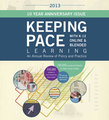
Keeping Pace with K-12 Online Learning: An Annual Review of Policy and Practice (2013) is the 10th in a series of annual reports that began in 2004 that examine the status of K-12 online education across the country. The report provides an overview of the latest policies, practices, and trends affecting online learning programs across all 50 states.
Keeping Pace is researched and published as a service to the educational and governmental communities. Distribution of the report and graphics for presentations are free.
Download the full 2013 report
Download the Planning for Quality Booklet
Jason Rhode
.
Blog
.
<span class='date ' tip=''><i class='icon-time'></i> Jul 16, 2015 01:44pm</span>
|
|
On episode 013 of Meet Education Project, 4.0 Schools founder Matt Candler joins the program to talk about developing new school models, school choice, the importance of people over experience, and the passion for moving education forward in New Orleans and around the world. Don’t miss it!
Mr. Candler, a veteran of the charter school movement is Founder of 4.0 Schools. After teaching and coaching middle school after college, Matt returned to his hometown to help run the main operations center for the 1996 Atlanta Olympics. After the Games he studied decision sciences and the emerging charter sector at the Kellogg School of Management. He then served as founding co-principal of a K-8 charter school in North Carolina and helped launch other charter schools in the Southeast.
See Matt’s TEDxTU talk here:
From 2001 to 2004, Matt served as KIPP Foundation’s Vice President of School Development, where his team established 37 new schools across the U.S. Matt later served as founding COO of the New York City Center for Charter School Excellence, a $41 million effort to promote quality charter school creation. Most recently, Matt servedNew Schools for New Orleans as its first CEO and built a team whose human capital and school creation efforts have led to the most innovative and aggressive public school reforms in the nation. Matt continues to play an active role in Louisiana reform as chairman of the Louisiana Association of Public Charter Schools and co-founder of the city-wide teacher support community closingthenolagap.org.
Getting in touch with Matt:
@mcandler
mcandler@4pt0.org
Shout Outs:
Center for Charter School Excellence
Brickolage - Re-imagining public education in New Orleans.
Maker State - MakerState empowers kids with real-world skills for college and career success through hands-on learning in science, technology, engineering, arts and math masteries. Started by Josh Densen.
Fantasy GeoPolitics - Started by Eric Nelson, the social learning game that follows countries and world leaders as they compete for news headlines.
M School
Robbie Vitrano - IDEA Village, Trumpet, & Naked Pizza Founder
New Schools for New Orleans
Book: The Same Thing Over & Over by Frederick Hess
If you could have dinner with one person you admire, who would it be and why?
Main: Elon Musk
Supporting: Sal Khan, Angela Duckworth, Dave Lewin
For more episodes featuring thought leaders in education visit MeetEducationProject.com, subscribe to the podcast on iTunes and follow Nick DiNardo on Twitter.
Edukwest
.
Blog
.
<span class='date ' tip=''><i class='icon-time'></i> Jul 16, 2015 01:44pm</span>
|
|
"Grade Change: Tracking Online Education in the United States, 2013″
This is the 11th annual report on the state of online learning in U.S. higher education from the Babson Survey Research Group, Pearson and the Sloan Consortium:
Is Online Learning Strategic?
Are Learning Outcomes in Online Comparable to Face-to-Face Learning?
How Many Students are Learning Online?
How are Massive Open Online Courses (MOOCs) faring?
And much more…
This survey also reveals that in 2013:
7.1 million higher education students are taking at least one online course.
The 6.1 % growth rate represents over 400,000 additional students taking at least one online course.
The percent of academic leaders rating the learning outcomes in online education as the same or superior to those as in face-to-face instruction, grew from 57% in 2003 to 74% in 2013.
The number of students taking at least one online course continued to grow at a rate far in excess of overall enrollments, but the rate was the lowest in a decade.
FREE REPORT DOWNLOAD
Jason Rhode
.
Blog
.
<span class='date ' tip=''><i class='icon-time'></i> Jul 16, 2015 01:44pm</span>
|
|
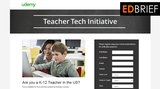
Global education marketplace Udemy announced the launch of its Teacher Tech Initiative at the fifth annual White House Science Fair. Through the initiative K-12 teachers in the United States get access to free and heavily discounted computer technology courses on the platform.
The Teacher Tech Initiative will focus on high demand job skills, like programming and web development, fields in which Udemy has a strong track record. According to Udemy, only one in ten US public schools currently offers programming courses due to the lack of trained teachers.
The first 1000 teachers who sign up for the Teacher Tech Initiative will get access to free courses. All K-12 teachers based in the United States will have access to a selection of heavily discounted courses that come at a price of $10 each throughout 2015, which translates into an investment of around $5 million by Udemy.
Further Reading
Udemy launches Teacher Tech Initiative to bring critical web development skills to K-12 teachers | Press Release
Udemy’s Teacher Tech Initiative | Udemy Blog
Links
info.udemy.com/teachertechinitiative.html
Edukwest
.
Blog
.
<span class='date ' tip=''><i class='icon-time'></i> Jul 16, 2015 01:44pm</span>
|
|
In the decade now that I have spent supporting educators in the endeavors to teach using technology, I have lost count of the number of times I’ve been asked by faculty for advice on how to choose the best technology tools for their teaching. With the seemingly endless selection of technology tools available, how do educators choose the right technology tools to incorporate into their teaching? If you are in the situation of considering a new technology tool in your teaching, here are 7 steps to take as you choose which tool may be best for you:
Step 1: Start with your objectives
It’s important to always start any conversation about technology selection with objectives. What is it that you and/or your students should be able to do? There are some great models available, such as Digital Bloom’s Taxonomy and SAMR, that can offer guidance as your craft and/or revise objectives that will form the basis for any decisions regarding technology decisions. Are you seeking to substitute, augment, modify, or redefine an existing teaching or learning activity? Make sure that it is clear from reviewing your objectives what your intended goals are.
Step 2: Survey your "tech landscape"
Once you have your goals and objectives clearly in mind, the next step is to take an inventory of your current technology use as well as look at your environment for incorporating the new technology. What tools are you and/or your students already using? What are you comfortable with? What is working? Keep in mind the adaage, "If it’s not broke, don’t fix it" and don’t discard an existing technology if it is the meeting your needs. What tools are already at your fingertips and/or perhaps provided/supported by your institution? What tools are frowned upon and/or blocked at your institution?
Step 3: Set your budget
How much are you and/or your students willing to spend on a tool? Do you need to stick with a free solution? Or, are you able to spend some money? Many tools take a "freemium" approach, meaning that they are available for use on a limited basis for free with additional features available for a fee.
Step 4: Sample available tools
Pick a few (5 or less) available options and try the tools yourself to see which you and/or your students like best, are easiest to use, and meet your needs. What are the pros & cons of each? What support is available? How does each integrate into the existing workflow and/or lesson?
Step 5: Select your tool
Eventually, you finally need to take the plunge and pick a tool to use. Don’t worry..you aren’t stuck using the tool forever If you eventually change your mind down the road, you can always change the tool.
Step 6: Set parameters for use
Clarify for yourself and/or your students how the tool will and won’t be used. It’s at this point you may want to revisit your objectives to ensure that your plan for use meets your stated learning objectives. Are you using the right tool for the right problem?
Step 7: Scrutinize your choice
After you’ve thoroughly used the tool for a specified period of time (term, semester, etc.) reflect on your use of the tool? Did it meet your needs? What unexpected issues did you and/or your students encounter? Is it working well enough that you want to stick with it, or is it time to try something else? You’re not locked-in to continuing to use the tool if it isn’t meeting your needs.
There you have it…a seven-step approach to selecting a technology tool for your teaching. Leave a comment if you found these steps helpful or if you perhaps have additional suggestions to share with educators as they choose technology tools.
Jason Rhode
.
Blog
.
<span class='date ' tip=''><i class='icon-time'></i> Jul 16, 2015 01:44pm</span>
|
|
Courtesy e-Learning Infographics
Jason Rhode
.
Blog
.
<span class='date ' tip=''><i class='icon-time'></i> Jul 16, 2015 01:43pm</span>
|
|
The Internet increasingly establishes the need for instant gratification. Information that used to take time to source and process is now available 24/7 and this basically anywhere we have connectivity. This new mindset also affects how we want to learn new skills like languages, coding, cooking, you name it.
Startups like Coursmos tackle this need by drastically reducing the time to learn new things by boiling content down to its essentials and presenting it in bite-sized learning units.
Introduce your startup and give a short description of what you are doing.
Coursmos is a micro-learning platform. Microlearning is a bite-sized education process for people that get easily distracted. Microlearning is not just about shorter courses. It’s about micro-courses where each micro-lesson has a message, completed idea or piece of knowledge. Courses are divided into categories for easy browsing, with sections running the gamut from art to cooking to computer to handicraft to health to work and business.
Who are the founders, how did you meet, what are your different roles in the startup.
Roman Kostochka, founder and CEO;
Katerina Seledets, COO;
Igor Gonednyy, Head of Business Development;
Slava Grachev, CTO
Roman met with Katerina when she was working at Ukraine/USA Business Incubator Happy Farm. Slava met with Roma in 2013 and joined Coursmos as CTO. Igor was Head of Business Development at LinguaLeo, a personal service for learning English online with more than 11,5M users.
How was the idea for your startup born?
In May 2013 we applied for Ukraine/USA business incubator Happy Farm with an EdTech project ‘Razmir’, we’d raised $500K for before. For that stage we’d started to develop monetisation and took the decision to go global.
During the process of the idea development, company scaling and communication process with Silicon Valley experts, we came up with the idea of a micro-learning format. As a part of ‘Razmir’ this new idea was hardly possible to perform — the offline part of ‘Razmir’ was not suited for micro-learning format. So we took decision to make a pivot as we saw great potential in micro-learning. This was in June 2013, also at this time I persuaded one of the business angels who has invested in ‘Razmir’ to support the new idea. Actually, it took me a call and in the end we had raised $80K. Then, we started over and registered a new company.
On the 1st of August later this year we started the product development and on the 1st of September we launched an iOS application called Coursmos, which allowed every user to get access to the first micro-courses. And this is how the Coursmos story began. Today we have an Android application, a web version, 14 000 micro-courses and more than 520 000 learners all over the world.
What is the main problem in education that you aim to solve.
Only 4% of students finish the online courses they signed up for, says Coursera. According to a YouTube study tracking average time spent watching a YouTube video, this time is somewhere between 1:04 and 2:43. We at Coursmos solve the problem of shrinking attention spans and decreasing motivation. At Coursmos courses consist of bite-sized lessons of up to 3 minutes each. Our statistics show, that over 60% of students finish a lesson, and over 30% a course.
Who are your main competitors? What sets you apart from them?
Udemy
Udemy.com is a platform or marketplace for online learning. Unlike academic MOOC programs driven by traditional collegiate coursework, Udemy provides a platform for experts of any kind to create courses. Over 6 000 000 students and 20 000+ courses. The top 10 instructors on Udemy earned $1,7M last year.
Lynda
lynda.com, Inc., is a privately held online education company offering thousands of video courses in software, creative and business skills. Founded in 1995, the company produces video tutorials taught by industry experts; there are 6 000 000 users. Lynda has raised $186M recently.
YouTube
YouTube is a video-sharing website headquartered in San Bruno, California. The service was created by three former PayPal employees in February 2005. In November 2006, it was bought by Google for US$1.65 billion. Over 5M people that created educational videos which have over 400M viewers
Coursera
Coursera is a for-profit educational technology company founded by computer science professors Andrew Ng and Daphne Koller from Stanford University that offers massive open online courses.
The Global E-Learning Market is $90B with 23% annual growth. Our competitive advantage is that we offer an effective micro format for quick assimilation of knowledges that results in high motivation and nice traction. We offer micro-courses created via our mobile app and the web, and we allow users to create their own educational environment. Also, Coursmos offers a corporate solution which allows companies to create educational micro-courses and train employees at any time convenient for them through through this effective format.
In which markets / regions are you active. What markets / regions are next.
Our strongests markets are the USA, the UK, Russia, India and Brazil. We plan to launch in LatAm market soon.
Who is your target audience.
In our online education micro-learning marketplace, the primary users are English-speaking students who want to gain some knowledge fast and people who want to share their knowledge, the secondary users are people searching for something interesting they could implement on a daily basis.
How do you engage with your target audience. How do you convert them into users of your product.
An author creates a micro-course that consists of bite-sized lessons and attracts users who in turn learn. In case deeper understanding of a subject or any additional information is needed, a learner makes a specific request for a new micro-course. The request goes to authors who have relevant knowledge and also goes to a requests’ catalog, which is inherently a tool for gathering and analyzing demand in the education market
Each author on the platform gets requests for new micro-courses from his or her students to get specific knowledge, provided an author meets the demand. These new micro-courses become available to the student who has requested it. Moreover, the micro-course is placed on the Coursmos platform, where every internet user has the ability to find it and learn.
Based on this process of non-stop creation and providing unique and relevant educational content, a host of new learners and authors populates the platform and micro-communities are established around each topic. As a direct result of Coursmos’ viral tools, like our request tool, social sharing and comments within each micro-community evolves and expands globally.
What is your business model. How much does your product / service cost.
On Coursmos an author has the option to make any course free or paid. On the other hand, students or users can buy a single course for the price set by author or subscribe for premium membership on Coursmos, which allows her to watch any course including premium without limits. Coursmos earns a 40% share from the total revenue generated both ways, giving 60% to authors.
There is an option for authors or companies to create their own schools on Coursmos, which gives authors additional advertising opportunities alongside with a list of wider features. We are looking forward to providing this opportunity on a freemium/paid subscription basis.
Also, we provide a corporate learning solution. Our SaaS solution is designed to implement micro-learning formats into a corporate structure. It takes the effectiveness of staff learning and developing to the next level.
If you raised funding, how much did you raise. Who are your investors. If not, are you planning to raise funding.
$1.3 in seed from business-angels, Imperious Group and Altera Capital
Are there milestones you are especially proud of and would like to share.
Coursmos is a global micro-learning platform:
with more that 15 000 micro-courses
with more than 50 000 micro-lessons
with more than 560 000 users and 6 000 authors
with strongest markets in the USA, the UK, Russia, India and Brazil
where 60% of students finish the first micro-lesson, and 30% of students finish a micro-course
where users spend 6 min on average, and 22% spend 11-30 min
with 47% users coming from mobile
We've already launched iOs and Android apps, a recommendation system which includes an expert system, and a request tool to provide learners with relevant micro-courses and an opportunity to get any micro-course they want.
What are the next steps in growing your startup.
At Coursmos we intend to gather all knowledge and provide access to every learner who seeks the opportunity of self and career growth. We build a global billion company with a product available worldwide.
How can people get in touch with you.
pr@coursmos.com;
coursmos.com;
CEO Roman Kostochka https://www.facebook.com/2beness
Edukwest
.
Blog
.
<span class='date ' tip=''><i class='icon-time'></i> Jul 16, 2015 01:43pm</span>
|
|
Courtesy e-Learning Infographics
Jason Rhode
.
Blog
.
<span class='date ' tip=''><i class='icon-time'></i> Jul 16, 2015 01:42pm</span>
|
|
Don Burton, former Managing Director of the Kaplan/Techstars EdTech Accelerator, and Jonathan D. Harber, co-founder and CEO of Schoolnet, teamed up to launch a new edtech accelerator program in New York.
EDGE Accelerator will host its first cohort in September 2015. The accelerator offers a three-month intensive program with mentoring from edtech CEOs, investors and education publishers. Each of the ten selected edtech startups will receive $170.000 in funding in return for 6% equity.
Applications are open immediately, the final selections will conclude end of June.
Further Reading
EDGE Edtech® Launches Accelerator in New York City for Education Technology Start-Ups, Offering $170,000 in Funding to Ten Selected Companies | PR Newswire
Links
edgeedtech.com
Edukwest
.
Blog
.
<span class='date ' tip=''><i class='icon-time'></i> Jul 16, 2015 01:41pm</span>
|