Blogs
|
According to a report from McGraw-Hill Education, the use of mobile devices for studying was on the rise in 2013 and 2014. 81% of the 1,700 college students surveyed used mobile devices like smartphones and tablets making them the second popular choice behind laptops.
Overall adoption of mobile devices for studying has seen a 40% year-over-year growth. Students find that technology helps them to save time and to be better prepared for classes. Overall, 77% of students say that the use of technology has positively impacted their grades.
Further Reading
Report: New McGraw-Hill Education Research Finds More than 80 Percent of Students Use Mobile Technology to Study | PR Newswire
Picture License Some rights reserved by francisco_osorio
Edukwest
.
Blog
.
<span class='date ' tip=''><i class='icon-time'></i> Jul 16, 2015 01:49pm</span>
|
|
Accredible, an edtech startup that tracks learning behaviour and performance, announced a partnership with Udacity to power its new professional profiles and nanodegrees.
Launched in October last year, nanodegrees are created to offer a compact and relevant education towards high demand tech jobs.
Udacity raised a $35 million Series C in September to double down on its new certification program.
Learners who start a nanodegree will now automatically create an evidence portfolio, which is then populated with learning related data. Learners can also upload extra examples and share their portfolios with recruiters or via LinkedIn.
Accredible offers institutions different ways of integrating their certification process, from WordPress and Moodle plugins over spreadsheet uploads to an API. Students can also upload pdf versions of older certificates which are then added by Accredible to their profiles.
Further Reading
Introducing Udacity Professional Profiles Powered by Accredible | Press Release
Accredible Partners With Udacity To Provide Context To Nanodegrees | TechCrunch
Related
Sebastian Thrun raises $35 million Series C for Udacity’s nanodegrees | EDUKWEST
Links
accredible.com
Edukwest
.
Blog
.
<span class='date ' tip=''><i class='icon-time'></i> Jul 16, 2015 01:49pm</span>
|
|
I was extremely honored and humbled to have been nominated and chosen as one of six inaugural recipients of Blackboard’s annual Key to the Community Award, which recognizes outstanding service to the Blackboard client community. I accepted the award at BbWorld13. The Blackboard client community truly is a collaborative and supportive network of colleagues and it’s my pleasure to continue to be a part.
Jason Rhode
.
Blog
.
<span class='date ' tip=''><i class='icon-time'></i> Jul 16, 2015 01:49pm</span>
|
|
Instructure Canvas and Pearson announced a bi-directional integration of the Instructure Canvas LMS with the Pearson PowerSchool SIS. According to Instructure’s Mitch Benson, this feature was the most requested by Canvas’ K-12 customers.
PowerSchool is the most widely used student information system with more than 30% of U.S. school districts using the product, reaching over 130 million students. The integration takes effect immediately. Schools that don’t use Canvas LMS can also easily set up an account using the data stored in PowerSchool.
Instructure raised a $40 million Series E last month in preparation of its IPO later this year, and launched a corporate learning and engagement platform called Bridge. Since its launch in 2011, Instructure’s Canvas LMS has been used by over 18 million students and teachers from more than 1,200 universities, colleges and K-12 school districts across the globe.
Further Reading
Instructure and Pearson Join Forces to Integrate Learning Management with Student Information System | Press Release
Related Links
EDBRIEF: Instructure raises $40 million Series E | EDUKWEST
Edukwest
.
Blog
.
<span class='date ' tip=''><i class='icon-time'></i> Jul 16, 2015 01:49pm</span>
|
|
Instructure and Pearson announced an interesting partnership at SXSWedu. The bi-directional integration of the Canvas LMS and the PowerSchool SIS is a strong statement by itself, but if we add the fact that Pearson is planning to sell its Student Information System business it gets really intriguing.
In early February there were rumors that no other than Blackboard was in final talks with Pearson to purchase PowerSchool. EdSurge’s Tony Wang has been following the rumors and posted details about the process of splitting the SIS business into a standalone unit before the sale.
Now, why would Instructure push for such a deep integration in such an uncertain phase of PowerSchool? Sure, having access to 30% of U.S. school districts that can now create Canvas accounts with a click of a button is surely one reason, but I guess there is more to it.
As mentioned Instructure is planning its IPO for later this year. If Pearson put off its pursuit of a sale for a couple of months, Instructure might just have enough cash to make a power grab, throwing the literal hammer (or flamethrower) in the face of its arch enemy Blackboard.
https://www.youtube.com/watch?v=dCIP3x5mFmw
Further Reading
EDBRIEF: Instructure and Pearson announce Partnership | EDUKWEST
Blackboard Flirts with Buying Pearson’s PowerSchool | EdSurge
Why Pearson Wants to Sell PowerSchool | EdSurge
Edukwest
.
Blog
.
<span class='date ' tip=''><i class='icon-time'></i> Jul 16, 2015 01:48pm</span>
|
|
Few current educational technology innovations have received the attention of Massive Open Online Courses (MOOCs). However, most of the discourse is philosophical and hypothetical. So how does designing and delivering a MOOC actually work? This fall, NIU offered its first MOOC titled "Perspectives on Disability." In this session at the 2013 SLATE Conference, my colleagues Stephanie Richter, Tracy Miller, and I shared the unique collaborative process we followed to design and develop the MOOC, including recommendations for other institutions beginning their MOOC journey. We will also discussed how we worked with Blackboard CourseSites to deliver the course. Slides are available here.
Thinking of designing a MOOC? Find more tips for designing a massive open online course here.
Jason Rhode
.
Blog
.
<span class='date ' tip=''><i class='icon-time'></i> Jul 16, 2015 01:48pm</span>
|
|
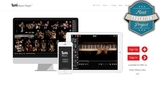
On episode 012 of Meet Education Project, Tutti Dynamics co-founder Kristen McEntyre joins the program to talk about music/arts education, the importance of experiential learning, and the vibrant ed tech entrepreneurship scene in New Orleans. Don’t miss it!
Kristen McEntyre has twelve years experience in media and technology. Previously, Kristen managed content creation and online community building strategies at FiLife, a joint-venture between Dow Jones and IAC. She also spent a summer at Google News helping to develop their news commenting product and worked at PBS as Production Coordinator on an Emmy-winning music series. Kristen started her career in finance as a technology investment banker at Roberston Stephens and Senior Consulting Associate at Cambridge Associates. She was awarded the Melville Jacoby Fellowship for graduate studies at Stanford University where she studied Digital Media & Entrepreneurship at the Journalism Program and Graduate School of Business. She is also a graduate of Williams College where she was Captain of the Women’s Lacrosse Team. Kristen plays the piano.
Shout outs:
More information on Tutti Dynamics - @tuttidynamics
*NOTE: You’ll be able to see the Tutti Player in action right from the home page!
Idea Village - @ideavillage - @robbievitrano
4.0 Schools - @4pt0schools - @mcandler
Propeller - @gopropeller
@DarrenHoffman - Co-Founder of Tutti Dynamics
Ed Tech Meetup New Orleans
If you could have dinner with one person you admire, who would it be and why?
@CoryBooker
For more episodes featuring thought leaders in education visit MeetEducationProject.com, subscribe to the podcast on iTunes and follow Nick DiNardo on Twitter.
Edukwest
.
Blog
.
<span class='date ' tip=''><i class='icon-time'></i> Jul 16, 2015 01:48pm</span>
|
|
As I often require my students to include working hyperlinks as part of the discussion, blog, or other assignments in Blackboard, here are the simple steps that I have compiled and shared with my students for creating a working hyperlink to any discussion, blog, etc. using the "Create/Edit" link in the visual text box editor).
Step 1: Highlight the text you want to make a working hyperlink
Step 2: Click the "Insert/Edit Link" button
Step 3: Copy/paste the URL for your link
Step 4: Select "Open in New Window (_blank)" from the "Target" drop-down
Step 5: Click the "Insert" button
Step 6: Click the "Submit" button (if a discussion post) or
Step 7: Test your hyperlink to make sure it works, clicking on the link you created to ensure that it opens as desired in a new window
As a matter of best practice, it’s always a good idea to make hyperlinks you add to Blackboard to open in a new window, as it will be easier for your users to view the website shared on either their computer or mobile device.
Jason Rhode
.
Blog
.
<span class='date ' tip=''><i class='icon-time'></i> Jul 16, 2015 01:48pm</span>
|
|
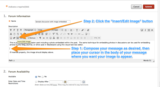
For several assignments in my online course, I require my students to embed image(s) into their postings in Blackboard. Below are the steps I’ve outlined for how to post a photo so it is embedded (ie: viewed in line with the text of your discussion post).
Step 1: Compose your message as desired, then place your cursor in the body of your message where you want your image to appear.
Step 2: Click the "Insert/Edit Image" button.
Step 3: Click the "Browse My Computer" button and locate the image on your computer that you wish to embed.
Step 4: Enter "Image Description" and "Title"
Step 5: Click the "Insert" button
Step 6: Click the "Submit" button (if discussion) or "Post Entry Button" (if journal or blog)
The photo you selected should be displayed where you cursor was located in your post.
Step 7: View your post to ensure that photo is embedded where desired
Whenever you are asked to post a photo in Blackboard, it’s always preferred that you embed the photo as described above instead of attaching otherwise.
Jason Rhode
.
Blog
.
<span class='date ' tip=''><i class='icon-time'></i> Jul 16, 2015 01:48pm</span>
|
|
We know that radical innovation and massive disruption is under way in higher education. Everything in the sector seems extreme. Whether it is new products, regulation, the rates of closure by traditional and some proprietary schools, or the rates of growth at others like Liberty and Southern New Hampshire, each week seemingly brings a new trend and meaningful change. Nationally speaking, demand is flat while capacity is skyrocketing and with every turn we have more technology and increased costs. Everything is in flux like never before.
Understanding the drivers of that flux, and the additional circumstances that will manifest in the near term, is critical to building a relevant road map for the future. The innovation required to compete will be radical and the finish line seems exciting. But we must first take a hard look at the realities facing us today and tomorrow so that we can effectively dream the big and bold dreams required for the future and beyond.
What follows below is a brief outline of seven critical realities all of us in higher education will operate against as we move forward on an uncharted path.
1) There will be 25 million Virtual Reality Head Mounted Displays (HMD’s) in market by 2018
Seemingly coming from nowhere, 25 million low cost consumer headsets will appear in 3 years. They will be relatively cheap and mainstream and connect to a phone and gaming system. The clock is ticking for you and your organization to be able to realize this opportunity. But wait, there is more! Those 25 million could still be considered "early adopters" and will lead to a tidal wave of adoption through the early 2020’s. This is far from being a situation where technology would be shipped to students who would be unfamiliar with it and consider it foreign and awkward in a school setting. Rather, kids will be walking into classrooms over the next 5-7 years who already plug Oculus into an Xbox daily, and have done so for some time. Twenty five million HMD’s and a generation coming fast that will grow up gaming in VR thanks to Facebook, and others.
2) The current traditional model has put thousands of schools on an unsustainable path
The 1 trillion dollars in collective student loan debt is a crushing burden and students will begin seeking alternative paths. Top tier research schools will continue to dominate one end of the market, but tuition (title IV) funded traditional liberal arts schools are increasingly becoming a quaint and old fashioned business model the country no longer has the luxury of affording, and students lack the interest they once did in attending. We overbuilt capacity, prices are starting fall, and demand is moving away. The number of students attending college has remained at around 20 million for several years in a row, yet schools are madly building new classrooms, both physical and digital. Whether or not you call it a bubble, when you have too much supply and artificially high prices, you have a market that will have to clear. The economics of the situation leave it no other choice.
3) Student Acquisition has not changed meaningfully in 20 years.
There are about 7,200 post secondary institutions in the country today, and roughly 100 of them have little to no need to invest in marketing as their reputations do all the talking. So let's talk about the other 7,100.
Most of the growth and development in higher education marketing has been of the digital variety. And rightly so, as potential students are not watching a lot of TV or reading a lot of magazines.
But, are digital channels as effective as they once were? While I do not know who submitted the first internet lead form to a higher education institution, that person deserves at least a plaque to commemorate what was a watershed moment. It was the last time someone experienced something new in higher education marketing in the last 20 years. And while we are at it, let us not forget the internet lead form resembles nothing more than the old index card pre internet recruiters used when someone called a 1-800 number after hearing a radio ad. It is flat, transactional, and completely underwhelming considering this is the first contact a prospective student has with a life changing and transformative experience. Lead generation and higher education marketing will need to get experiential and engaging and fast. I believe the shelf life on the status quo internet lead form is two years from today.
4) Cost of delivery is racing to zero
This seems obvious and it is, at least to students. Everyone uses the same online learning platforms, which offer the same content delivery options. Online platforms are fully commoditized and honestly represent nothing more than an organized replication of a traditional classroom. To date, digital and online have only enabled more access. Those that dominate in the next few years will be the ones that find out how to leverage that access by translating it to deeper and more meaningful experience and to improve learning. Charging what everyone else charges because you use the same platform and similar instructor base as everyone is fairly arrogant and shortsighted. It costs relatively nothing to deliver content. In the future, students will only give you permission to charge based on what you add to that equation. Consumers want tools that enable better learning, not just access to more of the same.
5) 51% of the K-12 population today is on free or reduced lunch
Over the last few generations, high school graduation rates have improved, especially among our poorest students. Among the lowest economic quartile, high school graduation rates have improved 10% since 1970. In 1992, those students continued to college at a rate of 19%. Today, they continue to college at a rate of 39%. This population has listened when we told them a college education was the ticket to the middle class. In the last ten years, the total population of traditional college age students has grown by 2.7 million. However, a lesser known fact is that 2 million of these students were on free and reduced lunch. Most (all?) of the meaningful growth in demand from traditional college age students has come from those that are historically underrepresented. This is a seismic shift in the college going population and a largely unreported story.
Yet, college services and environments look no different and no one has figured out the unique challenges or needs of this new student body. Instead, we look at summary averages regarding outcomes and bemoan a national retention and completion problem. The national post-secondary student body is fundamentally different than it was, yet an understanding of who our students are lags and student services and support look exactly the same as they did.
Looking to the future, by 2020 the cohort size of those not on free and reduced lunch and going to college will have shrunk by 2 million (based on the numbers of students in secondary schools today). The number of those on free and reduced lunch looking to attend college, if we adhere to the continuation rates we have today, will increase by another 1.5 million. At what point does the market wake up to this tragically under served segment and realize it's really the only segment growing?
6) No one understands where waves of genuine organic demand originate
Adult oriented higher education capitalized on historic levels of latent demand from 1990-2010, and suddenly students that lacked access to post secondary got it. These were adults in prime earning years. People saw education as an investment with immediate return, the baby boomers were entering prime earning years to enjoy that personal ROI, and schools began to understand the beneficial economics brought on by the expansion of Title IV, and later a lower cost structure offered by the ability to scale digitally. Adult students entering prime earning years funded by an employer or the government were a river that fed many corners of the higher education eco system. Where will the next wave come from? Why did some programs grow, which ones can keep growing, why do some markets outperform? Not that long ago, everything came easy and schools merely had to keep up. But no one figured out why it worked, or what demand looks like from here.
7) No one has scaled human powered engagement in an educational context
Digital tools in higher education have helped to deliver efficiency to our operations. Our classrooms have gotten more organized, and our gradebooks are online. We can host chats and pipe videos through our LMS in ways that seek to mimic what we would do if we were all together physically. Higher education seems to be the rare sector where digital technology is often tasked with the responsibility of replicating the physical environment as opposed to blending with it and transforming it. The digital technology of the future will blend with human interaction to radically reinvent learning through practice, simulation, personalization, and old fashioned human connection. The technology is there to break all previously held concepts of scale in a way that adds depth and purpose to delivery. Most exciting, our youngest students could benefit the most.
This is only a partial list as of course there are many, many more factors impacting higher education. The key is there has never been a more uncertain yet exciting time to think about what we can do in the sector to meet the nations needs and our students expectations. As long as we continue to search for the truth of our current situation and have the courage to deliver world changing solutions, we will realize a collective future far better than any one of us could have imagined alone. No less than our society and country as a whole is inviting you to lead and be a part of it. I trust you will answer that call.
I am truly excited. I cannot wait to see what we can create.
Picture License Some rights reserved by svenstorm
Edukwest
.
Blog
.
<span class='date ' tip=''><i class='icon-time'></i> Jul 16, 2015 01:48pm</span>
|