Blogs
|
In Asia mobile phones are more intensively used than in North America or Europe. Often they are the main computing device, replacing laptops or desktop computers entirely. This also means that mobile phones are more and more used to perform different tasks in the field of learning, from sharing questions related to homework to learning a new language.
HelloTalk offers a social app that connects language learners from across the globe. The app features a set of different tools to facilitate exchange within the community, and to help community members to learn a new language.
Introduce your startup and give a short description of what you are doing.
HelloTalk is a language & culture exchange social app. Users learn and exchange 100+ languages with language partners from 150+ countries worldwide.
Who are the founders.
Zackery is founder of HelloTalk. Born in China, raised in HK, and educated in the US, Zackery can speak English, Mandarin, Cantonese, Korean, and Japanese (intermediate). Currently, Zackery is learning Spanish (beginner).
Zackery created HelloTalk so language learners worldwide can find like-minded language exchange partners easily.
What is the main problem in education that you aim to solve.
The difficulty for language learners is to find language exchange partners through websites. Also it's difficult to maintain contact through the web. HelloTalk aims to solve this problem.
In which markets / regions are you active. What markets / regions are next.
We are currently active in Korea, Japan, China, the U.S., Brazil, Mexico, Russia, France, Turkey.
We plan to expand to India, Germany, UK, Italy, Spain, Argentina next.
Who is your target audience.
Language learners who want to practice with native speakers in the languages they are learning.
Who are your competitors? What sets you apart from them?
While Duolingo and Busuu provide language learners with quizzes, exercises, and course content, HelloTalk emphasizes on practice with real humans. The app also features Text to Speech, Voice Recognition, Translation, Transliteration, Sentence Favorites, and Grammar Correction.
What is your business model. How much does your product / service cost.
Value added pro membership features for US$0.99 per month. The first language pair is free, learning extra languages costs US$1.99 each.
If you raised funding, how much did you raise. Who are your investors. If not, are you planning to raise funding.
We plan to raise funding in the next six months.
Are there milestones you are especially proud of and would like to share.
HelloTalk should cross the 1 million user registration mark by end of March, 2015.
What are the next steps in growing your startup.
Allow users to join language groups based on interest and topics they want to discuss.
How can people get in touch with you.
Zackery616@gmail.com
Links
Website | iTunes App Store | Google Play
Edukwest
.
Blog
.
<span class='date ' tip=''><i class='icon-time'></i> Jul 16, 2015 02:14pm</span>
|
|
This infographic spells out exactly how undergraduate students are using technology, what they prefer, and how they want faculty to use tech.
Source: BachelorsDegreeOnline.com
Jason Rhode
.
Blog
.
<span class='date ' tip=''><i class='icon-time'></i> Jul 16, 2015 02:14pm</span>
|
|
AcadGild wants to tackle the shortage of IT professionals with an online training portal that connects learners in the United States with mentors from India.
If the concept sounds familiar to TutorVista you are right. AcadGild is founded by Krishnan and Meena Ganesh. For this new edtech venture they are joined by inventor and venture capitalist Vinod Dham who is often referred to as the "Father of the Pentium chip" and will take on the role of CEO.
As The Economic Times reports, the non-compete agreement between Pearson and Krishnan and Meena Ganesh ends in February. TutorVista was sold to the publisher for $213 million two years ago.
In April 2014 the Ganesh’s made their first step back into the online education space by acquiring Avagmah, an online school for working professionals, for an undisclosed amount.
Dham himself also has a successful entrepreneurial track record. He sold two of his companies for $1.2 billion and $837 million and was Intel’s lead in the Pentium chip project.
AcadGild offers three months courses priced at $725. The initial market focus in on clients in the United States and India with plans to expand into other English speaking countries like Australia, the UK, and Canada. China which sees a growing number of English speaking learners is also an option, says Vinod Dham.
With its offering AcadGild enters the highly competitive US IT education market that is currently under consolidation. Pluralsight and lynda.com which both raised massive rounds of venture capital in 2014 and this year are currently in a race to acquire smaller competitors that add to their content portfolio and reach.
AcadGild’s offer is a bit different though as the startup sets its focus on working with a mentor and not so much on self paced learning based on video lessons of above mentioned companies. The startup aims for a mentor to student ratio of 1:3. This makes the courses also much more expensive compared to the subscription models of Pluralsight and lynda.com.
Further Reading
Vinod Dham makes a comeback, to start an online technology education startup Acadgild | The Economic Times
Links
acadgild.com
Edukwest
.
Blog
.
<span class='date ' tip=''><i class='icon-time'></i> Jul 16, 2015 02:14pm</span>
|
|
San Francisco-based peer-to-peer lending platform SoFi (Social Finance) raised a $200 million Series D led by Third Point Ventures and affiliates of Third Point LLC, with participation of Wellington Management Company LLP, Institutional Venture Partners and existing investors.
Founded in 2011, SoFi has raised over $760 million in venture capital. To date SoFi has originated over $1.75 billion dollars in loans. At the time of its $80 million Series C in April 2014, the company funded $450 million in loans of over 5000 lenders.
The new funding values SoFi at $1.3 billion ahead of its upcoming IPO, reports FT. Peer-lending platforms LendingClub and OnDeck are currently valued at $7 billion and $1.1 billion after their respective IPOs. The Series D round will enable SoFi to further expand into consumer lending products throughout the United States and add new options for investors to its loan marketplace.
Last month Bloomberg reported that SoFi was planning to sell $313.8 million of securities backed by student loans
"the largest bond offering yet from a firm that extends credit to consumers through an approach known as marketplace or peer-to-peer lending."
The idea behind peer-to-peer lending platforms is that borrowers are less likely to default on loans made through a community rather than taking a loan from a faceless lender. At SoFi borrowers can expect a 5% ROI on average.
Besides its loan marketplace, SoFi offers related services like career advising, unemployment protection, a member network and entrepreneurial support for founders.
Further Reading
Leading Marketplace Lender SoFi Secures $200 million in Series D Funding | Press Release
Peer-to-peer lender SoFi raises $200m | FT
Peer-to-Peer Lender SoFi Planning Its Largest Sale of Securities | Bloomberg
Links
sofi.com | Twitter | Facebook | CrunchBase | AngelList
Edukwest
.
Blog
.
<span class='date ' tip=''><i class='icon-time'></i> Jul 16, 2015 02:13pm</span>
|
|
A recent study has revealed that some college students and young professionals are willing to sacrifice salary and employment opportunities for social media and technology freedoms.
Click to enlarge
Source: Online College Courses
Jason Rhode
.
Blog
.
<span class='date ' tip=''><i class='icon-time'></i> Jul 16, 2015 02:13pm</span>
|
|
Amazon opened its first on-campus pick-up and drop-off location at Purdue University yesterday. Amazon@Purdue is staffed by Amazon and offers students a location to pick-up their orders at a schedule that is adapted to their hours on campus.
Members of Amazon Prime and Amazon Student are eligible for free one-day pick-up of over one million items in the Amazon catalog. Textbooks that are being used by professors in their classes at Purdue are marked with a special badge and related class information once a student uses the search on purdue.amazon.com. Other items that are eligible for one-day shipping are marked with a Prime Campus badge.
"Whether students are ordering textbooks, laptops, or mac and cheese, Amazon and Purdue are now providing a convenient and secure spot for them to pick up their stuff at hours that work with their schedules. We look forward to bringing this experience to more universities soon."
states Paul Ryder, Vice President of Media and Student Programs at Amazon in the press release.
When ordering, students simply use the Amazon@Purdue shipping address. Once the item has arrived at the pick-up location, students receive a SMS or email, print out a barcode and collect the package at a self-service locker or at the pick-up desk.
As part of the arrangement Purdue University receives commission on sales of students, faculty, staff and alumni made through the program. Amazon has similar arrangements with the University of California, Davis and the University of Massachusetts Amherst.
Establishing this program means that Amazon is now in direct competition with campus bookstores and edtech companies like Chegg. Students at Purdue can now easily return their rented textbooks on campus and order other items related to campus life, something Chegg has been building through acquisitions of various startups, like Campus Special, over the past years though most acquisitions focus on digital services around career planning and employment.
Further Reading
Amazon Launches First-Ever Staffed Campus Pickup and Drop-Off Location, Free One-Day Pickup at Purdue University | Press Release
Links
purdue.amazon.com
Edukwest
.
Blog
.
<span class='date ' tip=''><i class='icon-time'></i> Jul 16, 2015 02:12pm</span>
|
|
Courtesy of: online-education.net
Jason Rhode
.
Blog
.
<span class='date ' tip=''><i class='icon-time'></i> Jul 16, 2015 02:11pm</span>
|
|
Blogging is about writing and reading, not the technology platform. This infographic identifies 4 steps for getting started blogging in the classroom.
Source: Langwitches
Jason Rhode
.
Blog
.
<span class='date ' tip=''><i class='icon-time'></i> Jul 16, 2015 02:10pm</span>
|
|
Social media has changed the way people communicate and consume information, and most people use a variety of different social apps for different aspects of their lives. In this constant stream of information some messages might get lost. This is especially true when the demographic starts shifting towards using new apps like Yik Yak on campus.
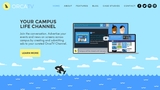
OrcaTV aims to cut through the noise and establish a unified channel for all information related to campus life and administration.
Introduce your startup and give a short description of what you are doing.
OrcaTV is a unique, curated channel of student and faculty submitted fliers, videos, and social media distributed to existing digital signage, cable TV, and websites that simplifies communications on college campuses and helps to inform and engage the university community. By bringing many different communication mediums to one place, OrcaTV creates a centralized platform that is accessible, interactive, and fun to use.
Who are the founders, how did you meet, what are your different roles in the startup.
OrcaTV was created by students for students to help make sharing information on campus as easy and fun as possible. As an undergraduate student, Rajiv Shenoy noticed screens around campus that nobody was using. So he partnered with the school to get student content on them and the platform quickly became a unique "Campus Life Channel", a centralized place for students and faculty to distribute and consume information regarding events and announcements on campus.
Realizing that this was a great way to engage and inform students on college campuses, he started OrcaTV and found three individuals just as passionate as him about college and improving the undergraduate experience to help build the company. Joey Goldberg leads the Sales and Marketing team, Adam Podlisky manages Operations, and Michelle Greenblatt is the Director of Content.
What is the main problem in education that you aim to solve.
Content can be shared in more ways than ever, making it difficult to effectively deliver information and news to campus communities. We aim to engage and inform university communities by turning the complex web of communication on college campuses into a consolidated, centralized "Campus Life Channel", a one-stop shop for all campus news and information. IT spends less time and money managing, converting, and delivering content to the university community and can focus more on enhancing the quality and efficacy of the content that is being disseminated. Students and faculty have access to one platform they can use to distribute and consume important campus information.
In which markets / regions are you active. What markets / regions are next.
We are currently exclusive to the higher education market and built our beta network across the Northeast. Now that we have launched The Campus Life Channel, we’re expanding across all regions in the US.
Who is your target audience.
Our target audience is college students and administrators who manage communication platforms. Our channel greatly benefits faculty and IT administrators by creating efficiencies around managing content and technology. For students, it’s a powerful on-campus communication platform that allows them to express their interests in fun ways.
How do you engage with your target audience. How do you convert them into users of your product.
Each university is extremely unique - and The Campus Life Channel has to showcase the campus culture. We have a robust marketing strategy that focuses on developing strong relationships with students and administrators, helping us to promote OrcaTV on-campus. We first hire student ambassadors who inform us as to what content students are interested in promoting on the platform, they present at registered student organization meetings, reach out to student leaders, distribute fliers, and much more. We participate in remote and on-campus product training, create custom promotional content, and facilitate focus groups. We also work closely with administrators to carry out unique campaigns they are interested in e.g. Twitter polls and Instagram contests. Once the university community is fully aware of OrcaTV, they are excited to contribute their content to the platform and naturally become users.
What is your business model. How much does your product / service cost.
OrcaTV provides software and content management services for an annual fee that alleviate many administrative burdens and streamline communications on campus. The cost of our product ranges significantly depending on the size and needs of each university. However, as a smaller company, we’re extremely flexible and able to accommodate the needs and budgets of all types and sizes of schools.
Who are your main competitors? What sets you apart from them?
At the moment, there are no main competitors who are providing the same service as us to universities.
If you raised funding, how much did you raise. Who are your investors. If not, are you planning to raise funding.
Bill Gray, a Senior Advisor to Blackstone and Former CEO of Ogilvy, NA made an angel investment in OrcaTV in 2012. Bill's extensive experience has helped us to define the Orca brand while focusing on enriching the experience of its users.
Campus Televideo, the nation’s leading provider of satellite delivered cable television services to colleges and universities, invested in OrcaTV in 2014. This partnership has allowed us to grow our team while building out the infrastructure needed to continue providing quality service to our customers.
Are there milestones you are especially proud of and would like to share.
A great milestone for us was hiring our first student ambassador and launching our student ambassador program. As our eyes and ears on campus, they have been essential in keeping us in-touch with university culture and events which helps us to push engaging and relevant content across our platform.
What are the next steps in growing your startup.
The next step in growing our startup is staying focused on how we can engage students through our Campus Life Channel while reducing the management burden for administrators. We are showcasing our product at several conferences this year to make new connections while continuing to innovate and deliver a fun experience for all of our current campus partners.
Room for anything else you would like to add.
As recent college graduates, it doesn’t get more fun than being able to build and provide a product to students and universities that we would have loved as undergraduates. Watching OrcaTV become an invaluable resource on our campuses brings us so much satisfaction and motivates us to continue to grow and innovate around making college the best possible experience not just for students, but for faculty and administrators as well.
How can people get in touch with you.
They can email us at support@orcatv.com, call us at (267) 373-8952, or fill out our contact form at www.orcatv.com.
Edukwest
.
Blog
.
<span class='date ' tip=''><i class='icon-time'></i> Jul 16, 2015 02:09pm</span>
|
|
A new survey from Dell indicates there are quite a few things the U.S. can learn from China when it comes to meeting students’ technology needs. According to the findings:
China is more likely to integrate technology into all curriculum,
Chinese students spend more time using technology in school, and
Chinese teachers are more technologically savvy according to students
Courtesy BrainTrack
Jason Rhode
.
Blog
.
<span class='date ' tip=''><i class='icon-time'></i> Jul 16, 2015 02:09pm</span>
|