Blogs
|
Solving Real World Problems in the 21st Century: IntroductionTwo points that I have tried to emphasize in describing cross disciplinary learning as it applies to collaboratively solving real world problems are:The approaches to problem solving that we used in the past are not measuring up to solving the complex real world problems that we have today and which are increasing in number. The wealth of resources that the world wide web provides, especially in the area of being able to collaborate on a global scale are not being effectively utilized. We are still trying to solve problems with a compartmentalized thinking mindset. Cross disciplinary thinking is alien to many because all of their educational lives have been immersed in a compartmentalized knowledge mindset.In a serious crisis, such as the Nepal earthquake, relief efforts were hampered, IMHO, in part by this type of mindset that exists in government bureaucracy. In no way should this point be construed as an indictment of the heroic efforts made by many nations to get aid to those who suffered greatly from this disaster. Credit: www.inquisitr.comThe Need for a Paradigm Shift That Reflects 21st Century Realities If we accept that cross disciplinary collaborative problem solving is an approach to dealing with the increasingly complex real world problems then what would this paradigm shift look like in real terms?A. /Collaborative Team--------> Analyzes Real World ProblemNecessary questions that the team needs to ask itself in order to effectively analyze the problem are:In order to get a complete picture of the problem what skillsets from what disciplines are required in order to analyze it?Do any of our team members possess the required skillsets to bring clarity to the analysis of the problem?If we are lacking necessary skillsets, where do we look online in order to make up for our deficiencies? Do we have access to other professionals who can contribute to the analysis? Do we have access to databases that offer easy access, excellent search qualities and are relational in their responses to queries in that they are able to relate and coordinate information from similar problems that may have bearing on our specific problem? B. /Collaborative Team-----------> Postulates and Tests Potential SolutionsNecessary questions that the team needs to ask itself in order to arrive at potential solutions are:Do we have protocols in place that encourage divergent thinking in our collaborations, using the data that we have gathered from the analysis of the problem?Can we draw on cross disciplinary expertise to test our thinking in regards to our proposed solutions?If you look carefully at this paradigm, what you should see is the context used for PBL (Problem Based Learning) but we are taking this context further by incorporating some of the useful elements available to us from the professional online learning communities. The reason is what every educator, corporate trainer, instructional designer and CEO should recognize which is:"As professionals, we do not have a sufficient level of expertise that is needed in order to solve the complex real world problems that we are facing today. Collaboration is not optional; it is absolutely essential. It is also essential that we begin to educate learners in schools, colleges and universities in the art of this type of mindset!"Real World Problem Solving: The Nepal Earthquake Crisis On April 25, 2015 an earthquake measuring 7.8 in magnitude struck the country of Nepal resulting in the deaths of more than 7000 people at the time.Credit:www.newirin.irinnews.orgThe incredible physical devastation was so wide spread that even Mount Everest was shaken causing a number of catastrophic avalanches that led to the loss of a number of climbing teams engaged on the mountain.Credit: www.newslocker.comIf the devastation and loss of life was not enough for the people to contend with, some serious questions arose in regards to the coordination of the relief effort that followed. I would like to make it very clear that many nations reacted and made a heroic effort to get what was needed to Nepal as the story unfolded but the question that needs to be asked is:"Was the coordination of the many levels of expertise to address the problems that existed present or was there compartmentalization and a refusal to accept the type of leadership and analysis of the problems needed to arrive at timely and effective solutions?"I know that hindsight is 20/20 but do we need to re-think how we approach complex problems? The media provided a variety of points of view on the relief effort. In a New York Times article by Gardiner Harris, titled:" Nepal's Bureaucracy Is Blamed as Earthquake Relief Supplies Pile Up" (May 3,2015), Jamie Goldrick, the United Nations resident coordinator was quoted in an interview as saying:"The bottleneck was the fact that the bureaucratic procedures were just so heavy. So many layers of government and so many departments involved, so many different line ministries involved. We don’t need goods sitting in Kathmandu warehouses. We don’t need goods sitting at the airport. We need them up in the affected areas."This was just one of many similar points of view. If what the article is saying is true then what you have is different levels all protecting their turf rather than providing the level of collaboration that should be expected. As a lesson in cross disciplinary learning, this could represent a classic example of a real world problem that we could and should build into E-Learning programs that want to deal with real world issues. We need to educate this present generation and those that follow to adopt this mindset and be as immersed in it as they have the previous mindset of the past. One thing that should be clear is that the approach that is taken affects more than the education sector. This mindset should be a priority for businesses in the 21st century if they hope to grow a culture of innovation.Next...Taking aim at higher education and education faculties
Ken Turner
.
Blog
.
<span class='date ' tip=''><i class='icon-time'></i> Jul 16, 2015 08:08pm</span>
|
|
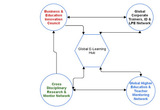
As we progress to looking at the Global Higher Education and Teacher Mentoring Network, it would be prudent to summarize first where we have been before moving forward with the global E-Learning re-organization proposal.GLOBAL E-LEARNING PORTALSummaryGlobal online education covering the planet is established through the development and institution of 6 Global E-Learning Portals.Each Global E-Learning Portal consists of 4 collaborative networks that advise and take direction from a central hub called the Global E-Learning HubThe Global E-Learning Hub has three primary functions: (a) It is an established "learning community" that students, who belong to the family of nations that the learning portal oversees with respect to education,can login to, collaborate with other students and receive personalized, adaptive learning according to their personal needs and learning profile. (b) It also has the responsibility to take direction and advice from the four networks that are part of the portal. This is especially important in its collaboration with the Cross Disciplinary Research and Mentor Network which serves the needs of learners by establishing a mentor relationship with professionals in the Sciences, Arts, Technology and Mathematics disciplines, and (c) It is a professional collaboration and innovation community.The other networks and councils are: (a) The Business and Education Innovation Council which maintains close ties with corporations who are part of the family of nations involved in establishing a learning and innovation culture for their respective organizations and is a forum for their employees to present proposals, (b) Global Corporate Trainers, Instructional Designers and Learning Principles Educator Network which collaborates with the Business and Education Innovation Council and also promotes and designs E-Learning ideas in collaboration with the Global E-Learning Hub, and (d) The Global Higher Education and Teacher Mentoring Network.Cross Disciplinary Learning and Higher EducationAs was pointed out in a previous posting, cross disciplinary learning is becoming more and more important in solving real world problems that have become more and more complex. The skillsets required to analyze and solve these problems require collaboration that cross a variety of disciplines. A bright spot in this is that the STEAM disciplines are starting to recognize this more and more as indicated by the rise of cross disciplinary research. The compartmentalization of disciplines are starting to transform into hybrids designed to challenge the problems of the 21st century.Credit: www.engent.blogspot.caAlthough research is starting to adopt the cross disciplinary and collaborative mindset, the institutions with the mandate to educate 21st century learners have shown a great deal of inertia when it comes to breaking free from the industrial model of education. Their experimentation with online education via the use of MOOCS has garnered mixed results but it is improving. They need to recognize that the technology advances will not improve their efforts if their pedagogy does not changeDe-Programming Education FacultiesSince most major universities have faculties of education responsible for the training of teachers, if the university is still mired in the old model of education it will be the same situation for the faculty responsible for training educators. De-programming these faculties is now essential if we are ever to have teachers who have a renewed purpose to be agents of change and encourage their students to be agents of change and creators of new knowledge and skillsets. It requires deprogramming minds and preparing them for a new mindset that is going to have an exciting impact on their careers as educators and on the students as agents of change in their respective societies.In order for these transformations to take place, E-Learning needs to communicate and even mentor educators and the faculties they attend in this cross disciplinary way of learning. This explains one of the purposes of the Global Higher Learning and Teacher Mentoring Network which I intend to describe in more detail in the next post.Just as a side note, I know that some of the labels I have used for these networks and councils might be a bit unwieldy. If you could suggest alternative labels that would be better, I am open to suggestions. After all, I am a life long learner!Next... Characteristics of the Global Higher Learning and Teacher Mentoring Network...
Ken Turner
.
Blog
.
<span class='date ' tip=''><i class='icon-time'></i> Jul 16, 2015 08:07pm</span>
|
|
By Richard Grosskreutz, student ambassador and veteran in the criminal justice program
Recently, Globe University-Wausau celebrated Veterans Day with cake, cookies and a message of thanks to those who have served in any branch of the military.
During the day, several veterans were asked if they would be willing to share some thoughts about their service. One veteran, Richard Grosskreutz, a student ambassador in the criminal justice program, offered these thoughts about Veterans Day and the importance of supporting our veterans:
Richard Grosskreutz
On November 11, 1918, World War I came to an end. The following year, President Wilson declared November 11 to be Armistice Day to recognize and thank the veterans for their service and their victory in World War I.
The holiday was celebrated unofficially until 1938 when it was signed into law by Congress as an official holiday. In 1954, Congress officially replaced the word "armistice" to "veterans" because Armistice Day was intended to honor World War I veterans only, and they wanted to officially include veterans from World War II, the Korean War and any future wars.
Since 1954, our nation has celebrated Veterans Day every year, although veterans haven’t always been treated as well as they are today.
During the Vietnam Conflict, returning veterans were looked down upon and treated as murderers and lower-class citizens. This attitude toward veterans slowly changed. After the beginning of Operations Iraqi Freedom and Enduring Freedom, our nation rallied around veterans. The vast majority of the population understood that military personnel do not choose when or where they go to war; they just go where they are sent and follow the orders given to them.
Our nation has become so supportive of veterans in the last 13 years that hundreds of veteran support groups and organizations have been established. These groups and organizations are founded by companies, different levels of government and private individuals.
Unfortunately, this also means there are fake organizations out there who claim to exist to help veterans, but in reality only exist to con well-meaning people out of money. I think it is important to support the real organizations, but we must also be careful and check the validity of the organization. I personally will only donate to organizations I know about and I have seen in action.
GU-Wausau veterans: Thank you for your service!
Here is a list of organizations I have researched and find to be legitimate:
The Wounded Warrior Project
Operation Not Forgotten
Wisconsin Veterans Foundation
Operation Muskie
Disabled American Vets
American Legion
Veterans of Foreign Wars
Purple Heart Cars
Iraq & Afghanistan Veterans of America
Intrepid Fallen Heroes Fund
Fisher House
Never Forgotten Honor Flight
This is only a small list, but all of these organizations are capable of making a huge difference in the lives of veterans. Please check these organizations out, and if you are able, please donate or volunteer with these and other veterans organizations.
It is important that we take care of those who offer their lives so we may live ours in this great nation of ours. If you are unable to donate or volunteer, simply take the time to thank a veteran and let them know you care. Sometimes that is all it takes to improve the life of one of our nation’s heroes. If you know of any other great organizations, help spread the word about them. Less than one percent of Americans serve in the five branches of the military at any time. Please let them know you care.
Globe University & Minnesota School of Business
.
Blog
.
<span class='date ' tip=''><i class='icon-time'></i> Jul 16, 2015 08:07pm</span>
|
|
Recently, Globe University-Wausau met with a video crew on campus who was filming various students and faculty members for a potential television commercial. One of these students, Katie Heisler, a student ambassador in the business program, took some time to speak with me about this experience.
How did you find out about this opportunity? What was the process like?
Business student Katie Heisler talks about her experience filming a potential commercial.
I found out about this opportunity from a campus-wide email from Andrew Carson who is head of the marketing department for Globe. I didn’t respond to the email right away because I didn’t believe I had a chance of receiving the opportunity for an interview.
One night while I was working in the library, one of our faculty members approached me and asked if I had responded to the email. I answered no. The faculty member was the person who convinced me to respond by saying to me, "How will you know if you don’t respond?" So I took a chance and completed the survey that was attached to the email.
What kinds of questions did they ask you?
They asked me about how my journey at Globe has been so far. They wanted to know my favorite class and my least favorite part about my program. They asked about the classroom setting and how the iPad has been so far with my classes. They asked what inspired my decision to come to Globe. I answered that I wasn’t sure what I wanted after high school, and then my mom got sick so it took me awhile to apply for school.
One day I stumbled across Globe and discovered that they were involved in the community. I’ve always volunteered, so I chose Globe because they were just as passionate about giving back to the community as I was.
What was the day like? Any funny/interesting incidents or events?
I was extremely nervous all day up until my interview at two in the afternoon. I was in class that morning and they just finished interviewing my instructor. They came into class to take pictures and get some footage of him teaching. My instructor told them I was one of the students that would be interviewed, so they stayed longer to take pictures and film me in the classroom setting, which made me even more nervous. It caught me off guard and I didn’t have time to prepare.
It was an overall fun experience. I think the hardest thing for me was trying to smile on demand, and then when I did, it felt awkward. The camera crew would say something funny or make me do something goofy to catch me off guard and get a genuine smile.
Did anything you talk about that day make you look at your experience at Globe differently?
It never changed how I viewed my experience at Globe, but was just another milestone in my experience that made Globe even more amazing than what it already was to me. Globe has been the place where I’m crossing things off my bucket list left and right. This experience was another one of those things.
Did anything you talk about that day make you look at yourself differently?
No, not really, but I was able to educate the marketing people that came to campus about the different clubs and events that our campus participates in. They seemed genuinely impressed with everything I told them about. Our students have some opportunities here that they don’t have at many other places.
Is there anything else you want to share?
I would like to share something that I told them during my interview. I told them that Globe was more than a school because it feels like a family. Our instructors and faculty members want to see us succeed, so they will help with anything we need. Our instructors and faculty members know us by name—not by a number—and they make us feel welcome. Even instructors I’ve never had classes with know my name, and you just can’t get that at other colleges.
Globe University & Minnesota School of Business
.
Blog
.
<span class='date ' tip=''><i class='icon-time'></i> Jul 16, 2015 08:06pm</span>
|
|
More and more employers are posting open positions on LinkedIn, and the "Jobs" section of the networking site is a great resource. But did you know there are other ways to use LinkedIn to your advantage? Learn more about what the site has to offer, and how you can use it to advance your career.
Use Optimized Keywords
Your LinkedIn profile should be optimized, so a recruiter who is looking for someone with your skills and experience can easily find you. This includes having a complete profile, with every section filled in to display the value you offer to potential employers.
"Use keywords in your profile to show your expertise," says Jodi Boisjolie-Rosen, corporate manager of career services for Globe Education Network. "Use keywords that can be found in job descriptions, and look at the profiles of others in your industry to see what kinds of terms they’re using."
Boisjolie-Rosen also recommends using keywords to search for open jobs, and to be more general than specific.
"For example, if you’re a vet tech, search ‘animals’ to pull everything that falls into that category," she says.
Connect with Decision Makers and Industry Influencers
You don’t have to wait for an employer to come to you. Take initiative, and get noticed by those who have the ability to make hiring decisions.
"Use the search feature to find individuals within companies in your area," says Boisjolie-Rosen. "Connect and reach out to HR representatives or hiring managers."
Follow the Right Groups
The search function is also a good way to find groups relevant to your industry. Once you join, be sure to share useful information on trends and current issues in your area of professional interest.
"Post about trends you hear about, participate in discussions and pose questions to build your credibility," Boisjolie-Rosen says.
Boisjolie-Rosen says you can also act as a resource by offering advice and support to other group members.
"Update your status regularly, and comment on others’," she says. "Forward on job leads, give recommendations and endorsements, and share examples of your own work."
To maximize your exposure, get into the conversations which are most active with substantive comments.
"If you are continuously active, it will show to others in your network," says Boisjolie-Rosen. "It will also shift your activity up in newsfeeds, exposing you to more industry influencers."
Boisjolie-Rosen also stresses the importance of utilizing the ability to send personal messages to others on LinkedIn, whether they are first connections or not.
"When you send a message to connect, make sure it’s customized," she says. "Mention that you noticed you’re in the same group, share a connection or have a common interest. If they’re working in your industry, ask them if they would be willing to discuss how they got into the field and how they’ve been successful."
Follow the Right Companies
Just like groups, connecting and getting involved with companies on LinkedIn can also get you noticed.
"Search for companies that you would specifically like to work for, and research, follow and engage with them," Boisjolie-Rosen says.
Use Advanced Searches and Notifications
You have the ability to search by people, jobs, companies groups and universities, and more specifically, by keywords, job titles and more in the advanced search feature. Boisjolie-Rosen says you should take advantage of this in order to nail down exactly who you want to connect with. You can look up alumni of your school, see where they are working and reach out to them, all with a couple clicks.
Be sure to pay attention to your notifications, too. When someone else comments on a post you commented on, continue the conversation. When someone views your profile, reach out to them.
Boisjolie-Rosen points out that LinkedIn provides additional resources for students and alumni, and anyone who is looking for tips on how to build their profile at university.linkedin.com/linkedin-for-students.
To learn more about Globe University and career support services visit www.globeuniversity.edu/about-us/career-services.
Globe University & Minnesota School of Business
.
Blog
.
<span class='date ' tip=''><i class='icon-time'></i> Jul 16, 2015 08:06pm</span>
|
|
They both use their "assets" to make money!
Our community service scholarship recipients both scored $2,000 while helping our community thrive and become a better place. Let’s see Kim Kardashian compete with that!
Globe University-Green Bay recognizes the importance of community service through our "We Care" mission and the incorporation of applied learning projects in and out of the classroom, as well as other initiatives.
A little-known secret is that every quarter, Globe awards two students $2,000 through our community service scholarship. That’s $16,000 annually.
Our summer 2014 recipients were (drumroll, please)… Laura Ankerson and Michelle Jadin!
They talk about their efforts below.
Laura Ankerson, Business Student
Volunteering with Brown County
I assisted the Volunteer Center of Brown County with their social media marketing. Although this started as an internship for college credit, my required internship hours have been completed and I continue to help out on a weekly basis, providing 12-18 hours of service.
I have created a majority of their Facebook, Twitter and Instagram content, and have also been learning how to manage their website.
I believe that my work at the Volunteer Center of Brown County is not only beneficial to them and the community, but it has allowed me to grow professionally and personally. I look forward to giving them more of my time in the future.
Michelle Jadin, Medical Assisting Student
Volunteering with Children and More
I never really thought that helping in my daughter’s classroom was considered volunteering. I just did it because I love working with children.
For the entire school year, I came to the facility twice a month to do one-on-one activities with children, and had the opportunity to help chaperone.
Some of my recent volunteer experiences have included assisting with my daughter’s Girl Scout troop and working as a scribe in the medical tent for the Packer 5K run.
I truly am enjoying being able to get back into volunteering. It is a great experience to give back and help people. This is the main reason why I decided to go back to school to change careers and to help people.
Globe University & Minnesota School of Business
.
Blog
.
<span class='date ' tip=''><i class='icon-time'></i> Jul 16, 2015 08:05pm</span>
|
|
There are so many great things about the Real Life Academy that I don’t know where to start.
Applied learning, community engagement, life skills training, volunteerism, education… and the list goes on.
Let’s start first by talking about what the Real Life Academy is.
Hosted by the Eau Claire Area Chamber of Commerce, the Real Life Academy is an event designed to help area high school students understand the importance of financial literacy. The financial literacy component is the goal of the event, though it encompasses so much more.
Twice per year, students from Eau Claire, Altoona and Fall Creek go through a simulated budgeting and money-management exercise, preparing them for their future after graduation. They are given a career, family status, and other factors that impact their lives. They are then required to manage their salary while taking into account all of the expenditures they are likely to face, including:
Housing
Transportation
Utilities
Apparel
Investing for retirement
Other day-to-day expenses
Community members volunteer to man stations, which represent each of these different areas. Students then go around to each station and make purchasing decisions. Each expense is tracked in their check ledger and they are required to manage online payments, automatic withdrawals and other transaction types.
Most students in attendance are enrolled in a personal finance or accounting class.
I have had the pleasure of volunteering at the event for the past two years and thoroughly enjoy every minute! It is great to see the students engage in the activity and discuss with them the many challenges they will face as they learn to manage their personal finances.
For as long as I have been at the event, Globe University has sponsored the cell phone table, where participants stop to purchase a phone and sign up for a service plan. The table is one of the required stops for students, since many will not have a landline phone.
Phones and service plans are designed around current pricing and students are challenged with balancing wants versus needs. This can often be a very eye-opening experience for the students, as many have no idea what their parents spend each month on their cell phone plan.
Adam Rocksvold, admissions representative at Globe University-Eau Claire, and I volunteered together for the past two events. Adam said enjoys participating and interacting with the students. From his perspective the academy provides an additional benefit to students beyond the financial education. Adam also noted that it helps students improve their communication skills by allowing them to "interact with businesses face to face in a professional setting."
Events like this are a great example of how we as a community can come together to help students gain valuable skills outside the classroom in an innovative, hands-on approach to learning. I look forward to next spring and the opportunity to participate in this amazing event once again!
For an opportunity to learn more about the event, check out the news story on WEAU or the Eau Claire Area Chamber of Commerce.
Globe University & Minnesota School of Business
.
Blog
.
<span class='date ' tip=''><i class='icon-time'></i> Jul 16, 2015 08:04pm</span>
|
|
Written by Tom Stoltz, business instructorDeShay Myers and son Trevon Nash
At Globe University-Minneapolis, two pairs of cross-generational students study business for future success
DeShay Myers, a business program student striving for her associate degree, is going to school with her son, Trevon Nash.
Indeed, they are even taking the same class together.
"I never thought I would be going to college with my child at age 40," said DeShay. "It’s definitely different, but also lots of fun."
DeShay and Trevon are enrolled in the Small Business Management class at Globe’s Minneapolis campus. They said they find the course especially invigorating because both are developing business plans and forming a strategy for their careers.
Trevon, who is also aiming for an associate degree in business administration, says that his main incentive in getting into business is having the ability to go further in life.
"Business is where the good jobs are and where the money is," said Travon. "I want to start my own business and provide a future for myself and my daughter."
DeShay and Trevon seem to motivate each other. They car pool, go to lunch together and help each other with homework.
"Trevon motivates me, and I want to be a role model," DeShay said. "It was a mistake for me not to go to college when younger, and I want Trevon to make accomplishments and to push himself."
Likewise, Trevon gets energy from his mother: "My mom motivated me to finish high school, now she is inspiring me to get a college degree."
Another Family Connection
Villa McIntosh and daughter Leshia DabbsVilla McIntosh and her daughter Leshia Dabbs, the other family team. They actually enrolled at the same time for fall quarter 2014 and plan to graduate together.
Both are in the business program and find it "different" yet fun at the same time to be going to school together.
"Surprisingly, it’s been very enjoyable and fun so far. We have more than one class concurrently, and it’s pretty cool," said Leshia. "Some students thought we were sisters at first; but this whole experience is allowing us to bond in a special way."
Asked if any conflicts have arisen in their parent-student relationship, Leshia said that the only difference is in their distinct learning styles.
"My mother takes an online class, but prefers to be in a classroom," she said. "Also, technology is more advanced than when my mom went to school 20 years ago. When she allows me to, I am able to teach her a few things, but basically, learning business skills is our mutual goal."
Globe University & Minnesota School of Business
.
Blog
.
<span class='date ' tip=''><i class='icon-time'></i> Jul 16, 2015 08:03pm</span>
|
|
Small class sizes. Night and day classes. Convenience.
Those are the top reasons recent medical administrative assistant graduate Christina Deyoe chose to attend Globe University.
"I chose the medical administrative assistant program because I love helping people and working with people, but I also love the administrative/office atmosphere," she said.
Christina and her daughter at graduation.
Christina, who graduated in September of this year, is currently working at SSM Healthcare as well as continuing her education at Globe University for her bachelor’s degree in health care management.
"Right after graduation, I started my new job at SSM Healthcare," Christina said. "My position is in the billing department and I absolutely love what I do; it’s a step in the right direction to what I want to do with my career."
"My coding and billing classes helped me a lot when I first started, especially the little experience I had with Epic. The administration and computer classes helped also, and being able to type at a decent speed and being computer savvy helped quite a bit."
Besides school, Christina had to juggle work and caring for her daughter. "It was important I designated enough time to get my school work done on time. The most effective way that worked for me was to make sure I wrote down my school and work schedules every week, the times I could study, and if there were any other obligations that week. It also helped to take my homework to work and study there on my breaks and I still do that. Every little bit of time helps."
Do you have any advice to give to students?
Be patient. "Finding a job doesn’t happen overnight. If you get frustrated from getting nothing in return, take a break for a week or two from applying for jobs."
Don’t give up. "Go see Julie and Elizabeth (career services department) for suggestions or to review your resume, I know I did. I had been applying for jobs for six months before I found the job I am in now. I stopped for a while, went to see Elizabeth, and she helped me update my resume. The initial hiring process took two months, so keep pushing, be patient and don’t give up."
Christina looks forward to continuing her health care management degree and would like to work her way up at SSM Healthcare in the future or apply for a supervisory/management role for a department in a hospital or clinic.
Globe University & Minnesota School of Business
.
Blog
.
<span class='date ' tip=''><i class='icon-time'></i> Jul 16, 2015 08:02pm</span>
|
|
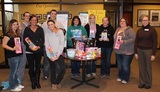
It’s the season of giving and students in the Professional Communications II class were inspired to support the American Family Children’s Hospital this quarter by coordinating a drive to collect both funds and toys for hospital children in need.
The class worked in committees to tackle public marketing, on-campus marketing and crowdsourcing/fundraising. The Professional Communications II class with the toys they collected for American Family Children's Hospital.
Throughout the project, students applied the skills they were learning in class. They worked on their written communication skills by creating announcements and posters, and they worked on their verbal communication skills by working on teams and reporting back to the class regarding their progress.
The drive ran from Nov. 10-19 and the students collected $50 and 20 toys for the children.
For many students, this was the first time they were part of an effort like this.
They got to learn new skills and learn what went well and what could have been improved upon if they were to do anything like this in the future. It was also an opportunity for them to learn about the American Family Children’s Hospital and those that they serve.
"The fundraiser was a good opportunity for us to give back to the community, especially since it is so close to the holidays," said veterinary technology student, Jennifer Gall. "The children are fighting to stay healthy and it is something small that we can do for them to help brighten their day as they are healing."
If you are looking for a way to give back this holiday season or any time of the year, check out the United Way of Dane County’s VolunteerYourTime.org. There is an opportunity for everyone!
Globe University & Minnesota School of Business
.
Blog
.
<span class='date ' tip=''><i class='icon-time'></i> Jul 16, 2015 08:01pm</span>
|