Blogs
|
When looking for a knowledge management system, there are key features to consider as you compare different options. These features will impact the overall cost, adoption, and success of your knowledge management system rollout. The most important ones to keep …
The post What to Look for in a Knowledge Management Solution for Sales appeared first on Bloomfire.
Alltop
.
Blog
.
<span class='date ' tip=''><i class='icon-time'></i> Jul 17, 2015 07:39am</span>
|
|
This is a really great list: 30 Things To Tell Students You’ll Never See Again. Print this out and put it up on a wall somewhere where you’ll see it often. Read it every day. Seriously. 30 Things To Tell Students … Continue reading →
Katrin Becker
.
Blog
.
<span class='date ' tip=''><i class='icon-time'></i> Jul 17, 2015 07:39am</span>
|
|
Photo: Bendta Schroeder Bendta Schroeder, School of Science writes, "Program aims to inspire female and underrepresented minority students to pursue STEM fields."Tara Falt of Anaheim, Calif., with her math solution. Photo: Allegra BovermanIn a noisy MIT classroom last week, high school students eagerly speculated on the problems they might see in the team math competition they were about to begin. The MIT students serving as the competition’s judges passed out problem sets, shouting pleas for order above the din.Out of the chaos, teams formed, and Tara Falt, a rising high school junior from Anaheim, California, was soon at the blackboard solving a problem.Now the only sounds in the room were Falt’s voice, explaining every move in her solution, and the click of her chalk moving across the board. She had everyone’s rapt attention.When she put the chalk down, both teams erupted into cheers. The judges awarded her full points.The final session of the MIT MathROOTS program was off to a strong start.Encouragement in STEMLaunched this year by MIT’s Program for Research in Mathematics, Engineering and Science (PRIMES) — an afterschool program for high school students — MathROOTS invited advanced high school students from underserved communities to develop their math skills at MIT. A total of 20 students spent 11 days — ending last Thursday — at the Institute, learning to solve Math Olympiad-style problems, as well as being introduced to special topics in mathematics.MathROOTS was designed to encourage highly talented minority and female students to persist in their passion for science, technology, engineering, and mathematics (STEM) fields through college and beyond; to give them a sense of belonging; and to expose them to the kinds of advanced math that will keep them inspired."I’m proud that MIT has introduced this wonderful program," says Michael Sipser, the Barton L. Weller Professor of Mathematics and dean of MIT’s School of Science, which provided funding for this summer’s program. "MathROOTS offers the real possibility of changing the lives of its participants, and through them, their communities. I hope that it will become a permanent offering for future extremely talented students, such as the ones we had the privilege of hosting this year."Read more... Source: MIT News
Alltop
.
Blog
.
<span class='date ' tip=''><i class='icon-time'></i> Jul 17, 2015 07:39am</span>
|
|
"Encouraging primary school pupils to have philosophical discussions can boost their maths and reading results, according to new research conducted by Durham University."Photo: Durham UniversityThe study shows that children as young as nine and ten, who are encouraged to have philosophical discussions around topics such as truth, fairness and knowledge, can improve their progress in maths and reading by an average of two extra months with disadvantaged pupils making even bigger strides. The research, funded by the Education Endowment Foundation (EEF), looked at the effectiveness of an inquiry-based learning approach, called Philosophy for Children (P4C), which is used by 3,000 teachers in the UK. Disadvantaged pupils taking part in the intervention saw their reading skills improve by an additional four months, their maths results by three months and their writing ability by two months, compared to a control group not doing the philosophy sessions. Feedback from the teachers in the trial suggests that the Philosophy for Children approach had a beneficial impact on wider outcomes such as confidence, patience and self-esteem too. At less than £30 per pupil, the researchers suggest that Philosophy for Children could be a promising and effective way to spend their pupil premium to improve outcomes, and close the poverty gap in attainment. Lead researcher Stephen Gorard, Professor in the School of Education, at Durham University, said: "Our results suggest that these philosophy sessions can have a positive impact on pupils’ maths, reading and perhaps their writing skills. But crucially, they seem to work especially well for the children who are most disadvantaged. This is very encouraging as we, along with the EEF, are committed to helping tackle educational disadvantage. "Evidence like this is extremely important in identifying what works and what doesn’t and to help headteachers decide how to spend their pupil premium funding for most benefit to their pupils." The team at Durham University worked with the charity Society for the Advancement of Philosophical Enquiry and Reflection in Education (SAPERE) to carry out a randomised controlled trial involving 3,159 pupils across 48 schools in the UK.Read more...Related link Read the study here. Source: Durham University News
Alltop
.
Blog
.
<span class='date ' tip=''><i class='icon-time'></i> Jul 17, 2015 07:38am</span>
|
|
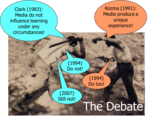
My most popular academia.edu paper is this one: The Clark-Kozma Debate in the 21st Century. It ends up being my most popular paper almost every week. Go figure. I wonder if that means the debate still rages, or if it … Continue reading →
Katrin Becker
.
Blog
.
<span class='date ' tip=''><i class='icon-time'></i> Jul 17, 2015 07:38am</span>
|
|
If you have spent much time developing training to support product launches, you know that the need extends far beyond a single launch meeting. For sales reps to be successful, you need a plan before and after the launch meeting that teaches and … Continue reading →
Alltop
.
Blog
.
<span class='date ' tip=''><i class='icon-time'></i> Jul 17, 2015 07:38am</span>
|
|
Just catching up: this is from earlier this year. Worth a read. Failure Is Essential to Learning | Edutopia. How do you make failure students’ friend? Set a high standard and don’t be afraid to tell students that they haven’t … Continue reading →
Katrin Becker
.
Blog
.
<span class='date ' tip=''><i class='icon-time'></i> Jul 17, 2015 07:38am</span>
|
|
#BLPLearn is our way of sharing resources our internal team finds relevant with the wider community. We take the best articles and resources shared between members of our Learning Services, Multimedia, and Product teams and publish them in this weekly … Continue reading →
Alltop
.
Blog
.
<span class='date ' tip=''><i class='icon-time'></i> Jul 17, 2015 07:38am</span>
|
|
Who would have guessed? Turns out, flashcards aren’t just for kids. The Secret to an Active Memory | ExamTime. This article promotes an app through goconqr* for creating flashcards, but there are other ways as well. Using a plugin called flippity, … Continue reading →
Katrin Becker
.
Blog
.
<span class='date ' tip=''><i class='icon-time'></i> Jul 17, 2015 07:38am</span>
|
|
Photo: Glenn AltschulerGlenn Altschuler, Cornell University reports, "An academic asks: whom should we teach? What should we teach? How should we teach?" What should be the aim of higher education? Photo: UBC Library CommunicationsThese days, public discussion of colleges and universities in the United States - and there is a lot of it - is almost exclusively concerned with rising costs, the job prospects of graduates, the contributions of colleges and universities to economic growth, and funding by the states and the federal government.Although this attention devoted to the economics of higher education is understandable, it has crowded out a discussion of equally fundamental, and perhaps even more fundamental, issues.At or near the top of this list, I would argue, are: whom should we teach? What should we teach? How should we teach?The observations (and assertions) that follow are meant to stimulate a conversation about these questions among professors, administrators and students inside the academy - and citizens who are (or should be) interested in the role of colleges and universities as engines of equal opportunity, empowerment and social progress.Who gets access? Let’s consider the first question: whom should we teach? Colleges and universities, especially elite institutions, can and should do a lot more to enroll academically talented students from lower- and middle-class families. A study completed in 2003 by the Consortium on Financing Higher Education found that 36% of all highly-qualified high school seniors (with excellent grade point averages and combined SAT scores over 1200) come from the top 20% of families as measured by income. Fifty-seven percent of undergraduates at selective colleges and universities, however, come from this group.Wealthy American families, then, are overrepresented on these campuses by 21%.Financial aid, provided on the basis of need, is of course essential to addressing this imbalance. But so is outreach to underrepresented students and their families, many of whom do not know much about financial aid, in the form of loans and grants, for which they might be eligible.As is evident in the above details, greater access to higher education will benefit not only the individuals who matriculate but American society as a whole.Read more... Source: The Conversation US
Alltop
.
Blog
.
<span class='date ' tip=''><i class='icon-time'></i> Jul 17, 2015 07:38am</span>
|