Blogs
|
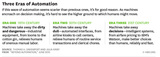
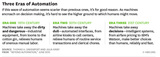
Beyond Automation — from hbr.org by Thomas Davenport & Julia Kirby Excerpt (emphasis DSC): After hearing of a recent Oxford University study on advancing automation and its potential to displace workers, Yuh-Mei Hutt, of Tallahassee, Florida, wrote, "The idea that half of today’s jobs may vanish has changed my view of my children’s future." Hutt […]
Alltop
.
Blog
.
<span class='date ' tip=''><i class='icon-time'></i> Jul 17, 2015 04:04pm</span>
|
|
"Marking the centenary of this remarkable achievement, Princeton University Press announced the publication of two new books." according to Jspace Staff, Author at Jspace.On November 25, 1915, Albert Einstein submitted his final version of the general theory of relativity to the Prussian Royal Academy. Einstein’s revolutionary explanation of how gravity works had far-reaching consequences.Not only does the theory accurately explain the motion of the planets; it also describes the history and expansion of the universe, the physics of black holes, and the bending of light from distant stars and galaxies. Over the years, the radical ideas that a 35-year-old Einstein proposed 100 years ago have been confirmed by many observations and experiments. Marking the centenary of this remarkable achievement, Princeton University Press today announced the publication of two new books: THE ROAD TO RELATIVITY:The History and Meaning of Einstein’s "The Foundation of General Relativity;"and RELATIVITY: The Special and General Theory, 100th Anniversary Edition.The co-authors are renowned experts in the field. Prof. Hanoch Gutfreund is professor emeritus of theoretical physics and a former president of the Hebrew University of Jerusalem, where he currently serves as the academic director of the university’s Albert Einstein Archives. Prof. Jürgen Renn, whose books include The Genesis of General Relativity, is director of the Max Planck Institute for the History of Science in Berlin.In THE ROAD TO RELATIVITY: The History and Meaning of Einstein’s "The Foundation of General Relativity," Profs. Gutfreund and Renn provide an English translation of Einstein’s paper, accompanied by insightful page-by-page commentary that places the text in historical and scientific context. Gutfreund and Renn’s concise introduction traces Einstein’s journey from special to general relativity, and their essay "The Charm of a Manuscript" provides a delightful meditation on the varied afterlife of Einstein’s text.Featuring an enthralling foreword by John Stachel, THE ROAD TO RELATIVITY is a handsome edition that also includes a biographical glossary, describing the intellectuals that influenced or were influenced by Einstein and his work; a comprehensive bibliography; suggestions for further reading; and numerous photos and illustrations throughout...In December of 2014, the Hebrew University, in partnership with Princeton University Press and the California Institute of Technology, announced the launch of the Digital Einstein Papers. The Hebrew University and Princeton University Press have spent decades studying an estimated 80,000 Einstein documents. Now anyone with an Internet connection can access transcripts of thousands of Einstein’s letters, papers, postcards and diaries at the Digital Einstein Papers, at http://einsteinpapers.press.princeton.eduThe Digital Einstein Papers contain text transcripts that link to many high-quality digital images at the Hebrew University’s Einstein Archive Online, at http://www.alberteinstein.info. Launched in March 2012 by the university’s Albert Einstein Archives (http://www.albert-einstein.org), and sponsored by the UK Polonsky Foundation, the Einstein Archive Online presents a complete catalog of more than 80,000 Einstein-related documents in the university’s possession, along with many high-quality digital images (http://www.alberteinstein.info/gallery/gallery.html).Read more... Source: Jspace News
Alltop
.
Blog
.
<span class='date ' tip=''><i class='icon-time'></i> Jul 17, 2015 03:04pm</span>
|
|
A successful eLearning experience gives learners the gift of mastery, whether it be skill sets, knowledge, or a specific task. The question is: how do you put your learners to the test in order to determine their proficiency level? In this article, I’ll present 5 different types of summative assessment and I'll reveal 4 tips for using summative assessment in eLearning.
This post was first published on eLearning Industry.
Alltop
.
Blog
.
<span class='date ' tip=''><i class='icon-time'></i> Jul 17, 2015 01:04pm</span>
|
|
Hast thou e’er been irritated whilst a comrade sp […]The post Casual Language for Classy eLearning appeared first on eLearning Brothers.
Alltop
.
Blog
.
<span class='date ' tip=''><i class='icon-time'></i> Jul 17, 2015 12:04pm</span>
|
|
In this article I will share 7 Instructional Design tips for creating effective eLearning courses, so that you will be able to impress your target audience almost instantly, regardless of your eLearning design experience.
This post was first published on eLearning Industry.
Alltop
.
Blog
.
<span class='date ' tip=''><i class='icon-time'></i> Jul 17, 2015 11:04am</span>
|
|
Isn’t it amazing, the expectations we have from our hard work? In our case, a complete eLearning course that (apparently) does not lack any feature to entice and retain a learner. Unfortunately, and we hate to break it to you, many of the eLearning courses fail to create loyal learners and dedicated followers in the... Read more »The post Avoiding drop outs in your eLearning courses appeared first on TalentLMS Blog - eLearning | Instructional Design | LMS.
Alltop
.
Blog
.
<span class='date ' tip=''><i class='icon-time'></i> Jul 17, 2015 10:05am</span>
|
|
Lately, the Fedena Support team has been receiving quite a lot of questions about barcode integration with Fedena and how it can be used to manage a library. In this article, we’ll try to address all the questions briefly.
What are barcodes?
A barcode is a way to encode information about an item in a visual pattern that an optical scanning machine can read. There are two types of barcodes - linear and 2D. A linear barcode is made up of black and white bars of various widths that create specific patterns. A linear barcode is the more commonly used on books.
A 2D barcode is more complex and can hold more information about an item. A QR code (Quick Response Code) is a common example.
What are barcode readers?
A barcode reader is a device that reads barcodes and outputs the details of the item on a computer. A perfect example of a barcode reader is the one you see at your favorite retail store that reads and logs the price of an item.
Is Fedena integrated with barcode technology?
Yes, Fedena is integrated with barcode technology to help you efficiently manage your library.
Does that mean Fedena can generate barcodes?
No, Fedena cannot generate barcodes for you. Fedena only enables barcodes read by a barcode reader to be filled in the system automatically.
Is there any setup that I need to perform in Fedena?
No, there is absolutely no setup you need to do. All you will need is Fedena with the Library plugin and a barcode reader.
What type of barcode code readers can be used with Fedena?
Regular barcode readers with USB or Bluetooth support can be used with Fedena. However, make sure that the device can read linear barcodes.
How does a barcode reader work with Fedena?
With Fedena, a barcode reader can be used when:
Adding a new book
Checking availability of a book
Issuing a book
Returning a book
Here’s how it works. Let’s say you want to add a new book to your Fedena system. Here’s what you got to do.
Go to the Manage Books page (Module access icon > Academics > Library > Manage Books) in Fedena.
In the top right, click the Add books button to open the Add book page.
Select By barcode as the book addition mode.
Position the cursor in the Barcode field.
Scan the barcode on the book using the barcode reader. The book’s barcode number is automatically filled in the Barcode field. Make sure the barcode reader is plugged into your computer.
Continue entering other required information and save.Here’s a GIF file showing you how it’s done.
The barcode reader used the above illustration is a plug (USB) and play reader manufactured by TVS Electronics, Model: BS-C 101 STAR
What are the benefits of using a barcode reader in my library?
A few key benefits of using a barcode reader in your library are:
Reduced staff workload
Increased accuracy
Faster check-in and check-out
Time saving
Easy stock verification
Reduced operational costs
Improved operational efficiency
Do you sell barcode readers along with Fedena?
No, we currently sell Fedena only.
How do I make my Librarian happy?
Get her a barcode reader!
The post All you need to know about barcode integration with Fedena appeared first on Fedena Blog.
Fedena
.
Blog
.
<span class='date ' tip=''><i class='icon-time'></i> Jul 17, 2015 09:46am</span>
|
|
Complete automation of management processes in an educational institution is needed. Why? To keep up with the fast evolving technologies affecting every aspect of our life, including education; why should school management take the back seat. Implementation of ERP software is a smart choice.
Selecting an ERP software selection is not an easy task and the process should be dealt with much care. Researches have proved that the main reason of failure of ERP software implementation is the disparity between the software and the needs and requirements of the institution. Hence, in order to help you avoid such circumstances, we get you some tips and suggestions that can guide you towards the right selection process of an ERP software for your institution.
Create the objectives. Why do you need an ERP software system for your institution? What you need to do in the very first place is to clear out the objectives and vision behind the ERP implementation. Set up a team of teachers and administrators who can review strategies according to the existing processes running in the institution and which require automation. Once the objectives are clear, rest of the processes will be easy and smooth.
Create the feature list for ERP software that you need for your institution. The researching team have another task to carry out- figure out the features of an ERP software in accordance to the requirements of your institution. Knowing the features clearly will help in choosing the right ERP software.
The ERP software list is highly important. See who all are the players in the market. Shortlist the ERP software providers, based on the kind of requirements you have. A smart way to shortlist providers can be through conversation with other existing ERP user institutions. They can help you out with their experience of ERP providers in the market. Based on the available info, you can shortlist and have a talk to each of the ERP software provider to go into details of the strength and weaknesses of each of them.
The next very important step is to prepare the request for proposal. Request for proposal is necessary for it helps you with selection of the final list of ERP software suppliers. Consider the weakness and strengths of each of them and seek additional information if there are areas of doubt anywhere. Based on your review, make the finalists to whom you can propose for a demonstration, to get a clear picture of how each of the ERP software functions.
Price is an important factor in the selection process. Yes, you cannot just ignore the pocket when you are deciding on an ERP software system. But it shouldn’t under-emphasize other critical factors of selection for sure, like implementation procedure, after-sale support,adaptability, flexibility to mold according to the needs of your institution as well as the ROI (return on investment) factor among others.
Do a value check of your investment. Based on the possible benefits and disadvantages that comes along with the ERP software you selected, comparing them with the cost you spend will give you a clear idea about your investment. An analysis of the benefits that awaits you including an increase in productivity in terms of management in reduced cost, better control of data in a safe and secure environment and all those important benefits for a real value check of your investment.
When you examine the ERP software options available in the market, it’s common that almost 80% of the offerings by the softwares are same; but it’s the remaining 20% that makes the real difference- the tailored-made offers according to individual requirements.If you wonder what all features of an ERP software should be considered, read through an interesting article here.
The post The Right ERP Software Selection Guide for Your Institution appeared first on Fedena Blog.
Fedena
.
Blog
.
<span class='date ' tip=''><i class='icon-time'></i> Jul 17, 2015 09:46am</span>
|
|
What makes a great teacher? Well, there are no hard and fast rules to make a great teacher and different approach towards teaching works for different people. Some teachers are in favor of showering praise to students to motivate them to work harder; while some considers praise to be causing harm to a child’s learning process. Telling your students what to do does not alone, means teaching. It’s more than that! Today, we bring to you some ideas that might assist you in your effort to make your teaching more effective in the classroom.
It’s all about passion!
What differentiates a good teacher from a great one is the passion for teaching. And the passion has to be genuine. Faking the passion would lead to nowhere. It is believed that students can get along easily with a teacher they think care about what they are teaching.
Know your students well; just like you know your subject.
Knowing your subject isn’t enough to make you a great teacher. Know the people you are teaching- what all they like in what you teach, their requirements and what they need to learn from you. Teachers should not get lost in the very important step towards effective teaching, i.e. know your students well.
Create a safe and better learning environment for your students.
Promising a secure environment for your students is important, to let them acknowledge what they don’t know and allow them to learn things. You, as a teacher, can create a safe and secure environment which will allow your students to take the risk to learn. Simple things like decorating classroom walls with students’ works can develop the faith in students for their teacher.
A good teacher-student relationship is crucial.
A very obvious step to follow. Make all effort to build up a strong relation with your students and it definitely has a lot to affect learning in classroom. Good environment in classroom with a thriving teacher-student relationship is a sign of a progressive classroom.
Keep your teaching CLEAR.
A great teacher can also be categorized as the one who has the ability to simplify complex learning into something that’s easily graspable to students. The biggest problem with most teachers is that they fail to realize if students understand them or not. Keeping the learning method simple and clear is important.
Be an amazing behavior manager.
Good knowledge about your subject and how you deliver it in class alone doesn’t make you a great teacher. Managing classroom behavior includes managing students behavior in the class, proper usage of lesson time and optimal management of learning resources. All these points are as important as your knowledge in the subject you teach.
A good teacher-parent and teacher-colleague relationship is also important.
Just as you need a good relationship between you and your students to build up, an equally good relationship is required on the professional front too. Timely communication with parents, being supportive to colleagues equally affect student learning. How? Good relation with colleagues can open up new teaching methods. Whilst, communicating with parents is highly important for a student’s overall development.
Be open to new learning styles.
A lot of teachers have the opinion that each student is comfortable with their own style of learning and it’s always better to encourage them to learn in their preferred style. Moreover, being a teacher, you have to keep updated about the latest teaching styles that can optimize the learning process.
The post 8 Tips to Teach Effectively in Class appeared first on Fedena Blog.
Fedena
.
Blog
.
<span class='date ' tip=''><i class='icon-time'></i> Jul 17, 2015 09:45am</span>
|
|
Why do ERP implementation fail? There can be several instances where one educational institution have made the most out of an ERP software; whereas, the same software have not yielded desired results in another institution. So, what can be the possible reasons? Let’s find out:
No clear objectives: A very common mistake most of the institutions looking out for ERP implementation is the lack of a clear goal. Without a clear and sure definition of the expected success, the problems to be targeted, financial benefits expected, the end result will be vague. This include the very first important stage of taking the decision to go for erp implementation as well. The dilemma of whether you need an erp for your institution should be solved in the first place.
Lack of proper user-training: The process of ERP implementation shouldn’t be done in a hurry, more specifically the training part. Since the erp system offers complete automation of most of the departments functioning in your institution, the training has to be apt, to the depth, for the right amount of time and should include all possible users in the institution. Without proper knowledge of the implementation by the end users, optimal usage of the system falls short off.
ERP implementation is not a cost. It’s an investment: Most educational institutions fail to realize that ERP implementation is an investment that’ll yield profit in the long run. In turn, they look out for vendors who offer the lowest quote, thus overlooking the expected benefits or results.
Change management: A very common reason for ERP implementation failure is the inability to manage the change that’s coming up with the new implementation. Adapting to the change the system brings about is a smart move rather than pointing out the difference between the old system and the new one. The point that the decision of upgradation of the system is opted by you, itself speaks how important it is to you to adapt to the change for optimal result.
Poor overall management of the project: Managing an ERP implementation project in your institution is not an easy task. A good management team or a leader is needed, who can look over the entire implementation process- scheduling things, proper communication between all the right people, etc is .
Absence of data accuracy: If proper and accurate data is not transferred to the new ERP system implemented in your institution, the system would lose its credibility with the end-users.
Overlooking technical difficulties: Hardware difficulties, interface problems with the management process in the institution, ‘bugs’ in the software can lead to a bad experience with ERP implementation.
ERP implementation is a long term process; hence, the steps you adopt towards implementation should be executed correctly. These problems, if timely dealt with, can never get you the undesired experience of an erp implementation failure.
Read more on ERP implementation:
The Right ERP Software Selection Guide for Your Institution
5 Good Practices for Successful ERP Implementation in Educational Institution
6 Important Features of a School ERP to Look out for
ERP in Education: The pros and cons of ERP implementation in education
The post 7 Important Reasons for ERP Implementation Failure in your Institution appeared first on Fedena Blog.
Fedena
.
Blog
.
<span class='date ' tip=''><i class='icon-time'></i> Jul 17, 2015 09:45am</span>
|