Blogs
|
At a time of a tremendous amount of incredible positives and incredible negatives, mixed all along with a huge sense of urgent uncertainty as to what’s going to happen next, one cannot, but truly appreciate how the world of the Social Web is changing us as a society, never mind the corporate world altogether, making us all reflect deeply on what really matters after all. Time and time again we keep getting exposed to those wonderful gestures of our human kind that clearly highlight where we are today, but at the same time we also get strong reminders of what’s stopping us altogether from making a better world, for everyone, which could perhaps be very well explained with this single quote: "it’s like a despair, destroying this world … people who have no hopes are easy to control" [- G'mork].
I love the Internet. I truly love the Social Web. I don’t even know what I would be doing without it, if there comes a time where it does no longer exist or I don’t get exposed often enough to it. I hope that never happens. I think those of us who have been lucky enough to live through it over the last 10 years have experienced, and never better said, such a fundamental change and shift on who we are as human beings that’s almost impossible to remain indifferent. No matter what. And the most exciting thing about it is that our younger generations have been born living through it all and will eventually complete our already started work of making this world a better place for us, for them, for everyone.
I heart social networking. I always have. Ever since I first got exposed to it back in 2001 I always felt it was going to help manage get the best out of all of us, human beings, so that we could go and create and do better things for those around us, and for the world at large. And I think I may have just witnessed one of the most inspiring confirmations of that inner urge that technology, when used right, could help us become better at what we already excel at: getting the good out of all of us and put it into practice. Good practice.
Earlier on today, and through one of my network(s), I bumped into this absolutely stunning, witty, smart, incredibly inspirational, thought provoking and rather moving dissertation by Dr. Pamela Gay at the recent TAM 2012 event (The Amazing Meeting 2012) under this delightful title: "Make the World Better (Ask If Anyone Minds Later)". It’s a presentation that lasts for a little bit over 36 minutes, but I can certainly guarantee you that it’s worth while every single minute of it. It’s fully packed with lots of rather thought provoking messages and plenty of calls to action on how the world of social media, and science, for that matter, are changing and shifting certain things that we have learned to take for granted as part of a rather sickening status quo that perhaps, almost certainly, has got its days numbered, because it no longer represents how our world works or should work to become a better place for everyone! Some sort of a call to action into what I would quote as "The Awakening (2.0)" (Sorry, I know, I couldn’t help using the 2.0 moniker), which I already hinted a little while ago on this blog entry as well.
Today’s blog post is going to be a short one. I would rather prefer you spend the time going through Pamela’s presentation to see what I mean with no longer being capable of remaining indifferent with everything that happens around you. Even more so that I originally had another idea and trend of thought for today’s blog post, but after watching her speech I though it was just too good to let it go by just like that. Why? Well, basically, for plenty of different reasons that I am sure you would be agreeing with as well if you have been reading this blog for a while, but mainly because of this particular quote from her:
"Imagine a world in which all the time, all the energy, all the bandwidth that currently goes into cyberbulling and trolling, instead goes into building good things; goes into doing science, goes into education […] Find what you are passionate about and build that thing" [Emphasis mine]
Or maybe, because of these other rather inspiring quotes that Pamela herself brilliantly used throughout her presentation that have certainly made me think about the inner power we all have and that it’s probably a good time now that it, finally, comes out. To quote her: "We can be the better example", "We do need to fight to build a better world", "Be the change you want to see in the world… well, damn it, be the change by doing something!"
Well, with all of that said, and without much further ado, here’s the embedded code of the YouTube video, so you can hit Play, watch and listen to Pamela and be prepared to learn how you, too, no matter what, no matter how, no matter when, can change the world. Our world:
Starting today!
Luis Suarez
.
Blog
.
<span class='date ' tip=''><i class='icon-time'></i> Jul 20, 2015 10:18am</span>
|
|
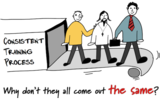
One of the things that we talk quite a bit in corporate education is consistency. I've spoken about it quite a bit earlier as well. It seems this is something that every training manager out there is thinking about. After all, if you want to train hundreds of people, then you need a consistent process and a consistent output. There's a small problem though, people aren't consistent. And the last I checked, if you place an inconsistent set of inputs into an extremely consistent process, you still get very inconsistent results. One size fits all, fits no one. In today's blogpost, I want to outline the problems with consistency and the alternatives that corporate education and education at large needs. Is the obsession with scale and consitency a monoculture of the mind?A few days back, my colleagues Rohit and Sriram spoke about monocultures of the mind. In particular they attacked the monocultured notion that "If it can't scale it's no good." For my benefit and for my argument I want to repeat what I understood of Rohit's argument. First - what is scale?Scale is any undertaking where more than a few people come together and organise themselves for a purpose determined by a small set of people at the top.The benefits of scale are things we've talked about several times, but there's one big problem with scale. While a majority complies and bears the brunt of scaling, only a minority reaps its benefit. And of course, as you increase scale and there are more people involved, you create so many levels of abstraction in your process, that you also increase the level of dysfunction. The problems with scaleRohit and Sriram talked about the further problems with scale. Let me list them out:When you separate planning and execution to scale, you effectively lose local solutions that individuals earlier had, albeit over a period of time. Take the example of the green revolution in India. It introduced fertilisers and pesticides to increase agricultural yield, but 40 years hence, we've lost the local solutions that farmers then had, so they could deal with the problem.The separation of planning and execution create way too many levels of abstraction. This leads to hidden incompetence and learned helplessness because people working at the service end of the process have lost connection with the reason why they do things in a certain way. You lose autonomy and ownership at the individual level, because at the end, everyone is just 'doing a job'.Scale leads to standardisation. For example, everyone in corporate India speaks English. In fact that's what I've spoken as a first language for all my life. This means though, that we're losing our diversity - I can't speak Bengali or Hindi or Marathi fluently though these are family languages!The most disturbing effect however is the apathy that the division of responsibilities causes. When I went to Bharatpur, I shared a lunch with my guide Mr Bhim Singh Rana. Rana farms for a living, but he doesn't eat the grains he farms. Instead he has a smaller plot of land where he grows his own food, devoid of pesticides and fertilisers. He's aware that this reduces his yield, but he'd rather have the non-toxic food. Isn't this a problem? The buyers of his grain are separated by so many layers of anonymity that he doesn't really care about poisoning them. His concern for me and the quality of food I had with him was a stark contrast to this apathy.Try to relate these same problems to top down, large scale, consistent educational programs and you'll know why I have little faith in our education system. People are different, so why does learning have to be consistent?"It's I believe we have a system of education which is modelled on the interest of industrialism...Schools are still pretty much organised on factory lines...We still educate (children) by batches...If you are interested in the model of learning you don't start from this production line mentality...It's about standardisation...I believe we've got go in the exact opposite direction...That's what I mean about changing the paradigm." - Ken RobinsonIf Sir Ken Robinson says something like this you've got to sit up and take notice. Learning is a very personal exercise. People learn differently. They prefer a different combination of modalities given the context, they have different talents, motivations. You cannot make curriculum the confinement of human experience. So what does education need instead?"We deal right now in the educational landscape with an infatuation with the culture of one right answer that can be properly bubbled on the average multiple choice test. I am here to share with you, it is not learning." - Diana LaufenbergIn my view what educators (corporate or not) need is a way to empower themselves. The old model of education where we needed scale, was based on an assumption. An assumption that knowledge is scarce. And since that assumption was true, you could make sense of the 'sage-on-a-stage', 'butts-in-seats', 'everyone-does-the-same-thing' model. As it turns out, knowledge is not scarce today, so educators need to let go of that part of their roles give way to democratised means of gathering knowledge. Share the context, and set them free. We have examples of great knowledge sources all around us. Starting from Wikipedia, all the way to Khan Academy, going right upto iTunesU. Corporates have a unique opportunity to use modern web media to create similar, yet contextualised knowledge sources for their organisations. I believe that we need to drive these knowledge sources using social, collaborative technology with new media at the center. Democracy is at the centre of content creation on the consumer web. Why can't it be in the enterprise?So what is the educator's role then, if it isn't to disseminate theory? I believe the educator's role in today's world focusses on skills instead of knowledge. Face to face interaction is a wonderful thing - this is an opportunity to solve complex challenges in a collaborative setting. Educators have a wonderful chance today, to participate as coaches, as facilitators of this collaborative experience. In that, you have a repeatable process, but one that is daringly inconsistent and individualised. Those learning have the choice to pick their own learning path to the challenge. Once in the challenge, they have the opportunity to decide how much they wish to stretch themselves. As they stretch their own selves, they challenge educators to support them through this journey. We now have the opportunity to create educational contexts where mistakes are the norm, we view failure as a stepping stone to learning and eventual success and there's no one-right-answer.The obsession with consistency and scale isn't new. It's something I've seen since the last decade and perhaps even earlier. In a way, the recession was a good thing for the industry. Several companies took some time to focus on learning without having to bother about massive scale given their reduced hiring targets. I'd be concerned though, if the attitude changes when the market does. I'd hope that Ken Robinson, Salman Khan, Diana Laufenberg, Sugata Roy and others have taught us enough about autonomy and individualisation for us to bury the notion of consistency once and for all.© Sumeet Moghe
Sumeet Moghe
.
Blog
.
<span class='date ' tip=''><i class='icon-time'></i> Jul 20, 2015 10:18am</span>
|
|
As you may have noticed from my social networking activities from last week, I decided to take a few days off, with the summer holidays, and head over to mainland Spain, to visit my family in León, where I was born and raised many moons ago. Although I’m from a small town nearby, this time around I decided to stay during that week in the capital, León, to do what every good tourist would do: enjoy the city. And I surely did, as you can see from the bunch of pictures I have already shared on my Google Plus profile.
This time around something really interesting happened though that I wasn’t expecting, but that it had plenty to do with Social Business and Customer Service. Yes, you know, that number #1 use case for social networking for business, basically, delighting your customers to no end with a far superiour customer experience. Regardless. In fact, while that scenario was taking place I just couldn’t help thinking about the good number of highly enlightening and educational conversations that I have been having with my good friend Esteban Kolsky on this topic, which pretty much comes to a single, rather powerful conclusion: great products, and great customer experiences, do not need customer service, nor customer support.
Indeed, while I was there in León for a few days I was capable of confirming that statement several times and I thought I would put together this blog entry over here today to relate what it was like. It all happened at Barrio Húmedo, which is a relatively small area of the old part of the city that specialises on having a bunch of rather small, or relatively small bars, where they keep serving drinks and free tapas, like in the good old days, centuries ago. A stunning place on its own, worth while a visit, for sure, if you would want to enjoy quite a differentiating experience of food & drink with a unique purpose: enjoy it to the fullest! And I am 100% certain that you would always be capable of doing that. The range of options, the wide variety of tapas, drinks and atmospheres, along with different clienteles makes up for a wonderfully immersive experience that would certainly take you back in time. Highly recommended walking out and about several times! Each of them would be even more worth it than the previous one.
However, right in the centre of Barrio Húmedo, there is this absolutely gorgeous place called "La Bicha", which is a rather small bar, at St. Martin’s Square, number 4, that specialises on serving one of the most delicious black puddings (or black sausages) you can taste in the city, if not in the whole of Spain. World famous, for sure, judging by the huge amount of people who kept popping in and out, waiting in massively huge queues, under an excruciating heat, for a succulent slice of home baked bread with that black pudding spread all over it. Mouthwatering altogether, to say the least. Even, right as we speak!, as I keep writing this blog post. (Excuse me for a minute while I wipe out my mouth with a hankie …)
Interestingly enough, if you look into a good number of different online spaces where plenty of people have been registering and sharing their reviews of "La Bicha" (In Spanish though, most of them), you would notice how their views and customer feedback is less than desirable for a business. In fact, some of the commentary verges on the vicious attack of what you should probably not do if you are the owner of such a business. Yes, indeed, some of the reviews are incredibly negative talking about the lack of hygiene, about the rudeness of the owner of the place, about how tiny it is, about how uncanny some of the verbiage of the owner is altogether and the list goes on and on and on.
I tell you, if I were the owner of "La Bicha", I would be extremely worried, at best, at having such incredibly negative feedback about my place and my products. And I would be trying to do my utmost to engage with those clients to learn how I could improve the overall customer experience. Yet, if you look into those online resources, you won’t see a single reaction trying to engage on that online customer service experience. I am sure by now you may be wondering why, right? Well, in my opinion, because of a single reason that we keep taking for granted in most places and for most products: if you have got an incredibly good quality product that helps enhance the overall customer experience you don’t need anything else. Simple.
Indeed, I actually went to that bar several times during the course of just one week, all in all to taste the absolutely stunning black puddings. And I noticed how the place was, indeed, very crowded to the point where, a couple of times, people had to wait outside of the bar for over half an hour just to enter the place and then for another 20 minutes to get their drinks and blood sausages. I noticed as well how the owner is, indeed, rather peculiar, verging on acting rather rude at times, although some other folks would consider that he’s rather comical. We surely had lots of good fun with the live, public entertainment. The service just doesn’t exist. It just happens when it feels like it is your turn. It sounds all very chaotic and everything, but the thing is that everyone is hanging out there, because they know they are going to get some of the best blood sausages from León itself, if not the entire country. So clients, basically, put up with all of that knowing the reward is going to be totally worth it. Eventually, their client experience will convert itself into a delightful one when they get to taste the goods. I can certainly guarantee you that, since I was one of them, several times, and had to make use of plenty of my patience to stick around. At least, on the first time, the others, knowing what the game was, was much better to endure, but then again, the end-result was a superiour customer experience tasting some of the most delicious black puddings I have ever tried in my life.
See? That’s where it really hit me. That’s when I realise that customer service, customer support, as some of the most popular use cases for Social Business would be a complete waste of time, resources, energy and effort if your product is of a superiour quality. You basically just don’t need it anymore. And I suspect that’s exactly what the owner of the bar knows from all along. If I have got the best blood sausages around, I probably can’t care less about what the customer service would be. You just come to enjoy the food, get a drink or two, move on. That’s exactly how it works and how despite having received such consistent negative feedback online over the course of the last couple of years, the place is packed every single day of the week for hours. Much to ponder and muse about for all of us, don’t you think?
While I was in León I just couldn’t help thinking about how there is one other business out there that I can think of that has taken the overall customer experience with their products to an obsession difficult to match by others, resulting in such a successful strategy that there is basically no competition. Yes, of course, I am talking about Apple and its wonderful products. Who would have told me that 6 years after I got my first MacBook Pro, I would be raving about a superb customer experience where their social interactions are just non-existent, and ironically enough, I don’t miss them at all. I just know that when buying one of those products I’m probably getting the best there is out there! Just like La Bicha’s black puddings.
Now we all know where Apple is at this stage, and I think the owner of La Bicha knows where his business is, probably one of the most profitable out there on that location. But what I think is also the most important lesson from these stories, at least, for me, is that social business may well not be *the* best, and only!, solution to each and every single product that aims at delighting their clients. In most cases, I have come to terms with the conclusion that if you excel with an incredibly good quality product and an imperious overall customer experience there is a probably a good reason why you may not even need to become a successful social business in the first place. Your great products will speak out for you to your customers. So do Apple’s and I am sure that if you ever drop by León’s Barrio Húmedo and check out "La Bicha" you would be probably agreeing with me that it’s *the* best blood sausage out there and you don’t need Social to taste it. You just basically go ahead and enjoy the experience, just as much as I did multiple times!
Have a good one and cheers!
PS. Oh, you may have noticed how these pictures are not even mine. I know, very weird, because over the course of the years I have developed that habit of becoming a #foodie with a camera (My iPhone 4S) every food place I go. Yet, at La Bicha I guess I was just enchanted and didn’t feel the urge to take any snap shots. Just enjoyed the experience for what it was. Unique and very very yummy!
Luis Suarez
.
Blog
.
<span class='date ' tip=''><i class='icon-time'></i> Jul 20, 2015 10:18am</span>
|
|
A few months back, I'd written about a similar topic. The case I mentioned in that post is dragging its feet in the apex court. In the meanwhile, the court has placed a ban on tiger tourism in the core zones of all 41 of India's tiger reserves. Since the ban first came about in the month of July, the conservation community in India has stood divided between those pro-tourism and those against. While listening to the views and counter views, I've participated in a few debates and then pulled out. I needed time to gather my own thoughts on the subject. As a wildlife photographer or a naturalist or a conservationist, I'm an absolute novice compared to some of the big guns out there. So I guess, I'm entitled to take my time to think through an issue as grave as this. The question before the supreme court is one of whether they should allow tourism in its current form or not. The answer to that is pretty clear - not. With all due respect to the honourable court, the eventual answer isn't 'no tourism' either. I'll try to explain my thoughts later in the post. The question before the conservation community is a slightly bigger one. It's a question of identity and realism. I'd like to touch upon some of these issues in today's blogpost.Divisiveness never helped a purpose"...all roads can lead to conservation if the intentions and actions are right, and that people from all walks of life can contribute equally." - Shekhar DattariThis month, Shekhar Dattari wrote a pretty interesting article about conservation. He argued quite rightly that no role in conservation is bigger or smaller than another. I'm not sure if it's me but I notice a huge amount of animosity in some sections of the conservation community towards others who maybe wholly or peripherally a part. For example, conservationists and naturalists seem to look down on photographers. Photographers look down on the general public. The general public looks down upon the forest department and forest dwellers. I like to believe that conservation is an orchestra - everyone plays their part. Sustainable conservation needs people from all walks of life - conservationists, activists, politicians, policy makers, the department, photographers and the common man. Why you may ask? In a country like India, the tiger is the smallest problem for politicians and policy makers to look at - let's be frank about this. Human beings are too short sighted to reconcile how the extinction of the tiger will lead to the crash of our ecosystem and eventually hit our water security. It's a fine scientific argument to pose to people and perhaps an item for long term education, but with 900 million Indians living at less than $2 a day, saving the tiger will never be a politician's priority. And the last I checked, tigers don't get to cast their own votes and even if they did, there's just 1700 of them! So for conservation to succeed, the tiger needs people to rally behind it. So the self-righteous attitude of 'certain people are bad for the tiger', needs to disappear in a hurry, or we'll see our tigers disappear before we can spell c-o-n-s-e-r-v-a-t-i-o-n."The tiger is a large hearted gentleman with boundless courage and that when he is exterminated; as exterminated he will be, unless public opinion rallies to his support - India will be the poorer by having lost the finest of her fauna." - Jim CorbettLets get off the moral high horseI participate on a forum of naturalists - quite obvious given my love for natural history. Recently we discussed the discovery of a flock of vultures in a remote village bordering Karnataka's Raichur and Bellary districts. It was happy news except when one of us jumped on a line from the report and said "...kudos for keeping the location a secret (I think you have already given too much information for picture hunters to swoop in)". To this, Santosh Martin(the naturalist who originally discovered the vultures) responded, "Picture hunters for personal glorification will never be entertained as before. Moreover, picture hunters these days are more focussed on tiger areas... Bellary is too far for them." To say the least I was hurt by the commentary. I'm an amateur wildlife photographer - and for the record, I detest trophy hunting. Somewhere the term 'picture hunter' made me feel that the two naturalists who used the term equated photographers with trophy hunters. Somewhere it felt that they looked down on photography as a way to appreciate and observe wildlife. In his defence, Santosh responded to me and said, "Picture hunters are certainly different from responsible wildlife photographers.Wildlife photographers are those who employ their skill to interpret nature for the benefit of those millions who never get the chance to visit see the animals and birds in their natural habitat. They also try and document new species which have never been documented before." While I have immense respect for Santosh Martin as a naturalist, I believe this is the kind of thinking that's detrimental to conservation. A photographer need not document new species. A photographer need not reach millions. If a photographer can, through the observation of wildlife become an advocate for its conservation, that in itself is a big win! If a photographer can show his/ her friends fabulous photographs of a much photographed tigress and get those friends excited about nature, that's fabulous too. As nature lovers we seem to live in our own little bubble - believing that there's already tremendous support for the wilderness, given we already see so much media related to it! The truth is far from it. Bump into someone on the street and ask them if they know about vultures going extinct or what the Great Indian Bustard is. Look for the gaze of bewilderment and you'll know what I mean. We need to convert that guy - and unfortunately we can't do this from atop a moral high horse. I don't have a photography website or even a Facebook page for my photos. I make photographs for my own pleasure and to share with my friends and family. Over the last couple of years, I've got several of my friends thoughtful about nature - I can say this about everyone in my immediate team at work. I haven't reached millions and I have no desire to do so and yet I believe I've achieved a conservation victory of my own. Running an inclusive conservation and tourism orchestra The fact that the Supreme Court now has this case pending before it, gives the conservation community an opportunity to appreciate the roles we all play to protect our wildlife. We can't be looking for ecocentric solutions to the problems of an anthropocentric world. For conservation to succeed, we need people to support it fully. So the solution that emerges needs to be win-win and this means a few trade-offs. I'm no expert, but if I had any authority, here's what I'd recommend:Let's ditch the pseudo-science: There's no correlation between tourism and tiger numbers. Simlipal has no tourism and yet has a healthy tiger population and while Sariska and Panna had great tourism, they lost all their tigers in 2005 due to lack of protection and improper monitoring and administration. On the other hand tigers have grown in numbers in Ranthambhore, Tadoba, Corbett, Kanha, Pench, Bandhavgarh and other parks despite the heavy pressures of tourism. If anything, the only thing we can say with confidence is that tourism has no adverse or favourable impact on tiger numbers.Locals play a key role: Local people pay the heaviest cost for conservation. They usually lose ancestral land (albeit with decent compensation) and often get second class treatment to tigers and tourists. And when tigers kill their livestock, they have to go through a painful compensation process. If wild cattle ravages their crops, they hardly ever get compensated. In such circumstances, wildlife is like vermin to them - better dead than alive. To make conservation successful, locals need to have a stake. What incentives can they get for a healthy tiger population? What part of tourism profits can they share? Is there room for a community centric ecotourism model like Il Ngwesi in Kenya?Let's not impose human emotions on tigers: If we really care about tigers we need to stop humanising them. We should be concerned more about maintaining the sanctity of the forest than about how a tiger feels when there are people on an elephant beside it. We have no reason to believe that the tiger near the tourist elephant is a 'poor animal'. Let's remember that these are animals that could become invisible whenever they desire and the fact that we do see them indicates their possible tolerance towards us. Let's appreciate every stakeholder's context: Yes, we all need to operate with compassion and respect for the wilderness, but to be begrudging of others smacks of a holier-than-thou attitude. First time casual tourists need education. Yes, their noisy behaviour is often irritating and admittedly disturbs the sanctity of the forest - yet, the potential that one among them could possibly bat for the tiger in months to come, is a fair trade-off to live with. Wildlife photographers will want the best shot and go lengths for it. Yes, this may be irritating for naturalists and conservationists - but please understand the value of visual storytelling. That photo could be their way to get their family and friends inspired. There's nothing wrong in judging people, as long as you're willing to be judged yourself. The attitude amongst some naturalists and photographers seems to be that everyone; everyone but them, is a disturbance to wildlife. Nothing's further from the truth.Let's be ready to live with restrictions: This may seem odd coming from someone who is admittedly pro-tourism. I embrace the educational value of tourism but at the same time tourism can't be anti conservation. We need to have proper emission norms for safari vehicles that enter our parks. We need to decide by some form of established science the optimal number of safari vehicles that can ply at any given time without adversely affecting the ecosystem. We need guidelines for resorts that operate in and around national parks. We can't have another Kosi fiasco. We need tourism to be zero impact to the ecosystem - in that it gives back more than it takes from it. The ministry of environment and forests needs to create a scheme of equitable tourism that allows local communities to benefit and participate in tourism. This is the only way they're likely to help increase the forest cover is if the wilderness is worth more alive than dead.Let's not have double standards: Given our colonial history, we seem to have a sense of disdain for all things brown. So it irks us to see several brown people line up in jeeps to see a tiger cross the road. And yet, the same naturalists and photographers happily go to the Mara and see 60 vehicles line up for a cheetah and 40 vehicles surround a mating pair of lions and have nothing but great stuff to say about the place. The tiger is the proudest piece of our natural heritage and there's a certain beauty in the fact that 80% of the visitors to our national parks are Indians - as against what you may see in Africa. The fact that everyone from the prime minister to an ordinary country bumpkin can see the tiger for a nominal fee is something we should be proud of and strive to preserve. If we believe we appreciate and love nature, then let's play a role in helping others develop the same passion - instead of trying to judge those who may be less informed.My intent here is not to take a dig at anyone. All I care about is that every person in this country has an opportunity to experience its rich natural heritage. I believe there's a nature lover in every one of us - our culture is one that inherently respects wildlife. You just need to take a good look at our mythology to believe me. I don't want to pre-judge anyone's intent, our wildlife could use every bit of support it gets in a country with huge population pressures and international poaching threats. I cannot bring myself to support a system where in a foreseeable future others will not have the opportunity to enjoy the privileges I've enjoyed in my life. Most importantly, I'd hope for the conservation community to stay together in its purpose.© Sumeet Moghe
Sumeet Moghe
.
Blog
.
<span class='date ' tip=''><i class='icon-time'></i> Jul 20, 2015 10:18am</span>
|
|
I am certain that if I were to ask you to name your Top 10 most inspiring thought leaders and thinkers on whatever the discipline out there, I would say there would be one or two that may come up on every single list and I would venture to state that probably one of those folks would be Seth Godin and by far. With his blog being one of those essential daily reads. He would definitely be on my Top 10 list of influential thinkers and thought leaders in various different fields. But today I just want to highlight his, once again, brilliant insights around the area of Social Business and the Social Enterprise, because a couple of his recent blog posts have pretty much nailed it for yours truly on why social networking for business makes sense, business sense, that is. And it all has got to do with a key concept that we have been discussing over here for a while: corporations are people and people are corporations, after all, so we may start behaving as such. As (responsible) people.
Indeed, in the rather insightful blog post "The Race to the Bottom" Seth comes to confirm how easy it is for businesses and corporations today to be enticed by the good old forces of money, power and greed, at whatever the costs, even human ones!, as he brilliantly quotes as follows: "We can eliminate rules protecting clean water or consumer safety. We can extort workers to show up and work harder for less, in order to underbid a competitor. We can take advantage of less sophisticated consumers and trick them into consuming items for short-term satisfaction and long-term pain. These might be painful outcomes, but they’re an direct path to follow. We know how to do this". He comes to state how easy it is to be tricked by the short term benefits of profitability and growth and I would venture to state that we are just far too close to seeing way too many instances in today’s corporate world of such businesses, to the point where it is getting a bit tiring, if not disappointing altogether. We know better, we should do better.
However, he doesn’t recognise that they would be successful in the long term and accurately states the following to go along: "You might make a few more bucks for now, but not for long and not with pride. Someone will always find a way to be cheaper or more brutal than you" [Emphasis mine], which is a rather inspiring introduction into what it would be like the race to the top, that is, to become a successful social business:
"[…] The race to the top is focused on design and respect and dignity and guts and innovation and sustainability and yes, generosity when it might be easier to be selfish. It’s also risky, filled with difficult technical and emotional hurdles, and requires patience and effort and insight. The race to the top is the long-term path with the desirable outcome"
How brilliant is that quote as an inspirational definition of what a Socially Integrated Enterprise should be like, don’t you think? Notice how the emphasis and the focus from such wording does not have anything to do with applying, embracing or living social technologies, but it is more about having the right set of core social values, the right corporate culture, and the right aspirations for sustainable growth, hinting that the clue to it all are not corporations, nor businesses alike, but right to their core, their people.
Which is where it gets really interesting, because on another fascinating article, under the suggestive heading "Corporations Are not People" he comes to explain what it would be like with an example of what not to do and with a marvelous quote of what to do. In that particular entry Seth picks up the recent debacle from Progressive insurance, which is certainly going to have a whole lot more consequences than originally thought out together, but he also comes to describe how such business practices are not going to be tolerated anymore in a networked, interconnected, intelligent, connected world: "[…] if someone in your neighborhood used this approach, treating others this way, if a human with a face and a house and a reputation did it, they’d have to move away in shame. If a local businessperson did this, no one in town would ever do business there again".
And rightly so! Because as he quotes shortly after
"[…] They [Corporations] bet on short memories and the healing power of marketing dollars, commercials and discounts. Employees are pushed to focus on bureaucratic policies and quarterly numbers, not a realization that individuals, not corporations, are responsible for what they do",
we may well be witnessing the tipping point where knowledge workers start, finally!, turning themselves into corporate rebels, i.e. rebels at work, outrageous optimists, heretics, free radicals, you name it; realising that certain business practices that may have been tolerated by the system for decades!, are not just sickening practices altogether, but they also lack both ethics and morale. And therefore they feel, at long last, they need to protest, and rather vehemently, because their social responsibility, their co-ownership of the firm, their openness, their transparency, their trust with / by others, their connectedness with the entire ecosystem, i.e. that Connected Company, is helping them remind, and rather strongly, those very same corporations that they "don’t have to act like this". Those knowledge workers are finally awakening, realising that "it’s people who can make them stop", that they are finally comprehending that those people are just they themselves. They are, at last, realising that "Corporations aren’t people, people are people", and, as such, certain bad business practices will no longer be tolerated, nor encouraged. Rather the opposite. They are starting to get challenged by each and everyone of us, knowledge workers. And, once again, rightly so.
Like Seth himself stated … Sign me up.
About time, too!
Luis Suarez
.
Blog
.
<span class='date ' tip=''><i class='icon-time'></i> Jul 20, 2015 10:18am</span>
|
|
Last weekend, I participated on a thread that caused me much angst. As someone who's participated in online communities for about 12 years now, I feel strongly about a sense of sharing. And yet I found my sensibilities challenged in this debate about sharing bird photographs under the creative commons license. Let me give you context. Indian Birds is a Facebook group with about 10,000 members. As the name indicates, most of the members are birders, quite a few being bird photographers. A few days back, the owner of the group made a suggestion - to make all postings to the group subject to the Creative Commons license. His intent was that all material and pictures posted on the group will be free: to Share — to copy, distribute and transmit the workand to Remix — to adapt the workThe range of objections I heard to this seemingly well intentioned proposal made me think quite hard about the spirit of sharing on online communities. In effect, as a community manager it made me think about one more thing I'd like to consider - ownership and licensing. Before I get into the details of what this may mean for your new community, let me explain my stance first. Full DisclosureI have to be honest. I'm biased towards the Creative Commons licenses. If this changes your views about the value of this article, you may want to stop reading. I also must say that I'm not a supporter of Creative Commons because of some deep desire to be awesome. While I think it's about being nice, I think it's also very practical. It's very difficult for creative people to write proper licenses for their content. Now the moment you publish a piece of work, you automatically own the copyright to it. And yes in cases of photography and similar art work, you can also put up a notice that says:"Copyrighted by ... and may not be used, downloaded in any form, or Print Media website without written permission of the Photographer."This however is an untruth. Under the terms of fair use or fair dealing anyone can use your work in part for the purpose of education, criticism, commentary, reference and review. So, in that a statement like the one you see above isn't very useful and it leaves a lot of room for ambiguity. You don't quite indicate the rights you're willing to give to your viewers and the rights you'd like to reserve for yourself. Now you can hire a lawyer to write all of this up for you, but that'll cost a heap of money. Instead, you can choose the Creative Commons licenses and select the rights you wish to reserve for your benefit. There are some great lawyers behind the Creative Commons system and your reserved rights are pretty air tight. But the bigger benefit is that you make your reservations quite explicit by making the rights you give away very clear. Of course there'll always be jerks who violate copyright, and the way to deal with them is no different from the "all rights reserved" world. So, that's my personal stance about Creative Commons - hopefully that sets the record straight.Licensing community contentOne of the things you want in a community that you set up for sharing, is people shouldn't sue each other for the simple act of using content from the community. Now communities are all about sharing. If you don't intend to share and to give other members the ability to benefit from your work, you shouldn't post to the community. If you participate on Indian Birds, you'll see that the majority content is photographs. It's perhaps 95% of the activity. The big question is - if you're unwilling to share, then why would you post a picture? For free publicity and marketing? I guess there are other opportunities for that. This is where some amount of legal protection is necessary. Now again you have two options. You can write your own license. This is what we've done for our internal community at ThoughtWorks. All content created by ThoughtWorkers on the community is the property of ThoughtWorks and for the benefit of ThoughtWorkers. So the question of suing each other doesn't arise. In our situation as a consulting firm, this approach makes sense. It may not make sense however for an externally facing community, especially one that's like Indian Birds. This is where an approach like Creative Commons comes in handy and saves you the trouble of writing a license for yourself.FAQs and misgivings about the Creative Commons licenses A few days back I watched a great episode of Chase Jarvis live. It was amazing how a well known commerical photographer like Chase promised to put his non-contractual work under the commons to make his commitment to sharing and his rights clear. The episode is very educational for photographers in particular to understand what it means to share their work online and the licensing that makes sense. That said, I realise that Creative Commons still isn't common vocabulary for a lot of people. In view of some of the objections that people raised to these licenses, I thought it might be worthwhile to dispel some of those myths and answer some questions.I cannot sell any of my work if I apply Creative Commons licensing. If a community uses these licenses, I cannot participate for this reason.This is incorrect. You can use any of the Creative Commons non commercial license to reserve rights to your work. If your community is also using one of these non commercial licenses, you can quite easily sell the work you share there and also other versions of the same work.Once I use Creative Commons, I cannot revoke the license at a later stageThis is true, but do remember that this applies only to the version of the work you share under the license. So let's say, you share a low resolution image online and apply a Creative Commons license to it, it's only that picture that is permanently in the commons. The high resolution version and it's other derivatives stay unaffected.Commercially viable and high quality artwork is never in the commonsFar from the truth. You've got to see the portfolios of Jonathan Worth, Kalyan Varma, Trey Ratcliff, John Harvey and others to know that. In addition, just do a search for Creative Commons photography on Flickr. The number of great photographs you'll see out there is just tremendous! If a community adopts Creative Commons licensing then violations become the responsibility of the community tooThis depends on who owns the content. If the community is set up so the community itself owns the content, then yes it becomes the responsibility of the organisation running the community to take action against violations of copyright. However, if the community only requires members to post under a Creative Commons license while retaining their copyright, then the community has no liability to get into legal battles. As in any other situation, enforcing copyright is still the responsibility of the artist.Why should anyone decide the licensing for my work?You're right. No one should decide the licensing for your work. However if you post to a community you should be willing to share your work. In return for publicity, appreciation and social currency, you give some benefits to the members of the community. If the community adopts a Creative Commons license, this is to balance the rights of community members and copyright holders. In case you're unwilling to share your work, you can still decide to reserve all rights by not posting to the community!If people want to use my work, why can't they just ask me?This is usually unnecessary friction. Empirical evidence shows that most people don't ask, they just use your work, either under the terms of fair use or not. Instead, a clear statement that allows people to use your work with attribution under the terms you specify is far lower friction and gets you publicity that you may have not even imagined!If I use a Creative Commons license, people can modify my work without permission.You can very easily reserve this right by applying a no derivatives license. This stops people from remixing your work in case you're uncomfortable with it. If your community uses a Creative Commons license, you can speak to your community manager about this.Why pre-empt the beautiful prospect of a friendship between user and an author/artist that could stem from a request to use a particular piece of work? Why make Creative Commons a middleman?Sure, you could always argue against the commons this way. Let me tell you of a different perspective though. By virtue of the fact that all my work and this blog fall under the Creative Commons, I've received innumerable words of thanks from people who have just used my work in a presentation or as part of their day to day life. I was quite glad some months back, when a reader of my blog found some articles so useful that he fashioned them into a little ebook. He shared it with me under the Creative Commons license too! It was quite beautiful. Kalyan has a similar story which actually took his photography career to prime-time. So while you may lose one way of striking a relationship, you create several more ways to create this bond.I'm not trying to make a watertight case for Creative Commons here. I'm sure there'll be more questions. The point I'm trying to make however, is more about the purpose of most online communities than about licensing itself. Licenses only serve to protect the rights of both community members and community authors. We need to ensure that authors still retain the opportunity to benefit from their intellectual property, while community members still benefit by using knowledge shared in that context. With this tension, Creative Commons feels like the simplest solution available to us community managers at this point. If things change anytime soon, I'll have something else to say!© Sumeet Moghe
Sumeet Moghe
.
Blog
.
<span class='date ' tip=''><i class='icon-time'></i> Jul 20, 2015 10:18am</span>
|
|
If you would remember, I finished last Friday’s blog post with an inspiring and rather revealing quote that is still lingering in the back of my mind. More than anything else, because of how much it means in helping us all transform the corporate business world from what we have known and experienced over the last 30 to 50 years (that, by the way, doesn’t seem to have taken us very far, if we judge by the current econoclypse we have been going through for the last 4 years), as a way to prepare for the next 30 to 50 years into what real, meaningful, purposeful and sustainable growth is all about: "Corporations aren’t people, people are people".
So with that mantra still lingering around, and rather deep, I thought I would bring back the Inspiring Video of the Week series, since I have left it behind for a little while now, and I think I may have the perfect one to keep things going and still follow the flow of the reflections we shared in last Friday’s article "Racing to the Top Where Corporations Are People". It’s, of course, another TEDx Talk, this time around in San Diego by the always insightful and rather stimulating Simon Sinek, who, over the course of a little bit over 12 minutes he came to talk about "Restoring the Human in Humanity":
The presentation itself is from early 2011, but I am sure that after you watch it you would have to agree with me that it’s now fresher than ever, specially, as we keep embarking into figuring out a way of how we are going to provoke that social business transformation that we all keep raving about, but that it looks like it’s pacing itself slower than never. Probably, due to the fact that corporations are finally coming to terms with the realisation that it is no longer possible to put a stop to it, nor neglect it, nor ignore it. So you may as well embrace it at a good and comfortable enough pace to be able to disrupt the whole model of how business has been conducted over the last few decades.
And in this particular case Simon does a superb job at it, because, on his dissertation, he places the focus right where it belongs to make that transformation happen: the people. The knowledge workers themselves, once again. People who come together, because, after all, "humanity is made up of humans, of individuals", and, like I have been saying over here for a long while now, we are social animals with an ability to form a community, a culture. He does a wonderful job in setting up the stage of what would define a community, a company, a nation: "it is a group of people with a common set of values and beliefs, where trust emerges as a distinctly human experience of individuals sharing that very same common belief". WOW! Powerful stuff!
He gets to talk further along during his presentation about how critical and rather important trust is, whether on a personal level, or on a work environment, although he keeps questioning why is it so tough to generate such trust at work versus our own personal lives. We have seen in the past, and over the course of time, indeed, how critical trust is in not only helping build healthy personal business relationships amongst knowledge workers, but, much more importantly, with customers and business partners. Yet, he brings up some excellent points as to why building trust in whatever the corporate environment is as paramount as being capable of striking a new kind of sustainable business growth. Trust becomes *the* new currency.
[By the way, if you are looking out there for some fascinating and delightful reads on the topic of trust and how much it disrupts the way we have done business putting humans back into the equation, I can strongly recommend you read these blog posts from my good friends JP Rangaswami (a.k.a. @jobsworth) and Rawn Shah].
His notion, Simon’s, that is, and further explanation of "The Split" is just pure genius. Precious little gem worth while going through on the presentation, because he links it, and rather accurately, to loyalty, a sense of fulfillment, a sense of purpose, of cause, before they fade away to no avail and with no turning point.
And technology won’t help to bring it all back, since, according to Simon, it would make things happen faster, therefore becoming an accelerator of the wrong behaviours, amplifying, therefore, that Split: "Technology is wonderful for making connections, for exchange of information, for driving transactions. [However,] Technology is terrible for creating human relationships" [Emphasis mine]
This is the point in Simon’s presentation where things get really interesting, because he comes to postulate something that we may have just taken for granted for far too long and, of course, we are paying for it, right as we speak: "Human experiences require humans, not technology". We keep starving for a human union which is, perhaps, one of the main reasons why we still keep going to face to face conference events. Seriously, what makes us go to live conference events, when technology can be a good enough substitute? Well, Simon keeps questioning that we have gone perhaps a bit too far, considering that a person should not be a luxury. That our mere survival depends on that notion, that is, not to take for granted individuals and those personal business relationships they have built over time, because, essentially, what we need is more human interaction, to shake hands. According to him, we need handshake leadership (Gosh, I *do* love that expression!), we need to have handshake conversations, handshake friends, handshake dialogues, handshake meetings. You name it. We just need to bring back the human spirit into all of the interactions we keep getting involved with. It’s eventually what makes us all more humans, with that rather strong sense of autonomy, decision power by lowering down the centre of gravity, co-ownership, co-responsibility, in short, smarter work. For everyone.
Goodness! I know! At this point in time your head is probably spinning just as much as mine is, but to be honest, the icing on the cake is this absolutely brilliant quote from his presentation that I think needs to become everyone’s motto, mantra, mojo or new career aspiration, or just simply a redefinition of the corporate knowledge worker of the 21st century: essentially, we need to put ourselves in situations where "we can create real human connections" and "where trust becomes a standard, and not the exception".
Truly outstanding! Let’s not forget about that, please, and let’s keep it in mind for every single human interaction that we carry out on a daily basis. Starting today, tomorrow. And always. Only then would we be capable of achieving a stronger sense of human awakening.
Luis Suarez
.
Blog
.
<span class='date ' tip=''><i class='icon-time'></i> Jul 20, 2015 10:18am</span>
|
|
When you're making pictures instead of taking pictures, the one thing that helps your execute great images is confidence in post processing. There's no substitute for getting the shot right in camera, but unfortunately the device isn't always the best at representing reality. Cameras lack the eye's dynamic range and also the ability to translate colours accurately. And every now and then we all make mistakes that we'd like the opportunity to correct after the fact. So, first things first, shoot in RAW - the amount of flexibility this gives you is quite awesome. Enough said about that.Now you have the choice of using Lightroom/Aperture or Photoshop. The difference is a good $400 - at $123 retail, Lightroom 4 is a real steal given the amazing non-destructive editing it allows you to do. Can it do all that Photoshop does? Of course not. That said, there's a lot Lightroom can do which Photoshop can't. Managing your photos, tagging, organisation, printing workflows, tagging, branding are just some of those advantages of Lightroom. I guess it's a toss up between Lightroom and Aperture for the Mac. Given it's availability on multiple platforms and my current familiarity with it, I prefer the former. In today's blogpost, I'll introduce you to the basics of post processing in Lightroom 4 and save you a boatload of cash. This is not an exhaustive set of tutorials, but just enough to get you started. If there are more tutorials you want me to add, please let me know. One word of caution. I assume that you know how to use your camera and to read your histogram. I also hope you know the basics of picture controls such as saturation vs vibrance. If you have some of that covered, these tutorials will help you take your images to the next level. The TutorialsI've gone ahead and added all the videos to a playlist on YouTube - you can either play them on the site or off this post. I don't have much more to say - I hope the videos are useful!Introduction to Lightroom and Adobe Camera RawImport Pictures into LightroomBasic Editing in LightroomRemoving Blemishes in LightroomWork with brushes in Lightroom (and reduce wrinkles)Noise Reduction in LightroomHue, Saturation and Luminance Adjustments in LightroomBlack and White Processing in LightroomProcess Landscapes in LightroomSharpen Images in LightroomAdd a vignette to your image through LightroomSplit Toning in LightroomExport your images from LightroomI look forward to hearing from you about the utility of these tutorials. My next aim is to create a series of tutorials on Photoshop and focus it on editing photographs. If there are specific topics you'd like me to cover there, just let me know. Thanks for being patient with my erratic posting.© Sumeet Moghe
Sumeet Moghe
.
Blog
.
<span class='date ' tip=''><i class='icon-time'></i> Jul 20, 2015 10:18am</span>
|
|
A few weeks back I published a set of tutorials to help you get started on Lightroom. I hope that those of you who do use Lightroom or Adobe Camera Raw found those tutorials useful. I've now created a set of Photoshop tutorials for you to learn how to use the most popular post-processing tool for photographers. Along with the Lightroom tutorials, these videos form two hours of instruction with real photographs from the field and should be a comprehensive starter pack for you to post process like a champ! Hopefully I can save you some money that you may have ended up spending on a post-processing course. You can use that cash to buy yourself some equipment or maybe fund a short trip!The TutorialsLike the previous tutorials, these videos are also part of a YouTube playlist and I've licensed them under a Creative Commons Attribution license. You'll find these videos most useful if you play them in high definition. That way you'll see the detail a lot better. Have fun!Introduction to the Photoshop interfaceIntegrate Photoshop with RAW processing softwareBasic Adjustments in PhotoshopNon Destructive Editing in PhotoshopUse Soft Light to Enhance your Landscapes in PhotoshopStraighten your horizon and Darken your Sky in PhotoshopReduce Noise on your Images using Photoshop PluginsBlack and White Conversion in PhotoshopNon Destructive Dodging and Burning in PhotoshopNon Destructive Healing and Cloning in PhotoshopMasking in PhotoshopSharpening Tools in PhotoshopCreate Frames and Copyright Marks in PhotoshopCreate Custom Actions to Automate your work in PhotoshopIf you find these tutorials useful, then do share them with your friends and popularise the tutorials. While I don't intend for these videos to be a comprehensive dive into Photoshop, I hope they serve as a good introduction for people to feel familiar with the application and to get started. If no one ever had to attend a basic post-processing course, it'd make these tutorials immensely successful.© Sumeet Moghe
Sumeet Moghe
.
Blog
.
<span class='date ' tip=''><i class='icon-time'></i> Jul 20, 2015 10:18am</span>
|
|
One of my favourite topics du jour is that one of the Future of Work and, more specifically, how the world of Social Networking is helping redefine it by provoking one of the most profound business transformations we have lived through in our entire history. But then again work, per se, is a whole lot more than just in a business context. Work keeps morphing at a rather rampant and unstoppable pace moving from being that physical space where things happen to become nowadays a state of mind. Work happens wherever you are, in a specific, unique and given context, with the tools you have at your disposal (and the people you may have around you to help you get it done). We are no longer restricted to the traditional office, nor a fixed top-down driven hierarchical team with a specific set of goals. We probably have got nowadays much better collaboration and knowledge sharing tools than ever before, allowing work to flow versus stagnate thanks to those unstoppable open knowledge flows amongst knowledge workers, whether inside or outside of the firewall, participating in meaningful conversations with customers, business partners, competitors, thought leaders, etc. etc. The traditional concept of the workplace is now a thing of the past. And about a good time, too! We are work. Work is us.
Later on next month, on September 21st, I will be participating, as one of the speakers, at the superb Joint Alumni Conference (a.k.a. JAC 2012) event that will be taking place in Zurich and my dissertation is going to be around this very same topic, i.e. The Future of Work. Over in Google Plus I have been having an exhilarating and rather inspiring conversation with a few folks, that I would love to invite you all to check it out, drop by and leave a comment, or two, if you wish to as well (Will be using that thread live on stage!), on what I will be covering on this very same topic and while doing plenty of research on stuff that I would want to talk about I bumped into another G+ Post from my good friend Jim Hays that clearly helps redefine our traditional concept of work. And how we may need to start shifting gears and make a mental switch from what we have considered, traditionally, as work, and what lies ahead for all of us, specially, in the current turmoil and financial econoclypse we have been going through in the last few years.
I think I would just go ahead and take the liberty of embedding the screen shot over here that Jim re-shared, so you can see what I mean with that redefinition of the state of work:
To quote:
"If you’re unemployed it’s not because there isn’t any work - Just look around: a housing shortage, crime, pollution; we need better schools and parks. Whatever our needs, they all require work. And as long as we have unsatisfied needs, there is work to be done. So ask yourself, what kind of world has work, but no jobs. It’s a world where work is not related to satisfying our needs, a world where work is only related to satisfying the profit needs of business. This country was not built by the huge corporations or government bureaucracies. It was built by people who work. And, it is working people who should control the work to be done. Yet, as long as employment is tied to somebody else’s profits, the work won’t get done."
I am not sure what you would think about such brilliant and incredibly provocative quote, but the Hippie 2.0 side of me keeps telling me that we are probably starting to witness an unprecedented and unique opportunity to go through a massive change on how we view work and how the business world needs to start readjusting to a new reality. A new reality where if it is not an integral part of helping improve the well-being of our societies, of our qualified workers, pretty soon we are going to reach that point where we may not have those workers anymore, not even qualified ones. Which certainly helps me get reminded about a quote that I recently blogged about by Don Tapscott that I think clearly defines the main big challenge ahead for the business / corporate world of the 21st century, very much along the lines of adapt to the new reality or die in the attempt:
"Business can’t succeed in a world that’s failing"
Indeed, I do strongly believe that the corporate world has been, long enough, perhaps for far too long!, totally disengaged with (knowledge) workers AND their societies. That lack of outer meaning, focus and purpose out of the short term, individualistic corporate profit (Driven by power, politics and greed, mostly) is soon reaching an end-point, if not already, whereby if businesses would want to survive in the 21st century they can no longer thrive in isolation, but must find their way to embrace and apply that so-called concept of corporate social responsibility, because otherwise knowledge workers will find a way to continue thriving without paying too much attention to the traditional business world environment.
Remember that myth of employee engagement? Well, thanks to social computing, and social networking tools, whether internal or external, we now have got a huge opportunity to revert that myth back, embed business back into society, our collective society, and continue through that learning process of redefining work to make it more human, democratised, accessible, universal, worthy, just and meaningful not only for those people who are actively working, but for everyone else altogether, as part of a single, unique ecosystem: society as a whole.
Exciting times, indeed, to live through! However, let’s just not waste that opportunity (again). We may not have another one coming up soon enough… and, if anything, let’s not forget that we, the workers, are the ones redefining the workplace of the future. Let’s ensure we get it right this time around with the little help and good effort from social software. We all are capable of wonderful things, we all know that. We just need to show it and demonstrate it. If we have been looking for a purpose for Living Social, I think this is our chance. We all know what’s the alternative, and how ugly it is, so it’s probably a good time to make a stand and start owning and take a bit more responsibility of our work. After all, it’s perhaps our only way to make this world a better place, not just for a few, but for everyone else altogether for that matter…
Luis Suarez
.
Blog
.
<span class='date ' tip=''><i class='icon-time'></i> Jul 20, 2015 10:18am</span>
|