Blogs
|
Europe is struggling to cope with a growing migrants flow. More and more migrants and asylum seekers are coming to Europe from Africa and the Middle East.First of all, we are going to try to understand what migration is and what it means today. Then, we are going to talk about multiculturalism and, of course, about multicultural society in Britain.Read the following articles, watch the video and answer the questions.READINGHISTORY OF MIGRATIONHistory of migration:http://www.historyworld.net/wrldhis/PlainTextHistories.asp?ParagraphID=bbvMigration from the colonies to Western Europe since 1800:http://ieg-ego.eu/en/threads/europe-on-the-road/economic-migration/pieter-c-emmer-leo-lucassen-migration-from-the-colonies-to-western-europe-since-1800Migration to Britain:http://www.bbc.co.uk/history/familyhistory/next_steps/int_05_europe_01.shtmlMIGRATION TODAYSome articles explain what is happening in Europe today Migration in Europe today: The following article try to answer these questions:Why is EU struggling with migrants and asylum seekers? What has caused migrant numbers to rise?What is the EU doing about it? Are all the EU countries sharing the burden?http://www.bbc.com/news/world-europe-24583286These 5 Facts Explain Europe’s Deadly Migrants Crisis:http://time.com/3833333/ian-bremmer-europe-migrants-deaths/Multicultural societies in an historic perspective:http://ndla.no/en/node/89615LISTENINGMULTICULTURALISMMulticultural BritainWRITINGAnswer the following questionsUnfortunately, because of the migrants crisis, xenophobia and anti-immigrant attitudes have recently risen across the continent. What do you think about that?Do you live in a multicultural place? Is there migration from or immigration to your country? What is your opinion about multiculturalism? What are the pros and cons of a multicultural society?Watch the video above about multicultural Britain and write a summary.SPEAKINGRole-playIf we are travelling to a foreign country, we are all immigrants although we are going to stay there for short periods. In fact, as soon as we set foot in a foreign airport, we have to pass trough the Customs Office, show our documents and answer some questions.Watch the following video. Imagine you are in a British airport, you and your class mate are respectively a customs officer and and a traveller. Invent dialogues like the one in the video, ask and answer questions like: What is your final destination?How long will you be staying in the UK?What is the purpose of your visit?Where will you be staying?Do you have anything to declare?English communication - Airport Immigration and Customs
Roberta Martino
.
Blog
.
<span class='date ' tip=''><i class='icon-time'></i> Jul 21, 2015 07:04am</span>
|
|
A common questions that is asked to us by companies, which are in the early phase of eLearning adoption, is: What eLearning Course Content should they start with on their eLearning Systems? We have seen business organisations building eLearning course contents covering variety of topics such as Induction, Company Culture, Work Ethics and Etiquette, Company Processes, Business Domain, Customer Awareness Programmes, New Product / Services Launch, IT Systems Training, etc. Is their any rationale to prioritise development of eLearning Content for Corporate eLearning Initiatives?
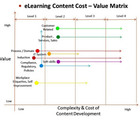
The answer to the above question is "Yes". Refer the eLearning Cost - Value Matrix diagram below:
The matrix shows various Corporate eLearning Content plotted on Value and Complexity/Cost dimensions. Value is typically seen in performance improvement, &/or savings in training costs. Arrows indicate possible movement of the content along either Value or Complexity/Cost dimensions depending upon the company / industry requirements.
Typically, organisations early on their eLearning Lifecycle phase, opt for Compliance / Induction / Domain courses of Level 1 or Level 2 types and then move to more high value and complexity content.
Navitus Education
.
Blog
.
<span class='date ' tip=''><i class='icon-time'></i> Jul 21, 2015 07:04am</span>
|
|
Interactivity is an important element of self-paced eLearning courses. For effectiveness of delivery, it is extremely critical that learners are engaged in a manner that makes learning experience interesting and compelling to focus and learners easily grasp or understand the learnings. This is achieved by making learning courses interactive. A number of standards have been framed to define level of interactivity. One of the most widely followed standard is the one formulated by Department of Defense (DOD), which defines 4 levels of interactivity:
Level I: Passive
In this level, the learner acts merely as a receiver of information. The learner may read text on the screen as well as view graphics, illustrations and charts. The learner may interact simply by using navigational buttons to move forward or back through the program. Engagement Techniques: Learning Content consisting of Simple Text accompanied by Graphics, Illustrative Images, Charts, etc.; Navigation Buttons
Level II: Limited Interaction
In this second level, the learner makes simple responses to instructional cues. The eLearning includes learning activities listed in "Level I" as well as scenario based multiple choice and column matching exercises related to text and graphic presentation. Feedback is given to the user responses either via audio or text. Engagement Techniques: Level I + Audio Narration Video Content, SCORM compliant; Use of Mouse-overs, capturing user input such as mouse click to move forward in the learning course; Simulations requiring learner to follow a process or procedure without any data entry e.g. Organizing objects in a group of objects, sequencing objects in the right order, etc.
Level III: Complex Interaction
In Level III, the learner makes multiple, varied responses to cues. In addition to the types of responses in Level II, complex interactions may require text entry boxes and manipulation of graphic objects to test the assessment of the information presented. Engagement Techniques: Simulations requiring learner to enter data into the fields, Scenario based branching logic where the learner experiences jeopardy for incorrect responses and their journey is predicted on their decisions, Custom animations where the learner has the ability to investigate
Level IV: Real-time Simulations
Real-time simulation creates a training session that involves a life-like set of complex cues and responses in this last level. The learner is engaged in a simulation that exactly mirrors the work situation. Engagement Techniques: Use of games and gaming technology, Real-life 3D simulations, Real-time collaboration amongst learners or learner and instructor to carry-out a simulation exercise.
Navitus Education
.
Blog
.
<span class='date ' tip=''><i class='icon-time'></i> Jul 21, 2015 07:04am</span>
|
|
Advances in web and mobile technology, have led to innovation in education models to address challenges of increasing costs as well as to meet the requirements to enhance quality of education. Following are some of the latest developments in education models:
Online Learning:
Education institutions are increasingly resorting to Self-paced learning as well as Virtual Classroom modes of eLearning, (which together are termed as online learning) to enhance quality of education imparted to their distance learning program students. Self-paced learning enables students to set the pace of their learning, while virtual classrooms gives them access to the faculty for interactive learning. Unlike in the past, education institutions no longer have to invest in expensive V-SAT technology & multi location classroom infrastructure to implement online learning. Students too can access online learning at the time & place, and using devices (laptop, desktops, tablet pcs as well as smart phones) of their choice.
Flipped Classroom:
In the conventional model of learning, students undergo lectures from tutors in the classroom followed by self-study outside of the classroom prior to taking tests & exams. In Flipped Classroom model of education, however, students, first study the theory / concepts related to the course through self-paced online learning course content. Later, in the classroom then students learn the application of these theories / concepts through case studies / problems. This technique is increasingly adopted and is found particularly effective in professional / management education. It makes the process of teaching - learning highly productive and effective.
Blended Classroom:
Blended Classroom model of learning uses online learning as a complementary tool. Here, learners undergo classroom learning first and then typically apply the learnings at their workplace. Follow-up sessions then typically are conducted in virtual classroom mode to address difficulties and challenges faced in applying learnt topics / theories at the workplace. Sometimes, Blended Classroom model is also referred to mode of learning, where courses are delivered using both Classroom and Online Learning technology together.
Social / Collaborative Learning
Social / Collaborative Learning involves large number of students forming a community and helping each other to learn the subject / topic. Social / Collaborative learning have always been existed in pre-Internet era. However, it was limited by geography. Internet has allowed learners across the globe to connect with each other and social / collaborative learning has taken many forms.
MOOC - Massive Open Online Courses
MOOCs are an implementation of Online Learning, typically self-paced courses in the form of pre-recorded videos or virtual classrooms with unlimited participation by learners / students. Due to the large numbers of students involved, this model leverages not only social / collaboration elements in learning but also assessments. Assessments could either be automated tests / quizzes involving multiple choice objective questions, or manual carried out by peers in case of subjective questions.
Navitus Education
.
Blog
.
<span class='date ' tip=''><i class='icon-time'></i> Jul 21, 2015 07:04am</span>
|
|
I have seen a number of organisations spending a lot of time & money in first implementing an expensive eLearning platform & building eLearning Content and then only a few months or years later wondering why their eLearning initiative hasn’t met expected success despite having the world-class system. There are normally many reasons for the eLearning initiatives that contribute to the failure. However, the most common question that is encountered while diagnosing the failure is, whether was it the system or the eLearning Content that was responsible the failure.
eLearning system is the delivery mechanism to deliver the eLearning system. It helps the organisation to administer the learning and has to have at least the following features such as:
- Ability to set-up eLearning courses- Ability to configure exams / quizzes / tests
- Ability to view the eLearning Content
- Ability to participate in Virtual Classrooms
- Ability to undergo exams / tests
- Ability to distribute notes / documents regarding the course content
- Ability to manage users
- Ability to track the performance of the learners
While on the other hand eLearning content:
- Has to be relevant
- Has to be of the right duration
- Has to have the right of interactivity
- Has to be engaging in terms of the style of presentation
As long as the system performs and content meets the above requirements, eLearning initiatives should have a fair chance to succeed. Both the elearning content and the system are important pieces of the the overall eLearning puzzle. So, when it is asked what is important, the content or the system, the answer is not easy.
Very generically speaking, when I evaluate the relative importance of the system and the content, I take the help of Herzberg’s two factor theory of Motivation and Hygiene factors. According to this theory, motivators are those factors, the presence of which motivates people and absence demotivates, while hygiene factors are those factors, presence of which may not motivate people but absence certainly demotivate.
For me, in the context of eLearning, the eLearning System is the hygiene factor, while the Content, the motivation factor. So, the organisation has to invest time and money to make sure that content is relevant, creative, and engaging for the learners, while for the system, not just functionality but also other non-functional requirements such as the following need to be given attention:
- User Interface: Is it really user friendly and cheerful?
- Navigation: Is it simple and intituitve
- Multi-device support: Is system easily accessible from all the types of devices?
- Performance: Are the system response times acceptable to the learners?
- Availability: Is the system available uninterrupted for the learner?
Navitus Education
.
Blog
.
<span class='date ' tip=''><i class='icon-time'></i> Jul 21, 2015 07:04am</span>
|
|
One of the benefits of elearning is the ability that it gives to learning & development administrators to monitor learning by learners. One can not only track the progress of learning by learners but also analyse the response of the learners to the content. But for this to happen, the eLearning content and eLearning system need to communicate with each other. Multiple standards evolved over last 2 decades to faciliate this communication. The most popular standards have been AICC and SCORM. Following is a quick overview on these standards:
AICC
AICC standard was the first such standard and was developed by Aviation Industry CBT Commitee. AICC, an international association of training professionals, was formed in 1988 to develop guidelines for aviation industry to evaluate, develop and deliver Computer Based and Web Based Training. AICC came up with the 1st interoperability specification CMI001 for Learning Management Systems (LMS) in 1993, which were revised subsequently many times as the technology evolved. The last specification, CMI-5, was released in 2010. Although AICC, was fairly popular, over the period its adoption declined due to larger acceptability SCORM standard. Interestingly SCORM was derived from an updated version of CMI001 in 1999. AICC in December of 2014, announced its closure and passed on its documentation of CMI-5 to the ADL (Advanced Distributed Learning), the body that has developed SCORM.
SCORM
SCORM (Sharable Content Object Reference Model) was developed by ADL, an institution part of US Department of Defense (DoD) formed in 1999 by a presidential order in order to meet following objectives:
Identify and recommend standards for training software and associated services purchased by Federal agencies and contractors.
Facilitate and accelerate the development of key technical training standards in industry and in standards-development organizations.
Establish guidelines on the use of standards and provide a mechanism to assist DoD and other Federal agencies in the large-scale development, implementation, and assessment of interoperable and reusable learning systems.
SCORM is is a collection of standards and specifications for web-based electronic educational technology i.e. e-learning. It defines:
communications between client side content and a host system (called "the run-time environment"),
how content may be packaged into a transferable ZIP file called "Package Interchange Format."
SCORM is XML based and has its roots in AICC. Though Various versions of SCROM: SCORM 1.0 (released in Jan 2000) SCORM 1.1 (Jan 2001), SCORM 1.2 (Oct 2001) and SCORM 2004 (Jan 2004, Jul 2004, Oct 2006, Mar 2009), were developed and released, SCORM 1.2 even today remains to be one of the most popular and widely followed standard.
x-API or Tin-Can
ADL released x-API (Experience API) or Tin-Can in 2013. x-API or Tin-Can, which addresses many issues associated with SCORM and is a webservices based standard.
We will see SCORM and x-API specification in more details in later blog entries especially for the benefit of technology professionals.
Recommendations:
If you are a learning and development professional responsible for eLearning initiative within your company, following are some of the key recommendations that you should follow while :
1. Please make sure that your system as well as content (and also authoring tools) are compliant with at least SCORM 1.2 standard.
2. Please also make sure to define your reporting/MIS requirements before you start building particularly your eLearning Content. Based on the reporting requirements, the content needs to be coded with the appropriate SCORM specified code, so that the necessary data can be communicated to the LMS by the eLearning Content at run time. This data is stored by the LMS to generate the required MIS/reports.
Navitus Education
.
Blog
.
<span class='date ' tip=''><i class='icon-time'></i> Jul 21, 2015 07:04am</span>
|
|
For this blog post, we interviewed Dr. Eran Gal, a Learnification expert. Dr. Gal has over sixteen years of experience with enterprises, helping them define, set and accomplish goals, as well as publishing research papers and lecturing at the Holon Institute of Technology.
We asked Dr. Gal to share his insights about what motivates employees, what types of gamification work better than others and what obstacles a company might confront when implementing gamification. Since Dr. Gal is an e-Learning expert, the focus of the interview was on Learnification. Learnification means using Gamification techniques for the purposes of training or employee on-boarding; the use of game mechanics promotes learning, review of materials and encourages a sense of completion. It also provides clear calls-to-action during the process of learning, and is more effective than traditional methods. By creating inherent incentives to learn, implementation of learnification projects promotes better employee knowledge and satisfaction.
What is your definition of Gamification?
Gamification is the use of game-like motivation mechanics in order to produce employee engagement in certain procedures. My focus is the procedure of learning for the purposes of training employees. The industry is moving from basic competitive games between individuals to more elaborate role-play games, which require team-work and cooperation. These gamified elements mimic complex real-life processes.
What do you think is the main challenge of Learnification?
Every Learnification model that exists today has to reinvent its relevance to the organization. Employees today are younger, tech savvy, self-conscious and have a lucid picture of where and how they want to be positioned in the future. The organization on the other hand is productivity biased and needs Learnification to support its goals; it cannot allow the Learnification process to become a disconnected, stand-alone process.
So that’s why gamification is becoming more social and team-oriented?
Social and team gamification come from the understanding that the individual can’t accomplish many corporate tasks, including learning and training, alone. Many companies discover that when an employee has to go through their long training procedure all alone, the company has to invest significantly more, both moneywise and time-wise. In contrast, when the organization creates a social environment (with exists anyway in a company) for an assignment or a process and instructs individuals to work together, as a team, the odds of success are much greater. This fact is old news by now.
Employee motivation has two parts to it: One aspect is that the employee should be having fun, enjoy himself and be interested in the process; the other, is that the employee must feel that the process genuinely contributes to their day to day work, that it has an added value to getting the job done. The game element is therefore very significant, if done correctly. It is what makes people more engaged and more aware of the process.
How would you describe employees’ willingness to participate in the process of Learnification?
The question is "participate in what". What is the experience of the employee? Is it an experience of an assignment that has to done, or one of play? Is it external to the work process or interwoven with it? The issue is definitely whether the employee sees the process as relevant to their work. The other element, equally important, is for the manager to recognize the process as such. In the case that one of these conditions is not met, we may encounter antagonism, a cynical attitude or a lack of cooperation. In this case, even if you wrap it up with organizational tools, the process is doomed to fail. So the most important thing is to apply a process which is relevant to the employees and improves the organization’s performance.
For example, implementing some sort of knowledge collaboration that the worker will either produce or use or both, should support the employee’s work routine. The best way to create knowledge collaboration is gamification. You must produce relevance, but nevertheless, you must wrap it in a way which will make people emotionally attached to the process. It depends on how well you design the gamification solution. Nowadays, if you design a solution which is too obvious, it quickly wears out. A gamification solution which is continuous, personal and intelligent has a chance of surviving and lasting for a longer time as a useful corporate tool.
If you were to advise an HR Manager or Sales Manager to purchase a gamification platform, what would be most important for him/her to look for?
The system has to live in the organization: it has to be integrated easily, in the technical sense. Then, it has to fulfill a vision the organization wishes to enhance. It has to express a specific goal - to motivate employees to participate in a learning process, or evaluation process, on-boarding, improve KPIs etc. The manager would have to make sure that the system provides the right tools.
In your experience -where is gamification is most effective?
Gamification works great with informal learning procedures. Obviously, in courses and in formal training the employee is bound to learn; but throughout the everyday work routine, the effectiveness of gamification is significant to the learning process. When I have to get out of my routine, it has to be for a good reason: it has to be interesting, or fun, "to see how I perform", "how I perform compared to others". This is where the social element comes into play and makes a difference in the quality and quantity of learning.
Games are often driven by competition and yet call for team work. How would you balance competition vs. cooperation?
The question is what is more important for the organization. To improve performance, more competitive elements are required, where individuals compete with each other. When the target is a common goal, or a vision, then games involving team work have to be chosen. The decision has to optimize the organization’s productivity. Basically, different parameters can achieve different results. The optimum is to apply game mechanics in a way that challenges the most employees, in a manner that fits their abilities.
You can build a game mechanic with an essence of sharing. This isn’t simple, because competition is perceived as an individual issue and not as a unifying force. When you build a team process, you have to group-motivate the employees. You have to be very aware as to what are the connecting dots between the people. I never witnessed cases in which competition was so harsh, to the point it was destructive. However, it is important to monitor the process constantly in order to do damage control, or motivate on the spot. Additional sophistication can be profiling of the participants and choosing the parameters accordingly, so no-one would feel left out, or that he or she doesn’t stand a chance since the same people always win. During the process prizes, bonuses, or change parameters can be added, in order to keep everyone engaged.
How do you address the gap between the customer (enterprise) that purchased a gamification solution, and the employee who is the end user?
When implementing a system, you must make sure it doesn’t treat the user (the employee) as a constraint. The programmers of the game must bear in mind not only the benefits to the organization, management, etc. but think constantly of the end user and how they are going to benefit from it. What is the KPI from the user’s point of view? There is never complete correlation, but it should be attempted.
Where do you stand with prizes and material awards?
It is a very problematic issue. I know cases where real prizes, whether an i-Pad or a dinner, brought the competitive component to undesirable levels. At the end of the day someone gets a prize, and if you are not that person, it damages your motivation. If I compare motivation to a locomotive, in some cases it runs so fast, that it could end up derailing. I have witnessed undesirable behavior while people tried to gain points. I know of people logging in with different names to send various emails to promote themselves, or other manipulations.
Basically, the person running the show should know if prizes are right for the specific company or whether they can generate exaggerated competition. It could be something material, but in that case it should be turned back to the team. Something like a joint dinner, or another collective activity. The thing to remember here is that a non-material reward is a reward nevertheless. However, it is important to be very clear about the reward. It should be designated and announced prior to the process; it should be something significant, out of the routine, which everyone in the organization acknowledges.
Many thanks to Dr. Gal Eran for taking part in this interview.
The GameWorks Blog
.
Blog
.
<span class='date ' tip=''><i class='icon-time'></i> Jul 21, 2015 06:40am</span>
|
|
By Corinne Geri:
As is the popular custom these days, I too was challenged to have a bucket of ice water thrown over my head. The Ice Bucket Challenge, sometimes called the ALS Ice Bucket Challenge, is an activity involving dumping a bucket of ice water on one’s head or donating to the ALS Association in the United States. The challenge dares nominated participants to be filmed having a bucket of ice water poured on their heads.
Not one to back down in the face of a challenge, even the kind to require a change of clothing, a bucket was quickly located and filled with bags of ice and… cue the camera!
So while I was being submerged in ice cold water, rethinking my whole prepared-to-take-on-any-challenge-that-might-come-my-way strategy for life, I came to realize the power of social media when it is combined with gaming elements.
What better way to increase engagement and virality than setting up a challenge (complete with an entertaining effect) and then asking people to post videos of their efforts in achieving the goal?
Just take the plunge
So what makes people pour buckets of ice over their heads?
Well, for a start, celebrities are doing it. The internet is awash (pun intended) with the famous, queuing up to douse themselves in freezing liquid. And I won’t lie - if Bill Gates and Mark Zuckerberg opted to chill their brains, I am willing to follow suit.
Having people of influence set a personal example is always a good motivator.
Social media, accessible to every person with a bucket, makes it that much easier to convey your message in the hope that people in your circle will follow your lead.
It also creates a sense of community, making you feel a part of something bigger.
Let’s rewind for a second. What is the ice bucket challenge?
Within 24 hours of being challenged, participants are to record themselves as a bucket of ice water is lifted overhead and poured over the participant’s head.
The participant is expected to donate $10 to the ALS association in the US if they have poured the ice water over their head and donate $100 if they have not. The cycle keeps going since everyone completing the challenge dares others to do the same thing.
This may seem pointless, but all of the awareness for ALS because of the Ice Bucket Challenge led to the ALS Association raising $ 41 million so far, compared to $1.7 million during the same time period (July 29 to Aug. 17) a year ago.
Rise to the challenge
Challenges are often great motivators. In this case, I was called to engage in a somewhat uncomfortable yet undoubtedly achievable task. This is the best kind of challenges - not a walk in the park, but still within reach. People should not get discouraged while trying to complete a challenge beyond their capabilities. At the same time, borrowing Roosevelt’s famous words, nothing worth having or worth doing was ever achieved without effort.
The original goal of the bucket challenge was to raise money for ALS. While people might be reluctant to donate or simply unaware of the cause, they can be persuaded into doing so by being challenged.
Watch me take on the challenge
So now I’m soaking wet and can’t stop sneezing. But I’m also up there, with the best of them, sharing a wet smile with LeBron James, my fellow Ice Bucket Challenge participant.
I have completed the challenge so now, my victory will be perpetuated on the web for all to see. And that is what social media does best - recognition.
Making the world a better place, one droplet at a time
Committing to a meaningful purpose is important for motivation and this challenge is the perfect example.
Donating to charity and helping to raise awareness for diseases are without a doubt worthy causes.
Don’t Try this at the office
OK, so this had all been a refreshing experience, but how can I use the mechanics that seem to be working great in this challenge to do some good within an enterprise environment?
First, we need to choose the challenge. Good choices can be doing something for the greater good and welfare at the company: participating in volunteer work encouraged by the company (and by doing the challenge getting the company to donate money to that cause), or doing something for the general welfare of the company, such as undertaking a clean-up or decoration activity that would make the work environment nicer or more fun (such as a sports facility).
Think of what can be the workplace equivalent to having a bucket of ice poured over your head. It should be fun! Don’t go into taxing those who haven’t participated with a worse task - they just won’t get the recognitions the others got.
Make a Splash
Completed challenges should be published in the company’s internal social network (or newsletter, or widely-distributed email). Colleagues might be asked to vote for the best or most creative execution of the challenge, thus allowing employees that choose not to take on the challenge, to still be part of the game.
To sum up, this challenge proved to be enlightening as well as refreshing. All in all, not a bad activity for a hot summer day!
The GameWorks Blog
.
Blog
.
<span class='date ' tip=''><i class='icon-time'></i> Jul 21, 2015 06:39am</span>
|
|
Can you learn something about social and knowledge collaboration from a venture capitalist? As a longtime enterprise gamification person I was doubtful at first. But now, with the Karma app my answer is a resounding "Yes!".
This July, Aleph VC announced a mobile app called Karma. I wrote about the app’s focus on creating a pay it forward culture and its attempt at gamifying good deeds - here. At the time the app was not available; the app was released on September 7th. This is a review of the knowledge collaboration and social sharing aspects of the app, all of which may come handy as great best practice examples for anyone interested in using gamification to encourage knowledge and social collaboration.
First of all, for those that did not read our previous posts, Karma was created by Aleph, a venture capital fund. Venture Capitalists are interested in promoting knowledge collaboration - entrepreneurs and startups need an environment they can thrive in - and that environment has to be willing to share lessons learned. Otherwise, entrepreneurs risk learning stuff the hard way - although some of the knowledge may have already informally existed in the community. When you learn stuff the hard way, some of the money invested by the venture capitalist is lost… see the reasons behind the necessity of promoting knowledge sharing?
Anyone in the VC space can tell you that much of the advice, know-how and information sharing is done for "karma" - a good deed with no tangible benefit attached. People help each other within the venture community for many reasons - some believe in "pay it forward" - helping others as you were once helped. Some use advice to maintain a reputation, and some do it for its own sake. Yet gamifying "karma" - just like using gamification for enterprise knowledge collaboration - can drive more adoption and result in more knowledge sharing. It is of great interest when people don’t know each other - and this is where gamification can work, by providing recognition and other forms of gamification satisfaction.
The Karma App is a way of institutionalizing advice, making it simpler to access and having the results shared with everyone. The app’s stated goal is to serve "Aleph’s entrepreneurial community, focused on helping the members of this community help each other. You can ask questions, request assistance and provide help to others".
As we had mentioned in our previous post, the app uses gamification elements to reward those who help others. Its inspiration is probably partially reddit, which has used karma points as a way to reward people contributing to its community.
The Karma App is also a nice reminder about how well designed knowledge collaboration can work. Here are some takeways:
1. Remind people of the basics: good onboarding makes knowledge collaboration simple to grasp
The first screens the user sees are those that remind him what Karma is good for.
The "gives & gets" screen says "Karma is a community of entrepreneurs giving and getting help from their peers".
There are several additional screens that ensure that whoever downloaded the app with some unclear notion of what it does will have a better idea of what it is about. This is a great approach when thinking of onboarding anyone on a knowledge collaboration or social collaboration system. State the importance of the system; explain how it works.
2. Don’t just encourage people to answer questions; they should ask one too
One of the first screens forces you to make your first request to the community. You cannot skip it and just browse other people’s questions. This forces people away from a passive involvement in the knowledge collaboration system - they can’t just browse around and see who asked a question. They must ask a question and become active - if they asked one thing they should probably also look for a question to answer. This is also a nice example of "show, don’t tell" since it forces you to see for yourself how your question will be answered.
This is how the Karma app states this principle: "Karma is a community dedicated to mutual help. We would like you to experience that from the get go, so go ahead and ask your first request."
3. Encourage referrals and introductions
Knowledge collaboration is sometimes about directing questions to the right people. Community creation is an important goal for many knowledge collaboration scenarios. That’s why the app encourages you to "introduce and be presented" stating that "when you don’t know the answer, but think of a group or person that might, refer the question to them. It’s just as valuable".
4. Reward contributions immediately
Each action on karma - answering a poll, responding to a question - is noticed and earns karma points.
5. Use a leaderboard
Karma points aren’t just personal. They earn social recognition which is reflected in a leaderboard, which is less about competition and more about recognition.
6. Karma points are made redeemable
On Reddit, karma points exist for their own sake. They are not attached to any tangible benefit. In Aleph’s Karma, Karma points can also be redeemed - but the app doesn’t set a fixed value on them (for instance X hours equal one office hour session or an invite to a closed entrepreneurial event), but rather states they will be redeemed at some future time.
7. But you can keep the rewards undefined - just point to further interactions with the community.
What I like about Karma points is that although Aleph promises they will have some value (probably not monetary and more to do with access and recognition) their future value is tied to interactions with the community, not to money or any other incentive that is external to the system.
The GameWorks Blog
.
Blog
.
<span class='date ' tip=''><i class='icon-time'></i> Jul 21, 2015 06:38am</span>
|
|
Liz Ryan, Founder and CEO of Human Workplace, tells us in a LinkedIn post that employee engagement is a scam.
Here’s a quote from her LinkedIn post "The Employee Engagement Scam":
"Employee engagement is a fake business term that cropped up about twenty years ago because consulting firms and software firms saw something new that they could scam leaders into measuring.
Measurement is an addiction for fearful business and institutional weenies. They can’t stop measuring things because it makes them feel that they’re in control. When the measurements hit established targets, they feel cozy inside.
Employee engagement is typically measured via a once-a-year employee survey. The employees get to fill out a survey to tell their management team how ‘engaged’ they are, as though ‘engagement’ were a real thing instead of a made-up construct devised to give HR people something to measure."
Reading this, I had a surge of contradictory thoughts.
Ryan argues that going for measurement of employee engagement - through anonymous surveys - is a bad idea that de-humanizes the workplace. She argues that HR management would be doing a far better job if they were to listen to employees’ engagement levels - by actually walking around and talking to them.
I wholeheartedly agree. Managers should take the time and energy to sense first-hand what type of energy their organization has. Measurements through surveys are not the best way to get at the heart of the emotional connection people have with their workplaces. They may provide statistics, which are sometimes worse than lies.
On the other hand, I also disagree with Ryan’s approach. Employee Engagement is important; the fact that it’s measured the wrong way doesn’t mean it doesn’t matter. Engaged employees care about the organization they work in, understand it better and do more in it. They can create something that can’t be measured or mechanically induced: a snowball of energy and enthusiasm. In this way, engagement is an important consideration for any organization. As a founder and CEO of an enterprise gamification company - www.gameffective.com - I view employee engagement as a core deliverable of all gamification efforts with several key questions in mind: are employees aligned with corporate goals? Are they changing how they work as a result? Are they working to engage additional employees?
This is why I came up with the employee engagement funnel. It is about making employees aware of corporate goals and engaging them in learning and in getting others to align with corporate goals. The funnel is a step-by-step visual demonstration of how each employee goes through the process of engagement, beginning with awareness of corporate goals, going through training and learning of corporate practices or offerings and eventually leading other employees through the same path. Viewing employee engagement this way gives managers concrete things to relate to and doesn’t focus them on empty measurement:
Are their employees aware of corporate goals, changes, new products, services and more?
Are they aligned with corporate goals (see this post about whether gamification is the new corporate performance management)
Do they care about sharing this knowledge with other employees?
Here are the first and second posts I’ve written about the Employee Engagement Funnel and how it matters for employers AND employees.
In this sense, I am a true believer in Employee Engagement.
The GameWorks Blog
.
Blog
.
<span class='date ' tip=''><i class='icon-time'></i> Jul 21, 2015 06:38am</span>
|