Blogs
|
I stumbled across this image the other day of the launch of Antares/ Cygnus from Virginia. Apart from the fact it is absolutely breathtaking, it really made me think about what we are capable of when we collaborate using technology.When you think of the teams of people who need to communicate to make this possible, is this why technology integration fails in schools? How many schools integrate a new technology by asking what we want to be able to do and working towards it? It is more likely that someone in the leadership team saw a sales presentation and thought that looks great, we should get it. In the presentation, they were told that the product could do x, y and z. What they didn't realise was that to get it to do x, y and z, you need a team of people to troubleshoot, experiment and develop the solution to meet the needs of the school. Even if you get the technical side down, the teachers often don't see how it will help them to help students learn more effectively.Even the most expensive rocket will get nowhere without fuel. When I hear of schools investing in expensive learning platforms (the rocket), I really think they need to think about whether they have the fuel to get it to lift off. The fuel for most schools has to be a willing body of staff that see the purpose in the mission and work together to make it a success. This post originally appeared on Free Technology for Schools www.freetechforschools.com
Jonny Liddell
.
Blog
.
<span class='date ' tip=''><i class='icon-time'></i> Jul 23, 2015 09:15am</span>
|
|
Verissimo Toste, an Oxford teacher trainer, looks at some different ways the language learning experience can be enriched.
More and more, English as a Foreign Language (EFL) is being taught in mainstream schools around the world. As part of a larger curriculum of general education, EFL teachers have an opportunity to focus on aspects of learning beyond grammar, vocabulary, and the traditional four skills. With the aim of enriching the language learning experience, I would like to focus on some of these aspects. For the experienced EFL teacher, these will not be new, but I hope that by focussing on them here, it will encourage teachers to give them more importance in their classrooms.
Encourage questions
This may seem obvious, but it is not always easy, especially when a lot of education leads many students to become passive recipients of information.
Before beginning a lesson or a unit of work on a topic, ask students what they already know about it. Make sure they do this individually first in order to get input from everyone. Have them share their knowledge. Then, tell them the next unit is on this topic. What do they want to know? Ask each student to write 1 or 2 questions. If you can, display the questions in the classroom. In this way you can refer to them as you work through the unit.
Encouraging questions from the very beginning tells your students that you expect them to be actively involved in the work of the class. Further, it tells them that what they are learning should be meaningful and useful to them. It is the best way to learn.
Bring their world into the classroom
Think about the lives of your students, at school, at home, their neighbourhood, city, country. Now think about what you will be teaching them during the term or the school year. How can you bring their world into the classroom? Let me give you a simple example. When teaching "can" for abilities, consider involving the physical education teacher. Students can do some of the activities in the physical education class, like jumping, running, throwing, etc. Once they have done the tasks, you can use the information in the English class as students express what they can do. This can be in the form of graphs or tables, individual or class posters. The important point is that students will be learning and using the language to communicate real information. The language they learn is not simply an end in itself, but a means to communicate.
Students can make a timeline of historical events to practice the past tenses based on work in their History lessons, explain the process of an experiment from the Science class, use skills from their Art classes to create displays of their work, as well as critical thinking skills from Maths classes to organise their language learning. The key is to involve other school subjects, and the teachers of those subjects, in the students’ language learning experience.
Once you have considered the school, move on to life outside school. How can you involve family and friends? One of my favourite activities with my students was when I was teaching "used to" to teenagers. I asked each student to talk to their grandparents and bring to class 2 - 3 things that were very different now from the time their grandparents were teenagers. I then would use the information to introduce the language point, "used to". The students were so interested in the information that the language quickly became secondary, and easy to use.
Stories
I am a big fan of stories. Someone once told me that stories may have been the first form of education, as people communicated important information around the camp fire. I have little trouble believing this. There is something about the structure of stories that makes learning easier. For this reason, stories are a great medium for language use.
Stories are everywhere: what happened on a holiday is a story, how a student begins his day is a story, what happened on the way home is a story. We tell each other stories every day. The key is the structure - beginning, middle, and end. The story develops, leading us to the end. It is by nature interesting, otherwise we wouldn’t be telling it.
When considering the topics and language you will be teaching, think about how these can be included in a story. The story may provide the basis for the language you want students to learn, or it may be the vehicle for the topic of the unit. When stories become a part of your teaching, you will naturally begin to collect them. Don’t forget local stories, stories from your students, and traditional stories of the country you live in.
Sense of achievement
Too many times education focusses on what students don’t know. Rarely do we have the opportunity to show students how much they have learned. Just as students learn the present simple, we move on to the present continuous. Just as they grasp past simple with regular verbs, we introduce them to irregular verb forms. Education focusses on what students don’t know. So, giving students a sense of achievement based on how much they have learned is important to raise students’ self-esteem and confidence in their ability to learn more.
Brief, unit-based projects can offer students the opportunity to show what they have learned, as well as give many students a second chance to learn what they have forgotten. Encourage your students to see the project as a learning opportunity: What language are they using? What mistakes are they still making? What are their weaknesses? Their strengths? How could they improve? The aim is not simply to learn more, but also to get students used to reflecting on their learning. In this way short projects can help students become better learners.
These four points may seem obvious, but it is not always easy to make them an integral part of our classes. However, as they do become a part of your lessons, you will find your students becoming more active in their learning. You will also find that learning itself will have more meaning and become more rewarding.
Image is taken from Flickr under the Creative Commons licenseFiled under: CLIL, Teenagers, Young Learners Tagged: Class questions, EFL, Language learning, Questions, Stories, Verri Toste
Oxford University Press ELT blog
.
Blog
.
<span class='date ' tip=''><i class='icon-time'></i> Jul 23, 2015 09:14am</span>
|
|
Wideo is a web-based platform for creating animated videos and is completely free. You can either create an account or log in using your Facebook account and be creating animated videos in seconds.The interface is very user friendly meaning that someone with zero artistic talent like me can create something with ease. I can see this being used effectively by students as a way to do short presentations or for teachers looking to add a bit of fun to presenting concepts.This video (or should I say Wideo) shows what it can do.This post originally appeared on Free Technology for Schools www.freetechforschools.com
Jonny Liddell
.
Blog
.
<span class='date ' tip=''><i class='icon-time'></i> Jul 23, 2015 09:14am</span>
|
|
Ian Brookes is a freelance writer and editor based in Scotland. He has edited a number of dictionaries and has written books about spelling, writing, and punctuation. In this post he takes a look at where some of our words have come from.
English has been described as a ‘magpie language’. If you look up the word magpie in the Oxford Advanced Learner’s Dictionary you will find a reference to ‘a popular belief that magpies like to steal small bright objects’. In the same way, the English language has been quite happy to steal useful words from other languages and add these to its vocabulary.
When English borrows words, it sometimes keeps the original spelling form, but sometimes it alters the spelling. As a general rule, when words are borrowed from unfamiliar, non-European languages, they are more likely to be transformed so that the spelling and pronunciation conform to familiar English patterns. Words taken from Asian, American, and African languages can appear in English with their spellings radically changed, as in the cases of chutney (from the Hindi word catni) and hickory (derived from the Algonquian pawcohiccora).
When English borrows words from European languages, however, it often preserves the original spelling and aspects of the original pronunciation. This is probably because native English speakers have some familiarity with the rules of French, German, Italian, Spanish, Latin, and Greek. So we preserve the French word brochure in its original spelling, and pronounce the -ch- as /ʃ/ in the French manner; similarly, we preserve the Italian spelling of pizza, and pronounce -zz- as /ts/.
Here are some other patterns of spelling and sound that do not conform to the standard English rules but are found in borrowed words:
-eau- is pronounced as /əʊ/ in words borrowed from French, as in bureau.
-que is pronounced as /k/ at the end of words borrowed from French, as in mystique.
-cci- is pronounced as /tʃiː/ in words borrowed from Italian, as in cappuccino.
Moreover, there are certain general rules that apply to English spelling that have to be suspended in the case of borrowed words. One of the most familiar spelling rules is that ‘I comes before E except after C’. However, caffeine and protein break this rule because they follow the pattern used in their original French and German spellings.
Less well known is the principle that native English words do not end with -a, -i, or -u. Perhaps the reason this principle is not well known is that there are so many exceptions created by borrowed words such as orchestra (Greek), spaghetti (Italian), and haiku (Japanese).
It is highly unusual to find a double consonant at the start of an English word. When it does happen, in the case of llama, again the explanation is to be found in the fact that the word is borrowed (in this case from Spanish).
Finally, we should note that the tendency of words borrowed from French, Italian, Latin, and Greek to form plurals following the pattern of their original languages (although in some more common words these inflections are not used or are regarded as alternatives to the simple addition of -s):
French words ending in -eau form plurals that end in -eaux, as in tableaux and gateaux.
Italian words ending in -o form plurals ending in -i, as in Mafiosi and paparazzi.
Latin words ending in -us form plurals ending in -i, as in stimuli and fungi.
Greek words ending in -on form plurals ending in -a, as in phenomena and criteria.
So if you were wondering why learners of English have to cope with so many exceptions, now you know the answer. It’s not the fault of English; it’s the fault of all the other languages!Filed under: Dictionaries & Reference, Grammar & Vocabulary Tagged: Etymology, Language, OALD, Vocabulary
Oxford University Press ELT blog
.
Blog
.
<span class='date ' tip=''><i class='icon-time'></i> Jul 23, 2015 09:14am</span>
|
|
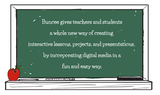
This is a guest post by David Kapuler, K-12 educator, tech integration specialist, blogger, consultant, etc. This was originally posted hereBuncee is a innovative new (beta) site for creating interactive presentations/lessons. This is a fantastically simple site to use to create not only beautiful looking slideshows but e-cards, posters, and more. I like to think of it as a combination of Glogster, Smore, and Biteslide. Best of all a user can embed a Buncee (presentation) into their site/blog. Finally, there are a ton of educational resources to browse through such as: lessons, projects, flyers, etc.Here are some ways Buncee can be used in the classroom (from their site)...*A great learning tool for Blended or Project Based Learning, as well as Flipping a Classroom.create interactive lessons or projects that flip your classroom in a fun and easy wayintroduce technology w/ Buncee projects and assignments that spark creativity and help support common core standardshave students of any age easily create multimedia projectsshare engaging school event invites, or class news w/ students, parents, and the community.I highly recommend checking out Buncee by clicking here!!!Below is a brief demo....This post originally appeared on Free Technology for Schools www.freetechforschools.com
Jonny Liddell
.
Blog
.
<span class='date ' tip=''><i class='icon-time'></i> Jul 23, 2015 09:14am</span>
|
|
Stacey Hughes, former teacher and current teacher trainer in the Professional Development team at Oxford University Press, shares some practical tips on getting your students to assess themselves, and each other.
We all need a fresh set of eyes sometimes. Successful writers or speakers often ask a peer for feedback. So, what is group, peer and self-assessment in the language classroom? For starters, it is not necessarily part of grading - we are not asking students to give each other a mark that will then count towards their grade. What it should involve is peer-to-peer communication about what is good about a piece of work and how it can be improved. It involves some learner training and it is important that assessment is not aimed at the individual, but at the work.
In this article, I’ll give examples of how group assessment might work for a presentation, how peer assessment might work for writing and how self-assessment might work in several contexts.
Preparing students to peer assess
Peer assessment may be new to students, so it is important to show them why it is a good idea, how it can benefit them and, most importantly, agree to some behavioural guidelines. Talk to your students about the benefits of peer assessment and get the class to draw up a list of guidelines. Some key points are below:
Peers can help us review our work so we can get a better grade.
Learning to help each other is a skill that will be used in a job.
Assessing a peer’s work can help us develop our own work by making us more aware of how a piece of writing or speaking affects the audience.
Example guidelines:
Comment on what is good.
Don’t make personal comments - just comment on the work.
Don’t judge. Be helpful.
Don’t just say something is bad or good. Say what is bad or good and why it’s bad or good.
Try to explain how it could be better.
Group assessment - group assesses group
As part of preparing for group presentations, set a date when all groups present to another group. You may need to send some groups out or if your classroom is suitable, just group them around the room. Give each member of the groups a sheet to fill in (see the example below) to help guide their comments. For a presentation, there are a number of different aspects that you might want groups to comment on. Create a feedback sheet that reflects what you have taught and what you will be grading on. The example below is fairly comprehensive and includes example student comments.
Please write a comment
Structure
Is it clear?
Is there an introduction?
Is there a conclusion?
You need an introduction. I wasn’t sure what you were going to talk about. You could say what your conclusion is. The main body was clear.
Content
Clear?
Engaging?
Did each person’s contribution connect with the others’?
Did each person contribute equally?
I really liked your topic. It was interesting. Maybe you could refer to each other’s section to make the presentation feel more connected. I think everyone spoke for the same amount of time.
Visuals
Clear?
Did they add to the content?
The visuals were clear and made the presentation more interesting.
Body language & voice
Confident?
Volume?
Eye contact?
Raul - very confident; good eye contact
Maria - I couldn’t hear you well; please speak more loudly Nida - maybe more eye contact; maybe use note cards instead of reading from a paper
Language & pronunciation
Clear?
Key words pronounced clearly?
Mostly clear. Raul, I didn’t understand what you said about the water on the roads. Nida - you were reading, so it didn’t sound natural. Maybe practice in front of a mirror.
Answering questions
How well did the group answer questions?
You answered questions well. You have good knowledge of the topic.
Peer assesses peer
As part of the writing process, ask peers to assess each other’s written work. Sometimes students think that they can’t judge another’s work because they think their English isn’t good enough. To help students realise that their contribution can be valuable, make sure have clear guidelines for what to look for in each piece of writing. Tell them that their goal is not to find every grammar mistake, but to just comment from the reader’s perspective.
The example below (with example student comment) is based on a paragraph about a holiday.
Please write a comment
Structure
Clear?
Topic sentence?
The structure is OK. You need a topic sentence. Your sentences are very short. You need to combine sentences 1 and 2 and 3 and 4. Maybe you can use and and but.
Content
Does it answer the question?
Does it make sense?
Why is it interesting?
You wrote about your holiday, but not about your feelings. You need to include your feelings. It makes sense. It is interesting because I have never been to Thailand.
Language
Vocabulary
Grammar
Punctuation
Spelling
You used good words like hotel reception and flew. Grammar is good, but past of take is took. You need to capitalise the city. Spelling is good.
Presentation
Indented paragraph handwriting
You should indent the first sentence. Your handwriting is very clear and neat.
Self-assessment
Self-assessment is not only useful as part of the writing process, but can also help students see the progress they are making.
The following simple checklist is an example of how to raise a student’s awareness of what they should be including in writing. It also gives them guidance on how to go about editing their work. It is based on writing a summary and review of a story.
Have you got two paragraphs?
Is the first paragraph a summary of the plot of the story?
Is the second paragraph about your views on the story?
Did you give reasons for your opinions?
Do you have topic sentences?
Look at your grammar: did you use present tense?
Look at your vocabulary: did you use some of the words you learned to describe plot? Did you use words like, because and for example?
Students can also assess their speaking performance in pair and group work. This could help motivate students to speak in English when it is often more natural to use the L1. Make a simple checklist which highlights the goals for speaking in pairs or groups:
I spoke in English
I asked another person a question
If I didn’t understand, I asked for clarification
If someone wasn’t speaking, I asked them for their opinion
When I didn’t know what to say, I said it another way
Can-do statements are a great way for students to assess whether or not they have achieved language aims. They should be very specific; for example, they can be directly linked to a unit. Collectively, these will help students see the progress they have made over time.
I have finished unit X and I can:
Use the past tense to talk about what I did yesterday
Use words like, last week, yesterday, a month ago in a sentence
Ask someone questions about what they did last week/ last month/ last year
Understand someone telling a story about their problems last week on the train
This article first appeared in the March 2014 edition of the Teaching Adults Newsletter - a round-up of news, interviews and resources specifically for teachers of adults. If you teach adults, subscribe to the Teaching Adults Newsletter now.Filed under: Adults / Young Adults, Exams & Testing Tagged: Adult Learners, Adults, Can-do statements, EFL, Group assessment, Peer assessment, Self-assessment, Stacey Hughes, Teaching adults
Oxford University Press ELT blog
.
Blog
.
<span class='date ' tip=''><i class='icon-time'></i> Jul 23, 2015 09:14am</span>
|
|
This is a guest post by David Kapuler, K-12 educator, tech integration specialist, blogger, consultant, etc. It was originally posted here 30 hands is a wonderful free iOS app that is ideal for digital storytelling and mobile learning. This is a very user friendly drag-n-drop app that allows students to create digital stories by importing photos from their iPhoto library. Best of all, a user can add narration to a slide by recording their voice. Finally, a finished story can then be published to their iPhoto library or shared to the 30hands Collaborative Learning Community. There is even a very simple to follow walk-through that shows how to create your first story.I highly recommend checking out 30hands by clicking here!!!This post originally appeared on Free Technology for Schools www.freetechforschools.com
Jonny Liddell
.
Blog
.
<span class='date ' tip=''><i class='icon-time'></i> Jul 23, 2015 09:14am</span>
|
|
Zarina Subhan-Brewer is a freelance teacher trainer and has been working in the field of English as a Foreign Language (EFL) for over 20 years. Here she previews the upcoming webinar How to get students writing which takes place on Wednesday 18th June and Friday 20th June.
Do you see more and more people whip out their smartphones to take a note of something instead of a notebook and pen?
With the advent of technology, you’d be forgiven for thinking that the act of writing is dying out. I don’t know about you, but I still like to scribble ideas down on paper. I think better with a pen in my hand, and even while using technology, that circumnavigates the need to write, I have a pen and paper to hand, or even a pen in my mouth!
In ELT, writing is a skill that tends to be developed later, once students become confident in listening, speaking and reading skills. This makes absolute pedagogical sense of course - immediate communication skills are strengthened in order to give students the ability to react and respond in real time to each other. These skills also lend themselves well to more fun-filled activities in the classroom, which can keep the learner engaged and motivated. As language teachers, however, we are also obliged to facilitate the learning of writing skills.
Writing in English is no longer simply something students have to demonstrate in order to pass exams. It is a skill which affects employment opportunities and is actually put to practical use in the global village we now occupy. It is a skill that can open many doors and can be the deciding factor between one person being promoted and the next. Therefore we need to ensure that even though writing may be a skill that is taught and developed last of all of the four skills, it is not one that is ‘half-heartedly’ taught.
So how can we get our students to spend time on writing activities that can make lessons less fun and more ‘serious’? In the webinar How to get students writing, we’re going to look at what constitutes writing, the difficulties students have with writing and the subsequent problems that arise for teachers and what can be done to overcome them.Filed under: Professional Development, Skills, Teenagers Tagged: #insightwebinar, insight, Writing, Zarina Subhan, Zarina Subhan-Brewer
Oxford University Press ELT blog
.
Blog
.
<span class='date ' tip=''><i class='icon-time'></i> Jul 23, 2015 09:13am</span>
|
|
Happy birthday Free Technology for Schools! On the 15th of January last year I published my first every blog post entitled "Where Should Schools Spend their Money?". The idea for the blog came from a general frustration with how schools waste so much money on technology without considering the excellent free solutions available. Creating Free Technology for Schools has helped me widen my professional network in ways I didn't know were possible and I have had some great help from the people I have connected with.There have been many highlights over the last year especially in the initial stages as I watched it grow, reaching a peak of over 17000 pageviews in May. I hope this year to increase this fivefold although I have been a little quiet lately due to my wife having a baby. Another year of blogging deserves some resolutions, it is January after all so this is what I would like to achieve this year.Grow the blog to 100000 pageviews every month. In the first 4 months last year, the traffic to the site at least doubled every month for the first 4 months. More traffic means more connections and more sharing of ideas.Find the time to post at least once a week. It's not about lack of time, it's about making time. If I can find time to Facebook, I can find time to blog.Connect, connect connect. The best thing about blogging is the connections you make. I hope this year to meet many more wonderful colleagues to share ideas with. I have had so much help this year it has been amazingGet more guest bloggers involved. This blog is designed to be collaborative so drop me a line if you want to get involved.Keep finding things to blog about. The great thing about having this kind of blog is that it encourages/forces me to continually develop and find new technologies that enhance learning.If you are reading this, I hope you have found the blog useful over the last year and I hope you keep coming back. Don't forget to follow on Facebook, Twitter, Google+, RSS or email. This post originally appeared on Free Technology for Schools www.freetechforschools.com
Jonny Liddell
.
Blog
.
<span class='date ' tip=''><i class='icon-time'></i> Jul 23, 2015 09:13am</span>
|
|
This is a guest post by Lim Chuwei, a tutor working at www.championtutor.com and father of two teenagers, the author actively makes use of iPad apps in his own classes and has benefited much from the use of these apps.Every teacher has something to share and explore with their students. In today’s technology driven world, having a latest Apple gadget is not just trendy, but also very handy. Teachers can help unearth the hidden talent of their students using unique ways provided via iPad’s App pool. So, whatever the lesson, you can make apps part of the plan. The power lies on your mighty Palm with the presence of these Apps.iPad is touted today as a versatile tool in education. It is defined as "Everything you need to teach anything". With some of the Apps described further in the reading that make students feel delighted and captivate them on the topic being taught. These apps provide a deep insight into the new world of learning possibilities. EvernoteEvernote is very popular, easy-to-use, free app that helps you to stay organized. It helps you by collecting and finding everything that matters. Evernote app lets you take notes, capture images, record voice reminders, synchronize files across all your devices. With this you can remember everything about your ideas.CloudReadersCloudReaders is free book /movie viewer/ comic, which is fully optimized for iPad. With its new version 2.02, it’s now possible to share your books over WiFi. It also supports on iPhone/iPod touch too! This app is freely available on itunes store.iPad outlineiPad outline is completely free to download and use. Outline is a robust app for note taking and drawing. Everything you create using it is saved in a user friendly notebook format with sections, subsections, groups and pages. It is similar to exactly using the old paper notebook. Outline is very powerful text editor with a variety of features that came as a Built-in. It helps in emphasizing text and provides a good organizational framework. NumbersNumbers is the most innovative spreadsheet app designed for a mobile device like iPad. This amazing app lets you make interesting spreadsheets in minutes. Using just your fingers you can add tables, charts and images into this app.Teacher Tool OneTeacher Tool One is an app designed for updating teachers always. It offers a combined package of gradebook, calendar, notebook and course register in your pocket that is always available and complete.Super 8With the help of Super 8 you can make professional-quality videos, movies and also add the shake effects. You can also arrange clips and scenes the way you want.Teacher’s can add their own credits also.Science 360Science 360 app is the result of creativity from the National Science Foundation (NSF) for iPad. This app provides easy access to engaging Science and Engineering images and videos from around the globe. A news feed featuring breaking news from NSF-funded institutions is a bonus.Dictionary for iPadDictionary is an Excellent, intuitive, consistent, hyperlinked, consistent and integrated English illustrated dictionary and thesaurus, spell checker, vocabulary builder and Wikipedia browser. It is premium quality reference, fast, reliable, up-to-date and really easy to use. You will love it! ShowMeShowMe can be freely downloaded from iTunes. This app turns your iPad into your personal interactive whiteboard. ShowMe allows you to record voice-over whiteboard tutorials and share them online without any delay. It’s an amazingly simple app that is best suited for teachers.This post originally appeared on Free Technology for Schools www.freetechforschools.com
Jonny Liddell
.
Blog
.
<span class='date ' tip=''><i class='icon-time'></i> Jul 23, 2015 09:12am</span>
|