Blogs
|
Those of us involved in training-teaching-learning viscerally understand the power of a good story and the value of a good storyteller. So when New York Times columnist Bob Herbert left the newspaper in 2011 to accept a position with the public policy organization Demos, some of us felt as if one of the great storytellers in American journalism was vanishing—and that our world, consequently, would be a bit less vibrant.
Herbert’s writing in the Times was always strong, passionate, inspiring, and laser-sharp in its focus on stories that provided context and gave meaning to the overwhelming flow of reports that inundate us day after day. His final column ("Losing Our Way"), in fact, began with the observation "So here we are pouring shiploads of cash into yet another war, this time in Libya, while simultaneously demolishing school budgets, closing libraries, laying off teachers and police officers, and generally letting the bottom fall out of the quality of life here at home." Those words provided a searing reminder to that learning, libraries, and involvement in the setting of public policy are integral parts of the overall responsibility each of us has to actively working to create the world we would like to have.
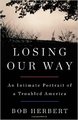
It’s a pleasure, therefore, to find that the storyteller has returned with a book that effectively and engagingly expands the thoughts included in that final New York Times column—Losing Our Way: An Intimate Portrait of a Troubled America—and continues what he has occasionally produced via columns for Demos.
Losing Our Way focuses "most intently on four specific areas: the employment crisis, which was badly underestimated and poorly understood; the need to rebuild and modernize the nation’s infrastructure and the relationship of that vast project to employment; the critical task of revitalizing the public schools in a way that meets the profound educational imperatives of the twenty-first century; and the essential obligation that we have as rational and civilized beings to stop fighting pointless and profoundly debilitating wars," he tells us in his introductory author’s note (p. 6).
As always, the real strength and value of what Herbert produces is in his attention to the human side of the story—just as so much of what we do in training-teaching-learning benefits from focusing on the human element of our efforts. We don’t, in Losing Our Way, find the typical unengaging diatribe against our failing infrastructure; we follow—and are moved by—the story of Mercedes Gordon, a woman who was driving across the I-35 bridge across the Mississippi River the day the bridge collapsed and sent Gordon and others into a plunge that shattered and took lives. We don’t find ourselves in another exploration of the financial cost of wars; we follow Dan Berschinski from the moment he loses his legs in Afghanistan, through the unexpected story of how he struggles to regain an incredible amount of mobility, and then muse, with Herbert, over the way the honoring of Berschinski for his achievements carries with it the deeper question of why "there seemed to be no collective sense that it was insane to allow the maiming of men like Dan…to continue so may long years after the attacks of September 11, 2001….What was the point?" (p. 169)
And when we move into the realm of learning, via an exploration of what is happening in our public schools, we don’t simply rehash the failed policies that, according to Herbert, have undercut rather than enhanced our educational system; we see how individuals including Jessie Ramey and Kathy Newman, in Pennsylvania, refused to accept billion-dollar cuts to educational programs and, through hard work, created partnerships that drew attention to the human cost of those reductions.
"The United States needs to be reimagined…" Herbert writes at the conclusion of his book. "Ordinary citizens far from the traditional centers of power…profoundly changed American society. Through sustained, thoughtful, and courageous efforts they…shifted the nation onto a better path. A comparable effort by ordinary citizens is needed today if the United States is to regain its great promise of fairness and opportunity for all" (pp. 245, 247).
As I sit here in Chicago, about to join colleagues for a variety of discussions at the American Library Association Midwinter Meeting, I think about Herbert’s earlier references to the closing of libraries, about the challenges we face in providing effective learning opportunities, and about his call for reimagining the world around us—and I think I couldn’t be in better company to explore what training-teaching-learning, effective collaborations, and engagement in active communities of learning and communities of practice can produce.
Paul Signorelli
.
Blog
.
<span class='date ' tip=''><i class='icon-time'></i> Jul 23, 2015 02:10pm</span>
|
|
We’ve known, for a long time, that having key players in the room is an essential part of fostering achievements in training-teaching-learning and many other endeavors. What wasn’t as obvious until recently is that drawing those essential colleagues into the room is becoming increasingly simple by redefining what the room actually is.
Attending the New Media Consortium (NMC) Horizon Project retreat—"The Black Swan Ball"—in Austin, Texas a couple of weeks ago provided a fabulous reminder of how our concepts of meeting spaces are changing. Arriving in Chicago yesterday for the American Library Association (ALA) 2015 Midwinter Meeting is supplying another dynamic example of this development. And other ongoing personal experiments in creating a virtual presence within onsite meetings convince me that we’re seeing a major shift in how our changing concepts of meeting spaces, learning spaces, participation, and collaboration are working to our advantage.
While drawing an offsite colleague into onsite meetings as a co-presenter via Google Hangouts over the past couple of years, I have asked onsite meeting participants to describe how big our meeting spaces are. It quickly becomes obvious to everyone that our videoconferencing capabilities have improved to the point where those offsite participants feel as if they are physically present with us—and we with them—so the room is no longer defined by the immediate four walls that surround us—it extends over the hundreds (or thousands) of miles that would separate us if our technology didn’t create a visceral, virtual presence for all involved.
Our NMC colleagues at the Black Swan Ball—an event inspired by Nassim Nicholas Taleb’s book The Black Swan: The Impact of the Highly Improbable and designed to help us develop the skills needed to adapt when what seemed improbably quickly becomes commonplace—were exemplary in creating a meeting space that transcended physical walls. Even though we were all in the same conference center room for much of the discussion, we were also using virtual spaces created online by NMC staff so we could create, in the moment, learning objects that would carry the discussion out of the room so the explorations would not end when the conference did. And, by the simple act of tweeting observations while those discussions were underway, we found the discussions spreading far beyond the conference center premises even while invited participants were still onsite.
Our ALA colleagues are taking this expansion-of-the-room concept further than what I have seen most organizations attempt. Acknowledging that there is frequently a conference backchannel conversation nurtured by those who consider themselves "left behind" by their inability to be onsite (united via the hashtag #ALALeftBehind), conference representatives have already encouraged the "left behind" crowd to expand the size of the room and join the conversation via LinkedIn, Twitter, Facebook, and pages on the Association’s website:
"You can get a flavor of the event and insights by following American Libraries coverage at http://www.americanlibrariesmagazine.org/alamw15 and the show daily, Cognotes, at http://alamw15.ala.org/cognotes.
"You can also
track #alamw15 on Twitter at https://twitter.com/search?q=%23alamw15
join the Facebook Event at http://bit.ly/mw15event
get the latest on Google+ at http://bit.ly/alamw15gp
follow the Pinterest board at http://www.pinterest.com/alamidwinter/
keep up on Tumblr at http://americanlibraryassoc.tumblr.com/
follow the fun on Instagram at http://bit.ly/ALAinstagram
"And looking ahead-for information about the 2015 ALA Annual Conference & Exhibition June 25-30, and to find resources to help you make your case for attending, visit http://alaannual.org."
This is a magnificent example of how a commitment to inclusivity and a bit of advance planning can create opportunities for extended conversations; greater levels of engagement among members of an association, a community of learning, a community of practice, or any other collaborative body; and an awareness of how existing tools and resources can create possibilities where barriers once existed. If each of us at the Midwinter Meeting (or any other onsite convocation) contributes to the effort to draw our offsite colleagues into the onsite conversations, and our offsite colleagues reciprocate by contributing via the channels available to them, we will have taken another positive, productive step toward expanding the size of our room and fostering the levels of collaboration that produce results beyond anything we previously imagined.
Paul Signorelli
.
Blog
.
<span class='date ' tip=''><i class='icon-time'></i> Jul 23, 2015 02:09pm</span>
|
|
When as association like the American Library Association (ALA) sets out to empower its members by fostering collaboration, magic happens, as a few of us saw again yesterday while attending an open discussion about online learning in libraries at the ALA 2015 Midwinter Meeting here in Chicago.
Arriving early for a 90-minute session, seven of us who had not previously met engaged in brief, informal conversation for several minutes while waiting for the session facilitator to arrive. And when it became clear that the facilitator was not going to arrive, we quickly decided we weren’t going to take the typical tact of assuming we should leave because the session had been cancelled. ALA, after all, does many things very, very well—including creating opportunities where members interact informally, help shape the conversations we want to join, and extend conversations across onsite and online platforms to be sure no interested member is left behind.
Because most of the members in that room are involved in training-teaching-learning endeavors in university libraries, we’re familiar with how to design and facilitate effective learning opportunities, so we quickly agreed to start by introducing ourselves and the work we do. We then agreed that we wanted a couple of clear-cut learning objectives: an exchange of ideas about the current state of online learning in libraries, and the possibility of initiating a conversation that would continue long after that initial 90-minute session came to an end. So we exchanged business cards, took a few minutes to describe what we hoped to learn from each other during our time together, and even, thanks to one participant’s action, created an online document to capture highlights from the conversation in the hope that the document would quickly evolve into an ongoing "learning space" where we could continue to learn with and from each other.
One of the most striking elements of this entire meeting created on the fly was how it reflected so much of what is happening in training-teaching-learning today: a recognition that learners gain by shaping their own learning experiences—as we did during those 90 minutes of conversation. And that collaborative or connected learning is most effective when there is no one dominant voice in a learning situation. If everyone contributes, everyone gains—which is what ALA so effectively nurtures by bringing colleagues together in ways that combine formal and informal learning while connecting onsite and offsite colleagues in engaging ways.
As we created our own meeting/discussion within the overall Midwinter Meeting context, we found immediate payoffs. In sharing observations about what is happening among undergraduates engaged in online learning, we learned that the University of Arizona University Libraries has an open source program called Guide on the Side and that is has been successful enough to be adopted by others. We explored the challenge so many of us face in trying to define and support digital literacy and shared links to resources including Doug Belshaw’s online Ph.D. thesis on digital literacy: What Is Digital Literacy? A Pragmatic Investigation. We briefly explored the challenges of working with learners in online environments when those learners have been inadequately prepared to thrive in online learning environments, and heard a bit about the first-rate report Adaptability to Online Learning: Differences Across Types of Students and Academic Subject Areas, by Di Xu and Shanna Smith Jaggars, published through the Community College Research Center, Teachers College, at Columbia University.
Moving on to the topic of Open Educational Resources (OERs) in learning, we heard a colleague summarize what she had learned earlier in the day while attending an Association of College and Research Libraries (ACRL) OER session here at the Midwinter Meeting. OERs, she noted, are offering great benefits for international distance learners—including access to OERs in a timely fashion instead of making those learners wait weeks for standard printed textbooks to arrive via mail. We learned that Rice University is doing great work with OER textbooks through its OpenStax College and that more libraries are beginning to work in this area—actually appointing "OER librarians." We heard about colleagues who are first-rate resources for us on the topic of OERs, e.g., Nicole Allen, Director of Open Education for SPARC (the Scholarly Publishing and Academic Resources Coalition); David Wiley, Associate Professor of Instructional Psychology and Technology at Brigham Young University; and Steven Bell, Associate University Librarian Temple University, through his work on open textbooks.
We heard numerous examples of how colleagues are engaging learners by creating and embedding personal videos in online courses, facilitating online forums that include audio feedback to learners, and using Twitter, Facebook, and Google Hangouts for online office hours and other learning opportunities that are showing online learning can be every bit as personal and engaging as face-to-face learning can be.
A frequently-used tagline used by ALA to describe its conferences and large-scale meetings is "the conversation begins here." Conversations certainly began in that small conference room yesterday afternoon, and may well continue through extended interactions in virtual "learning spaces" including live tweet chats, development of that shared online document, and even blog articles along the lines of this one. They key is that we are responsible for fostering our own learning, creating our own meetings, and taking full advantage of the learning opportunities that continue to come our way through the simple act of association.
Paul Signorelli
.
Blog
.
<span class='date ' tip=''><i class='icon-time'></i> Jul 23, 2015 02:09pm</span>
|
|
With informal help and encouragement from our staff colleagues in the American Library Association (ALA), several of us successfully managed, this afternoon, to reduce the number of people "left behind" during the current ALA 2015 Midwinter Meeting being held here in Chicago. And, in the process, we produced a learning object designed to help members of ALA and other associations achieve similarly rewarding results.
"ALALeftBehind" has been a bittersweet movement for quite a while now: those unable to be onsite for the Midwinter Meeting held early each year and the Annual Conference held early each summer contact onsite Association members via Twitter, Facebook, and other social media platforms for news about what is happening onsite. They also, via the #ALALeftBehind hashtag, comment on how much they wish they could be part of the onsite action.
This was the year we reduced the onsite-online gap a bit more. Largely thanks to the efforts of ALA staff, those who could not attend the conference received tips about resources that could help connect them to onsite activities and colleagues. That commitment to offsite members as well as to the onsite members who could afford the time and cost of traveling to Chicago inspired at least a few of us onsite to seek ways to support that effort and find ways to further draw our offsite colleagues into the onsite rooms.
As we were meeting (during the first day of the conference) in the Midwinter Meeting Networking Uncommons—a wonderful space meant to facilitate unplanned encounters and conversations at a significant level—a few of us were expressing the same sort of comments expressed by those left behind: sadness that familiar faces weren’t present for Midwinter 2015 conversations. One person who is particularly important to us is our training-teaching-learning colleague Maurice Coleman, who brings us together online through his biweekly T is for Training conversations/podcasts and has been making audio-recordings of live face-to-face T is for Training sessions at ALA Midwinter Meetings and Annual Conferences for the past few years. Without Maurice onsite, we realized we would miss our semi-annual face-to-face session—until we decided that if we couldn’t bring Maurice and "T" into the Uncommons and the rest of the conference, we would bring the Uncommons and the conference to Maurice.
We were lucky enough to be sitting with Jenny Levine, the ALA staff member who remains the driving force behind the Uncommons (and much more), as our plan began to develop; she quickly confirmed a reservation for the final 30-minute slot remaining for formal use of the Uncommons during the 2015 Midwinter Meeting. We then contacted Maurice and a few other T is for Training colleagues who were offsite to see whether they wanted to participate in a unique T is for Training session via a Google Hangout rather than the usual audio-only format we use through TalkShoe.
There was a conscious decision that we weren’t going to make the Hangout appear too well-rehearsed, and we also agreed that we would rely on our improvisational skills to address any unexpected problems that came up during the session. Having experimented with blended onsite-online conference attendance via Twitter and blended learning opportunities via Google Hangouts, I saw this as an opportunity to pull a session together with minimal planning, preparation, and rehearsal so that #alaleftbehind colleagues would see how easily similar gatherings could be arranged while also seeing what can go wrong with this sort of impromptu erasing of the Left Behind brand.
Virtual Maurice Coleman before he joined the live Hangout
That’s exactly how it played out during the live session earlier this afternoon. The opening segment with guest host Kate Kosturski, T is for Training colleague Jules Shore, and me in the Networking Uncommons began right on time and featured a decent quality of audio and video. Our first (not-unexpected) glitch occurred when Maurice was unable to join the Hangout in its recorded version, so came in through a virtual back door: my tablet. Figuring that low-quality Maurice was better than no Maurice, I took the only action I could imagine taking: I held the tablet up to the webcam and hoped for the best. Watching the archived recording shows that it was a gamble that paid off: the audio and video feed captured from the tablet was even better in the recording than it was for those of us in the Uncommons—which doesn’t mean it was great (far from it), but as a spur-of-the-moment solution, it worked. Better yet, it added the sort of levity to the session that is such a valuable and valued part of all T is for Training sessions.
The experiment gained momentum about12 minutes into the session with Jill Hurst-Wahl, another key part of the T is for Training community, was able to join the Hangout from her home. After a moment or two of trouble-shooting, she was completely integrated into the exchange and the conversation resumed where it had stopped when Maurice first came in via the tablet.
Our moment of success came just after the halfway point, when Maurice was able to switch from the tablet feed to the version visible in the archived recording. And, for the remainder of the program, we once again showed how a conference room can quickly expand from being a small onsite space to a space that extend across entire states.
It could have been better; we should have been able to include other participants via the chat function in Google Hangouts. But as an example of how low-cost, high-impact technology can help us redefine our meeting and our learning spaces and how it can further reduce the size of our Left Behind groups, it offers an effective case study. And it will continue reducing that Left Behind group person by person as more people view the recording and use it to create their own no-longer-left-behind experiences.
Paul Signorelli
.
Blog
.
<span class='date ' tip=''><i class='icon-time'></i> Jul 23, 2015 02:09pm</span>
|
|
You didn’t have to be in Chicago from Friday, January 30 to Tuesday, February 3 to avoid being left behind. American Library Association (ALA) staff, members, and presenters, during the Association’s 2015 Midwinter Meeting, displayed an amazing, noteworthy commitment to bringing colleagues together regardless of geographic, economic, and temporal barriers—and, in the process, provided an example every trainer-teacher-learner can benefit from exploring.
Association staff began the process, in the days before the conference began, by reaching out to members with a set of tips on how to be part of the conference whether onsite or offsite; they also carried the popular ALA Youth Media Awards ceremony to offsite members through a live webcast of the event. This is clearly not an association that cares only for those paying registration fees and booking rooms in conference hotels.
Onsite individual Association members helped augment these efforts connecting offsite colleagues to the conference in a variety of ways, including the use of a Google Hangout and an extremely active Twitter feed that fostered plenty of back and forth. The Hangout, designed to serve as an episode of Maurice Coleman’s T is for Training podcast series for those involved in training-teaching-learning within libraries, was a successful experiment in creating a gathering that, through the discussion of "bringing offsite colleagues into the room," engaged colleagues in the moment and produced a 30-minute archived recording demonstrating how Hangouts work (and, in their weaker moments, don’t work) to extend live conversations beyond the barriers of physical rooms and to further extend them beyond their initial synchronous interactions. And the multi-day #alamw15 flow of tweets from onsite and offsite Association members was so heavy during the ALA Youth Media Awards ceremony Monday morning (February 2) that it completely overwhelmed the feed from the social media tool (Twubs) I was using to monitor the exchanges; new tweets appeared to pop up at one-second intervals, and a notification at the top of the Twubs page confirmed, at one point, that more than 480 tweets were waiting to move from a queue into the actual Twubs feed I was observing on my mobile device—which means the feed was, at that point, a full eight minutes behind what all of us were producing. The fast, steady pulse of tweets flowing into the feed made me feel as if I were watching a heart monitor somehow attached to an Olympic athlete engaged in a sprint.
It seemed that the ALA community’s commitment to inclusivity never faltered. When Atlas of New Librarianship author R. David Lankes began setting up for his hour-long "Radical Conversations on New Librarianship" session Monday morning, for example, he obviously was fully immersed in extending the conversation (and the size of his room) through the same efforts others had pursued. Using Adobe Connect to reach out to offsite participants and using a projector to display the chat feed so those of us inside the physical space at McCormick Place in Chicago could see what our offsite colleagues were saying, Lankes made it possible for us to at least be aware of both sides (onsite and offsite) of an ongoing, intriguing conversation about how librarianship is continuing to evolve to the benefit of all whom it serves. It was clear—as was the case with that Google Hangout Sunday afternoon—that the conversation would continue after the formal session ended: several entry portals to the conversation remain on Lankes’ blog, and the book that will come out of those conversations is sure to inspire additional exchanges long after the ALA 2015 Midwinter Meeting begins fading in our memories.
Another extended no-one-left-behind conversation that was easy to join during the conference was the Association’s current efforts to update its strategic plan. We often hear, from ALA staff, that "the conversation starts here" at the Midwinter Meeting and the Annual (summer) Conference, but the current strategic planning process shows the conversations are also continuous—beginning before we arrive onsite, continuing (rather than starting) while we are face to face, and extending far beyond the few days we have together during those meetings and conferences. Three town hall meetings had been held online from November through December 2014, and archived recordings remain available for those who don’t want to be left behind; several 90-minute onsite "kitchen table conversation" sessions facilitated by Association members during the 2015 Midwinter Conference were open to anyone interested in helping shape the strategic planning process and, by extension, the near-term future of the Association itself. Conversations are scheduled to continue as the planning process proceeds, and anyone paying attention knows that this is yet another example of an association keenly aware of a foundational tenet: without membership engagement, there is no real association in any sense of that word.
Those of us involved in training-teaching-learning—and nearly everyone in libraries falls into that category at some time during day-to-day library work—are far from unfamiliar with what was on display at the Midwinter Conference. The nurturing of community that took place there (as well as before and after the event) is what we strive to nurture as we develop and maintain the valuable communities of learning that provide meaningful experiences for those we serve. It’s what connects conferences. Workshops. Webinars. Courses. And every other learning opportunity part of our overall dynamic learning landscape. And I, for one, am glad to be part of associations that do more than understand that idea—they transform the concept from idea to reality in ways that make a difference to everyone they/we touch.
Paul Signorelli
.
Blog
.
<span class='date ' tip=''><i class='icon-time'></i> Jul 23, 2015 02:08pm</span>
|
|
New Media Consortium (NMC) Horizon Project reports on key trends, significant challenges, and developments in educational technology seem to be bursting beyond the boundaries of their virtual covers in spectacular ways, as the release of the 2015 Higher Education Edition this week makes abundantly clear.
There was a time when reading these free online training-teaching-learning resources involved little more than downloading the documents, taking a couple of hours to absorb the content, and then following a few selected links to learn more about the topics covered. Then the ever-increasing amount of content included within the reports created a need for a video synopsis posted on the New Media Consortium YouTube channel; the lavishly-produced and well-paced 2015 Higher Education Edition video clocks in at nearly seven minutes (compared to just under four minutes for the 2014 Higher Education Edition video). A very helpful infographic that further synthesizes the report through a single well-designed image for those who want to quickly grasp the high points of the report. A chart on page 35 of the report mirrors the online resource that lists the more than 50 technologies followed through the Horizon Project—a great gateway for anyone interested in exploring individual technologies they haven’t yet encountered. Increasingly numerous resources available through endnotes—nearly 300 spread over two pages near the final pages of the latest report—offer information-hungry readers a chance to explore the topics in greater depth. And the usual access to report expert-panel discussions within a well-facilitated wiki make the process of producing the report as transparent as possible while also providing an educational-technology resource unlike any others currently available online.
Simply compiling the endnotes for the report is a magnificent effort in collaboration, report lead writer Samantha Adams Becker explained via a recent email exchange: "Citations are split across three writers/researchers on the NMC team [Becker, Alex Freeman, and Victoria Estrada as co-authors]. Each of us is responsible for writing researching six of the 18 topics in the report. We have a rule to never write anything editorial or in our own opinion—we must back everything up with sources—hence the giant list of citations. We then review each other’s sections and provide feedback for improvement and check each other’s citations. We also have a research manager [Michele Cummins] who finds the further readings for each section, and I check that work as well. So while there are three writers of the report [supported by editor/Horizon Project founder Larry Johnson and Johnson’s co-principal investigator, Malcolm Brown], we meet weekly to critique each other’s work and then turn in revised drafts. I then compile all of our revised drafts into a master document and go over the entire report with a fine-toothed comb, editing for voice, cohesion, etc."
The results are stimulating discussions of six key trends, six key challenges, and six technological developments expected to "inform policy, leadership, and practice at all levels impacting universities and colleges" in ways that have repercussions for any of us involved in training-teaching-learning within the ever-expanding lifelong learning landscape we inhabit.
Key edtech trends documented within the Horizon Report > 2015 Higher Education Edition as "driving edtech adoption in higher education in five or more years" include "advancing cultures of change and innovation" and "increasing cross-institution collaboration." Those expected to drive edtech adoption in a three- to five-year horizon include a "growing focus on measuring learning" and a "proliferation of open educational resources." The short-term one- to two-year horizon includes an "increasing use of blended learning" and attention to "redesigning learning spaces."
Key challenges impeding technology adoption in higher education within the short-term horizon include "blending formal and informal learning" and "improving digital literacy." Mid-horizon challenges include those posed by "personalized learning" and "teaching complex thinking." The "wicked" challenges—those "that are complex to even define, much less address"—include addressing "competing models of education" and finding ways to effectively reward teaching.
Important developments in educational technology for higher education in one year or less include the "bring your own device (BYOD)" movement and, for the second consecutive year, the flipped classroom model. Makerspaces and wearable technology are placed in a two- to three-year time-to-adoption horizon. "Adaptive learning technologies" joins "the Internet of Things" in the four- to five-year horizon.
What all of this means to those of us engaged in lifelong learning efforts will be explored more deeply in the remaining articles in this series of posts. In the meantime, those interested in playing a more active role in the Horizon Report process that many of us currently treasure are encouraged to complete the online application form.
NB: This is the first in a series of articles exploring the latest Horizon Report. Next: Key Trends
Paul Signorelli
.
Blog
.
<span class='date ' tip=''><i class='icon-time'></i> Jul 23, 2015 02:08pm</span>
|
|
If you’re noticing increasing amounts of attention given to collaboration, blended learning, and efforts to redesign learning spaces in training-teaching-learning, you’re not alone. And if you are new to or remain curious about these topics, you’ll find plenty to stimulate your interest in the "Key Trends" section of the newly-released New Media Consortium (NMC) Horizon Report > 2015 Higher Education Edition.
Horizon Project reports, for more than a decade, have been guiding us through what is changing and what remains consistent in our learning landscape; the flagship Higher Education Edition, which currently is accompanied by K-12, Library and Museum editions, consistently helps us identify and become familiar with key trends that are "accelerating technology adoption in higher education"—and, I continue to maintain, in many other parts of our overall lifelong-learning landscape.
Reading through the latest Key Trends section confirms, among other ideas, that collaboration is a common thread weaving the trends into a cohesive tapestry of ed-tech developments. We see, through the report, that key trends (in addition to an increasing use of blended learning and significant amounts of attention given to redesigning learning spaces) include advancing cultures of change and innovation; increasing cross-institution collaboration; a growing focus on measuring learning; and the proliferation of open educational resources—OERs. And the 2015 Higher Education Edition includes plenty of examples to help us see how we can adapt, in our own learning environments, what our more adventurous colleagues are already doing.
Looking first at the long-term trends—those "driving ed tech adoption in higher education for five or more years"—we encounter examples of how learning organizations are advancing cultures of change and innovation and increasingly fostering cross-institution collaboration. We are, according to the Horizon Project team (New Media Consortium staff, along with the volunteers who serve on the report’s panel of experts), seeing an increasing awareness among "higher education thought leaders" that agile startup models and the lean startup movement are stimulating positive change and "promoting a culture of innovation" in learning (p. 8). "It has become the responsibility of universities to foster environments that accelerate learning and creativity," report co-authors Samantha Adams Becker, Alex Freeman, and Victoria Estrada bluntly tell us—an assertion that I consistently apply to workplace learning and performance (staff training) programs as well. Among the examples provided are the University of Florida’s Innovation Academy, where students work innovatively in a variety of dynamic learning spaces to "learn more about creativity, entrepreneurship, ethics, and leadership," and the University of Colorado, Denver’s ten-week Online Skills Mastery training program "designed to prepare you for teaching with digital tools, with a focus on great digital pedagogy" and culminating with a project in which participants actually produce a learning module—experiential learning at its best. (Modules are available online for those of us interested in further exploring what the program offers.) And for one of the many examples of how learning organizations are engaging in productive collaborations, we can follow the report link to "7 Ways Higher Ed Institutions Are Increasingly Joining Forces" from EducationDive.com—yet another resource well worth pursuing.
As we move into the mid-term trends—those "driving ed tech adoption in higher education for three to five years"—we turn our attention to the growing focus on measuring learning (think learning analytics) and the proliferation of open educational resources. With the growing focus on measuring learning, we are reminded, "The goal is to build better pedagogies, empower students to take an active part in their learning, target at-risk student populations, and assess factors affecting completion and student success" (p. 12); among the numerous first-rate resources cited in the 2015 Higher Education Edition are the "Code of Practice for Learning Analytics" prepared by Niall Sclater for Jisc, and records from the Asilomar Conference (here in California) that was designed to "inform the ethical use of data and technology in learning research" through development of six principals ("respect for the rights of learners, beneficence, justice, openness, the humanity of learning, and continuous consideration"). Turning to the trend toward increasing use of open educational resources, we see how they represent "a broad variety of digital content, including full courses, course materials, modules, textbooks, videos, tests, software, and any other means of conveying knowledge" (p. 14). Among the open textbook projects receiving attention here are Rice University’s OpenStax College and College Open Textbooks; massive open online courses (MOOCs) and the North-West OER Network also receive much-justified attention for their ongoing collaborative and open approaches to learning.
The Key Trends section of the report concludes with the two intriguing and fruitful short-term trends—those "driving ed tech adoption in higher education [and elsewhere] for the next one to two years": increasing use of blended learning and redesigning learning spaces. "[B]lended learning—the combination of online and face-to-face instruction—is a model currently being explored by many higher educational institutions" (p. 17) and some of us who work in other learning environments, as we’re reminded through a link to a blended-learning case study (written by Carrie Schulz, Jessica Vargas, and Anna Lohaus) from Rollins University. And changes in pedagogical approaches themselves are driving the need to re-examine and redesign our learning spaces: "A student-centered approach to education has taken root, prompting many higher education professionals to rethink how learning spaces should be configured," the report co-authors confirm (p. 18). If, for example, we are interested in having the learner at the center of the learning process, we’re going to have to rework the numerous lecture halls that continue to place the focus on learning facilitators. The FLEXspace interactive OER database and the Learning Spaces Collaboratory are among the wonderful resources cited for those of us interested in diving much more deeply into the world of learning-space redesign, and Tom Haymes’ Idea Spaces presentation provides additional food for thought while also serving as an example of how we can create online content in a way that creates its own type of learning space—the website itself.
NB: This is part of a series of articles exploring the latest Horizon Report. Next: Key Challenges
Paul Signorelli
.
Blog
.
<span class='date ' tip=''><i class='icon-time'></i> Jul 23, 2015 02:07pm</span>
|
|
Intriguing educational-technology challenges ranging from "solvable" to "wicked" remain on the horizon for trainer-teacher-learners, the recently-released New Media Consortium (NMC) Horizon Report > 2015 Higher Education Edition reminds us.
Although focusing on learning in formal higher education settings, the report’s summary of six "significant challenges impeding technology adoption in higher education" covers a set of challenges trainer-teacher-learners in a variety of learning environments would do well to consider—and attempt to address. In the short term (a one- to -two-year horizon featuring challenges "that we understand and know how to solve"), there are the challenges of blending formal and informal learning and improving digital literacy. In the category of "difficult" challenges—those "that we understand but for which solutions are elusive"—we find personalized learning and teaching complex thinking. And in that wonderfully knotty area of "wicked" challenges—those which become more difficult the more we attempt to resolve them—are the efforts to address competing models of education (massive open online courses—MOOCs; competency-based degree programs; and other alternative models of learning) as well as the need to find effective ways to reward teaching.
Report co-authors Samantha Adams Becker, Alex Freeman, and Victoria Estrada begin with the solvable challenges by noting that "there is an increasing interest in the kinds of self-directed, curiosity-based learning that has long been common in museums, science centers, and personal learning networks.…Many workplaces already encourage informal learning methods for professional development…" (p. 22). They help us better appreciate the roles social media and other resources are playing in helping us blend formal and informal learning, expose us to innovations including the Cork City Lifelong Learning Festival that "promotes and celebrates learning of all kinds, across all ages, interests and abilities, from pre-school to post-retirement" on an annual basis, and discuss numerous "informal professional development opportunities," including NMC’s Academy; among the resources explored are the European Union’s Lisbon Recognition Convention—in essence promoting recognition of learning achievements across learning organizations—and the "Formalising Informal Learning" article written by Rory McGreal, Dianne Conrad, Angela Murphy, Gabi Witthouse, and Wayne Mackintosh and published in the Open Praxis distance- and e-learning journal in 2014.
If we care to go beyond what is already copiously documented in the report, we might further explore efforts to support the blending of formal and informal learning by looking at proposals for a lifelong-learning database (item #6 in NMC’s 2014 Wikithon list of new topics in educational technology) and Stephen Downes’ efforts through the National Research Council of Canada to create and promote learning and performance support systems.
Remaining in the realm of solvable challenges, we join the report co-authors in a brief survey of efforts to improve digital literacy. They begin by noting that "[l]ack of consensus on what comprises digital literacy is impeding many colleges and universities from formulating adequate policies and programs that address these challenges"—a failing that is equally prevalent in many other learning environments, including workplace learning and performance (staff training)—and point out that "[c]urrent definitions of literacy only account for the gaining of new knowledge, skills, and attitudes, but do not include the deeper components of intention, reflection, and generativity" (p. 24). But they don’t just leave us at that juncture where need and confusion intersect; they take us to "20 Things Educators Need to Know About Digital Literacy Skills" (from Innovation Excellence) and the "Jisc Developing Digital Literacies Infokit" as points for departure for addressing the challenge. The Public Library Association division of the American Library Association offers links to additional digital literacy resources for those interested in going beyond what the 2015 Higher Education Edition offers.
When we follow the report into the area of personalized learning, we find ourselves immersed in the intriguing world of learning designed to "enable students to determine the strategy and pace at which they learn"—learning opportunities that support the learning process at an individual learner’s own pace: "The goal is to give the student the flexibility to make…learning as effective and efficient as possible" (p. 27). Those already familiar with self-paced learning in settings ranging from the online staff training efforts to the flexible learning environments provided by connectivist MOOCs will find themselves on familiar ground here, and those wanting to become more familiar with the challenge and possible solutions can follow the report links to "Personalized Learning Changes Everything," from the University of Maine at Presque Island, and Mike Keppell’s engaging "Personalised Learning Strategies for Higher Education" article that explores interrelated topics ranging from "learning in ubiquitous spaces" to "personalized learning strategies."
Moving through the final three challenges (teaching complex thinking, working with competing models of education, and finding ways to effectively reward teaching), we find ourselves in areas interwoven with other topics covered in the report. We can’t, for example, explore competing models of education/learning without thinking about how we try to transform the formal-and-informal conversation from an either-or proposition into an and-and proposition. When we seek ways to effectively reward teaching, we find ourselves struggling to even define what "exemplary teaching" is: lecturing, facilitating learning in ways that encourage learner-centric approaches, guiding learners to a level of proficiency that allows them to pass competency-based tests, or a combination of these and additional learning goals and objectives we are still struggling to define within our various learning sandboxes?
One of the many strengths of the Horizon Project reports is that they help us focus on these challenges and, in the process of fostering that level of attention, encourage us to actively participate in the creation of effective, creative responses to these and other challenges to which curious, dedicated, innovative trainer-teacher-learners are drawn.
NB: This is part of a series of articles exploring the latest Horizon Report. Next: On the One-Year Horizon—Bring Your Own Devices (BYOD) and Flipped Classrooms
Paul Signorelli
.
Blog
.
<span class='date ' tip=''><i class='icon-time'></i> Jul 23, 2015 02:06pm</span>
|
|
It would be easy, while immersed in New Media Consortium (NMC) Horizon Project reports, to miss a critically important word: potential. But that’s the word—and the world—we explore as we move into the "Important Developments in Educational Technology" section of NMC’s Horizon Report > 2015 Higher Education Edition: the six technologies, including Bring Your Own Device (BYOD) and, for the second consecutive year, the Flipped Classroom model, "have the potential to foster real changes in education, particularly in the development of progressive pedagogies and learning strategies; the organization of teachers’ work; and the arrangement and delivery of content," Report co-authors Samantha Adams Becker, Alex Freeman, and Victoria Estrada remind us (p. 35).
As always, the six highlighted technologies are placed within specific time frames (BYOD and the Flipped Classroom model within a time-to-adoption horizon of one year or less in higher education settings; makerspaces and wearable technology within a two- to three-year adoption horizon; and adaptive learning technologies and the Internet of Things within a four- to five-year adoption horizon).
As we saw when reviewing the 2014 Higher Education Edition, the Flipped Classroom model—with its use of brief lectures online to free up students and learning facilitators for learner-centric experiential learning/project-based learning opportunities in onsite (or online) learning spaces—has repercussions that extend far beyond formal learning settings in higher education. It is already extending further and further into our lifelong learning landscape from its roots as a response to the need to reach young students who otherwise couldn’t be present for classroom lectures; workplace learning and performance (staff training) programs are also looking at how the Flipped Classroom model builds upon what is already in place and extends learning opportunities in the workplace—and beyond, if we consider the way in which learners within connectivist massive open online courses (MOOCs) initially watch videos and engage in other learning opportunities before coming together online to engage in collaborative learning opportunities.
It’s when we take the time to see the repercussions of this simple yet far-reaching flip that we begin to also see how interwoven the content is throughout the 2015 Higher Education Edition. In viewing the Key Trends section, we explored advancing cultures of change and innovation along with the increasing use of blended learning and an increasing focus on redesigning learning spaces. While viewing the Key Challenges section, we explored efforts at personalizing learning and blending formal and informal learning. And as we now focus on the Flipped Classroom model, we see how that flip leads us to respond to the need for redesigned learning spaces that foster more personalized as well as collaborative learning, embrace cultures of change and innovation, blend formal and informal learning opportunities, and even engage in additional explorations of teacher-trainer-learning facilitators in the learning process. Our colleagues in the Flipped Learning Network offer one possible framework centered on a combination of flexible environments, learning cultures, intentional content, and evolving roles for professional educators (and other trainer-teacher-learners). Clyde Freeman Herreid and Nancy Schiller offer us "Case Studies and the Flipped Classroom." And our colleagues at the New Media Consortium remind us that there is still plenty of potential to nurture.
The second technology included in that one-year-or-less-to-adoption timeframe, Bring Your Own Device, has equally far-reaching and abundantly-noted implications. As the Report co-writers note, increasingly large numbers of learners are bringing their own tech devices into our learning and work spaces. BYOD, furthermore, reduces overall spending, by organizations, on technology; increases productivity among those who are using their own (familiar) devices rather than having to spend time learning other (unfamiliar) devices; provides each user-learner with the personally-chosen content installed on those personal tech devices; and also creates potential disparities in learning and in workplace opportunities and performance among those who are not able to afford to provide their own devices. Perusing resources cited within the 2015 Higher Education Edition, we find plenty of guidance on how we can get the best devices into higher education and how innovative learning spaces incorporate BYOD into learning. Armed with this information and sensitive to the challenges, we’re better prepared to respond to the potential provided by BYOD while also working to address the challenges is poses in our learning and work environments.
NB: This is part of a series of articles exploring the latest Horizon Report. Next: On the Mid-Range Horizon—Makerspaces and Wearable Technology
Paul Signorelli
.
Blog
.
<span class='date ' tip=''><i class='icon-time'></i> Jul 23, 2015 02:05pm</span>
|
|
Helping trainer-teacher-learners place educational technology in a meaningful context remains one of the many strengths of the New Media Consortium (NMC) Horizon Project—a strength fully and engagingly on display in the Horizon Report > 2015 Higher Education Edition survey of how makerspaces and wearable technology are supporting positive learning opportunities in a variety of settings.
Report co-authors Samantha Adams Becker, Alex Freeman, and Victoria Estrada go far beyond simply describing makerspaces (learning spaces where people, technology, and learning interact in creatively dynamic and innovative ways) and wearable technology (tech tools that can be worn to support learning and a variety of other endeavors). At the beginning of the makerspaces section of the 2015 Higher Education Edition, they remind us we are seeing a significant "shift in what types of skillsets have real, applicable value in a rapidly advancing world. In this landscape, creativity, design, and engineering are making their way to the forefront of educational consideration…" (p. 40).
As we think through the need for and repercussions of developing new skillsets, we see that overtly working to develop the skills to effectively incorporate makerspaces and wearable technology into our training-teaching-learning endeavors is an often-overlooked part of our ever-evolving learning landscape. It’s not enough for us to simply enter a makerspace or put on the latest piece of wearable technology; we actually need and benefit from guidance in what these developments offer us and, more importantly, how we may have to rethink our approach to training-teaching-learning if we’re going to effectively incorporate them into our most stimulating and productive lifelong-learning efforts. Makerspaces and wearable technology, after all, have the potential to move us further away from a focus on lecture-based learning and closer to creatively-engaging experiential learning opportunities.
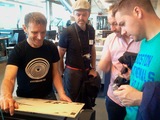
Touring the Autodesk makerspaces on Pier 9 in San Francisco (July 2014)
Walking into Autodesk’s high-tech makerspaces here in San Francisco several months ago with a colleague who had arranged for us to join a tour of the facilities, I was initially struck by the numerous unfamiliar tools on display and in use by those using the space. Although familiar with the expanding use of makerspaces in libraries, I had not yet had the opportunity to use a makerspace as a learning space. It didn’t take long for those of us on that Autodesk tour to move past the state-of-awe stage; through impromptu conversations with artist-learner-makers who were incorporating 3D printers, lasercutters, and other high-tech tools into their own learning and creative-production efforts, we began to understand what an engaging approach to learning and collaboration these spaces foster—something that would not have been so obvious and engaging without the guidance of Mark Gabriel, the Autodesk rep who was serving as an Autodesk intern when we were onsite. Our own learning-about-learning experience was, furthermore, tremendously supported by our onsite learning colleagues—the artists and others who contributed to our wonderful informal-learning experience by helping us take the first steps toward raising our own skill levels in ways that may eventually lead us to more active engagement in makerspaces wherever we encounter them.
The need for that same relearning-how-to-learn guidance is obvious as we monitor and dive into the rapidly-changing environment of wearable technology and how that is going to affect our training-teaching-learning efforts. Watching (with admittedly great enthusiasm) the apparently inevitable move toward mainstream adoption of Google Glass—the 800-pound gorilla of wearable ed-tech—over the past couple of years made many of us involved in the Horizon Report expert-panel explorations last fall firmly place wearable technology in a two-to-three-year time-to-adoption horizon for higher education; we were already seeing numerous examples of how Google Glass prototypes were being incorporated into learning, and some of us were taking steps to hone the skillsets necessary to effectively connect wearable technology to training-teaching-learning. It was, therefore, a real Black Swan moment—that moment when we come face-to-face with something that had previously appeared improbable—when we read (shortly before the 2015 Higher Education Edition was released but long after the text for that report had been written and submitted for publication) that Google Glass in its current iteration was being pulled back for further development.
There were the inevitable and completely predictable mainstream media stories and blog posts about how it had been clear that Google Glass was never going to work, and I was briefly among those who saw that two-to-three-year adoption-horizon rapidly slipping away (as horizons so often do in the extremely volatile world of ed-tech developments where today’s snapshot can unexpectedly fade, only to be restored later by additional Black Swan developments that make the improbably suddenly so obviously real). There were, however, new wearable-tech announcements within days of the announcement that Glass was being withdrawn, and a glance at the Tech Times website shows that wearable technology is not going to disappear in training-teaching-learning or other endeavors anytime soon.
Our eLearning Guild colleague David Kelly, in fact, was quick to point out intriguing ways in which Glass, even at this point, can be seen as a success because of the ways it "opened minds" and "explored important questions"—which brings to our attention the most important skillset we need to continue developing: the skillset which helps us to look beyond the momentary successes and setbacks, the changes in specific technologies’ placement within one-year, two-to-three-year, and four-to-five-year adoption horizons, so we’re not completely flummoxed when a black swan lands in our learning nests.
NB: This is part of a series of articles exploring the latest Horizon Report. Next: On the Four- to Five-Year Horizon—Adaptive Learning Technologies and the Internet of Things.
Paul Signorelli
.
Blog
.
<span class='date ' tip=''><i class='icon-time'></i> Jul 23, 2015 02:04pm</span>
|