Blogs
|
That awful moment has again arrived: a cherished friend within one of the communities of learning that sustains me has lost a loved one.
It was not an easy passing. My friend’s mother succumbed to pancreatic cancer during Easter weekend after all the usual pain, struggles with a health-care system that just doesn’t seem mature enough to adequately support those who are ill and those who love them, and numerous literal and figurative dark nights that never quite produced an obvious dawn.
But among the most stunning elements of this entire passage was the consistent reminder of what it means to be part of an extended onsite-online blended community in which friends stand with friends.
My friend—a fabulously gifted writer in addition to being an inspiring trainer-teacher-learner—was never at a loss for words, nor was she at any point reticent about sharing the most intimate details about what she, her mother, and others within her inner circle were feeling and experiencing. The moments of rage at health-care providers who seemed remarkably insensitive to basic needs. The moments of gratitude expressed toward health-care providers who were the onsite guardian angels. The emails and phone calls and social media postings. And the sharing of information that might be helpful to others in similar situations. All of these interwoven elements combined to produce one of the most moving invitations to celebrate a life well lived and mourn a loss I can imagine accepting.
The results produced amazing reminders of how interconnected we all remain in spite of all the ridiculous assertions we encounter that tech tools and other changes in our rapidly-changing world are somehow stopping people from communicating with each other at a meaningful level. Each time I read a Facebook post from my friend and then followed the dozens of responses from people I knew and from people I had not previously encountered (but came know through these exchanges), I felt my world broadening a bit and also understood that our ever-extending community was gaining the additional strength it would need to adequately support our friend, her mother and father, and others close to them. Every time I followed a link to read something my friend had read and from which she had taken solace, I found my own emotional connections to her experiences and her impending loss growing.
An afternoon during which she mentioned Anya Krugovoy Silver’s latest collection of poetry—I Watched You Disappear—was one of many turning points. A few lines from the title poem ("That fucking doctor killed you. Killed you./But I keep sending e-mails to your account.") sent me racing to my local bookstore eager to obtain and devour a copy of what includes some of the most beautifully moving poetry I have read in years. Those lines opened a door to conversations my friend and I might not otherwise have had.
My friend’s post written on the evening of her mother’s departure ("Go rest high on that mountain, sweet Mama—your work here is done but will live on…She looked up at me, took her last breath, and was gone…") put me right there with them in ways I would have never have expected to experience.
From "Virtual Dave…Real Blog"
And a from-the-heart set of reflections ("Stand for Those We Miss and Love") from one of my friend’s colleagues (R. David Lankes) posted earlier this week included passages so searingly poignant that I feel as if our collaborative endeavors over the past several months should once and for all silence anyone who disparages the gifts provided through effective use of social media tools: "I stand as someone who has fought with cancer and as someone who will remember you. Someone who says your life was important. I stand to remind those who remain that life can be hard. I stand to remind everyone that cancer takes and takes and takes. I stand to remind everyone that no matter how much we are loved, or how much good we seek to do, we all can be taken too soon."
This evening, as I write these words I have been trying to compose for nearly a week, I find cause to celebrate even while consumed by the sense of loss I keenly feel. I celebrate the members of my various communities of learning who help me understand and appreciative what I have. I celebrate the depth of experience those friends reveal and to which they lead me. And I celebrate the importance of remembering we can never be too busy to take the time required to stand with our friends.
Paul Signorelli
.
Blog
.
<span class='date ' tip=''><i class='icon-time'></i> Jul 23, 2015 02:39pm</span>
|
|
Listening to a recording of R. David Lankes’s "The Faithful and the Radicals" over the weekend felt like going to church. It’s inspirational. Transformative. And steeped in a sense of the divine. It is the sort of plea for community, collaboration, and action that runs consistently from the earliest seminal public presentations of our history through a continuum that includes more recent efforts including Jon Stewart’s speech at the end of his Rally to Restore Sanity in October 2010.
Although "Faithful and Radicals" is ostensibly about school librarians, libraries, and the society-shaping roles they play and need to play in the extended communities they serve, it’s really far much more than that. If we are at all interested in the present and future of our communities—and who among us can afford not to be?—Lankes’s thoughts can’t help but touch and move us.
He is, as always, funny. (Who else would jokingly threaten to slash the tires on our cars if we spend more time creating booklists and pages full of links to online resources that soon will be broken than fulfilling our potential to contribute to the success of our communities?) Engaging. (The positive reactions to what he says are audible throughout the recording.) Radical (in the complex, multifaceted way that the word "radical" in its varying definitions implies: foundational, rooted, fundamental, and cool as well as extreme). Visionary. (His proposed mission statement for librarians—"The Mission of Librarians is to Improve Society through Facilitating Knowledge Creation in their Communities"—flows right off the pages of The Atlas of New Librarianship into "The Faithful and the Radical.") Poignant. And humble. (He actually pokes fun at his own title for the presentation, commenting on how it could serve equally well as the name of a PBS production or a soap opera.) Above all, he’s obviously an incredibly talented teacher-trainer-learner—as I learned while participating in his New Librarianship Master Class (a massive open online course) and writing extensively about it last year. And all of those attributes combine to make him the sort of mover and shaker who keeps the world alive, vibrant, dynamic, thinking, and smiling—which is, in itself, a point worth lingering over momentarily, for it wasn’t at all clear a year ago that he would still be with us. He has openly, painfully, and beautifully, via his blog, chronicled his experiences with Hodgkin’s Lymphoma, and he begins "Faithful and Radicals" by noting that it’s his first major public presentation since undergoing stem cell transplants.
But that’s just the backdrop to much of what he accomplishes with "Faithful and Radicals." His starting point is something every one of us needs to remember: that all of us—regardless of profession, interests, values, and experiences—has moments in which our faith is severely tested and doubts can become overwhelming. With that in mind, he recalls a recent, personal crisis of faith in which he asked himself why he continues to remain part of the group fighting to assure that libraries—and, more importantly—librarians (which, as I’ve written many times before, are our close allies in training-teaching-learning, and vice versa) are supported and that they are active participants in shaping their communities.
When all is said and done, the answer was quite simple. He decided that the strong role librarians play in serving communities—similar to the role I see any great trainer-teacher-learner playing—is so overwhelming powerful that he was "unwilling to be part of those who stood by and destroyed something I loved. Ultimately, the decision was, ‘I have a limited time on this Earth, and I’m going to use it to build up and be part of what I believe in because I have faith…that this stuff works. I have faith that we improve people’s lives. I have faith in you."
It’s far more than the oft-quoted mission to support reading, he noted, adding that he actually hates the pervasive libraries-support-reading promotions because libraries and librarians promote so much more that is essential to learning, community-building, and creativity.
"Working with kids on an interest of theirs to develop an interest of theirs…this gets a big big big happy smiley face," he reminds us as he moves us into a deeper, richer exploration of what it means to play leadership roles in our communities through libraries or any other significant learning organization. "It’s about using resources to learn, to improve, to build knowledge," and to help prepare learners for their roles as "stewards of this world."
The current movement to support the creation and growth of makerspaces within libraries, he suggests, is only part of the story—far from rooted in questions about whether to purchase a 3D printer or any other form of technology to create that makerspace: "If your library is not already a makerspace, you’re doing it wrong."
Nearing the end of his presentation, he doubles back to overtly address his decision to undergo all the brutally awful treatment he has endured. Reflects on what it means to choose between giving up or fighting against a life-threatening disease through potentially lethal treatments. And acknowledge that surrender would have deprived him of the opportunity to be with us long enough to share "The Faithful and the Radical" with us.
From "Virtual Dave…Real Blog"
"I have been at the edge of certain death. When I got my stem cell transplant…I had to go through terrible chemo, chemo that ripped sores in my tongue, chemo that tore out all my intestinal tract, chemo that took my hair, took my energy, took my ability to walk up a flight of stairs, and it even killed the very marrow in my bones. I voluntarily took a lethal injection. Why? Because I had faith. I had faith in my doctors. I had faith in my nurses, and I had faith in my caretaker and my wife and my family and myself that I was going to get there, that I was going to face down certain death and that I was going to move ahead, and I’m here without a hair in my head to show for it. But I’m here…
"Faith can be hard. Radical can be hard. Moving out of your comfort zone and seeing yourself as larger than you think you are can be hard. But it is essential. I have been through my crisis of faith, You have seen your crisis of faith. We will live through it, and we will use it to become even stronger radicals. We will use it to take that faith message to those who don’t really have it…"
Reaching the end of that recording, I was left rethinking long-held beliefs about what decision I might make if/when faced with the sort of life-threatening situation Lankes has struggled; I have to admit that what he says and what he does has, in the most significant of ways, served the purpose of great learning facilitation: he made me do some serious rethinking about personal comfort and preferences as opposed to the greater responsibilities each of us has.
Lankes could have opted to forego the fight. In a sense, however, he decided to work beyond the shift life had apparently decided to assign him and do some overtime by staying with us. It’s the sort of overtime for which there can be no adequate payment. But perhaps we can do our part in rewarding him by listening. Taking action. Thinking about the need to transcend our own comfort zones to take actions for the greater good of the people, the communities, and the societies that support us. And continuing to stand with those we love and admire through the best and worst of times in the hope that the best remains ahead of us.
Paul Signorelli
.
Blog
.
<span class='date ' tip=''><i class='icon-time'></i> Jul 23, 2015 02:38pm</span>
|
|
The news that I made a new friend by participating in the American Society for Training & Development (ASTD) 2014 International Conference & Exposition (ICE) today isn’t particularly noteworthy. The fact that I unexpectedly accomplished this with the help of two other people who weren’t physically attending a conference that I, too, am not physically attending does, however, suggest that there is a worthwhile story to tell any trainer-teacher-learner who is interested.
We’ve heard quite a bit suggesting that social media tools make us lonely; that it’s time to deliver "A Eulogy for Twitter" as "the beloved social platform enters its twilight"; and that a social network can’t replace a "real" one (as if everyone who uses social media makes this an either-or decision).
What isn’t as often heard or read is the idea that being left behind when we are not able to physically join our friends and colleagues at wonderful professional development gatherings like ASTD ICE, American Library Association (ALA) conferences, and the numerous others that beckon is increasingly less of a problem than it was before social media tools came our way.
As I have continued experimenting with the use of social media tools in workplace and personal settings over the past several years, I’ve become intrigued by the possibilities they offer in terms of not being left behind. With that in mind, I tried a spur-of-the-moment experiment with ASTD colleagues last fall by trying to participate in an ASTD conference I was unable to physically attend. And while the last-minute nature of that experiment limited the number of exchanges I had with those onsite colleagues, I did unexpectedly encounter one sign of success: interacting with onsite participants by responding to tweets rather than just retweeting content for others caused a couple of people to ask if I were actually there. When we see the lines blur so much that offsite participation creates the sense of onsite interaction, I believe we have, in the best of situations, moved beyond the idea that we can’t be there unless we’re there.
The inspiration to retry the experiment with more deliberate planning came after another ASTD colleague, Larry Straining, posted a note on his Facebook account to let others know he was sorry he wouldn’t be physically present this week, but that he was looking forward to seeing tweets from conference attendees.
"If we follow the backchannel a bit and interact as time allows, we might extend the reach of the conference in significant ways and, at the same time, learn even more about how to effectively incorporate social media into our training-teaching-learning process," I wrote in response—and that’s exactly how it played out today as I followed, responded to, and interacted with onsite colleagues from the comfort of my own home.
It didn’t take long for my initial retweets—including brief comments building upon that content—to begin being retweeted under the conference hashtag. And it took less than three hours for a wonderful colleague to pop that magic question: Are you here? Which, of course, inspired the response "yes and no," depending on how we define "here."
Those who remain skeptical of the power of online exchanges will immediately raise a number of objections, including the (mistaken) belief that we can only make new conference acquaintances and interact with conference colleagues when we are face-to-face—an idea we disproved when Larry and I, via Facebook exchanges extending his initial thoughts, drew one of his colleagues into the exchange. The colleague—Kent Brooks—asked Larry for permission to quote from Larry’s postings about the value of using a Twitter feed to stay in touch with colleagues at a conference. I dove back into the exchange to ask Kent whether he wanted to try to coordinate blog postings on the topic—at which point Larry formally introduced us to each other, and Kent and I quickly completed the "friend" process on Facebook to move things along. My own tweet (to the conference feed) documenting that we had met through the conference without physically being at the conference was retweeted—as was a follow-up tweet I forwarded to draw attention to Kent’s earlier piece on "10 Reasons to Tweet at a Conference."
It probably goes without saying that I laughed out loud when I discovered that my retweet of Kent’s piece was itself, retweeted by others—including Melissa Daimler, who serves as head of organizational effectiveness and learning at Twitter and also serves on the ASTD Board of Directors.
It’s worth noting that one very important element making this level of onsite-offsite interaction possible is the existence of a very strong backchannel among the first-rate trainer-teacher-learners who are at the heart of ASTD. The quality of the tweets from ASTD conference attendees is among the strongest I encounter: multiple voices tweeting individual sessions (not just notes about where to meet for drinks or swag) so that it’s possible to gain a sense of what is being discussed onsite; combined with the use of a conference app that is easily accessible and includes schedules, speaker bios, session materials when presenters have made them available so we can view them from a distance, and much more; and observations which in themselves provide magnificent learning moments.
As we began to wind down toward the end of this ever-evolving cross-platform series of exchanges, Kent and I returned to Facebook and Larry’s original post.
"When you state in your [original "No Longer Left Behind"] post, ‘The real pay-off for the experiment came when the exchanges put me in touch with one of the presenters who had seen the retweets and comments. The result, in many ways, was exactly what it would have been if I had been onsite and meeting members of those expanding communities of learning and personal learning networks rather than feeling as if I were part of the left-behind gang,’ I would suggest it was better than a come and go exchange which includes the standard ‘business card trading ritual’ as it allowed you to follow them (on Twitter, LinkedIn, etc. and continue to learn from them beyond the 60 minutes of the session + the 5 minute rush to talk to the presenter immediately following the session," Kent proposed.
To which I openly admitted: "It would have been true if I hadn’t treated the virtual exchange exactly as one of those business-card exchanges you describe. Just as I do keep and return to business card contacts occasionally as time allows (loud sound of rueful laughter here for missed opportunities), I do occasionally return to that sort of virtually-established contact—but not nearly enough. It would appear that bad habits onsite translate to bad habits online-but I’m continuing to learn, thanks to people like you who inspire me to look for ways to become a better trainer-teacher-learner."
So, no, Facebook is not making me lonelier. And I’m far from ready to join others in delivering a eulogy for Twitter. And yes, it would be lovely to be there onsite at the conference with others. But if I were there, I wouldn’t have had this latest magnificent experiential learning opportunity to help me further understand, at a visceral level, what amazing tools we currently have at our trainer-teacher-learner fingertips. Each experience brings its own benefits, its own rewards. And having the opportunity to learn with my colleagues remains at the heart of what continues to draw me to these conferences and exchanges.
N.B. — Here’s Kent’s latest contribution to the conversation: Twitter Activity at #ASTD2014 Through Monday May 5 [2014]. Also found backchannel participation from Michelle Ockers on her blog.
Paul Signorelli
.
Blog
.
<span class='date ' tip=''><i class='icon-time'></i> Jul 23, 2015 02:38pm</span>
|
|
With a bit of help from the American Society for Training & Development (ASTD) and the use of social media tools, I was far from left behind this afternoon not only in my attempts to actively participate in a first-rate conference I can’t physically attend this year (the 2014 International Conference & Exposition—ICE) but to keep up with much that ASTD is doing. Which, I learned while watching a live online broadcast from the conference itself and live-tweeting it just as if I would have done if I had physically been there, includes the transition from ASTD to ATD—the Association for Talent Development—to reflect the evolving nature of what all of us do as trainer-teacher-learners.
The past couple of days, as I noted in an earlier article, have provided tremendous learning opportunities about how outdated our beliefs are in terms of the concept of being left behind when we can’t join friends and colleagues at professional-development opportunities beyond our geographic reach. By engaging with onsite attendees through the conference Twitter feed and actually commenting on what was happening onsite, I was able to do quite a bit of what I would have done onsite: learn from what presenters were discussing; pick up (from tweets) bits and pieces of (other) sessions I wasn’t able to attend; share my own tweets and those created by others with my own extended community of learning/personal learning network; and even make new acquaintances from whom I will continue to learn in the months and years to come. The levels of engagement fostered through these online exchanges even caused one colleague to send a tweet asking if I were actually onsite.
Seeing onsite participants retweeting my offsite tweets was just one of many signs that we have tremendous potential for interacting with colleagues and other learners in very creative ways if we nurture our skills in this direction. Actually working to connect one onsite participant with another onsite participant—they didn’t know each other, but a tweet from one made me realize that contact with the other would be rewarding for both of them—took the idea of facilitating connections to an entirely different level for me: I have often helped colleagues who are geographically separated make connections online—just as others have done the same for me—but never before had the experience of being an offsite facilitator of onsite connections.
Setting up laptop to view live announcement and desktop for live tweeting
The breadth and scope of the conference exchanges also continued to evolve—which is a good sign that we have not at all reached the limit of what we can accomplish by combining the use of our social media tools to meet our learning and communication needs. As I mentioned in that earlier article, the experiment started with a Facebook posting from another ASTD colleague (Larry Straining); reached fruition via backchannel interactions on Twitter; and then returned to Facebook at one point as Larry connected me to another offsite ASTD colleague (Kent Brooks) I had not met before that moment. Larry, Kent, and I continued out offsite conference-attendance interactions in a way that drew a few others into the Facebook conversation, then expanded it into cross-postings from our own blogs. Having carried this into a posting on LinkedIn last night, I was delighted this morning to discover a response, on LinkedIn, from an ASTD colleague I hadn’t seen in more than two years—which means our "attendance" now extends from the conference site across Facebook, Twitter, and LinkedIn.
Which brings us back to that moment when I realized, earlier today, that if I logged into the live online broadcast of ASTD/ATD President and CEO Tony Bingham’s much publicized surprise announcement about the future of the organization, I would be able to virtually join colleagues as the announcement was released and, at the same time, tweet it as if I were there. And as I engaged in that exercise and saw onsite attendees retweeting a few of my own tweets, I felt all thoughts of being left behind vanishing. I was there. In a very real sense, present. To hear and join in the celebration of a major step forward for an organization to which I’m very happy and lucky to belong. Onsite. As well as online.
N.B. — Here’s Kent’s latest contribution to the conversation: Twitter Activity at #ASTD2014 Through Monday May 5 [2014]. Also found backchannel participation from Michelle Ockers on her blog.
Paul Signorelli
.
Blog
.
<span class='date ' tip=''><i class='icon-time'></i> Jul 23, 2015 02:38pm</span>
|
|
As the Association for Talent Development (ATD)/American Society for Training & Development (ASTD) 2014 International Conference & Exposition) reached its conclusion this afternoon, I couldn’t help but think about how much I forced myself to learn from it—by not being physically there.
I thought I had pretty much drained the learning pool over the past few days by experimenting with virtual participation via social media tools and the conference backchannel. My own increasingly-immersive participation over the past few days had included interactions with onsite and offsite colleagues extending across Twitter, Facebook, LinkedIn, and blog posts. I had even watched and tweeted a live online broadcast that made me feel present yesterday afternoon at the formal announcement that ASTD was officially transformed, at that moment, into ATD after 70 years of successful operation as a first-rate training-teaching-learning organization; the experience became more visceral this morning when onsite attendees used Twitter to share numerous photographs documenting that all conference signage had been changed overnight to reflect the change of name.
But it didn’t occur to me, until this morning, that I had overlooked the use of one more piece of technology—one so familiar that I had completely overlooked it. The moment of revelation and experimentation came when I was again reading and reacting to tweets from the conference. Among the flood of messages was one from Walt Hansmann, a long-time ASTD friend and colleague with whom I’ve presented, brainstormed, learned, dined, laughed, and groused countless times. (In fact, it was through Walt that I met Larry Straining, whose Facebook posting a week ago sent me down the path of more creatively and intensely experimenting with learning through virtual-conference attendance; ATD/ASTD really has been and continues to be pivotal in helping me understand what a small world we all inhabit and serve.) So there was Walt, tweeting about the fact that he was already wearing a new ATD pin while I was on the other side of the country thinking, "If I was there, I’d be wearing one of those, too." And then it dawned on me: all I needed to do was try to reach him on his cell phone. Which I did. And the ensuing conversation led to his assurance that one of those pins would work its way across the United States and into my hands sooner than later.
That combination of tweeting and calling may have produced the virtual-conference-attendance equivalent of the joys and rewards of meeting and learning from each other in conference hallways. More importantly in terms of the virtual-conference experiment, the call carried us back into cross-platform conference participation as he immediately posted a tweet ("@paulsignorelli @trainersleaders may not be @ #astd2014 physically, but he is sharing via SoMe [social media] and just called to touch base!") while I was tweeting my own response to the phone conversation: "Oh, technology, with all your lovely variations: just briefly joined @WaltHansmann at #ASTD2014—via a phone call. #NoLongerLeftBehind." I was also, at the same time, responding to another tweet suggesting that Dan Steer’s tweets had made the tweeter sorry to have missed the conference—to which I responded, "made me feel closer to it." We closed the circle on that conversation when Dan himself—whom I’ve never met face to face—used the "favorite" option on Twitter to acknowledge my appreciation for all he had done to carry the conference far beyond the physical site of the conference.
This exploration of how we might more creatively incorporate the use of social media tools into learning opportunities benefitted from a wonderful combination of resources. The fact that many ATD members are adept at synthesizing content via backchannel interactions on Twitter is an essential starting point; they were the portal to the conference for me and for others who were attending from a (physical) distance. ATD’s first-rate conference app made it possible to monitor the conference schedule and access some presenters’ conference materials; that helped me see and understand what others were reacting to onsite. Having a tablet meant I could turn this into a mobile-learning/mobile-conferencing experience at times by following the backchannel feed even while I was using public transportation here in San Francisco to move from appointment to appointment when I wasn’t at home using a desktop/laptop combination. And the encouragement of training-teaching-learning colleagues provided what a successful learner needs: a great community of learning and engaged personal learning network that supports the learner’s process and explorations.
There was a time, for me, when having that stimulatingly immersive experience face-to-face with conference colleagues—call it "conference high" for lack of a better term—concluded with a sense of melancholy that came from knowing I was about to leave them and wouldn’t see them again for anywhere from six to twelve months—until we were reunited for the next intensely inspiring set of learning interactions that we found through our shared conference experiences. The bouts of melancholy diminished noticeably over the past few years when it became obvious that we would be "seeing" each other far more often through our shared use of social media tools, conference calls, and interactions via Skype and Google Hangouts. But I found a different, yet parallel, sense of melancholy setting in this afternoon for the first time as we said our virtual good-byes. And I realized that it wasn’t just the coming and going of friends who interact, then are apart for considerable periods of time, that used to cause that melancholy. It’s the fact that a well-run conference or any other sort of convocation is, in and of itself, the catalyst—a special meeting of friends and colleagues to creatively explore, at a very human level, what is important to all of us; it’s a form of augmented reality that might best be described as "augmented intellectual and emotional reality." It deepens the emotional connections that draw us together. It ignites all that is most worth cultivating within each of us. And it reminds us that without those shared community-building moments of engagement regardless of whether they are onsite or online, we would be far less than what we are.
N.B. — This is the third of three interrelated articles inspired by the ASTD/ATD 2014 International Conference & Exposition in Washington, D.C. For two additional views of the virtual conference attendance experience, please see Kent Brooks’ Twitter Activity at #ASTD2014 Through Monday May 5 [2014] and Michelle Ockers’ My #ASTD2014 Backchannel Experience.
Paul Signorelli
.
Blog
.
<span class='date ' tip=''><i class='icon-time'></i> Jul 23, 2015 02:38pm</span>
|
|
Being virtually present earlier this week at the formal announcement that the American Society for Training & Development (ASTD) is immediately beginning a year-long process of transforming itself into the Association for Talent Development (ATD) provided, in many ways, a stunningly positive view of how a well-managed branding campaign rolls out.
Association managers including President and CEO Tony Bingham used the presence of approximately 9,000 association members at the 2014 International Conference & Exposition (ICE) to build excitement throughout the day with notifications that were also disseminated on the conference backchannel feed. He and his colleagues, furthermore, also took the much-appreciated step of arranging for the announcement to be available via live online streaming for those of us who could not be at the conference. Joining the backchannel discussion via Twitter as I watched and listened to the announcement online gave me the sense that I was there, with colleagues, sharing and reacting to the changing of the name. The backchannel exchanges gave the impression that initial reaction was fairly positive, although—not surprisingly—there were also questions and concerns expressed onsite and online during and after a brief question-and-answer period; many colleagues were acknowledging and applauding the direction the name-change implied; onsite vendors with space in the exhibits hall posted congratulations; and Chief Learning Officer was quickly among the first to spread the news throughout the industry it serves.
Even more interesting as an example of how to take advantage of the opportunities inherent in renaming a dynamic 70-year-old membership organization with an international clientele was what conference attendees saw upon returning to the conference site the following morning:all conference signage had been changed overnight to reflect the change of name; viewing even a few of the numerous photographs posted online via Twitter suggested the magnitude of planning and execution that went into making the transition real and immediate. And the online transformation was equally obvious: the ASTD website had a new graphic displaying the old and new logos side-by-side; chapter leaders had immediate access to new individual chapter logos so they could begin using them as soon as they are ready to do their part in making the year-long transition successful; and the transition webpage had plenty of background material for those curious about the process and the repercussions.
So the obvious next step was for ATD members themselves to absorb and further respond to all the change implies—both in terms of opportunities accepted and opportunities missed. For anyone interested in how managers and members in any association interact or don’t interact, reading Tricia Ransom’s online open letter to Tony and the organization’s board of directors is instructive. She includes a confirmation that she likes the new logo and that she is more positive than negative about the new name. But at the heart of her letter is a concise summary of why she feels left out of a decision in which she very much wanted—and felt entitled—to be included: "You said that you’ve spoken with countless CEOs and other leaders who recognize our efforts and how important our field is. You highlighted three executives, Senior Vice Presidents and higher, to tout the change. You emphasized the fact that you kept this change a secret for 2.5 years. Listen now to the voices of the tens of thousands of us who will never be an executive. Listen to the vast majority of the organization you lead. Listen to the people you are supposed to serve. We wanted to take this journey of change with you. You denied us. Why? We wanted to share our ideas, thoughts and suggestions about how we can grow. You denied us. Why? We have opinions to share with you. You never asked us. Why?…You don’t have to implement our choices, but at least ask."
Reading Tricia’s note made me once again compare and contrast two membership organizations which I adore and which I consistently strongly support—ATD and the American Library Association (ALA)—because they have a lot in common. Both are large, well-run organizations with members in many countries. Both have a long history rich both in tradition and innovation to serve their members’ needs. Both work with people playing a strong role in training-teaching-learning. Both fulfill an impressive educational role by producing books, magazines, webinars, and other resources including first-rate conferences to support their members’ lifelong efforts to professionally serve their constituents. And both offer opportunities for volunteer engagement.
What is consistently different about the two, however—and what I believe is a core element of what Tricia is expressing—is that ASTD has, at least in the years I’ve been involved, tended to make huge decisions that leave members (correctly or incorrectly) with the impression that they were not part of the decision-making process. I repeatedly hear trusted and cherished ASTD colleagues express the theory that there are two ASTDs: one run by association managers rather than practitioners (which unfairly ignores how much Tony has done to consistently serve as a thought leader in our industry and how inspiring he is as a public speaker) and a second comprised of the practitioners themselves. Exploring this with an ALA staff member a few years ago, I was surprised by an insightful question he asked: how many volunteer opportunities does ASTD offer in comparison to what ALA offers? And my answer was "significantly fewer." One of ASTD’s strengths is the streamlined nature of the organization; it doesn’t have the absolutely labyrinthine structure of committees, divisions, and round tables that sometimes absolutely drive ALA members to distraction. But, as my ALA colleague noted, it also doesn’t have the thousands of volunteer opportunities that come with the large number of committees, divisions, and round tables. We simply can’t be members of ALA without knowing that there are abundant opportunities to engage and participate in the decision-making process in ways that are custom-made for our numerous and varied roles in that industry.
Moving from Tricia’s open letter to a blog post by Clark Quinn, I found a wonderful exploration of a second theme consistent among those who are—at least initially—less than enamored of the new name for the organization: "To me, Talent Development is focused only on developing people instead of facilitating overall organization performance. And I think that’s falling short of the opportunity, and the need. Don’t get me wrong, I laud that ASTD made a change, and I think Talent Development is a good thing. Yet I think that our role can and should be more. I wish they’d thought a little broader, and covered all of the potential contribution[s]."
What Clark notes is something with which many of us in ATD and ALA—managers and members alike—struggle: finding terminology that accurately, concisely, and inspirationally captures all of what we do; I believe, because of the breadth, scope, and depth of our contributions to the communities we serve, that it’s ultimately a fruitless endeavor that will never produce a completely satisfying result. My own less-than-adequate term in the ASTD/ATD context for the past several years has been "training-teaching-learning" since I believe those are three core elements I consistently observe in the colleagues I most respect. But what Clark’s note suggests is that there is still a hole, and he concludes with this observation: "I just wonder who’s going to fill the gaps."
To myself, to Clark, and to all my colleagues who are wonderful enough to passionately engage in and contribute to the work of our associations, I suggest that it is all of us who are going to fill the gaps. And not just by spending time trying to find the perfect name; ASTD was a far-from-perfect name, but somehow inspired results that contributed magnificently to the communities we serve. But by continuing to do what we do best: facilitating learning opportunities that serve the numerous workplace and lifelong learning/professional development/talent development needs of the individuals, organizations, and communities who rely on us to help "create a world that works better."
N.B.: Additional thoughts on the change have been posted by ASTD staff, Tony Bingham, Jay Cross, David Kelly, Alan Montague, Marc Rosenberg, and others.
Paul Signorelli
.
Blog
.
<span class='date ' tip=''><i class='icon-time'></i> Jul 23, 2015 02:38pm</span>
|
|
It’s far more than sleight of hand, this act of learning alongside our learners. It’s as delightfully magical for the way it occurs at the most unexpected moments as it is for how it rapidly produces small and large shifts in our own training-teaching-learning approach. And the stimulation that accompanies that level of collaboration in the learning process is one of the most consistently rewarding aspects of formal and informal learning opportunities we are likely to encounter, I was reminded again yesterday morning.
I didn’t even, when the moment of magical learning began, know I was walking into a classroom; I thought I was actually walking into a neighborhood café—the sort of Ray Oldenburgian third place—The Great Good Place—where we meet friends, interact, and walk away the better for having set aside the time for exactly that sort of encounter. But that morning quickly and unexpectedly turned into a far deeper and richer learning experience that a friend and I had expected to produce.
It began when I spotted the friend and sat at the restaurant counter to join her for a cup of coffee while she was eating breakfast. Commenting on how nice it had been to see her engaged in journaling as joined her, I inadvertently opened a door to a wonderful conversation about how she wished she had more time to write and how, more importantly, she wished she could find a way to combine her love of writing with work that produced an income.
"Want to play a game?" I asked. "It takes about two minutes and is a great learning exercise I know that helps people find what’s eluding them."
Not wanting to skew the results or lead her in any specific direction other than helping her identify the sort of work that might combine her varied interests, I didn’t tell her that this simple exercise I had leaned in a creative writing class many years before had served me well in helping learners achieve a variety of goals including creating branding/marketing slogans for their personal businesses; crafting mission statements for their organizations; and even finding a name for a volunteer-driven community-based project that was so perfect that participants were still discovering lovely nuances in the name a couple of years after they shaped it. I also didn’t tell her that I used a two-minute time limit for the exercise because experience showed that most people and groups were winding down after 90 seconds and that two minutes was generally all it took to complete the most important element of what we were doing together.
Hearing her agree to accept the challenge, I told her to use her journal—I have generally used blank pieces of paper when working with individuals and paper on flipcharts or large whiteboards in classroom settings when working with groups—and take no more than two minutes to write down every word—no editing allowed—that came to mind when asked to think about the question "What makes me happy?" (When working on the mission statements, I’ve asked those learning the technique by using it to write down every word that came to mind when they thought about their organization; when working with those crafting marketing slogans, I’ve asked them to write down every word that came to mind when they thought about what concrete results they wanted to help their clients produce; when I worked with colleagues in the volunteer project, I asked them to think of every word that came to mind when they thought about the site on which the project was to be completed.)
I knew magic was about to occur when my friend/learner actually began jotting words down into her notebook even before I had a chance to start the timer on her smartphone. And it continued to take shape when I realized that, after 90 seconds, she not only was still writing as quickly as her hand and pen could place ink onto paper (with no slowdown in sight), but was also writing from left to right and top to bottom on the page rather than doing what every other learner had done before—simply throwing words helter-skelter all over a page or flipchart or whiteboard so the words could be grouped thematically later.
As the two-minute mark approached, I recognized I had my own unanticipated moment of leaning to address: stop the exercise as planned or respond to her obvious engagement and complete immersion in what she was doing by ignoring the timer and seeing where additional time would take us. After she finally raised her head five minutes and fifteen seconds into her wonderful stream-of-consciousness flow and asked if her two minutes were up, we both had a good laugh before beginning the process of reviewing what she wrote to see if she could spot meaningful connections between those apparently disjointed words and phrases. And as she read back what she had produced, I felt another moment of leaning magic unfolding: not only had she written down numerous nouns, verbs, and adjectives, but she had actually jotted down words reflecting what she was thinking as she wrote comments along the lines of "oh, this isn’t working" and "oh wait there it is." Not only had she produced the most richly complex record of a learner’s thoughts I had ever seen in response to this simple exercise, but she had reminded me of something no trainer-teacher-learner can afford to ever forget: set the rules, then break them as soon as they become a hindrance to the learner’s learning process.
When we were finished with the review, she told me how helpful the exercise had been in identifying things she knew innately but hadn’t consciously acknowledged, and confirmed that she had learned enough to strike out on her own by returning to the results, running the same sort of exercise using individual words that resonated strongly with her from round one, and creating the sort of pithy summary of what would most appeal to her so she could try to match that statement with work that would reward her far more than what she currently does. And I, in turned, told her that the simple act of running that exercise with her and watching all that she produced had revitalized and freshened a tool I had long enjoyed—and now magically, unexpectedly, and inspirationally, would use with even more enthusiasm for learners who would never know how much that she as learner-teacher had contributed to their learning process—and a wonderfully adaptable tool to help them on their journey.
Paul Signorelli
.
Blog
.
<span class='date ' tip=''><i class='icon-time'></i> Jul 23, 2015 02:38pm</span>
|
|
Being in the same room with my friend, colleague, and co-presenter Samantha Adams Becker earlier this week along with colleagues from the Golden Gate Chapter of the Association for Talent Development (ATD)—formerly the American Society for Training & Development (ASTD)—required a combination of technological sleight of hand; some knowledge of the neuroscience of the brain, learning, and magic; and plenty of practice.
What helped make the evening intriguing was that Samantha, in a very real sense, was not more than a few feet away from me in San Francisco for our "Ed-Tech, Learning, and NMC (New Media Consortium) Horizon Reports: What’s In It for Us..and Our Learners" discussions with local ATD colleagues while simultaneously being more than 1,850 miles away, in Baton Rouge.
I’ve been learning how to be in at least two places at once ever since colleagues and I, in fall 2007, used Skype to connect a colleague from Ohio with an onsite audience in San Francisco to show how the use of free online tools could effectively and viscerally bring people together in ways that simulate face-to-face conversations—think of it as telepresence without costly investments. I continued the experiment with Skype in a different context for a virtual face-to-face just-in-time lesson in using Excel and PowerPoint two years later to help a friend prepare for a job interview she was about to do. Racheted it up a bit more via Skype by bringing two offsite colleagues into an onsite presentation for ASTD Sacramento Chapter members in May 2011. And returned to the experiment with Samantha in June 2012, shortly after Google Hangouts became available as a way to viscerally connect individuals regardless of geography: she was co-presenter, from New Orleans, for an onsite session I was facilitating in San Francisco’s East Bay Area for ASTD Mount Diablo Chapter colleagues.
We knew we had exceeded participants’ expectations—and our own—when I managed to step out of the room unnoticed while the Mount Diablo Chapter members were interacting with Samantha; rejoin the conversation from outside the room by logging into the Google Hangout via a tablet I was using, and briefly talk to her about how that interaction by tablet was an example of how smartphones and tablets were allowing us to engage in a variety of m-learning (mobile learning) opportunities regardless of whether those opportunities were asynchronous or synchronous—which is what the ATD Mount Diablo Chapter event had become at that moment.
Our latest collaboration with members of what is now the ATD Golden Gate Chapter included some interesting twists, and those interested in how to duplicate the experience have plenty to consider. Basic equipment includes a desktop or laptop computer; webcams (mine is built into my relatively lightweight Toshiba Portégé laptop); ability for us to hear each other (both of our laptops have small built-in speakers that produce high-quality audio output when hooked up to an onsite speaker system), and she usually doesn’t wear a headset or have any other visual cues that would remind people she is not physically in the room; a small, portable back-up speaker system that can be hooked up to my laptop in case the onsite speaker system isn’t working properly on the day or night of a presentation; and a projector and screen (or blank white surface) to project Samantha’s video feed from the Google Hangout in a way that made it easily and clearly visible for everyone onsite.
Onsite rehearsal time is critically important. When using a site for the first time, rehearsals can extend from an unusually short 45 minutes if all works well—it rarely does—to as much as two two-hour sessions if intensive trouble-shooting becomes necessary. (We once had to solve an unexpected Internet connectivity problem by ending one very frustrating two-hour session so I could obtain a 4G hotspot device and make arrangements to purchase enough online time with that device to carry us through an additional rehearsal and the live event itself.) Rehearsal includes checking sound levels from various points throughout the room, locating the best position for the webcam so it captures enough of the room for Samantha to be able to see as many participants as possible, and trying to create the least-intrusive tech set-up possible: the point is to create a set-up which has participants looking at the projected image of Samantha, me, and each other as much as possible so that the technology quickly fades into the background—which, thankfully, it generally does!
Understanding how our minds process visual and audio information also helped us more effectively take advantage of creating the illusion of presence even though she was physically in Baton Rouge, so reading the section on ventriloquism in Stephen Macknik and Susana Martinez-Conde’s book Sleights of Mind: What the Neuroscience of Magic Reveals About Our Everyday Deceptions. The key element here is understanding that our brains process sound the same way they do when we watch movies in a theater, matching sounds with images to make us believe the sound is coming from the screen rather than the speakers, so we always attempt to have speakers unobtrusively placed as close to the screen as possible and match the sound level as much as possible to the level of my own voice onsite.
We have also come to understand that worries about lack of synchronization between what participants hear and see (as when lip movement is ahead of or behind what they hear) is not as important as many of us might assume. Macknik and Martinez-Conde convincingly demonstrate, in their book, that we focus on an extremely small part of what is in our overall field of vision. Extrapolating from what they show, we realize that the only time participants notice discrepancies between sound and lip motion is when they focus their visual attention on the motions of the speaker’s lips onscreen. If they are looking at Samantha’s eyes, or at me, or at anything else in the room, the illusion of presence is not at all interrupted.
Our onsite-online blended presentation this time also carried the experiment one step further. To control and limit potential bandwidth problems, Samantha and I were the only two participants in the Hangout; other offsite participants received the program feed via a separate remote-viewing option that Chapter members routinely provide. If offsite participants had wanted to ask questions, the person monitoring that external feed would simply have repeated questions to Samantha and me, and we would have responded orally so the outgoing feed carried the response from the room to the offsite participants.
But all of this is just a prelude to the real magic that occurs through this type of learning experiment/experience: it’s a perfect match of content and delivery method for everyone involved. We were introducing participants to current trends, challenges, and developments in educational technology that affect them and their own learners, and we were facilitating discussions on the topic through the use of relatively low-cost technology that they themselves could immediately use if they chose to do so. We had cobbled together a smart classroom to show how relatively easy a task that could be. We learned from the questions they asked as much as they learned from the presentation we offer.
Emergency responders needed for e-learning trauma?
Most importantly, it became another example of the power of learning opportunities that are engaging. One of our most rewarding discussions came from participants’ observations that e-learning/online learning experiences generally are far less engaging than they should be and almost leave learners requiring the assistance of trauma-unit personnel—which made us laughingly agree that one service ATD and other learning organizations could provide would be an e-learning trauma/paramedic service to minister to those who had suffered through traumatically bad learning experiences online. We also used our ersatz smart-classroom set-up to exchange ideas about how to address digital literacy challenges among ourselves as trainer-teacher-learners as well as among the larger group of learners we all serve.
The conversation came to an end with the all-important confirmation that everyone in the room felt as if Samantha had been there with us in our blended onsite-online learning experiment—and in every significant way, she had been! The technology we have and the technology that others are continuing to develop creates magnificent opportunities to meet and interact with first-rate colleagues and provide effective learning opportunities—as long as we focus on each other and see the technology as the background tool that facilitates learning, communication, interactions, and meaningful collaboration.
Paul Signorelli
.
Blog
.
<span class='date ' tip=''><i class='icon-time'></i> Jul 23, 2015 02:38pm</span>
|
|
There’s something viscerally appealing about a dynamic, creative community, regardless of whether it is onsite or online.
If we walk on a city street, through a public plaza or park, or in a library or museum where people are engaged with each other, we often feel the urge to be part of what it offers. If we participate in and contribute to a civil, active, well-facilitated, and creative online community of learning, community of practice, or community of interest, we frequently feel well-rewarded and stimulated by the positive interactions we have. Conversely, if we stumble upon or through communities that feel uninviting or in any way unsafe, we’re not going to remain there very long.
Reading Alan Ehrenhalt’s book The Great Inversion and the Future of the American City tells us plenty about the state of some of our most interesting physical communities; it also, I believe, offers us opportunities to draw productive parallels about what makes online communities attractive.
The settings for his onsite explorations include urban and suburban neighborhoods in or near Chicago, Cleveland, Gwinnett County (Georgia), Houston, Philadelphia, Phoenix, and several other American cities, and he also draws upon several European cities (including the Paris of George-Eugène Haussmann’s time and Vienna as the Ringstrasse was opening in the latter half of the 19th century). He reminds us that a great European street served—and continues to serve—as "a center of activity, much more than of motion, a center of commerce and sociability, of nonstop human drama, of endless surprises and stimulation….To talk about a crowded city thoroughfare of the nineteenth century as ‘mixed use’ urbanism in the modern sense is to miss the point altogether. This was essentially ‘all use’ urbanism" (p. 23) He then explores various American cities to document ebbs and flows of population into and out of areas in an attempt to help us understand what makes contemporary cities appealing or lacking in appeal.
As we share Ehrenhalt’s journey through our physical sites, we consider the impact immigrants, the availability of public transportation, the presence of street life, street furniture, parks, residents’ commitments (or lack of commitment) to their communities, and even levels of housing available in downtown areas have on making or breaking communities.
And that’s where I believe we can draw parallels between what we see in The Great Inversion and what we see in equally dynamic or challenged online communities. The diverse points of view that can result from interactions between immigrants and well-established residents of a community also provide the advantages and challenges of welcoming various points of view in our online communities. The presence of engaging levels of onsite street life has its online equivalent in communities where friends and colleagues can drop into an online community with the assurance that their "neighbors" will be there to interact synchronously as well as asynchronously in rewarding and stimulating ways. The elements that contribute to a sense of safety and engagement in our onsite settings also have their online parallels: just as broken windows and large amounts of graffiti can quickly chase us away from onsite settings, the presence of spammers and haters in an online community can quickly inspire the departure of previously-engaged members of an online community.
Street life in our physical settings is returning in various forms, Ehrenhalt contends, and I see—and benefit from—a parallel level of street life in the best of the online communities to which I’m drawn. Although Ehrenhalt’s own conclusion is that "The more that people are enabled by technology to communicate with one another while remaining physically solitary, the more they crave a physical form of social life to balance out all the electronics" (p. 236), I believe that an equally compelling interaction is occurring as those of us who are lucky enough to meet in dynamic onsite communities continue some of our interactions online. The result is that for those of us who comfortably move back and forth within our blended onsite-online communities, the opportunities to engage and benefit from interactions from dynamically diverse communities has never been better.
Paul Signorelli
.
Blog
.
<span class='date ' tip=''><i class='icon-time'></i> Jul 23, 2015 02:38pm</span>
|
|
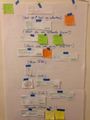
Many of us try to open doors for learners. Jesse Lee Eller, a trainer-teacher-learner whose instructional-design efforts always strive to keep learners front and center in the process, uses those doors in a somewhat different way: to create low-tech high-impact storyboarding maps that keep all of us who are working with him on track in our collaborative instructional-design efforts.
"I’m a visual learner," he explained when he recently introduced me to his innovative way of assuring that learners remain at the center of all that we do together. "These charts help me keep track of everything we’re doing."
Eller’s tools to sketch flexible first-draft storyboards of learning modules are wonderfully simple. He starts with a blank door in his studio/apartment, post-it notes, felt pens, and, when the process advances a bit, pieces of tape and large sheets of paper that most of us more frequently use as flip-chart paper with sticky backing. In the early stages of the process, he prints out text from Word documents provided by his subject matter experts, cuts the text into pieces that can be taped to his door to show where they will be incorporated into online lessons under development, and places post-it notes with questions he expects to address as he completes his part of the instructional-design process for online learning modules.
Once he has arranged and rearranged the notes on a door, he begins to formalize and reassemble the map he is creating by transferring it onto the pages of flip-chart paper that are connected into a continuous top-to-bottom sheet to be hung on those same doors and shared with his instructional-design partners.
What helps maintain the focus in his design process are the headings he jots onto those top-to-bottom sheets reflecting his own commitments to facilitating learning and supporting learners: "Hook ME! Get my attention," "What Do We Already Know?", "Where Are We Going? (What’s in It for Me?)", "New Info," "Example/Show Me!," "Assessment," and "Summary." Those headings provide the working space for efforts that eventually produce storyboards to be used by his partners creating online videos and other instructional materials. And this is where the process begins to feel familiar, for the headings unintentionally mirror several of the nine "events of instruction" that Robert Gagné outlines in The Conditions of Learning (p. 304): "Gaining and controlling attention," "Informing the learner of expected outcomes," "Stimulating recall of relevant prerequisite capabilities," "Presenting the stimuli inherent to the learning task," "Offering guidance for learning," "Appraising performance," and "Insuring retention."
Engaging with Eller and his instructional-design door hangings can be wonderfully stimulating. Where many of us understand and apply the guidelines that Gagné and others have provided, Eller’s questions and prompts continually remind us that we need to foster engagement with learners if we’re going to serve our learners well. Seeing that reminder to "Hook ME!" consistently reminds us that if we don’t immediately provide an engaging invitation to the learning experiences we are preparing, our learners will see our products as just another set of exercises to complete, set aside, and forget the moment they have completed a lesson. "Hook ME!" provides one of the most important reminders we can receive at any stage of learning development: we’re writing to an audience we need to keep in mind; that audience has plenty of competing calls for its attention; and we must be competitive in attracting members of that audience to what they, those for whom they work, and those they ultimately serve in their workplaces expect us to facilitate—meaningful, useful, and memorable learning experiences.
It takes a bit of time to completely appreciate how flexible and useful Eller’s system actually is. Looking at the text and post-it notes on the doors throughout his studio immediately and implicitly reminds us that the early stages of storyboarding require lots of thinking and rethinking, so the convenience of being able to move blocks of text and comments on post-it notes around keeps us from locking ourselves into a specific plan of action too early in the design process. Moving those blocks of text, notes, and headings onto large sheets of paper that can be hung on doors or walls moves us a bit closer to developing a useable roadmap for the learning experiences we are crafting; it also proves to be amazing resilient as a way of making information available to others: collaborators working with Eller in his studio can easily contribute to the process by moving elements around on the sheets of paper; those who are responsible for transferring those rough drafts into PowerPoint slides to further finesse the storyboarding process can physically carry the rolled-up sheets to paper to their own offsite workspaces. And those of us who don’t have time to visit Eller’s studio to retrieve the rolled-up sheets of paper can access them through digital photos Eller quickly takes and forwards as email attachments. Having seen one of those door-hung maps and becoming familiar with the instructional-design process it represents, most of us can easily keep one sample in our own workspace and use it to format text provided by subject-matter experts for other learning modules.
The door-hangings that Eller and those of us collaborating with him are using may not replace the posters, photographs, and artwork we hang to stimulate our creativity in our workspaces. But creating and developing those rudimentary and flexible storyboard templates upon our doors provides an effective reminder that doors to learning can be used in many different creative ways to serve our learners well.
Paul Signorelli
.
Blog
.
<span class='date ' tip=''><i class='icon-time'></i> Jul 23, 2015 02:34pm</span>
|