Blogs
|
With the release of Bruce Springsteen’s High Hopes album earlier this month, many of us are hearing his version of "Dream Baby Dream" (originally recorded and released by Suicide in 1980) for the first time, and hearing how he transformed that simple song is as intriguing as comparing the Holly Cole trio’s version of "Tennessee Waltz" to the original Cowboy Copas version (1948) or comparing Neil Young’s version of "Four Strong Winds" to Ian Tyson’s original.
There are at least two lessons here for all the trainer-teacher-learners arriving in Philadelphia for the American Library Association (ALA) 2014 Midwinter meeting from Friday, January 24 - Tuesday, January 28: like well-composed songs, the work we do can be approached in myriad ways, and like the advice in that song on High Hopes suggests, we need to dream—and dream big.
Dreaming (and then acting upon those dreams) is, of course, at the heart of any conference of the caliber of the ALA Midwinter Meeting. This, unlike its larger, more presentation-oriented counterpart held each summer by ALA, is where Association staff and members gather to do the actual business of ALA within the context of the numerous division, round table, and other committee meetings that draw participants from across the country together for several few days, and I couldn’t be happier than to be among them.
This, for me, is a chance to participate (as a volunteer serving on the ALA Publishing Committee) in that committee’s work through a daylong planning and review session; we will, among other things, be dreaming and acting upon ideas to assure that ALA publications continue meeting Association members’ needs. I also hope to catch up with colleagues in the ALA Learning Round Table, where volunteers dream about and actively promote continuing education and staff development among their colleagues in libraries across the United States. With any luck, I’ll also be able to attend at least part of the American Libraries Advisory Committee meeting so I can learn more about what colleagues have been doing to make American Libraries online and in print a dynamic source of information and a means for promoting discussions and actions on issues affecting those fabulous learning organizations that we serve on a daily basis.
Each of those groups is composed of ALA staff along with ALA members who are interested enough in Association business to travel, at their own expense, to help shape and further the business of an organization they/we support through our collaborative efforts. And the fact that these business/committee meetings draw us together each January is just the beginning: the formally scheduled meetings are just part of the learning opportunities we create for each other. Some of us arrive early so we can attend informal dinners to keep each other up to date on the trends and challenges we are seeing in the industry we serve. At least a couple of us will be serving as guest bloggers on the American Libraries blog. Some of us fill otherwise unscheduled time by attending panel discussions on topics including tech developments in libraries, digital learning initiatives, how massive open online courses (MOOCs) might benefit libraries and library users, and how partnerships and collaborations benefit libraries and members of the communities they serve. And some of us look forward to those unplanned encounters that bring us together with some of the best, most dynamic colleagues we have so we can exchange ideas; become inspired, once again, by what those colleagues are accomplishing; and return home to even more effectively tackle the challenges we willingly face. Because we care. And because we dream, baby, dream.
Paul Signorelli
.
Blog
.
<span class='date ' tip=''><i class='icon-time'></i> Jul 23, 2015 02:44pm</span>
|
|
Attending the American Library Association (ALA) 2014 Midwinter Meeting here in Philadelphia is helping me viscerally understand the concept of dog years—that belief that a year in a dog’s life is much more compressed than a year of a human’s life.
Arriving a couple of days early so I would have a chance to acclimate to time and climate changes (and make no mistake about it: leaving San Francisco’s unseasonably warm weather for nine-degree Fahrenheit temperatures and snow-covered sidewalks and plazas here is a major change), I spent a little time during that first evening learning to walk on snow and ice without looking as if I were a runner-up contestant on a show combining America’s least-coordinated people with a perverse parody of the Ice Capades (sans ice skates).
Having remastered the art of walking by mid-day Thursday, I immersed myself in one of the relatively new local gems: the Barnes Foundation, with its exquisite collection of Impressionist works, African masks and more contemporary paintings and watercolors. Entering the gallery spaces with little more than a passing awareness of the controversies surrounding the move of the collections from their original site to this newly-created space near the Free Library of Philadelphia, the Philadelphia Museum of Art, and the Rodin Museum, I found curiosity about the controversies being quickly replaced by a sense of awe and wonder by the scope of the collections (more Renoir, Cezanne, Matisse, Prendergast, Glackens, Demuth, and Pascin paintings than I’ve ever seen in any other permanent collection). And more importantly, I felt a deep sense of appreciation for the learning opportunities that ALA inspires me to pursue each time I travel to a major city to attend and participate in an ALA Midwinter Meeting or Annual Conference.
Midwinter-mania really began to set in late Thursday afternoon and evening when I continued a long-standing practice of having dinner with colleagues engaged in training-teaching-learning in libraries and started also monitoring the #alamw14 Twitter hashtag to see how others were faring. Dinner and the conversation with the colleagues reminded me again of why I so deeply value the connections made through ALA and other professional organizations and through the use of Twitter backchannels. The shared meals combined with the use of those backchannels makes it possible to no longer be limited to being in any one place at any given moment—they provide us with countless sets of virtual eyes to gain a far more complete view of what conference interactions produce. And they also set us up for the very fruitful encounters none of us could possibly arrange but which seem to come our way if we’re attentive, flexible in how we approach our conference schedules, and sometimes just plain lucky.
Those unexpected encounters sometimes begin very early in an Annual Conference or Midwinter Meeting cycle: I’ve run into colleagues while waiting to pick up luggage in airports, while checking into hotels, and even once unexpectedly met a conference-bound colleague when the conference-scheduling muses arranged to have both of us ride the same shuttle to reach the San Francisco Airport for our departing flight to a conference. And today was no different: two hours before the first official conference event—the opening of the Exhibits Hall—I was looking for a way to relax after a very stimulating and inspiring daylong committee meeting which involved strategic planning for the group of which I am a member. Knowing that the Networking Uncommons offers a place to decompress, I was beginning to settle into a table when a cherished colleague—ALA Learning Round Table board member Maurice Coleman—spotted me from across the room, walked over to the table, and invited me to join him and some of his LITA (Library and Information Technology Association) colleagues for what turned into an unexpected exploration of how Google Glass works because one of the LITA members had obtained a Google Glass two days earlier, followed by yet another dinner with colleagues deeply immersed in and passionate about the libraries, library users, and library association they serve.
So yes, I feel as if I have lived weeks instead of days between Wednesday and Friday of this week. And yes, I’m already completely exhausted yet equally exhilarated by what attendance at ALA Midwinter 2014 has provided even though most of the formal programming and meeting opportunities are yet to come. Can’t wait to see how many dog years Saturday brings when I rejoin the world Saturday morning.
Paul Signorelli
.
Blog
.
<span class='date ' tip=''><i class='icon-time'></i> Jul 23, 2015 02:44pm</span>
|
|
Most of the learning at conferences takes place in the hallways, I learned from American Library Association (ALA) Strategy Guide Jenny Levine during a conversation we were having in an enormous hallway here at the ALA 2014 Midwinter meeting in Philadelphia before she delivered the obvious punch line: "And ALA conferences have a very large number of hallways."
Anyone involved in training-teaching-learning knows that Levine’s observation about hallways (and, by extension, other spaces such as the conference Networking Uncommons and exhibits areas) parallels conclusions firmly grounded in research done on informal learning in our workplaces. And anyone who habitually participates in conferences arranged by the organizations serving specific professions (ALA for libraries, ASTD for trainer-teacher-learners, and many others) know that those hallways are increasingly blended to combine onsite and online interactions via Twitter and a variety of other tools to respond to those who might otherwise feel left behind.
Informal learning in the ALA 2014 Midwinter meeting Networking Uncommons
My own informal learning at the ALA 2014 Midwinter meeting began on Friday—the first full day of the conference—when I decided to visit the Networking Uncommons before the exhibits area opened. The fact that I never made it to the exhibits area—one of my favorite informal learning spaces—that evening is a testament to what ALA Strategy Guide Jenny Levine has created: Finding a group of colleagues engaged in an impromptu conversation about technology in libraries, I realized I didn’t have to cruise the aisles of the exhibits hall to meet those colleagues—the group of people I needed and wanted to be seeing were gathered right there in the Uncommons.
The same thing happened the following morning when I walked over to the cavernous area housing the ALA onsite bookstore, the conference registration desk, and an area being used for demonstrations of Google Glass. On assignment for the American Libraries blog, I was hoping to photograph a few people trying that wearable technology, interview them, and learn more about how Google Glass might be a useful tool in the work my colleagues and I do. With my usual good luck, I arrived just a few minutes before former ALA President Barbara Ford did, so I was able to photograph her trying the device and then conducted a follow-up interview that was included in that blog article providing readers with projections of how the voice-activated device might work its way into libraries and other learning environments dedicated to facilitating training-teaching-learning.
My informal learning continued over lunch that day with Peggy Barber, a cherished colleague who always manages to bring me up to date on something I wasn’t smart enough to be exploring on my own. She had recently published an article on "contagious marketing" in American Libraries, so I asked her about one of the sources she had quoted (Jonah Berger’s Contagious: Why Things Catch On) and told her about a similar book I had read a few years before (Chip and Dan Heath’s Made to Stick: Why Some Ideas Survive and Others Die). What we learned informally from each other over lunch will deepen as each of us reads the book recommended by the other.
The sort of expanded onsite-online hallways I’ve noticed at earlier conferences reappeared while I was attending an onsite session Sunday morning on ALA’s "Libraries Transforming Communities" initiative. Presenters Maureen Sullivan and Cheryl Gorman. As they were discussing the positive impact the initiative has had in fostering collaborations and partnerships between libraries, library staff, and members of the communities they serve, I tweeted out summaries of some of the highlights. Some of those tweets were immediately retweeted by other conference attendees so that the information reached a larger audience than might otherwise have been possible, and at one point a tweet attracted a response from a novelist who objected to a comment made by one of the presenters. Seizing the opportunity to further expand the conversation, I read the comment to Sullivan and Gorman during a question-and-answer period, took notes on their response, and condensed it into a tweet to briefly extend the conversation with the novelist. The informal learning that morning traveled down some very long and intriguing ALA hallways that eventually drew responses from colleagues who aren’t even formally affiliated with ALA.
Similar exchanges continued throughout the days I’ve been here in Philadelphia, and the expanding hallways continue to take some intriguingly unexpected turns. Conversations in a wonderful session this morning on libraries as catalysts of change began within the formal setting of the session itself, expanded a bit through tweets and retweets, then unexpectedly continued briefly when the presenter—Lisa Bunker—and I ran into each other in the Networking Uncommons, and really deepened when the two of us decided to continue our informal conversation over lunch, which provided the most wonderful learning nugget I acquired during this Midwinter conference: "We don’t have to be perfect. We just have to show up."
As long as those hallways that Levine and many others help create are available, I will be exploring them. And reporting informally on what I learn.
Paul Signorelli
.
Blog
.
<span class='date ' tip=''><i class='icon-time'></i> Jul 23, 2015 02:44pm</span>
|
|
We now have a new, unexpected corollary to American Library Association (ALA) Strategy Guide Jenny Levine’s belief that ALA conference hallways provide an extensive network of informal learning venues: those hallways extend much farther into our blended onsite-online world than any of us could have imagined—and create amazing intersections.
While most ALA 2014 Midwinter meeting attendees were leaving Philadelphia Monday and Tuesday to return home last week, I remained in town an extra couple of days to relax, to explore the city and its wonderful museums, and to continue conversations and other informal learning opportunities with colleagues who were still there.
Georgia Public Library Service Director of Continuing Education and Training Jay Turner and I, for example, had an unplanned dinner, followed by an additional meal together the following day when it became apparent that the severe storm disrupting all forms of travel in Atlanta was going to force him to remain onsite in Philadelphia far longer than he anticipated. We took advantage of that opportunity to continue learning from each other about some of the tech trends in libraries and library learning endeavors we have both been exploring and, in that way, extended the conference hallways far beyond the walls of the Pennsylvania Convention Center.
In between those shared meals, I carved out time to visit libraries on the Temple University and University of Pennsylvania campuses—and had no idea that the ALA hallways were about to intersect with the hallways created and nurtured by colleagues in the New Media Consortium (NMC) one year earlier.
The visit to the University of Pennsylvania begins with a return to one of the most lovely libraries and library reading rooms I’ve ever seen: the Anne & Jerome Fisher Fine Arts Library. The reading room is the sort of space where you ache to find something to read just so you can read it in that space—and if you love art, it’s not at all difficult to find something to meet that need. Leaving the Fisher, I decide to cross the quad for a brief visit to the Van Pelt Library. And that’s when the ALA Midwinter meeting hallways and the NMC hallways expand and collide in the most unexpected and wonderful way—transcending time and space.
Attending the NMC 2013 Summit on "The Future of Education" in Austin, Texas exactly one year ago—immediately before flying from Austin to Seattle to attend part of the 2013 ALA Midwinter meeting—I had met an NMC colleague (Anu Vedantham) who serves as director of the David B. Weigle Information Commons. Dinner with Anu and a few other NMC colleagues in January 2013 was a spectacular experience for me for many reasons: I had loved the Weigle Information Commons from a distance ever since I had come across a playfully clever introductory video prepared by Weigle students using Weigle resources; sitting with Anu and other colleagues in Austin a year ago gave me a chance to hear first-hand about how the Commons had developed since the video was produced; and the conversation unexpectedly continued a few days later in Seattle when one of our dinner partners unexpectedly showed up on the ALA Midwinter exhibits floor at the same time I was browsing the exhibits—and, furthermore, turned out to be sharing a room with a colleague with whom I was serving on an ALA committee.
And now, I’m experiencing that NMC-to-ALA process in reverse, for as I enter the Van Pelt Library, I turn to my left on the first floor of the building and see a large sign marking the entrance to Weigle—which I had completely forgotten was on the University of Pennsylvania campus. I approach a person sitting at the Commons reception desk and ask if she can "help me find a colleague who works here" (because, of course, I had also forgotten that Anu is director of the Commons). Less than a minute later, Anu is giving me a fabulous whirlwind tour of the Commons in the 15 minutes she has available before her next meeting.
Anyone interested in training-teaching-learning and the intersection of technology, learning, and libraries needs to see the Weigle Information Commons. It doesn’t matter how you see it. In person. Online. Through blog pieces like this one. Or through videos. What is important is that you become aware of what it means to contemporary training-teaching-learning endeavors.
The spaces are lovely, flexible (furniture can easily be rearranged to accommodate various learners’ needs), well lit, and inviting. Data diner booths, for example, include prominently-displayed cards encouraging learners to "Talk away" and reminding them that "Weigle Information Commons is for discussion and group collaboration"—key elements in many successful learning experiences.
Walking past a variety of group study rooms designed to facilitate conversations onsite as well as online (through Skype), we arrive at the original Vitale Digital Media Lab—another sign that those ALA Midwinter conference hallways are reaching beyond the spaces within the Pennsylvania Convention Center, for I see a physical manifestation of the sort of tech learning and lending library that former ALA President Barbara Ford described to me a few days ago (at the Midwinter conference) when she was discussing the roles libraries can play in helping learners explore new technology. Staff and student interns are there in the Digital Media Lab to work with their peers. And for those of us involved in workplace learning and performance (staff training) endeavors in a variety of settings, there is yet another opportunity to be pursued: students who in the course of learning to help other learners explore new technology could easily be part of the talent pool from which we will draw new trainer-teacher-learners as they enter our workplaces in the next few years if we welcome them into learning organizations such as ALA and ASTD (the American Society for Training & Development) to provide them with a gateway to our profession.
Dot Porter, in the "Vitale II" media lab
The tour doesn’t end there. With my usual luck, I have arrived just in time to attend a launch party marking the opening of an extension of the Digital Media Lab: "Vitale II," a wonderful space that operates as a smart classroom/collaborative meeting room, on the sixth floor of the Van Pelt Library, to support digital research in the Kislak Center for Special Collections, Rare Books, and Manuscripts. Vitale II has a moveable conference table and chairs in the center of the room; a high-resolution camera in the ceiling so that what is being demonstrated on the table can be projected onto a large screen in the room and also transmitted to offsite colleagues who want to participate in whatever is happening in the lab; and a white board listing upcoming formal and informal learning opportunities, Curator of Digital Research Services Dot Porter shows me as Anu leaves for her next appointment.
To say that I’m inspired and overwhelmed by all I’m trying to absorb during this 30-minute visit doesn’t even begin to capture all that Weigle, its labs, and its staff and students suggest in terms of where we are going in training-teaching-learning. I want to be working and learning in one of those spaces. Now. But knowing that my time in Weigle and the two Vitales is limited, I play one of my favorite games with a staff member: I ask her to blurt out whatever words come to mind as she thinks about what Weigle offers so I can see the Commons through the eyes of someone very familiar with it. She confirms what I expect: Collaboration. Learning. Technology. Playfulness. Whimsy. And then she captures what she loves about what Anu fosters throughout the extended Commons: "She has toys"—and she makes them available.
It’s clear that our opportunities to learn from each other in this sort of creative, playfully collaborative setting are steadily increasing. And it remains in our hands to reach across the onsite and online hallways we all traverse to see where these opportunities will take us—and those we serve—in the days, weeks, months, and years ahead of us.
Paul Signorelli
.
Blog
.
<span class='date ' tip=''><i class='icon-time'></i> Jul 23, 2015 02:44pm</span>
|
|
If we wanted to design a course on the current state of technology in learning, we could easily adopt, as our online textbook, the latest Higher Education Edition of the New Media Consortium (NMC) Horizon Project reports on key trends, significant challenges, and developments in educational technology.
The reports are consistently a magnificent learning resource not only for those involved in higher education, but also for anyone involved in workplace learning and performance (staff training) or any other part of lifelong learning endeavors. And the release of the 2014 edition earlier this week—in a revised format that provides much more extensive explorations of trends and challenges—suggests that what we have is a Horizon Report on steroids.
As I note each year while exploring the reports, even the highly-collaborative process of preparing the reports could (and should) be a topic for study and discussion among trainer-teacher-learners interested in understanding how a well-facilitated wiki can inspire learning and produce learning objects. Those of us who serve on the report advisory board become immersed in a combination of well-facilitated research and asynchronous exchanges via the report wiki before co-principal investigators Larry Johnson and Malcolm Brown work with lead writer/researcher Samantha Adams Becker to produce the document that does so much to shape conversations about learning worldwide. Previous reports have documented how the modified Delphi Method approach inspires fascinating exchanges and produces results that survey our learning environment and shape the conversations we have throughout the year; the latest report introduces us to yet another tool—the Creative Classroom Research Model developed through the Up-Scaling Creative Classrooms (CCR) project—that is well worth our attention.
But all of this, as important and stimulating as it is, is just a prelude to the real meat of the report. Glancing at the table of contents tells us where the rest of the document is going to take us.
Key trends this year receive significantly more attention and space; they also, for the first time, are placed within their own horizons: fast trends driving changes in higher education over the next one to two years (the growing ubiquity of social media and the integration of online, hybrid, and collaborative learning); mid-range trends driving changes within three to five years (the rise of data-driven learning and assessment, and the shift from students as consumers to students as creators—think makerspaces here and you’re on the right track); and long-range trends driving changes in five or more years (agile approaches to change and the evolution of online learning).
Significant challenges, arranged in the same type of horizons and with the same expanded attention and space, include solvable challenges (the low digital fluency of faculty members and the relative lack of rewards for teaching); difficult challenges (competition from new models of education and ways to scale innovations in teaching); and expanding access to educational opportunities and keeping education relevant).
Then we arrive at what we have come to expect from Horizon reports: the list of important developments in educational technology, divided into a one-year horizon, a two- to three-year horizon, and a four- to five-year horizon. Flipped classrooms and learning analytics are what we can expect to see having the greatest impact in the next year, according to the report. 3D printing and games and gamification are on the two- to three-year horizon; and the quantified self and virtual assistants are placed in the four- to five-year horizon.
We’ll explore each of these areas in upcoming blog postings and see what they suggest for anyone engaged in lifelong learning. In the meantime, it’s well worth repeating that the beauty of this and other Horizon reports released throughout the year—others focus on K-12 education, museums, and specific regions—is that they are free, accessible, well-researched and well-written, and transparent. Anyone wanting to review and use the advisory board members’ discussions for their own learning purposes has access to them on the project wiki. And those interested in playing a more active role in the Horizon Report process are encouraged to complete the online application form.
NB: This is part of a series of articles exploring the latest Horizon Report. Next: Key Trends.
Paul Signorelli
.
Blog
.
<span class='date ' tip=''><i class='icon-time'></i> Jul 23, 2015 02:44pm</span>
|
|
We can easily see, in the newly released (2014) Higher Education Edition of the New Media Consortium (NMC) Horizon Report, a cohesive narrative that helps us understand what we and our learners face not only in academic settings but also in many other training-teaching-learning settings where learning, technology, and creativity intersect.
The newly-expanded "Key Trends" section of this wonderful annual report on trends, significant challenges, and innovations in educational technology, first and foremost, is itself an example of the spirit of innovation that drives NMC projects (e.g., reports, summits, and a wiki-thon): it provides more in-depth explorations of each trend than have been included in previous Horizon reports, and places each trend within a specific time frame (fast trends, which are driving changes in higher education over the next one to two years; mid-range trends, which are driving changes within a three- to five-year horizon; and long-range trends, which are driving changes in a horizon of five or more years from the date of publication of the report). Again, I suspect that what we’re seeing here has strong parallels in our extended lifelong learning playground.
Report co-principal investigators Larry Johnson and Malcolm Brown, working with lead writer/researcher Samantha Adams Becker, take us from those fast trends (the growing ubiquity of social media and the integration of online, hybrid, and collaborative learning), through the mid-range trends (the rise of data-driven learning and assessment, and the shift from students as consumers to students as creators), and then up to the virtual doorstep of the long-range trends (agile approaches to change and the evolution of online learning) in a way that leaves no doubt as to an overall consistent trend of engaging learners in the learning process through the use of tools that are as useful in learning settings as they are in many other parts of our lives. A key conclusion we might reach: barriers are falling; work and play are intersecting with increasing frequency; and undreamed of possibilities continue to come our way.
Anyone with any level of involvement in social media understands that the various and ever-growing set of tools available to us (everything from Facebook, Twitter, and LinkedIn to Pinterest, Scoop.it!, Delicious, and many others) provides collaborative learning opportunities not previously available to us. We see, in the 2014 report, the connection between those fast-trend elements of social media and online/hybrid/collaborative learning where social media tools are an integral part of learning. Being aware of data-driven learning and assessment as well as the shift from students as consumers to students as creators draws us further into blended onsite-onsite interactions with social media tools and other resources in ways that are reshaping—at last—how we approach the training-teaching-learning process. (While recently rereading decades-old literature on the state of learning, I was fascinated to see sources from the 1920s calling for a shift from lecture-based learning to learning that had students acquiring knowledge outside the classroom so that classroom time could be used for experiential/collaborative learning opportunities, so it’s wonderful to see relatively new technology supporting that concept through the flipped classroom model that receives attention elsewhere in the 2014 Higher Education Edition of the Horizon Report.)
When we move into the long-range trends, we see agile approaches and the continuing evolution of online learning (massive open online courses—MOOCs—being one of many relatively new innovations that are adding to our learning toolkits and expanding the way we think about and deliver learning opportunities).
The theme of collaboration that is an integral part of so many of these trends takes us down some interesting paths. Libraries, for example, are cited in the report as key partners in the trend toward shifting learners from being consumes to learners becoming creators. Makerspaces and other collaborative spaces are increasingly a part of libraries as learning spaces with support from a variety of sponsors, including the Institute of Museum and Library Services. We also, in the report, see examples of collaborations between learning organizations and business entrepreneurs—relationships where businesses serve as models for an agile approach to learning while connecting learning and learners to the development of critically-important business skills.
It all neatly wraps back into that final long-range trend—the evolution of online learning—in the sense that online learning itself is fostering a level of exploration that makes us question some of the most basic assumptions that have guided training-teaching-learning for centuries: the role of grades in learning, the tension that often exists between traditional instructor-centric teaching and learner-centric learning, and even the increasingly intriguing question of what it means to "complete" a course or other learning experience. (Is completion, for example, defined by a final exam or instructor-defined project, or can and do learners play a role in deciding when then have completed a learning experience, as sometimes happens in the more innovative connectivist MOOCs available to us?)
The report itself offers trainer-teacher-learners a variety of levels of engagement. We can simply read and absorb what is of interest to us; follow any of the numerous links to other articles and resources so we learn more about the trends that are most interesting to us; or start with the report summaries of the trends, follow a few of the links, and then carry those learning experiences into conversations with colleagues face to face and online—which means we’re not only fully engaged in integrating online, hybrid, and collaborative learning into our work and play, but are also helping define the evolution of online learning through our own online learning efforts.
NB: This is part of a series of articles exploring the latest Horizon Report. Next: Key Challenges.
Paul Signorelli
.
Blog
.
<span class='date ' tip=''><i class='icon-time'></i> Jul 23, 2015 02:44pm</span>
|
|
Any of us involved in training-teaching-learning might take comfort in the idea that we’re not alone in the challenges we face—something made abundantly clear in the latest Higher Education Edition of the New Media Consortium (NMC) Horizon Project reports on key trends, significant challenges, and developments in educational technology.
Although by definition focused on challenges in academic institutions, the report readily lends itself to serving as first-rate documentation of challenges—and potential solutions to them—far beyond the physical and virtual walls of its intended audience in higher education. Those "significant challenges," arranged along three distinct time horizons, are grouped into solvable challenges (the low digital fluency of faculty members and the relative lack of rewards for teaching); difficult challenges (competition from new models of education and ways to scale innovations in teaching); and wicked challenges (expanding access to educational opportunities and keeping education relevant) that will take much longer to resolve.
One consistent theme that connects several of the challenges is the need to help teachers (and, by extension, other learning facilitators) develop better teaching/training skills. It’s an obvious element of addressing the problems of low digital fluency among teacher-trainer-learners, lack of rewards for teaching/facilitating learning, addressing new models of education as well as workplace learning and performance (staff training), and keeping education (and training) relevant.
It’s not as if we’re lacking in options in dealing with some of these issues. The report contains links to a variety of articles documenting creative approaches, such as the Andrew W. Mellon Foundation/Davidson College collaboration to "create a comprehensive curicular model of digital studies to support the faculty’s development of digital skills." With a bit of creativity, we might be able to apply, to other training-teaching-learning settings, what comes out of that collaboration.
Moving to an even deeper level of engagement, we might find ourselves inspired to seek productive and creative collaborations by the fact that "[e]mployers have reported disappointment in the lack of real world readiness they observe in recent graduates who are prospective or current employees" (p. 21)—something clearly not solely a problem for those in academia. Pasi Sahlberg has already, through his book Finnish Lessons: What Can the World Learn from Educational Change in Finland?, provided one potentially fruitful route of exploration for those seeking business-education collaborations. Sources cited within the Horizon Report, including the UK-based JISC, provide other collaborative models through which "schools, public libraries, and community learning bodies" partner to explore information and communications technology in learning (quoting from Wikipedia).
And our own experiences working in and with a variety of learning organizations places us in a great position to tackle a broad and particularly wicked problem: "It is difficult for institutions to stay ahead of workforce needs" (p. 21).
My own involvement in New Media Consortium projects, American Society for Training & Development (ASTD) activities, and a variety of training-teaching-learning endeavors through the American Library Association, has convinced me that collaborations among these three first-rate learning organizations could produce positive results that the organizations and their members cannot accomplish on their own—it’s really no different than the JISC approach to bringing schools, libraries, and community learning bodies together. And I suspect that trainer-teacher-learners with experiences and affiliations far different from my own can readily see equally strong prospective partners capable of addressing the challenge of finding ways to stay ahead of workforce needs.
The resources mentioned in passing in the "Significant Challenges" section of this new Horizon Report could (and probably should) keep us busy for several weeks or months. In addition to the references to JISC, we find brief, easy to overlook mentions of the 2013 Report to the European Commission on Improving the Quality of Teaching and Learning in Europe’s Higher Education Institutions; Harvard University’s WIDE World online resource for teachers, professors, teacher trainers, and administrators; and the European Commission’s Opening Up Education and Training initiative in addition to numerous links to shorter articles and videos. There are also abundant reminders that expanding access to learning opportunities relies as much on helping people learn to learn in online environments as it does on technology infrastructure. Di Xu and Shanna Smith Jaggars’ "Adaptability to Online Learning" report through the Community College Research Center at Colombia University is one significant resource that carries us far beyond what can be documented within the pages of the new Horizon Report and is an invaluable resource for anyone interested in helping learners thrive in online learning environments.
Learners themselves seem to understand that we need to be working more diligently to create a vibrant and responsive lifelong learning environment moving beyond traditional silos within our organizations (academic learning opportunities that don’t interact with staff training programs that don’t interact with learning opportunities provided by libraries). There is clearly recognition—at least among Millennials—that lifelong learning has become essential to lifelong success in the contemporary workplace, the 2010 Pew Research Center report Millennials: A Portrait of Generation Next, documented. Expanded interactions among NMC, ASTD, and ALA members alone could produce positive responses to that perceived need and the challenges noted in the latest Higher Education Edition in the Horizon Report series.
What the report does, then, is highlight the challenges we face so we don’t lose sight of them. It reminds us that we are far from alone in trying to resolve those challenges. And it encourages us to draw upon available resources to better serve those who rely on us to provide effective learning experiences that address their—and our—short- and long-term needs.
NB: This is part of a series of articles exploring the latest Horizon Report. Next: On the One-Year Horizon—Flipped Classrooms and Learning Analytics
Paul Signorelli
.
Blog
.
<span class='date ' tip=''><i class='icon-time'></i> Jul 23, 2015 02:43pm</span>
|
|
With the confirmation of flipped classrooms and learning analytics as topics that are "very likely to drive technology planning and decision-making" in higher education this year, the latest Horizon Report from the New Media Consortium (NMC) once again provides anyone involved in training-teaching-learning with the sort of insights, inspiration, and resources we have come to expect from the Horizon Project. And if we look a little deeper into the expanded information provided in the latest report, we have the most comprehensive overview of key trends, significant challenges, and developments in educational technology ever produced by NMC.
Having been lucky enough to have served on Horizon Report advisory boards for four years now, I’ve been as fascinated by what does not overtly show up in each of the published reports as what does. NMC staff annually creates and maintains master lists of tracked technologies that remain accessible on the Horizon Report wiki, but those who rely solely on the reports rather than exploring the wiki have missed a lot—up to now.
Recognizing the gold mine of data available on the wiki, report co-principal investigators Larry Johnson and Malcolm Brown, along with lead writer/researcher Samantha Adams Becker, have given the current list (which includes consumer technologies, digital strategies, Internet technologies, learning technologies, social media technologies, visualization technologies, and enabling technologies) far more prominence by including it on p. 35 of the 2014 Higher Education Edition of the continuing series. And while the near-term (one-year) horizon, as usual, focuses on the two most prominent technologies driving our work, it also feels more comprehensive through the display of the entire table of topics. When we take one further interim leap and look at the results of the 2014 Advisory Board preliminary voting, we add Bring Your Own Device and massive open online courses (MOOCs) to the near-term (one-year) field of study and spot an overall theme: we’re continuing to look for creative ways to engage learners (e.g., through the flipped classroom model), to support them at their moment of need (through the effective use of learning analytics), to make it easier for them to learn (through the use of their own tech tools), and even finding ways to allow them to participate in setting their own learning goals (through connectivist MOOCs) within the broad framework we design and employ in some of our most interesting learning endeavors.
Johnson, Brown, and Becker, in fact, explicitly call our attention to this broad theme at the beginning of the "Flipped Classroom" section of the report (p. 36): "The flipped classroom model is part of a larger pedagogical movement that overlaps with blended learning, inquiry-based learning, and other instructional approaches and tools that are meant to be flexible, active, and more engaging for students."
We are reminded that everyone in training-teaching-learning is affected by this this model in that it suggests a continuing transition in roles "from lecturer to coaches." Furthermore, it provides a model many of us are using even without fully embracing the flipped classroom model—incorporating readily-available online videos and other online resources into our face-to-face and online learning endeavors. Among that ever-increasing array of readily available resources are Khan Academy and TED-Ed videos, the UK-based Jorum open educational resources—OER—site from the University of Manchester, and the Indian School of Business in Mumbai, and numerous others are just a Google search away, as I’ve repeatedly confirmed when creating links to learning resources for the adult learners I serve in online as well as onsite settings.
The 2014 Horizon Report > Higher Education Edition provides plenty of resources for any of us interested in learning more about the flipped classroom model. The "6 Expert Tips for Flipping the Classroom" article from Campus Technology is a great starting point; it includes the following recommendations: "use existing technology to ease faculty and students into a flipped mindset"; "be up front with your expectations"; "step aside and allow students to learn from each other"; "assess students’ understanding for pre-class assignments to make the best use of class time"; "set a specific target for the flip"; and "build assessments that complement the flipped model"—wonderful tips that can be adapted and should, at some level, be in every trainer-teacher-learners’ toolkit.
Equally useful for anyone involved in the learning process—not just those exploring flipped classrooms—is "A Review of Flipped Learning." This report from the Flipped Learning Network (an online resource with a founding board that includes Aaron Sams and Jonathan Bergmann, two educators who are considered to be among pioneers in the flipped classroom model even though they openly acknowledge that the term comes from others) further immerses us in the topic in ways that provide plenty of inspiration for adopting (or adapting) flipped classroom practices to a variety of learning environments. Hardcore flipped-classroom fans will find additional information in Flip Your Classroom: Reach Every Student in Every Class Every Day, the book that Sams and Bergmann produced in 2012.
When we turn to the complementary theme of learning analytics—using increasingly sophisticated tech tools to determine where our learners are thriving and where they are struggling—we see another aspect of what is being fostered through flipped classrooms: engagement with learners in ways that benefit learners and make all of us better in our work as learning facilitators. Among the links from the report is one leading to a video by George Siemens ("The Role of Learning Analytics in Improving Teaching and Learning") from a teaching and learning symposium held in March 2013. Jumping beyond the pages of the Horizon Report, we find a great summary of "The Growth of Learning Analytics" from Training magazine; a list of "6 Things You Should Know About Learning Analytics" from the Office of the Chief Information Officer at The Ohio State University; and a variety of articles through the EDUCAUSE Learning Analytics page online.
And when we return to the beginning of the Horizon Report > 2014 Higher Education Edition, we’re reminded why the topic of learning analytics is important to all of us: it’s another quickly-evolving educational application that leverages "student data to deliver personalized learning, enable[s[ adaptive pedagogies and practices, and [helps us] identify learning issues in time for them to be solved."
NB: This is part of a series of articles exploring the latest Horizon Report. Next: On the Mid-Range Horizon—3D Printing and Games/Gamification
Paul Signorelli
.
Blog
.
<span class='date ' tip=''><i class='icon-time'></i> Jul 23, 2015 02:43pm</span>
|
|
With all the justifiable attention given over the past few years to 3D printing and gaming/gamification in learning, it’s not surprising to see these topics highlighted in the latest Higher Education Edition of the New Media Consortium (NMC) Horizon Project reports on key trends, significant challenges, and developments in educational technology.
If we take the additional step of looking at two additional technologies (wearable technology and the Internet of Things) that grabbed the attention of Horizon Report Advisory Board members but were not formally included in the section of the report listing important developments in educational technology expected to "have a significant impact on the practice of higher education around the globe" over the next two to three years (the report’s mid-range horizon), we find wonderfully interconnected resources that are clearly on our training-teaching-learning landscape but haven’t quite reached complete mainstream adoption yet.
The report is a road map for any trainer-teacher-learner who wants to keep up with what learners are currently exploring and experiencing. Report co-principal investigators Larry Johnson and Malcolm Brown, along with lead writer/researcher Samantha Adams Becker, help us by offering background on the two featured mid-horizon technologies and providing links to resources to support our own learning. There are, for example, connections to an article showing how the University of Delaware is incorporating 3D printing into learning and an article showing how learners use 3D printing to collaborate with members of a local artists collective. If we are curious and inspired enough to engage in our own self-directed learning, we easily find other wonderful online resources, including the "3D Printing in the Classroom" video from Marlo Steed at the University of Lethbridge; another video, featuring East Carolina University of Technology Professor of Instructional Technology Abbie Brown, on the topic of 3D printing in learning; the EDUCAUSE article "7 Things You Should Know About 3D Printing"; and "3D Printing in the Classroom: 5 Tips for Bringing New Dimensions to Your Students’ Experiences" from The Journal. ("Admit you don’t know it all" and "Don’t grade the results" are two wonderful tips that could be applied in many learning situations.)
"3D printing is an especially appealing technology as applied to active and project-based learning in higher education," the new Horizon Report reminds us—and that suggests that 3D printing in many other training-teaching-learning settings can’t be far behind.
The same can easily be said of the second mid-range horizon technology (gaming and gamification): "Gameplay…has found considerable traction in the military, business and industry, and increasingly, education as a useful training and motivation tool….the gamification of education is gaining support among educators who recognize that effectively designed games can stimulate large gains in productivity and creativity among learners" (p. 42).
Following a link from the Horizon Report to the EdTech article "The Awesome Power of Gaming in Higher Education" provides further context for our exploration of gamification. EdTech writer Tara Buck tells us about "a future in education where MOOCs [massive open online courses], live events and extraordinary gamification initiatives all blend into a new way of learning," summarizes a presentation by "games designer, author and researcher Jane McGonigal," and provides three examples of educational gamification discussed by McGonical."
And that’s where we come full circle, finding the same sort of interweaving of key trends, challenges, and developments in educational technology that I’ve noted throughout this series of articles on the latest Horizon Report. We can’t really look at 3D printing or gaming and gamification in isolation if we want to fully grasp what is happening in our learning environment. Exploring 3D printing in learning connects us to the report key trend of "the shift from students as consumers to students as creators" as well as some of the other technologies tracked through the Horizon Project (e.g., makerspaces and collaborative environments). Exploring gaming and gamification in learning connects us at some level to the key trend of integration of online, hybrid, and collaborative learning, the challenge of keeping education relevant, and other technologies including flipped classrooms, social networks, and augmented reality.
Our greatest challenge, of course, is simply finding and making the time to explore and incorporate into our work all that the Horizon Report and our own insatiable curiosity provide.
NB: This is part of a series of articles exploring the latest Horizon Report. Next: On the Four- to Five-Year Horizon—the Quantified Self and (Digital) Virtual Assistants.
Paul Signorelli
.
Blog
.
<span class='date ' tip=''><i class='icon-time'></i> Jul 23, 2015 02:43pm</span>
|
|
Although I did not, last Saturday, expect to find myself joining others in singing "Deck the Halls" at a memorial service, I also didn’t expect to be saying good-bye to Patricia Vanderlaan Post so soon—she died of heart failure on January 1, just a few weeks before her 62nd birthday.
Patricia Vanderlaan Post (in pink shirt) at Hidden Garden Steps workshop July 2013
Patricia—Pat or Patti to those of us who knew her—was one of those wonderful people who are so deeply immersed in our communities that we hardly notice how much they are doing until they are no longer there doing it. Others at that memorial service last weekend recalled how Pat volunteered at her daughter’s school, or opened her home to a student from Kosovo for six years, or was an active member of The Gratitude Center community. We heard about how she "took delight in children of all ages, and worked to promote their welfare and education," how she "was an ardent supporter of empowerment for women and social justice" and once told her stepdaughter that she would buy her any CDs she wanted—as long as those CDs featured women musicians to augment a CD collection mainly comprised of music by men.
She quickly won my gratitude and admiration when, after joining the Hidden Garden Steps organizing committee to complete that project that placed a second ceramic-tile mosaic staircase and gardens here in San Francisco’s Inner Sunset District, she offered to do anything that would help move the project toward fruition. She wasn’t looking for anything glamorous; she just wanted to help where help was needed most. When she asked how she could be most useful, I provided an embarrassingly honest answer: we needed someone to sit with me for an hour or two to complete the application for permits needed before installation of the mosaic could take place on City and County of San Francisco property. I knew that if I didn’t have someone to work alongside me, I would continue procrastinating about completing that simple task.
It wasn’t that the paperwork was daunting, and it wasn’t that deadlines were looming before us. The real issue was that other committee members were too immersed in the short-term challenges and deadlines to spend time on preparing permit paperwork for an installation that was still at least 12 to 18 months away; the fact that the application process could take anywhere from six months to a year from submission to approval just wasn’t a compelling issue for most of us to address.
But Pat saw it. She got it. And, most importantly, she immediately set a specific time and day to sit with me so we could complete that fairly simple application and compile all the supporting documentation needed to start the application process. While others saw it as a distraction and as something that had no urgency, Pat and I completed everything in one afternoon, and I submitted the package to our City/County liaison a few days later, in November 2012. And when final approval was finally granted by our County Supervisors in October 2013—nearly a year later, and less than 48 hours before the installation was scheduled to begin—I couldn’t find enough words of praise to offer Pat for the underappreciated role she played in assuring that the mosaic went onto those concrete steps rather than having to sit in storage all winter and spring until we could be assured of having weather good enough to complete the installation process in 2014.
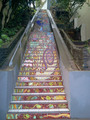
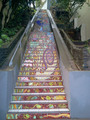
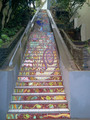
Lower section of Hidden Garden Steps, 16th Avenue between Kirkham and Lawton streets in San Francisco
Those of us involved in the project saw Pat at other times. She was there to help with public workshops that allowed Steps supporters to create small parts of the mosaic under the direction of project artists Aileen Barr and Colette Crutcher. She joined others in laying background tile onto some of the Steps risers during those workshops. And my wife and I ran into her and her husband—Marty—a few times while all of us were taking walks along one of the small lakes in Golden Gate Park at dusk; we would stop, chat about the Steps and other things we were all doing, and look forward to the day when we would be celebrating a collaborative community success on the completed Steps themselves.
We never had the chance to have that onsite Steps celebration together. By the time we had our opening ceremony, in December 2013, Pat wasn’t well enough to join us. I did, on the other hand, feel as if the decision to celebrate her life and her spirit by singing "Deck the Halls" at her memorial last weekend made perfect sense after her husband explained that it was her daughter’s choice—in honor of Pat’s habit of singing her children to sleep throughout the year with "Deck the Halls" rather than something more mundane. After all, "mundane" is not a word to be connected to someone who so gracefully, charitably, and diligently worked to make her community a far better place than it would have been without her.
Paul Signorelli
.
Blog
.
<span class='date ' tip=''><i class='icon-time'></i> Jul 23, 2015 02:42pm</span>
|