Blogs
|
Do titles matter?
If they do, then why are so many people with such big titles unable to make decisions in their organizations? If they don’t, then why does everyone seem to want a bigger and more grandiose title?
Maybe it makes us feel good at the summer cookout when we can say we’re the "Executive Senior Vice President of (fill in the blank)". And people go "wow - now that sounds impressive". But does it matter?
It might matter to some external aristocrat who won’t take a meeting with anyone below a Vice-President (yes they are out there), but internal to the organization - the place that actually pays you, does having a title help you be effective?
For some it may, but for many, I wonder.
So, would you rather have a title or influence?
Glenn Whitfield
.
Blog
.
<span class='date ' tip=''><i class='icon-time'></i> Jul 27, 2015 10:07am</span>
|
|
Saw a headline for an article the other day in a local Medical News journal espousing the benefits of Lean Management. Needless to say, I was excited to see Lean get some press in the local medical community which has been slow to implement the tenants of Lean Thinking. That is, until I started reading the article…
The opening sentence reinforced to the reader the biggest misperception about Lean out there - it is all about eliminating waste. Reading on, it all made sense to me that this was the angle the author chose since he’s a CPA from a local Accounting and Consulting firm. Now I’m not trying bash CPA’s or accounting firms (I used to work for one), or the writer himself - he’s trying to get a lead, make a sale, get someone to call him and his firm for help. And what better way to get people’s attention than to say you can help them eliminate waste (read as cut costs)?
And while talking about eliminating waste with Lean Management principles may make for quick and easy cocktail fodder, after all, if I cut costs, I will make more money - simple right (not); it is not what Lean is about.
Lean is about Increasing Value with Respect for People.
But this is a much harder conversation. I mean, when you start talking about increasing value, and what it takes to do that, it can become a deep conversation with a lot of critical thinking skills involved. And this respect for people thing? You mean you want me to involve the people doing the work in changing the system? Well, that will take a lot more time and we just don’t have time for anything like that - we need to act now. Let’s just eliminate waste - that sounds a lot easier! And so it goes…
We need to continue to teach others about what Lean is truly focused on and not take the easy way out. If all you’re going to do is eliminate waste, don’t call it Lean, call it what it really is - cost cutting.
Let me know your thoughts!
Glenn
Glenn Whitfield
.
Blog
.
<span class='date ' tip=''><i class='icon-time'></i> Jul 27, 2015 10:07am</span>
|
|
I’ve been spending some time lately working on improving our ability to solve problems, specifically developing a more structured problem solving method, including root cause analysis. Historically we have used problem solving and root cause analysis to, well, solve problems. But one thing we need to realize is that it can also be used to create opportunities. Here’s an example:
While in one of our outstanding facilities a few weeks ago, I listened intently as the leadership team proposed a way to increase their census. As they went through their presentation, it occurred to me that they had not thought through the solution to verify that it would indeed increase census. They were simply guessing at the solution they "felt" would work. When pressed for more data on what led them to this conclusion, they quickly realized they needed to go back to the drawing board.
How often do we do this? Just jump to a solution because it "feels good" or we "think" it will work, when we may not even understand the problem we are trying to solve?
To prevent this, one of the first things we need to do is make sure we clearly understand what we are trying to accomplish. We need to ask, "What is our purpose?" Once this is determined, we can use a thinking process to work through the issue and solve the problem or create the opportunity. For example, the following is a simple 8-step method that can be used to think through any problem or opportunity:
Clarify/understand the problem
Define the current situation
Set a goal/target
Perform root cause analysis
Provide recommendations
Develop an implementation plan
Follow up
Share the results with others
The depth of each step will vary with the issue being resolved, but it is critical to note the importance of Steps 1 & 2: To clearly understand the problem you are trying to solve (or opportunity you are trying to create) and the current situation.
Using this process can take a little more time than just jumping in, but it will produce better, more sustainable results.
If you want to know more, drop me a line!
Until next time,
Glenn
Glenn Whitfield
.
Blog
.
<span class='date ' tip=''><i class='icon-time'></i> Jul 27, 2015 10:06am</span>
|
|
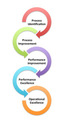
Process Identification -> Process Improvement -> Performance Improvement -> Performance Excellence -> Operational Excellence
The journey of Continuous Improvement is long, arduous, and best of all, never-ending. One could say that is the whole nature of the word "continuous". This road does, however, have several checkpoints. With that said, here we’ll provide an overview of the entire journey, but spend more time at the beginning - because that’s where it all starts!
When organizations determine they want to embark on the CI journey, they often just want to jump right in. Process Improvement is where most start. This, however, can be wrought with peril. I once worked with an organization who did just that - started a Process Improvement Initiative. They did all the training on Lean, Six Sigma, Team Building, etc. There was mixed reception from the operations team, and mixed results at best. What they did not realize was that, for them, PI did not mean Process Improvement; it meant Process Identification. They wanted to jump right in to improving without establishing a fundamental, core foundation of what they were actually doing. This led to much frustration and confusion among the staff.
Many organizations fall into this trap. They think they are better than they actually are - or at least farther along the CI journey. After all, who wanted to admit they don’t even have a consistent identification of their processes? That would mean a failure of management, and no manager is going to admit to that! Well, guess what people, time to take a hard look in the mirror. I once had the opportunity to work for a manager, who, whenever a "sticky" problem was presented to him, would pull out an old truck mirror from under his desk, take a look and ask, "Is the problem me?" When was the last time you did this? But, I digress.
If one wants to embark on a journey, while the destination may not always be known, the starting point darn well better be! If not, how will you be able to measure your progress? Only once we have identified (honestly) where we are, can we improve; otherwise, we are just kidding ourselves. So, Process Identification leads to Process Improvement.
Once processes start to be improved, we can expect to see performance be improved through the use of well defined measurement systems and processes - remembering to measure what is important - not everything needs to be measured! Now, Process Improvement leads to Performance Improvement.
As our performance in focused areas improves, we begin to see excellence in our processes and areas of focus. We have best practices that can be shared across the organization into other areas. Performance Improvement leads to Performance Excellence.
As we begin to seek and strive for excellence in our impacted areas, we start to share the approach across the organization, through all operational activities. We integrate ideas, share best practices, and continually work on improving the way we do things. Now, Performance Excellence leads to Operational Excellence.
Operational Excellence becomes the way the company does things. There is a mindset of always wanting to improve. Celebrating successes along the way, and appreciating the gains made by all to improve the organization. It becomes a de facto thought process. It is never ending….
A Summary:
Your thoughts?
Glenn Whitfield
.
Blog
.
<span class='date ' tip=''><i class='icon-time'></i> Jul 27, 2015 10:06am</span>
|
|
Albert Einstein is credited with defining insanity as "doing the same thing but expecting a different result." And so it goes with another EHR implementation gone bad…
The Royal Berkshire Foundation Trust in Reading, UK recently announced they had to write off £18 million ($28 million) due to the recent implementation of an EHR system (Article here). According to CEO Ed Donald, "Unfortunately, implementing the [EHR] system has at times been a difficult process and we acknowledge that we did not fully appreciate the challenges and resources required in a number of areas." Huh? Since the British are far more eloquent in their explanations, allow me to provide a translation: "We thought we could pay a vendor, flip a switch, and it would work." Unfortunately, that translation is not limited to my British friends, but works for every hospital CEO trying to explain a EHR implementation gone horribly wrong.
I would imagine this project failed in two key areas:
It was probably treated as an IT project, instead of a business project involving IT (read more here)
The People, Process, Technology approach was likely Ignore the People, Glance at the Process, Focus on the Technology instead of Focus on the Process, Engage the People, Prepare for the Technology (read more here).
The hard part is, this is hard. Really hard. Business/Operations owners must be fully engaged from the start for the duration, and resources have to be dedicated and aligned throughout (even before the official project "kickoff").
I don’t know the details or full history of this situation, but I imagine it parallels many I have come across. It is highly unlikely that no one mentioned to the senior leadership of the hospital how difficult this would be, and how important it would be to put the proper amount of resources on the project, after all, we’re talking close to $50 million. It is also highly likely the senior leadership responded with "we can’t afford that, what is the minimum we can do?" After all, the up front sticker shock to do these types of projects properly can require a trip to the ER to check your heart. So they played it "safe."
The CEO says he will not resign, despite pressures from the local media, but one wonders if he should be sacked? There’s clearly not enough information publicly available to make that call, but "not fully appreciating the challenges and resources required" should have consequences. Unfortunately, those consequences will likely fall on some poor Project Manager and the vendor, and not on the executives who ultimately made the call not to invest resources up front. The same executives that will move on to other healthcare organizations and make the same decisions about resources on the next project and have the same poor outcomes.
Insanity? Perhaps. But until organizations decide to truly do things different, to make the hard choices up front, when they are the hardest, to have true courage and resolution, things will continue as they always have… and that’s just crazy.
Until next time!
Glenn Whitfield
.
Blog
.
<span class='date ' tip=''><i class='icon-time'></i> Jul 27, 2015 10:06am</span>
|
|
One of the interesting things I always notice as we approach big games, like the recent Super Bore, is that business writers and observers tend to skew their musings toward sport, or the business of sport (maybe that’s just a way for them to justify their employer paying for a trip to the game??).
Anyway, not being one to miss the boat, I began to think - what if an organization was run like a sports team?
I’m talking - what if EVERY person in the organization was on a yearly or multiple year contract? From the CEO to the janitor? Sure there might be some short term thinking, but the multi-year deals would reduce the worry about trying to maximize today’s profits at the expense of tomorrows; besides, that’s where ownership has to decide if that’s what they want.
Pay a bit of a premium in salary, still offer standard benefits, and have solid performance measures for each position. Even have a performance bonus plan that could be based on quality, quantity, etc. Add incentives for participating in improvement activities and a share of the improvement gain. Really try to engage employees. Treat every day like game day.
Think about it - that person in accounting who just does the minimum to get by - they wouldn’t last past the end of their contract - LIFERS beware!. And good talent jumping ship, well, they can, but their contracts would need to be bought out.
Maybe part of the contract is a job placement service for a certain period of time if your contract is terminated. Lots of possibilities.
But would this improve operational performance? What kind of culture would it create? Collaborative or Back-Stabbing?
What do you think?
Glenn Whitfield
.
Blog
.
<span class='date ' tip=''><i class='icon-time'></i> Jul 27, 2015 10:05am</span>
|
|
A few weeks ago, I had the honor and privilege to speak to the founders of four manufacturing startup companies as part of the Vogt Awards program. The topic was near and dear to my heart - Lean Manufacturing.
My initial thoughts were many - how am I going to cram all I know about Lean into 90 minutes? There are so many topics to discuss - How will I pick the ones that will help them the most? Is a high level, broad-brush approach appropriate or should I go into details on selected topics? Where should I start with such a blank sheet? Then it hit me - a blank sheet… These are startups. Early stage startups are that. Some of them have only developed a prototype, and they will probably not be making their own products initially, so talking about 5S, Visual Factory, KanBan, Poka-Yoke, and other topics may not be of immediate use for them. So where to start?
Well, as Julie Andrews once said, "Let’s start at the very beginning, it’s a very good place to start." So I went back to the basics, introducing the concept of Lean Thinking and focused on the Principles of Lean introduced by Womack & Jones:
Value
The Value Stream
Flow
Pull
Perfection
Understanding these fundamental principles are key to understanding Lean. All the topics, tools, etc. can be traced back to these 5 principles. And since we’re talking about people who are just starting their companies, what better place to start! They can use these to serve as a foundation for how they will operate their companies, as Lean is intended. So instead of jumping to the solution, I focused on thoroughly understanding the underlying philosophy - something they could really use.
Then I started thinking - how often to Lean practitioners jump straight into the solutions before making sure the audience understand the principles? We go straight to the tools and templates without understanding why we are using them. And then we wonder why Lean transformations fail. It’s like teaching Calculus without understanding Algebra (or even basic Arithmetic), and we need to stop. Take the time to go back to the basics and focus on the fundamentals. It’s time well spent.
Oh, and interestingly enough, the cohort I spoke to was also going through the Lean Startup Program (which I think is fantastic), so I asked them: How much time did you spend learning about Lean and these fundamental principles? Answer: None.
Let me know your thoughts!
Glenn Whitfield
.
Blog
.
<span class='date ' tip=''><i class='icon-time'></i> Jul 27, 2015 10:04am</span>
|
|
Editors note: While some may consider Design Thinking and the Lean Start Up methodology competing, in my view they compliment each other quite well. This post is my view on how they can be integrated to help organizations succeed.
The importance of design cannot be understated. It is a premise that most readily accept, especially when it comes to product design; but when we take an honest assessment of the results of our projects (or initiatives), in retrospect, many of our designs - system designs - are poor. Problems and opportunities are identified, and a solution is visualized, but at the end of the day, the vision rarely materializes as originally seen.
Design Thinking incorporating the Lean Start Up can help.
Design Thinking
Design Thinking is a term that according to Tim Brown, CEO of the design firm IDEO, was coined by David Kelly, and is defined by Brown as:
"A discipline that uses the designer’s sensibility and methods to match people’s needs with what is technologically feasible and what a viable business strategy can convert into customer value and market opportunity"
Upon reflection, Brown was not totally satisfied with this definition and added that "design thinking connects need into demand." He has since even asked if this is a general definition of Design Thinking and if it is even useful to have one.
Going back to the definitions proposed, it is important to note that Design Thinking centers around the principles of Human Centered Design. Design thinking relies on our ability to be intuitive, recognize patterns, and develop ideas that have an emotional meaning in addition to being functional in the design of new innovations.
Innovation is powered by a thorough understanding, through direct observation, of what people want and need in their daily lives, or what they like or dislike about the way a product or service is delivered.
Design Thinking should not be thought of as a series of steps one performs, but rather a system of spaces that overlap. There are three spaces in the design thinking system: Inspiration, Ideation, and Implementation. Projects can move between spaces as the ideas that impact the project evolve. The reason to think of these as spaces instead of as discrete steps is that projects can flow through each space more than once as the team refines the ideas and experiments with new directions. Projects can start in the inspiration space, move to the ideation space, back to inspiration, back to ideation, to implementation, to ideation, and back and forth many times until the project is successfully completed.
This very fluid model can seem chaotic, but as teams work with it and use concepts from the Lean Startup such as Build-Measure-Learn, and Shewart’s Plan-Do-Study-Act cycle, they become more comfortable with the process.
Visually, the design thinking process can be represented as follows:
Inspiration
Although projects will move through multiple spaces, the design process typically begins in the Inspiration space with the identification of a problem or opportunity that motivates people to search for a solution. However, it does not stop with the identification of the problem or opportunity. For many projects, this is the end of the inspiration space, and it never to be heard from again - not so with the Design Thinking methodology.
The Inspiration space involves the direct observation of the activity (the process) and the people who are performing the process. It includes interviews, getting people to tell their story and immersion into the process so that a complete understanding of the problem or opportunity is gained. It involves documenting the critical steps required and being able to tell the story of the users.
It allows the designers to take a look at the world through the lens of the user and see what they do, how they think, what they need and want. There should be several disciplines involved to help gain a more complete understanding and close attention should be paid to so-called "outliers" as they may be more common than believed. The team should not jump immediately to technology solutions, but should be looking at how technology (new or enhanced) could help.
Once the observations are completed, the information needs to be organized and synthesized to provide more clarity. A project room can serve as a good place for insights to be shared and to start into the next space: Ideation.
Ideation
The next space in the design thinking process is ideation. Once the team has observed and documented activities in the inspiration space, they need to synthesize what they saw and heard into thoughts that can lead to solutions to the problem or opportunity.
The major activity in this space is brainstorming. To get the most out of this activity, it is important the team is made up of interdisciplinary members with different backgrounds and approaches to the solution. This will allow the team to be truly creative and potentially create disruptive innovations. The process should be structured, with each idea written on a Post-it note and shared with the team on the wall - visualization is important during this time. The ideas can then be stratified into different categories as they move closer to becoming implemented. It is important during brainstorming there is open and honest communication, and that the often obstructionist role of the devil’s advocate is minimized. Once the ideas are vetted further, this role can become useful, but early in the process, it will stifle creativity.
Depending on the problem to be solved, the team can move into a more detailed mapping of the process, constructing current and future state maps, confirming critical steps, identifying wastes (those activities which add no value), and the initial selection of metrics. The team should also research and investigate any applicable Best Practices that may exist.
Once the ideas are vetted and a process map is developed, questions often arise about the problem - will this solution solve the problem? what are we missing? etc., as the team starts to move toward the next space of Implementation. To answer these questions, the team needs to move back to the Inspiration space before moving forward. This will allow for clarification and help ensure the solution proposed will actually solve the problem. Once this is complete, the solution is updated as needed, and the team will move into the next space: Implementation.
Implementation
The final space of the design thinking process is Implementation. In this space, the ideas generated during Ideation are turned into a solid, well rounded action plan. The action plan should go beyond a simple task list, but incorporate visual tools, and be part of an accountability process in order to keep the team on task.
Critical to success in this space is prototyping - turning the idea in to an actual product or service that will be tested, iterated, and refined. Through the development of a prototype (or pilot), designs can be observed, modified, and validated.
The Implementation space will have many iterations, and moves through what Eric Reis, author of The Lean Startup, refers to at the Build-Measure-Learn Feedback Loop (shown below). In this loop, ideas are built and a product/service is developed and piloted. Measurements are developed to gauge the success of the product/service, and data is collected. The data is analyzed allowing the team to Learn about how the product/service is being used, which leads to more ideas generated on how to improve the product/service. The overall goal is to minimize the total time through the loop.
Once the prototyping/pilot process is finished, and the product is ready, the design team needs to create a communication strategy. The importance of communication cannot be underestimated - according to John Kotter of the Harvard Business School, organizations under-communicate new initiatives by a factor of 10. Storytelling, especially through multimedia can be very powerful in communicating a message to a diverse audience. Other communication tools such as micro-learning, town hall meetings, video chats, and even traditional flyers can prove helpful.
Applying Design Thinking with The Lean StartUp
The design thinking process can integrate very well into the culture of any size company. In fact, various spaces of the design thinking process are often utilized on projects, but not as an integrated design process.
The design thinking process, along with the Lean Start Up feedback loop, can be used for every new initiative an organization considers, whether it be a new department or initiative, or a new product or service that could potentially become a free-standing company. Better defining the innovation and strategic execution process will allow the organization to focus on and prioritize those initiatives and products that will truly contribute to success.
Most ideas start in the inspiration space, though the originator of the idea rarely realizes they are operating in that space, they typically just have come to the realization there is a problem or opportunity and they have an idea on how it should be solved. They quickly move into the Ideation space and possibly Implementation space, then realize they may not have correctly or accurately framed the problem, so they return to the Inspiration space to learn more. As the idea gains momentum, they move into the Implementation space. This incorporates heavy use of the Build-Measure-Learn (BML) loop, which may cause them to move back to the Inspiration space as they learn from their customers about how the product was implemented. And the cycle continues; weaving in and out of different spaces, utilizing BML as a guiding principle, all the while making improvements to the product or service for the customer.
Summary
Design thinking is a structured process without a lot of structure. The foundational spaces of Inspiration, Ideation, and Implementation provide a framework to operate under, yet are not constrictive or so self-prescribing to state things must be done in a specified way. The ability to flow between spaces is critical to the successful use of the design thinking process.
Systemic problems need systemic solutions, and design thinking provides a process for this dilemma.
Glenn Whitfield
.
Blog
.
<span class='date ' tip=''><i class='icon-time'></i> Jul 27, 2015 10:04am</span>
|
|
In the last post, we discussed how to overcome the PPT phobia. Today, we shall clear the mist from the next myth.
Myth 2: E-learning is a waste! Books are better, when it comes to learning.
From a trainer’s point of view, this can prove to be a nightmare. Comparing e-learning to books, is like comparing apples to oranges.… Read the rest...
Learning and Sharing
.
Blog
.
<span class='date ' tip=''><i class='icon-time'></i> Jul 27, 2015 07:04am</span>
|
|
In the last 2 posts we discussed about how to get over with the two common psychological challenges, that an instructional designer faces -
1. Myth 1: Learning the e-learning tools are very difficult, hence creating an e-learning is difficult
2. Myth 2: Books are better than e-learning. My course cannot surpass a book.… Read the rest...
Learning and Sharing
.
Blog
.
<span class='date ' tip=''><i class='icon-time'></i> Jul 27, 2015 07:04am</span>
|