Blogs
|
I’m not a great believer in leadership training, even though it’s very much the trend. But the fact that such training exists means that there is a problem to be solved. I notice that some of the manuals like to quote the 10 leadership principles of Jack Welch. I’ve copied below the first five: 1. There is only one way - the straight way. It sets the tone of the organisation. 2. Be open to the best of what everyone, everywhere, has to offer; transfer learning across your organisation. 3. Get the right people in the right jobs - it is more important than developing a strategy. 4. An informal atmosphere is a competitive advantage. 5. Make sure everybody counts and everybody knows they count. Three of them I find vitally interesting for the rethinking of learning. Forget the first, which is there as a kind of shocker, asserting the authority of the leader (what better way to say "I’m Jack Welch, shut up and listen"?). If I wanted to quibble, I’d say that just as there’s no such thing as a free lunch, there’s no such thing as a straight way. All viable ways follow the relief of the land and are therefore not straight, but rather as straight as possible or as straight as management can make them… which means that professional life doesn’t end up looking like a series of right angles. It starts getting interesting with number 2. Learning is as close to the top as you can get (once you get the phantom straight line out of the way). And notice what it says: learning is everywhere. It doesn’t come from trainers and SMEs. Everyone’s involved. And the need is to transfer, not to teach. Skip to point 4. What do we find? A celebration of informality, not as a method of learning (who in the organization really cares about learning besides Jack Welch?*) but as a factor of competitive advantage! Put 2 and 4 together and we begin to see how learning organizations may develop. Point 5 is equally important. How do people show they count and know they count for others? I don’t think Welch is talking about pay packages and brownie points. It’s rather that their voice is heard because they have something to contribute and a forum for making it heard. That forum is the ongoing informal dialogue of an organization where "everyone, everywhere" has something "to offer". Maybe we should be concentrating on giving shape to that forum by encouraging communities where the dialogue is real and authentic, not polluted by too many "learning points". Anyway, it's a great honor to welcome Jack Welch to the exclusive club of promoters of informal learning. He deserves to be one of us! * To answer my own question, I’d say "nobody except the CEO" because everyone else, including the CLO, has a job to do and they all know the criteria on which they will be judged. And it ain’t learning - which is oriented towards the future -- but keeping the machinery going with as few hiccups as possible - which means having one's eye fixed on the present and quarterly results. Having worked closely with a direct disciple of Jack Welch, I know how focused those objectives are.
The Learning Circuits Blog
.
Blog
.
<span class='date ' tip=''><i class='icon-time'></i> Aug 19, 2015 03:36am</span>
|
|
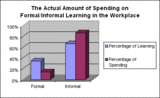
I recently posted an article on this blog, Investing in Informal Learning. Seeing more in it that what I originally posted, I used it as part of a larger posting on trdev, State of the Learning Industry. Tony Karrer urged me to post it to Learning Circuits as trdev is semi-public in that you have to join the group to view any of the postings (it is free however). For those of you who are not members of trdev, I urge you to join as it is one of the more dynamic and critical T&D discussion groups on the web. However, simply cross-posting the same material holds no real interest to me, so I delved into the subject and thought about it some more. . .I'm sure most readers of this blog have seen charts similar to this posted throughout the web:Which of course makes informal learning look like a better investment than formal learning. However, in Training in America, the cost of formal and informal that they give ($30 billion for formal learning and $180 billion for informal learning) means that the true investment for learning should look more like this:The second chart suggests that "formalizing" the informal learning would now be the better investment in order to make it more efficient. However, in the trdev discussion, Tony suggested that the second chart is not counting the payroll expenditures (soft costs) of the students in the formal learning classes. Thus the formal learning expenditures should be higher. We could argue back and forth about what costs should be included in each one, but we would only be second guessing what the authors actually counted under each form of learning. Then it dawned on me what the numbers really mean; we are using the government's term of informal and formal learning -- if the money invested in learning falls under a training department's budget, it is counted as formal learning; if it falls only under payroll, then it is being counted as informal learning. We are using monetary terms to define informal and formal learning. However, I think that most of us would define it more or less as Stephen Downes views it -- if it is managed by the learner it is informal, if it is managed by someone else it is formal. The government defines OJT and apprenticeship programs as "informal" simply because they normally fall directly under payroll's budget, rather than training's. Yet for the most part, learners are not walking into the workplace and deciding what and how they will learn their job. Rather they are being directed or managed by supervisors and coworkers. The OJT programs are often under the guidance of the training department.Thus the numbers thrown at us that 80% of the learning in the workplace is informal and 20% is formal is totally misleading, unless of course you want to define formal and informal learning in dollar terms. So what is the real percentage? I doubt if anyone really knows. Besides, I think it would totally depend on the type of workplace itself.
The Learning Circuits Blog
.
Blog
.
<span class='date ' tip=''><i class='icon-time'></i> Aug 19, 2015 03:36am</span>
|
|
UPDATE 2/19/07: After an error then a typo, the link below goes to the correct page. Just to be sure, it's http://learningcircuitblog.pbwiki.com/bigquestions and the list is now 112 questions long.Since I'm not tracking comments this month for The Big Question, I thought I'd do something that I hope will be valuable. I've aggregated all of the questions that have been proposed in the participating blogs. You can find the list, which at the moment stands at 102 questions, on the LCB Discussion Wiki on the Big Questions page.On the wiki page I describe a few things that I needed to make educated guesses at. If you don't care for how I've presented your question(s), please feel free to edit the table.Dave Leeyour humble blogmeister
The Learning Circuits Blog
.
Blog
.
<span class='date ' tip=''><i class='icon-time'></i> Aug 19, 2015 03:35am</span>
|
|
I’d like to follow up on my last post and also weigh in on the question of investment in formal training and informal learning. I tend to see the world through my own professional lens, which is that of culture. Although usually taken to be about the behavioral differences between people of different national, geographical, ethnic, religious origins, culture is everywhere and constitutes a property of all groups. This idea isn’t new to the industrial world, since for the past 20 years or so we have talked about "corporate culture", which for many more decades has been pro-actively practiced by companies such as IBM (with its now abandoned dress code and "IBMer" identity) or HP, with the "HP Way". Jack Welch used a much softer and holistic approach at GE, where, as we now know, there was a strong emphasis on informal communication and bottom-up creativity, aiming at creating a learning culture. Defining or imposing a culture and disseminating its principles aren’t enough to make it effective. The key reason for this is organizational inertia. And consistent with it is the relatively short tenure of CEOs, whose promotion of culture is essential if we wish to maintain any hope for cultural change. Alas, though essential, it isn’t enough, partly because the permanent management -- from divisional directors to line managers, the ones who have to deal with human performance -- see the CEOs as living in a stratosphere that has nothing to do with their lives and their professional objectives (i.e., in most cases, maintaining their jobs). Have any of you tried inviting a group of people in a "teaching situation" to be creative? Even though - depending on the group -- a few voices will inevitably speak up, it generally isn’t creativity that’s expressed but rather "competitive personality". And its effect is usually to silence the others (the same thing happens in discussion groups, by the way). Department heads live essentially in a world of competitive personality. I began working on the subject of professional culture when it became a mission critical issue in the 1980s as companies here in Europe began the revolutionary step of introducing the PC into their workspace. This was a major paradigm shift, especially concerning the distribution of power and the status of staff autonomy. It wasn’t an easy ride, but it certainly was an interesting one, and possibly more important in terms of world culture and even geo-politics than the collapse of the Soviet Union. I did a lot of work with one company in the Thomson group where the CEO was on a mission of mondernization. Nobody knew at the time, but he was asked by Thomson’s CEO to prepare this subsidiary of a state-owned company, which possessed a largely military culture and thrived on defense contracts, to be sold to a privately-owned Canadian competitor and to be more active in the civil sphere. My small training/consulting company was asked to prepare the entire staff on two fronts: intercultural (dealing commercially with other countries, including speaking the same language) and adoption of PCs (the machine, the keyboard, DOS, spreadsheets, databases, word processing, etc.). To my surprise, the biggest challenge was getting French males to use a keyboard! This was an exciting mission and, knowing the CEO had clearly stated his goals, I began by interviewing the department heads whose staff was concerned by the "new culture". Imagine my disappointment to discover their attitude was unanimously blasé and even dubitative. In the following months, we had some fun and achieved some significant but limited success, until the CEO resigned 18 months later and the great experiment was abandoned (and they never managed to sell off the company). In the meantime I had been co-opted to create a new department of engineering services around training technology (basically, interactive video) to be proposed to the company's clients, so I was no longer involved in the internal training challenge. We all know now that the teething problems of introducing the PC lasted as long as teething problems tend to last and that, among other things, within three years French males started massively accepting the use of a keyboard. There is little doubt that this happened not because of a massive increase in training (which actually did take place), but because there was a deep cultural shift leading to a much more massive amount of informal exchange. Training helped, but it remained blissfully ignorant of the cultural reality around it. The question we can now ask is, "could it have happened more quickly, more efficiently and at less cost had training departments taken into account the informal?". The answer should be resoundingly "yes", but as Don Clark points out, there are no "objective statistics" to cite, so that a classic resource management approach is incapable of taking the issue on board.How could informal learning have been encouraged? First of all, by concentrating the formal training less on the technical skills of the staff and more on the human skills of department heads. It could have included things like group dynamics and communication training, to say nothing of corporate culture itself (which I still don’t see as a significant item in training course catalogues). Although this type of action is formal, it represents a direct investment in informal learning and could be added to the column of strategic investment rather than "just in time" fixes. They could have encouraged rather than neglected the potential of the expensive and hard to deploy groupware (Lotus Notes) they began investing in during the 90s. They could have looked at questions of corporate architecture (some did, by the way, but not necessarily with the conscious idea of stimulating informal professional exchange). They could have adopted an attitude of "visionary evolution" focused on the long term, taking into account human behavior; but of course the obsession with quarterly results still makes that difficult. Executives with long-term vision write books rather than struggling to impose their vision in the real corporate environment they work in. As this is turning into an essay, I’ll stop here, for reasons of inappropriate length. But I’m sure others will have many things to say to keep the discussion going and tease out the meaning of these issues, including the "how to invest in informal learning". If we could situate the "how to", we might be able to clarify the "how much?".
The Learning Circuits Blog
.
Blog
.
<span class='date ' tip=''><i class='icon-time'></i> Aug 19, 2015 03:34am</span>
|
|
Ok, so it looks like Learning Circuits Blog is not a spam blog after all. And that means that we can ask this month's big question - a few days late.This month's big question actually was a question asked by an attendee at Jay Cross' presentation on informal learning at ASTD TechKnowledge. She was in charge of designing training and support systems to help people transition into management roles throughout the organization (customer service, sales, operations, etc.). She told us that her organization was used to doing this with instructor-led training, but that she wanted to explore a combination of instructor-led, online and informal learning. She wanted suggestions on things she could do, what she needed to consider, and how to balance what approaches were taken.So, this month, The Big Question is...What Would You Do to Support New Managers?Please answer this question by posting to your own blog or commenting on this post.(For further help in how to participate via blog posts, see the side bar.)Points to Consider:As much as possible please provide specific suggestions to this person.Since dialog with her is possible at this point, if there are key forks in the road - you just have to tell us about them and the options that exist.Participating Blogs:The form for March's Big Question has been closed. If you have a post in response to the March Big Question, please contact the Blogmeister by using the Dear Blogmeister form which can be linked to from the top of the sidebar.NOTE: If the forms do not appear below, please hit your browser’s refresh button. If the forms still do not appear, please use the Dear Blogmeister form which can be linked to from the top of the sidebar.
The Learning Circuits Blog
.
Blog
.
<span class='date ' tip=''><i class='icon-time'></i> Aug 19, 2015 03:34am</span>
|
|
Well in the spirit of community building and the voice of Jay Cross in my head ("just post it to the blog") I'm asking the community what happened this month with The Big Question. For the first five months of The Big Question we've averaged 24 post per month. Currently, March stands at 7 posts.Help Tony and I examine the situation so we can make The Big Question as vibrant as possible. Did everyone just get busy with other things at the same time? Did you forget about TBQ this month? Did we forget to remind you? Was the question just not of interest to you? Did the Blogger "spam blog" snafu and resulting delay at the beginning of the month throw you off? Are those of you in northern climes suffering from seasonal duldrums (he asks from Palm Springs)?I'd love to get feedback from as many of you as possible - whether you've contributed to TBQ in the past or not. TBQ has been a great feature to this point and this March sag may just be a blip. But why not discuss it. Process is a part of community building after all.So in the words of Linda Richmond, "Alright, I'll will give you a topic. The March Big Question: Came in like a Lion and out like a Lamb. What's up with that? Talk amongst yourselves."
The Learning Circuits Blog
.
Blog
.
<span class='date ' tip=''><i class='icon-time'></i> Aug 19, 2015 03:34am</span>
|
|
Like many industries today, there are significant changes going on for Instructor-Led Training (ILT) and Off-the-Shelf Content Vendors today. In recent conversations with different vendors, they cited a variety of pressures that are making their situations increasingly difficult:On Demand: Customers want to have both up-front training and on-demand materials. However, on-demand materials are perceived to be similar in form to what’s freely available through search.Smaller Increments: Customers want to purchase training in smaller increments to minimize time away for learning. This causes several problems for ILT and Content Vendors. Scheduling courses in smaller sessions distributed over days or weeks often interferes with a vendors' ability to delivery ILT on-site because the trainer is booked for consecutive days in class. It’s also not clear what pricing models work for these kinds of approaches.Rates: Rates for people continue to go up, while price points do not. Vendor prices are not likely to increase as additional training options continue to increase ways in which people can learn.Courseware Quality: Higher quality courseware (simulations, interactive, referenceable, etc.) is more expensive to produce and it is hard to get that expense back from customers unless there’s significant volume. Further, it is often more out of sync with customer demand because of time-to-market issues. This environment makes it easier to justify PowerPoint plus audio type courseware, but customers are never satisfied with the quality.New Competitors: If you're in IT - Microsoft and other vendors like to give away training, or bundle it with their software sales. If you are in productivity training, there are excellent resources available for free online around systems like "Getting Things Done" (GTD).The bottom line is that many vendors are struggling to determine their direction moving forward. And likely, this is not that far away from some of the same struggles faced by services groups inside organizations.So, this month, The Big Question is...ILT and Off-the-Shelf Vendors - What Should They Do?Please answer this question by posting to your own blog or commenting on this post.(For further help in how to participate via blog posts, see the side bar.)Points to Consider:What do you believe will be blends that will be succsseful both for learners and from a business model standpoint? In other words, what’s the mix of offerings that can command a high enough price and produced at a cost where the vendor can be profitable?How can ILT providers integrate alternative delivery methods for live training when their trainer resources are often on the road or "in-class" during business hours?Are there other business opportunities to leverage the core competencies and assets of these providers? In today’s world when many referenceable resources are available online to the learner, what is the right model?Is this all hopeless in a Do-It-Yourself world? Should they all get out of the business now?Participating Blogs: The Big Question for April has been closed. If you'd still like to submit your post to the April Big Question, please contact the Blogmeister by using the Dear Blogmeister form found at the link at the top of the sidebar or by clicking here.
The Learning Circuits Blog
.
Blog
.
<span class='date ' tip=''><i class='icon-time'></i> Aug 19, 2015 03:33am</span>
|
|
Simple Example (click to enlarge the two pictures) Here is a great, simple example ofPedagogical Elements. Take two, almost identical pictures of Earth. The first is made up just of accurate simulation elements (if you ignore the corners). Click on it and see if you can make out the details. The second picture adds just a bit of pedagogy. Now click on it, and see how much richness a little pedagogy adds.
The Learning Circuits Blog
.
Blog
.
<span class='date ' tip=''><i class='icon-time'></i> Aug 19, 2015 03:33am</span>
|
|
I think we are going to be using these more for formal learning programs, so I thought I would share a quick overview and, better, some examples:Mini games: small, easy-to-access games built to be simple and addictive. Mini games are "one-note" in terms of gameplay, often focusing on mastering an action, sometimes with a desired message as a backdrop.Mini-games are typically for:marketing (such as [Dr. Pepper Speedway Rush] or [Monster.com Climbing the Corporate Ladder]),editorial (such as [Take Back Illinois]),explanation (such as [Dean for America game], or this [Cisco example]).commerce (where players will play a few free levels, and then buy the full game).Mini games can sometimes provide an awareness of some more complicated issue, such as fit.Mini games are often created in Adobe Flash, sometimes in less than three weeks.
The Learning Circuits Blog
.
Blog
.
<span class='date ' tip=''><i class='icon-time'></i> Aug 19, 2015 03:33am</span>
|
|
In light of the stunning news of Kathy Sierra's terrifying experience with death threats and other horrid comments made on her blog, Creating Passionate Users, I'd like to raise the question of whether we need to draft and post a code of conduct. Some time ago, I posted some basic guidelines for commentors in the FAQ under the question "What can or can't be posted to a comment?". I'd love feedback from any and everyone. Is this statement strong enough?Does it include everything it should?Is is alright to leave it in the FAQ?Should I put a link to it from the sidebar?Are there codes of conduct for other blogs we should consider? (I've seen and like Blogher's and the O'Reilly proposed blogging code of conduct)Should I just wait for the O'Reilly code of conduct to be finalized and use it?Is this a tempest in a teapot and I should just forget about it?To date, because we have had an invitation-only author team, posts have not been a problem regarding inappropriate language or threats to others. I have pulled down two posts written by authors for content that was misaligned with LCB's purpose (but unoffensive) and another for being more "novel" in length than "blog post". The only comments I have removed from LCB have been obvious spam or inadvertent duplicate comments.But as we move toward a more open contribution model, (i.e., The Big Question) the chance of conduct offenses will rise. As blogmeister, it's helpful to have a previously published policy to point to when informing a contributor that they are in violation of that policy and I'm taking down their contribution.I look forward to reading your thoughts. (I promise, none will be pulled down!)
The Learning Circuits Blog
.
Blog
.
<span class='date ' tip=''><i class='icon-time'></i> Aug 19, 2015 03:33am</span>
|