Blogs
|
For a social artist, their in-breath is observing, allowing, listening, and understanding and their out-breath is connecting, enriching, inspiring, and enlivening. As with any artist, they seek out opportunities to stretch their capabilities beyond what they could imagine.
----Polly Superstar
For months now I've been trying to get a handle on what it is I'm trying to do as I make shifts in my own career. I operate better when I have a framework for understanding my work, so I'm always looking for the thread that ties together what can seem like disparate pieces of myself and my career identity.
Serendipitously, I ran across Nancy White's post on social artistry a few weeks ago. In a flash, it became apparent how everything I'm doing comes together.
If this were just about me, I would have kept it in my career journal. But I realized it's not. Social artistry is something that many of the people I work with are trying to do, too. It's a work identity I see more and more people striving for without realizing it. I think it's a necessary identity, so it made sense to me to share.
What is a Social Artist?
Through Nancy's post and my own research into social artistry, I came up with a few definitions that I think tie together
Etienne Wenger in a comment on David Wilcox's blog says that social artistry is
"knowing how to use who you are as a vehicle for opening spaces for learning. . .it’s about being able to use who I am to take my community to a new level of learning and performance."
Jean Houston defines social artistry as:
". . . the art of enhancing human capacities in the light of social complexity. It seeks to bring new ways of thinking, being and doing to social challenges in the world.
…Social Artists are leaders in many fields who bring the same order of passion and skill that an artist brings to his or her art form, to the canvas of our social reality.
Social artistry is about creating space for change and transformation, which is what learning is really all about. How do we create the space for people to be together, to learn from their experiences and connections and to move them to make a difference in their part of the world? How do we help people grow into their possibilities?
Jean Houston, who developed the concept, calls this:
Creating the lure of becoming
What a beautiful image for transformation. We lure people into the process of "becoming," which is essentially luring them into the possibilities of change.
Why Social Artistry?
Etienne Wenger in his comment referenced above talks about the need for us to become "learning citizens" and to consider how we can act as learning citizens in this world. Social artistry asks all of us to consider how we create and support learning in our lives. How do we help ourselves and others continue to grow?
This seems huge to me at a time when we see that lifelong learning is so necessary for work. But more than that, as I look at the social problems that face us, problems that cannot be solved without all of us working together, becoming a social artist feels even more critical as an aspiration for us all.
Social artistry is about understanding that deep learning is an emotional experience, not just an intellectual one. If the learning we are trying to facilitate goes beyond helping people develop mere technical skills and veers into the territory of supporting people in realizing and sharing their creative gifts, then we must see the work we do differently. We must bring different awareness and skills to the process.
The Skills and Attitudes of Social Artists
First and foremost, I think social artistry requires us to have a growth mindset. We must believe in the possibility of growth and transformation. If we don't, then there's no space for us to practice our art. There's also no purpose for it.
Jean Houston has more on what she sees as the necessary skills and capacities of social artists, including the skills to:
Work with diverse cultures and contexts.
Preserve existing culture, while helping a culture's members move to new stories and ways of seeing the world.
See new trends and patterns in apparent chaos.
Help people work in collaborative networks and circles of connection, and move away from hierarchies and power structures.
Present a model for a constantly learning society and new frameworks for learning.
Use story, art and metaphor to draw out individual and organizational potential.
Be a fool, a humorist or a comedian when laughter is required.
Be a healer, recognizing that transformation is in some ways a process of creation and evolution that moves us to a higher order--to our best possible self.
Respect the individuality and unique qualities of each person he/she works with, helping people grow into their own possibilities, rather than teaching them how to conform.
Reflect on experience and embrace the role of the inner journey in creating outer change.
To this list, I would add skills in:
Asking good questions--questions that are thought-provoking and inspirational and that invite new ways of seeing and solving problems.
Being honest and transparent and creating a safe space for others to do the same. This builds learning, trust and community, all of which are essential to the practice of social artistry, I think.
Facilitating the creation of vision, helping people see potential, but then also facilitating the recognition of reality to create the necessary tension for change.
"Deep seeing" and "deep listening." This involves listening for what is being said beneath the words and seeing what is apparent, beneath surface appearances. And then facilitating others in the process of deep seeing and listening.
Implications for Learning and Career
So what does all this mean for learning and careers?
First, I believe that the skills of social artistry are skills we should all strive to build. They seem to me the core of participating in a creative economy and building for ourselves the world we want to live in. Developing the skills and attitudes I outlined above can only enhance our capacity to perform acts of "radical imagination" and bring new problem-solving skills to our work and personal lives.
On a very practical level, the skills of social artistry--using story, art and metaphor, working with diverse populations, working in collaborative networks and asking good questions--these are the skills necessary to thrive across a variety of occupations. In a creative economy, these are also the skills that keep you relevant and irreplacable.
Social artistry as a a working identity has powerful career implications, too. If I see myself as a social artist, then I am using the skills of social artistry to uncover and share my own gifts, to get clearer about the ways that I can create space for learning and change in my corner of the world. It keeps me more flexible because I am more than just my occupation. I am something bigger than my job, with many permutations and options for playing out who I am.
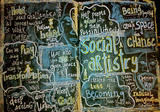
For me, seeing myself as a social artist opens up new lines of inquiry and discovery. For example, I created the images above over the course of a long afternoon of contemplation. Using art to explore the topic led me to deeper thinking and insights, which in turn led me to re-think what I'm doing and how I'm doing it. I am delving more deeply into how I can facilitate conversations and story-telling and how I can use practices like circles and art to deepen learning. What are my unique gifts and how do I use them in the world to help others find their own possibilities?
This is an exciting, inspirational and energizing way of looking at the work that I do. Already it has had huge implications for my thoughts about career and the ways I operate my business. I think it's something we should all be looking at to add meaning and inspiration to our work.
What would happen for you if you thought of yourself as a social artist? How could it transform the work that you do?
___________________________________________________________________
Are you interested in finding your inner social artist and discussing how to support social artistry at work? I am and would love to facilitate conversation on the topic! Drop me a comment or send me an email at michelemmartin(at)gmail.com so we can connect and start discussing!
Michele Martin
.
Blog
.
<span class='date ' tip=''><i class='icon-time'></i> Aug 19, 2015 04:49am</span>
|
|
When I was a junior in college, we were hit by a severe outbreak of salmonella, a result of undercooked eggs in some stuffing. It was so bad, people were literally collapsing in the quad. The walls of the infirmary were lined with retching students and the National Guard had to be called in to help with the situation.
In the aftermath, a weird sort of competitiveness set in among those who had been unfortunate enough to contract the disease. People tried to one-up each other over who had lost the most weight or had the most wrenching story of illness. It was weird and always stuck with me as a bizarre kind of commentary on my fellow students and the culture of competition that existed at a college known for its pre-med and pre-law programs. Who competes over misery?
I've seen a similar kind of competition in the work world--who is most stressed and over-worked? We see exhaustion, depletion and anxiety as a strange badge of honor. On some level it seems to communicate our worthiness. We complain about being overworked, but at the same time, there's a competitive edge to our complaints. "I have it worse than you do," we seem to be saying, as though this is somehow the measure of our lives. We secretly judge those who seem to be less stressed, as though they are not working as hard as we are and therefore are less worthy.
I no longer want to be part of the anxiety wars. I don't want to feel somehow inadequate if I'm not putting in 12+ hour days and working from a state of depletion and worry. I don't want to judge the worth of my fellow human beings based on whether or not they seem to be "working hard enough," which in our culture has come to mean working to the point of exhaustion. I don't want to compete anymore on misery.
I want to start a new competition, one that focuses on how energized and creative we feel. I want to support a culture that says there's something wrong with our lives if we are constantly living with a low-grade (or higher grade) anxiety. A culture that doesn't value depletion, but asks what we can do to re-fill people's wells.
I want out of the Anxiety Wars. Who wants to come with me?
___________________________________________________________
It's not too late to sign up for tomorrow's career visioning webinar at 8 p.m. EST. I got great feedback from the first group that the session really helped them start to get some clarity about their careers and where they want to go. Instructions for participating and the link to sign-up for the webinar are here.
Michele Martin
.
Blog
.
<span class='date ' tip=''><i class='icon-time'></i> Aug 19, 2015 04:48am</span>
|
|
The quest for technical best is a form of hiding. You can hide from the marketplace because you're still practicing your technique. And you can hide from the hard work of real art and real connection because you decide that success lies in being the best technically, at getting a 99 instead of a 98 on an exam.
What we can become the best at is being an idiosyncratic exception to the standard. (my emphasis) Joshua Bell is often mentioned (when violinists are mentioned at all) not because he is technically better than every other violinst, but because of his charisma and willingness to cross categories. He's the best in the world at being Josh Bell, not the best in the world at playing the violin.
The same trap happens to people who are coding in Java, designing furniture or training to be a corporate coach. It's a seductive form of self motivation, the notion that we can push and push and stay inside the lines and through sheer will, become technically perfect and thus in demand. Alas, it's not going to happen for most of us. (my emphasis)
--Seth Godin
Achieving ever-higher technical proficiency in our occupations is seductive, but fruitless. Past a certain point of competency, the ways we need to develop become less about specific skills and more about infusing our own personality, strengths and point of view into the work that we do.
Knowing when to start this process can be difficult. Our organizations often resist the idea because they are focused on "competencies" and "career ladders," which from their perspective are easier to manage.
Companies, especially large ones, are in the business of bureaucratizing and codifying work, which lends itself to a focus on technical proficency at the expense of the person. They need this for efficiency and productivity and because it's easier to do than supporting the development of individual people. Less risky, too. If you supported the growth of individuals, then they might take that growth someplace else. Better to focus on making people great at working for YOUR company, rather than helping them to be better in general.
For many organizations, it's just not part of the culture to look at the growth and development of individual people, so counting on your employer to signal when it's time to make the shift is useless.
Instead, my friends, you have to find this time for yourself.
For some people, the itch to be more than just a collection of skills, to become that "idiosyncratic exception to the standard," is felt as a certain restlessness and boredom with their profession. There's an urge to tweak and shape and be more authentic at work, a certain rebelliousness of spirit that begins to take hold.
For others, there are no signals. Just a sinking into inertia, a "going through the motions" approach that sucks the life from them and makes going to work a chore.
Regardless of how it manifests, the only cure for the disease is to shift your focus. You must move from building your technical skills to infusing your work with your unique gifts, talents and points of view. This is the time for you to dig deeper into yourself, to excavate the buried treasure and bring it to the surface where you can use it to construct something only you can create.
Last week I wrote about social artistry and how this is the work of using who you are to create spaces for learning and growth. Ultimately, I would argue that this is where most of us need to land in terms of own career development. We need to find our core strengths and the key talents we bring to what what we do and find ways to infuse these parts of ourselves into the work.
What this ultimately looks like will vary, of course. I have no recipe or easy list of steps I can give you to make it happen. It is really a messy, iterative process of working each day to uncover the core of who you are and to bring that authenticity to your work.
Although I can't tell you HOW to do this, I can tell you what it feels like when you get it right. You will feel energized and whole. What you do will feel like art, like a passion, rather than drudgery or a series of steps you must take to achieve a soulless end. Your work will feel "right" to you, like you're fitting into a slot that you made for yourself, rather than forcing yourself into a slot made for you by others. You won't feel like you are wearing a mask or assuming a role at work. You will feel like YOU being great at what you do.
So don't shoot for technical competency long past the time when you've achieved it. Instead, stay alert for the time when you must make the shift from the being good at your occupation to being great at being you. That's what "being the best" is really about.
____________________________________________________________________
Trying to figure out your next career move? Check out my upcoming 4-week Career Clarity Camp, starting January 9, 2012. You'll get 4 weeks of activities, 5 live events and lots of support as you figure out where you want to go next.
Michele Martin
.
Blog
.
<span class='date ' tip=''><i class='icon-time'></i> Aug 19, 2015 04:48am</span>
|
|
Derek Sivers, serial entrepreneur and founder of CD Baby, shared some advice last week on his business model:
I feel like I know almost nothing about business, because the only business I’ve ever done is the co-op / sharing model.
It goes like this:
1. You already have something that people want.
It might be something you own, something you’ve learned how to do, or access to valuable resources, space, or people.
2. Find a way to share it with everyone who needs it.
Share because it’s what you do for friends, because it’s the right thing to do, because it makes the world a better place, and because it’ll make you deeply happy.
Share as your contribution in return for all the things and ideas that people have shared with you.
(If you’re having a bad day, or someone has recently wronged you, you may not feel the world has shared much with you, but here’s a reminder.)
3. If it takes some effort for you to share it, you can charge a little something for your effort, to ensure that this giving can continue.
Many people I know are thinking about starting businesses of their own. It's the next iteration for their careers. A good place to start is figuring out what you have that other people want, sharing it the way you would with friends, and charging a little something for your effort.
Clearly it can get more complex later, but as a simple model for starting up, why not start with what you have to share?
__________________________________________________________________
Want to work with a creative way to explore some major career questions? Sign up for one of my upcoming Career Question Image sessions. In December we'll plan for 2012. In January we'll look at defining success and in February we'll explore what may be holding you back. You'll get a chance to try out the VisualsSpeak Image Center and work with other professionals in a live online discussion of your image. You can also try out this online icebreaker to see how the Image Center works.
Michele Martin
.
Blog
.
<span class='date ' tip=''><i class='icon-time'></i> Aug 19, 2015 04:48am</span>
|
|
In my experience, when it comes to career, there are two kinds of courage.
The first is the courage it takes to pick yourself up after you've fallen. This is the courage to make a career change or find a new job after you've been laid off or fired. An event occurs and the person responds. This is reactive courage.
The other kind of courage is the courage it takes to say, "This situation is not working for me. I don't know where the road after this leads or how I'm going to get there, but I know that I need to make a change, regardless." This is the courage it takes to quit your job and start a new business venture or to go on a totally different career journey.This is the courage to act when action is not required. This is pro-active courage.
Here's another way to think about it:
Reactive courage is being pushed off the cliff.
Pro-active courage is about deciding to jump yourself.
There's nothing wrong with reactive courage. It's a wonderful thing and necessary when life hits you with unexpected events. But it can feel a little disempowering, too. It's about life happening TO you and you having to respond. Someone else made the circumstances and now you have to deal with them. You feel the blow to your self-esteem and the world seems just a little more chaotic and random than you'd like.
Pro-active courage is something different. It says, "I'm going to act on MY timetable. I'm going to take the situation into my own hands and do what it takes to turn it around. I will set the circumstances and parameters for this change and I will be in charge" It is empowering to do this, but also scarier than finding courage once an event has already happened. No one is forcing this change, so it's easier to second-guess yourself and wonder if the change is necessary at all.
In my life I've been both pro-actively and reactively courageous. I can tell you, though, that while scarier at the beginning, my pro-actively courageous decisions have had far greater payoffs than my reactively courageous ones. I can also say that in my career, I've tried very hard to be pro-actively courageous as much as possible.
The decision to quit my job 15 years ago and start my own business was a pro-actively courageous decision that has paid huge dividends.
The decision to begin shifting my business in new directions as I see my own passions and skills evolving is another pro-actively courageous decision I've made. Even if it doesn't pay off financially the way that I'd like, it already is providing me with greater career fulfillment and much-needed energy.
The point I'm trying to make is this. We can show courage when we are pushed from the cliff and we can show courage in making the decision to jump. Which form of courage feels the best to you?
_____________________________________________________________________________
My upcoming Career Clarity Camp may be just the thing you need to find some pro-active courage. And if nothing else, it's a great way to get clearer about your career direction. Details and the sign-up are here.
Michele Martin
.
Blog
.
<span class='date ' tip=''><i class='icon-time'></i> Aug 19, 2015 04:47am</span>
|
|
This weekend, I went on a retreat with 10 other women to reflect on our experiences in 2011 and plan for what we wanted to do in 2012. It was a fabulous experience that I'll be writing more about.
One of the most eye-opening realizations I had in our weekend away was the profound LACK of meaningful conversations at work and in our personal lives.
Sure, we're talking all the time about transactions and meetings and getting work done. But we aren't talking about the meat underneath, the stuff that is really bothering people or that inspires people--the stuff that makes us tick. What became clear to me in our weekend away was that there is a HUNGER for this kind of conversation in our work and personal lives.
In a work context, it's easy to say that there isn't time or that work isn't the place for this kind of talk. But I would argue that work is exactly the place right now where we need to be having deeper discussions. It is the lack of meaningful conversation that is draining us of our creativity and commitment.
According to a recent Gallup Poll, the majority of US workers are disengaged from their work--that is, 2/3 of American workers are not "involved in and enthusiastic about their work and contributing to their organizations in a positive manner." I would argue that part of the reason for this disengagement is because we are not talking about the deeper, more systemic issues that are going on in the workplace and what we can do about them. We spend our days talking about the work, but do nothing to really get at what's going on underneath that leads to those undercurrents of tension, dissatisfaction and anxiety.
Here's a sampling of some of the things we discussed during our retreat:
There's a sense that workers are "disposable"--we can put our heart and soul into the work that we do, and it can still result in a pink slip at the end of the day. That leaves people wondering if it's worth it to do anything other than put in their time.
So many of us are being under-utilized or mis-utilized at work. We have some amazing gifts and talents, but instead of work playing to our strengths, in many cases we are shuttled from one project to another as though we are simply interchangeable cogs in a machine, rather than human beings with real passions and strengths. This is demoralizing and de-humanizing. And let's not lie to ourselves. It has an impact.
The employment contract is starting to feel extremely one-sided. We are expected to give our all, putting in the long hours and demonstrating the "commitment" to our work. Many of us sacrifice family, friends and personal renewal to keep those commitments. But we don't see the same commitment from employers, who remind us that "employment at will," means we can be let go at any time. I don't belive that this is sustainable in the long-term. We are already paying the price in terms of disengagement, which costs companies billions.
Much as we don't want to admit it, gender issues still impact the workplace. We may have curbed the most virulent forms of sexual harassment, but the more subtle influences of patriarchy are still alive and well, influencing many of our beliefs about the workplace and "acceptable" forms of behavior there. This is a trap and a problem for both men AND women.
What came through loud and clear for me is that for many people, it's not safe to have deep conversations about issues like this at work. Yet it is these unspoken issues that are having a profound influence on how we engage with our work and on our relationships with colleagues.
One thing I know is this--when we don't address the elephant in the room, he keeps getting bigger and bigger. We're forced to move furniture and shrink up against the walls in order to make room for him. Pretty soon there's little room to even breathe. But if we started acknowledging and discussing what was going on, we could ease him out, making space for people again.
So what meaningful conversations are you NOT having at work? And what can you do about it?
________________________________________________________________
Want a chance to have some more meaningful conversations about work? We'll be talking about meaty stuff in Career Clarity Camp, starting January 9. Info on the Camp and the sign-up form are here.
Michele Martin
.
Blog
.
<span class='date ' tip=''><i class='icon-time'></i> Aug 19, 2015 04:47am</span>
|
|
Our careers are all about decisions. What do I do and when? How do I know when to act?
Through conversations with others, as well as observing my own behavior, I've discovered a couple of creative strategies to LOOK like we're making decisions, when, in fact, we are not.
Crowdsourcing the Decision
A regular reader of this blog (she knows who she is!) tells me she's excellent at crowdsourcing her decisions. This generally involves asking other people for input and feedback on their experiences as a way to gather information. This can give us valuable insight. It can also be a trap. We keep waiting for that one person's story that will make us finally dive in. But we're really substituting the information-gathering for an actual decision. I've done this many times myself.
Making Irrelevant Decisions
When I'm avoiding a big meaty decision (should I change the fundamental nature of my business, for example) I'm a big fan of making a bunch of smaller, irrelevant decisions to cover the fact that I'm avoiding the big one. So I will start looking at things in other parts of my life that I think need cleaning up and focus on those so I can avoid looking at the real elephant in the room. I feel like I'm making progress, but really I'm not.
So what creative strategies do you use to fool yourself into thinking you're making a decisions when you're not?
___________________________________________________________________
Sign up for my newsletter! If you sign up now, you'll also get 15 days of activities to help you reflect on 2011 and plan for 2012.
Michele Martin
.
Blog
.
<span class='date ' tip=''><i class='icon-time'></i> Aug 19, 2015 04:47am</span>
|
|
Earlier this week, I wrote about the need for us to have more meaningful conversations at and about work, digging deeper into the real issues that influence us. Today I want to share some thoughts on how we can start to move in the direction of having more meaningful discussions. I'm "thinking out loud" here, so bear with me. . .
Ask Different Questions.
Conversations start with questions. It can be easy to get into a "tell" mode at work, where we are talking at each other, rather than with each other. We can also get into the habit of transactional questions--questions that are strictly about the transactional nature of our work. Where's the report? Who is going to be responsible for this task?
Asking different questions can start to move us toward more meaningful discussions. You can start small with questions like:
Why do you think that happened?
How are you feeling about what happened?
What do you think we need to do about it?
What do you need from me?
As we develop the questioning habit, we can go deeper. We can start to practice with positive questions , with debriefing questions and with looking for important questions in our work. We can ask questions that challenge the status quo or that are the questions we usually try to avoid.
Our questions shape our discussions, so this is the place we have to start.
Reveal Yourself
We all wear masks to work. We all play roles. Both of these things tend to force us to act in accordance with those masks, keeping us on the shallow side of life.
To have REAL conversations, though, we have to go beneath our masks. We have to be willing to speak our truths as we feel them and to say the things that are on our minds.
That means that sometimes we have to show the raw, vulnerable parts of ourselves that lie just beneath the surface. We have to share when something evokes an emotional response, be it pleasure or pain. I'm not talking about being a walking wound at work. I'm talking about sharing the human side, the part of you that feels unsure about a decision you've made or that sees that people are having a difficult time getting along and calls attention to it. Or the part that feels really grateful for a few co-workers and says so.
Several years ago, I stopped in the middle of a facilitator training session that was going off the rails and said that I needed us to break for the day. We were clearly headed into bad territory and I needed to collect my thoughts on how to proceed. This was a MAJOR removal of my mask and I was scared to death to do it, but it turned out to be the best decision I ever made. It completely transformed the rest of the course. And we ended up having a very real discussion about how people's identities were being challenged and the fears and concerns they had as a result.
Make it Safe For Others To Reveal Themselves
Of course, one of the main reasons we don't reveal ourselves is because we don't feel safe doing it. We can't control how others behave in the workplace, but we can control our own behavior. So if someone reveals themselves to us, we can make it safe for them to do so. We can keep their confidences. We can ask questions to draw them out. We can try to put aside any of our own defensiveness that may be getting in the way. In doing this, we start to create a safe space for others to come to us have more meaningful discussions.
One strategy I use all the time is the "Vegas Rule"--what's said in Vegas, stays in Vegas. I've found that this is an excellent way to help people feel more comfortable about getting into meatier discussions. And it helps when I'm explicit about it. "This goes no further."
Be Intentional
One thing I realized about our retreat was the fact that there was something about the intentional nature of it that allowed us to be more open with one another. We created a space specifically for people to talk and share. We came to the space knowing that we were going to have conversations that went deeper than the norm.
In structuring things, I drew on the ideas in Christina Baldwin and Ann Linnea's book, The Circle Way. There's a lot of great information in there on how to structure space to make it safe to have more meaningful discussions. I highly recommend it. Not only does it talk about the need to be intentional, it also has some valuable insights on the use of circles and how the physical structure of the discussion can be transformative. There's intention in having the discussion, but there's also intention in creating the right space for it to happen.
Go with the Flow
So here's some advice that contradicts what I just said about being intentional.
Something I learned from two teenage daughters was that often the best conversations happened when I least expected it--in the car, walking through the mall, just before bedtime. I learned to pick up on the signals that told me that they wanted to talk. Often it was at a time when they didn't have to look me in the eye. Somehow it felt safer to talk without having to see my face. This has been true of work-related conversations, too.
We have to be alert for the doorways that open up and be willing to go through them. Sometimes they don't appear when and where we expect them to or plan for them. We have to be willing to go with the flow and to ride it into something deeper than what we expected.
Take a Chance
Ultimately, the biggest shift we have to make is in our willingness to take the risk on meaningful discussions. I'm acutely aware of the toll that anxiety and fear takes on many of us. When you're worried about your livelihood or spending your days putting out fires, it can be hard to see the space for any kind of meaningful discussion.
But I would argue that fear and anxiety are actually clues that deeper conversations are necessary. It is precisely those emotions that tell us it's time to start getting real about what's going on.
There are no guarantees that our first attempts, or even our second or third attempts will get us anywhere. We can keep trying, though, in small ways with a few discussions with a few trusted colleagues. And then maybe in bigger ways, speaking up in meetings or deliberately calling together a larger group of people.
We are the only ones who can really make things happen. If we wait for someone else to do it, we could be waiting quite awhile. If we're feeling the need, then we need to take the leap, show others how to do it and bring them along with us. I know from experience that major shifts take place when we do.
What else can we do to encourage and support meaningful conversations at and about work?
____________________________________________________________________
Want a chance to have some more meaningful conversations about work? We'll be talking about meaty stuff in Career Clarity Camp, starting January 9. Info on the Camp and the sign-up form are here.
Michele Martin
.
Blog
.
<span class='date ' tip=''><i class='icon-time'></i> Aug 19, 2015 04:46am</span>
|
|
Cathy Scott writes in Forbes on how to leave an unsatisfying job and pursue your dream career:
How-to guides are regularly published about the process of pursuing new careers. I, however, don’t believe a guide can show you exactly how to do that. You have to first believe in yourself, and then take a risk. (my emphasis) Otherwise, you will stay in a dead-end job afraid to step away from your comfort zone.
I see a lot of people who keep looking for those "how to" guides. They want steps, a road map, an expert who will show them exactly how to do it. But what they really want is certainty and safety of the kind that they think they have with their unsatisfying job. The devil you know is better than the devil you don't.
Having struck out on my own to create my own dream career, I know that what Cathy says is correct. It isn't about "how to" guides. It's about being willing to choose what you love, being willing to choose happiness over safety. It starts with believing that you can do it and then taking the risk. It's about making the leap.
Sure, eventually you will want and need practical information about how to move forward. Maybe you will need new education or training. Maybe you want to start your own business and will need help in doing that.
But the biggest step you will take in pursuing your dream is to allow yourself to have it. The second step is finding the courage to pursue it. Don't look for the "how-to" guides that will make you do this. The only place you can look is within yourself.
_______________________________________________________________
Sign up for my newsletter! If you sign up now, you'll also get 15 days of activities to help you reflect on 2011 and plan for 2012.
Michele Martin
.
Blog
.
<span class='date ' tip=''><i class='icon-time'></i> Aug 19, 2015 04:46am</span>
|
|
In a comment on last week's post about how to have meaningful conversations at work, Jean Tower points me to a post on her blog about the tension between advocacy and inquiry at work. In it, she points out that we can often become so entrenched in advocating for our own position, we fail to inquire into the positions of others. In addition to hindering our ability to find real solutions to problems, Jean mentions in her comment on my post that this also make it difficult for us to have meaningful work conversations.
I agree that this tension betwen advocacy and inquiry can be a major block to meaningful discussion. I find that when we are in "advocacy" mode, we are more likely to be defensive, to be focused on our next "argument" and to be trying to get other people to agree with us.
For me, meaningful discussions have to be grounded in a spirit of inquiry, where we are trying to understand both our own position and the positions of other people we are talking with. Conversation is not debate and too often when we start to stray into touchier territory, we can end up trying to shore up our own view of the world, rather than trying to illuminate the issue we are discussiong.
Partly this is because meaningful discussions are really about our values and what we believe is important in the world. These values are part of our identity, so a discussion about something meaningful can end up being a discussion about who we are and how we choose to live our lives. Your choices can somehow make me feel like my choices have been "wrong."
Jean's advice for bringing a spirit of inquiry to the workplace is spot on and her suggested questions are wonderful:
I know I’m passionate about this, can someone else jump in and play devil’s advocate?
I know I have an opinion - I want to know how others feel (or what others think).
What would you like to see happen next?
Sometimes, if I have presented an issue and a possible solution to my department, my questions or prompts are intended to invite dissension.
OK guys, what am I overlooking?
What could go wrong?
Am I being too optimistic?
Have we thrown something off the table too quickly?
Or, perhaps the whole group agrees on something, and they agree (a little) too quickly and vehemently? An echo chamber is as unhealthy as a one-sided meeting in which one person pushes their opinion relentlessly.
OK, let’s put the brakes on and think about this?
Are we rushing to an answer?
Do we need to consult some others to check in on our plan?
Bringing inquiry to work is something we have to do intentionally. For most of us, the subconsious, preferred behavior we are most likely to turn to is advocacy for our own position. But we need inquiry to create a safe space for learning and for challenging our own sense of identity and understanding. I am far more likely to develop professionally when I approach conversation with a spirit of inquiry and learning than I am if I bring only my own advocacy to every discussion I'm in.
Meaningful conversations require some sort of "advocacy" in that we need to try to illuminate our own positions and the values that underlie them. But they require us to do so with an inquiring mind, where we are open to the questions that our positions raise and the to the positions of those with whom we are talking. Even in our advocacy, we must still leave room for questions.
______________________________________________________________________
Want a chance to have some more meaningful conversations about work? We'll be talking about meaty stuff in Career Clarity Camp, starting January 9. Info on the Camp and the sign-up form are here.
Michele Martin
.
Blog
.
<span class='date ' tip=''><i class='icon-time'></i> Aug 19, 2015 04:46am</span>
|