Blogs
|
Andrew Maynard, an expert on new scientific technologies, has a post reprising the notion of the two cultures (science and humanities, with a chasm between them). He offers a one-question poll and sees the results as indicating that the chasm isn’t necessarily that vast.
Ruth Seeley offers a similar poll from the humanities side.
I liked both polls, though as I commented to Ruth, I’m not sure her topic is necessarily comparable Andrew’s.
Ruth knows this isn’t a serious disagreement; we’ve had several enjoyable exchanges. The two polls did give me an excuse to test a polling plugin (a piece of code for WordPress blogs like this one).
Other than messing around in the tool aisle, I was shooting for a question like Maynard’s that touches on more fundamental concepts.
Note: There is a poll embedded within this post, please visit the site to participate in this post's poll.
Okay; now you can scroll down to the comments and check. Then, if you would, the bonus round: a second poll to help analyze the answers:
Note: There is a poll embedded within this post, please visit the site to participate in this post's poll.
Dave Ferguson
.
Blog
.
<span class='date ' tip=''><i class='icon-time'></i> Aug 19, 2015 05:17pm</span>
|
|
For some time, I’ve been using CC-licensed images on my blog posts and elsewhere as well. CC Search makes that easy, as does Compfight.
I’m using far less text and far more images when I create presentations or workshops. Here, you still get lots of text. So it goes.
I think it’s important to give credit to the people who offer the images, and so I try always to make the image itself a link back to the source. And I try to include a credit (like at the bottom of my posts), linking to the photographer’s profile.
One other thing I’ve been doing is writing a brief note to the photographer. I thank him for sharing. I include a link to the photo (so he knows which one I’m talking about), and I include a link to the blog post (in case he’s curious about how I used the image).
I’m often surprised by the associations I make based on the images. Even if my contact with the photographer is a one-time thing, it reminds me that there aren’t events-but there are connections.
By the way, the April edition of the Working / Learning blog carnival has arrived, hosted at Dave Wilkins’ Social Enterprise blog. It’s worth a visit.
If you don’t think you can contribute this time around, Kevin Jones of Engaged Learning will host the May edition. (Wanna host in June?)
CC-licensed hoto of phone photo by Dave.Hull.
Dave Ferguson
.
Blog
.
<span class='date ' tip=''><i class='icon-time'></i> Aug 19, 2015 05:17pm</span>
|
|
WordPress code is freshly scrubbed; database is tidy; posts and images are back where they should be (I think). Glad I didn’t lose my head.
CC-licensed photo of my favorite female in France by wilth.
Dave Ferguson
.
Blog
.
<span class='date ' tip=''><i class='icon-time'></i> Aug 19, 2015 05:17pm</span>
|
|
Series: Ten Steps to Complex Learning
« Previous post in this series • Next post in this series »
As with the previous post in this series, I’m on Step 4, "design supportive information," of van Merriënboer and Kirschner’s Ten Steps to Complex Learning.
To recap briefly, supportive information includes cognitive strategies (different ways that experts go about dealing with problems in a domain) and mental models (the conceptual maps showing how parts of the domain are organized).
This post will summarize the four remaining topics in Step 4:
Presentation strategies-how to help people learn by providing supporting information
Elaboration-what it is and why it matters
Cognitive feedback-another element in learning to learn
Positioning-when to provide the theory, when to provide feedback
Deduction, induction-your thoughts?
A deductive approach moves from the general to the specific. As vM&K note, it’s the default for a lot of technical training: the theory of widgets, the principles of negotiation, Maslow’s hierarchy.
Deduction is hard for novices. I’d say it’s nearly impossible. Since by definition they’re new to the field, they have little if anything already in their mental inventory to connect with the new information.
If you wanted to learn Scottish Gaelic and I began by explaining lenition, slenderization, and epithentic vowels, that’d be taking a deductive approach. Not only would you likely be confused, you couldn’t go into a pub on Lewis and order a drink in Gaelic.
Deductive approaches make sense, the Ten Steps suggest, in certain circumstances:
Limited time
Learners already knowledgeable about the domain
No need for deep knowledge (which certainly applies to my own skill with Scottish Gaelic)
Inductive learning: the specific start
Inductive approaches start with concrete examples and work toward general cases. Where the deductive approach is exposition ("principles of widget design"), the inductive approach is inquisitory ("What do you like about the layout of Amazon’s home page? What do you like about the layout of Zappo’s?"). Examples and models are like stepping stones to the more general concept.
What’s going on is that the specifics help to activate what the learner already knows, since it’s easier to grasp a concrete example than a general case. Using analogies and models, the learner makes connections between what she’s already learned and the new information at hand.
Inductive approaches are inevitably more time-consuming, especially if there’s a great distance between the examples and the broad concept they’re part of. A short-distance example might be seeing photos or videos of different dogs in order to come up with the broad concept of dogs. That’s less challenging that seeing examples of behavior and coming up with the concept of "justice."
Even so, the Ten Steps advocates making induction the default strategy for complex learning.
Guided discovery: you’re on your own
Guided discovery is a third approach. There’s no presentation; the learner independently identifies and articulates the general information. vM&K make a distinction between pure discovery and guided discovery; the latter has leading questions and other prompts.
You can see how a detailed serious game, simulation, or virtual world could serve as a vehicle for guided discovery-the structure of the environment, the information available, the decisions to make can all provide opportunities for the learner.
When to consider this approach?
Ample time
Learners with well-developed discovery skills
A need for deep understanding
This chapter discusses ways to promote "activation of prior knowledge" as well as elaboration of new information-for example, through epistemic games (here’s an article; here’s a commercial website).
("Epistemic forms" have to do with how knowledge is organized and how different facts and concepts are related. )
Let’s do more with elaboration
vM&K say (again) that supportive information-those cognitive strategies and mental models-provide abridge between what learners know already and the new information they’re working with. Along with induction, a key learning process is elaboration.
This means in part that the learner searches his memory for ways to understand and connect with the new information. "Oh, that’s kind of like when I…" This links what he already knows to the new material, and does so consciously.
The theory is that elaboration aids learning because the more connections that exist (within the parts of the new material, and between the new and what’s already known), the more readily he can retrieve and apply what’s new.
Which also means that a person can learn to elaborate-for example, to deliberate work at incorporating new information, to ask how it might apply in other contexts, and so forth.
Elaboration and induction can produce new cognitive schemas to guide problem-solving and reasoning about a domain. Usually that guidance is specific, as if you’re following a mental checklist. ( "I saw a problem like this five years ago-let me think, that was for an executor who was transferring funds from a 403(b)…")
Performers sometimes activate certains schemas often enough that they become automatic. vM&K don’t think this is all that common, but it may produce the tacit knowledge we think of as the specialist’s knack.
People constructed advanced schmas through elaboration or induction, and then form cognitive rules of these as a function of direct experience. Afterwards, the schemas quickly become difficult to articulate because they are no longer used as such. The cognitive rules directly drive performance, but are not open to conscious inspection.
To me, this makes sense, and helps explain the notion that it takes around 10,000 hours to become an expert. That amount of time-the equivalent of five years at a full-time job-allows for increase range and depth in a field, and thus for richer elaboration.
Of course, some people don’t have five years’ experience; they’ve got one year that they repeat five times.
Cognitive feedback’s not for correcting
Feedback on the quality of performance, in the Ten Steps, is cognitive feedback. It refers only to the non-recurrent aspects of the tasks, and provides information (such as prompts, cues, and questions) to help the learner construct or reconstruct cognitive schemas so that future performance is improved.
Such feedback encourages the learner to reflect both on the problem-solving process and on the solution found. vM&K say the purpose is not to detect and correct errors but to encourage self-reflection.
This, they say, relates to the concept of double-loop learning put forth by Chris Argyris and summarized in a blog post by Ed Batista.
How can you encourage this?
Ask learners to compare their own problem-solving processes with those in systematic approaches to problem-solving (SAPs), or with those of other learners, or with mdeling examples.
Ask learners to compare their own solutions (or partial solutions) with those in case studies, with expert solutions, with those of other learners.
Provide counter-examples.
In that last case, vM&K give the example of a medical student who decides that a patient has a particular disease based on the particular symptoms. The instructor provied a hypothetical patient who has the same symptioms, some of which may have arisen as side-effects of medication (rather than from the disease in question).
What goes where?
Van Merriënboer and Kirshner suggest that in a deductive approach, general information (the theory) appears in the form of lectures, textbooks, and other preset formats. In an inductive approach, learners often have to search for the theory; they start with the specific examples.
And in a guided discovery approach, the general information is never presented in a present form; the learners must articulate it for themselves.
Meanwhile, cognitive feedback makes no sense until learners have finished a learning task. You can’t see how you did until you’ve done something. (Note, as vM&K do, that immediate feedback does make sense for the recurrent aspects of tasks, as we’ll see in a later post.)
CC-licensed photo of a Manly NSW street sign by Jeff Croft.
Image of Ma’at, ancient Egyptian "concept of justice," from Wikimedia Commons.
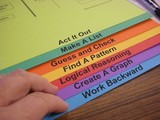
CC-licensed "strategies" photo by Old Shoe Woman.
The posts in this series:
Complex learning, step by stepComplex learning (coffee on the side)Ten little steps, and how One grewProblem solving, scaffolding, and varied practiceStep 2: sequencing tasks, or, what next?Clusters, chains, and part-task sequencingStep 3: performance objectives (the how of the what)Criteria for objectives-also, values and attitudesStep 4: supportive info (by design)Learning to learn (an elaboration) (that's this post) Step 5: cognitive strategies (when you don’t know what to do)Step 6: (thinking about) mental models
Dave Ferguson
.
Blog
.
<span class='date ' tip=''><i class='icon-time'></i> Aug 19, 2015 05:17pm</span>
|
|
Series: Ten Steps to Complex Learning
« Previous post in this series • Next post in this series »
If you follow this blog, you haven’t had much to follow lately. I’m still grappling with site-hacking problems. Their persistence leaves me frustrated and far, far from gruntled.
Two busy, productive couple of days working with a great client have re-energized me, so I’m back in business. And, as a bonus, we’re halfway through the Ten Steps.
Step 5 in Ten Steps to Complex Learning` is "analyze cognitive structures." As the diagram depicts, this step falls under the "supportive information" component of the overall learning blueprint.
Van Merriënboer and Kirschner point out that when someone encounters a task that’s different from what he’s seen before, procedural knowledge isn’t enough. He needs strategic knowledge-a way to figure out how to do what he haven’t done.
I’ve already talked about SAPs (strategic approached to problem-solving). If you’re designing learning, these may already exist in job descriptions, instructional material, and other stored knowledge. If not, you need to identify and make such SAPs explicit, which explains the three sections of this chapter:
Specify SAPs.
Analyzing intuitive cognitive strategies.
Using SAPs in design decisions.
(Time out for a quibble, and not about vM&K’s apparent determination to avoid parallel lists. I really dislike their use of "intuitive" here. What they mean, as you’ll see in a bit, are the homegrown strategics that newcomers bring with them to a new domain. In other words, those existing strategies aren’t intuitive in the sense of ingenious; they’re naive.)
SAP: a plan with a goal-and rules of thumb
A strategic approach to problem-solving has a goal, and likely subgoals as well, related to solving problems in a particular domain. The SAP also has heuristics to help reach that goal. In fact, those are key to SAPs.
…SAPs are always heuristic….though they may help a learner to solve problems in the task domain, their application does not guarantee the solution of the problem.
Although they are less powerful than algorithmic procedures, power is exchanged for flexibility, beause SAPs may be helpful in many more different problem situations than a solution algorithm.
In identifying the cognitive strategies that go into SAPs, you will:
Assemble material to develop problem-solving guidance (like process worksheets)
Help refine classes of learning tasks (in other words, identify a sequence of simpler to more complex cognitive strategies)
Start the development of a key part of the supportive information discussed under Step 4.
If you’ve read any of the other posts in this series, you know how vM&K will go about identifying these strategies. They’ll interview and observe expert performers performing the actual tasks, starting with relatively simpler ones and progressing to more difficult ones.
Sometimes the problem-solving process is mostly linear or sequential. The much-maligned ADDIE model for instructional design (analyze, design, develop, implement, evaluate) fits that category. If you were working with expert designers, you could identify simpler and more complex goals in each of those stages, and from that develop simpler and more complex SAPs.
vM&K use "solving thermodynamics problems" as an example of a non-linear set of phases to use in a particular domain. Another example might be the CRAP principles for designing text and graphics (contrast, repetition, alignment, and proximity) that Robin Williams explains in The Non-Designer’s Design Book.
Grasping rules of thumb
The general form of a heuristic is, "If you want X, then do Y." Rules of thumb are midway between domain-specific algorithms (like, say, how to calculate the number of shingles needed for a roof) and full-blown problem-solving methods in a domain.
The image at the right (which you can click to enlarge) is an example of rules of thumb for managing conversations on a blog.
vM&K offer this advice:
Provide learners only with rules of thumb they don’t yet know.
Limit the rules to those necessary for performing the most important tasks.
Write them clearly. (That is, "formulate rules-of-thumb in a readily understandable way…and use the imperative to make clear that they are directions for desired actions." )
Find a balance so the text is as specific as possible but applies to all the situations where the rules make sense.
Analyzing intuitive strategies
You see that the first step is to analyze the cognitive strategies used by experts, since these are built up and refined over time as the experts grapple with a range of problems in the domain. What you end up with is how the task should be performed.
If you observe the target learners addressing the same tasks, you find out how they are performed. These are the approaches that non-experts figure out on their own-that they intuit, hence the lable "intuitive strategies." Often, though, these naive approaches don’t work all that well.
For examples, novices often take what the authors call a top-down, depth-first approach. In programming, that might mean breaking an overall problem into a group of subproblems, and then attacking each subproblem in depth: writing highly detailed code for one section at a time.
As a result, the novices can lose track of relationships between sections, and they’ll often spent a lot of time linking things together after the fact.
Experts in contrast take a top-down, breadth first approach. After identifying the subproblems, they’ll continue to expand each subproblem before starting extensive coding.
An instructional design example might be breaking a large course up into what seems like logical sections. Less-experienced designers tunnel down into the separate sections, writing them in detail. More experience designers (ahem) will break those subsections down but will tend to think of them in outline or summary mode, making it easier to move up and down levels and see the larger picture.
In a client project I’ve been working on, this means we haven’t yet finalized the overall sequence for what will be a two-and-a-half-day workshop, but we have what I think of as lots of recipes for areas of concentration and for activities. We sketch enough detail so understand them and look at the design for other course elements. It’s much easier to refine and shift at this stage.
So we won’t end up with, say, a freestanding section on ethics (which most of the time is like a long sermon on a warm Sunday). Instead, we plan an activity where participants handle a typical contract problem, then they’ll get questioned by the client about business-ethics issues, embedded (as in real life) in what looks like real work.
Mind the gap
Not only do gaps exist between the rules of thumbs that novices use and those that experts use, but the expert heuristics may be counter-intuitive to the newcomer. (Maybe this is where "intuitive strategy" came from? Not that I’m obsessing about the term.)
Think of a beginning driver: her naive model for steering is "keep the car straight at all times," resulting in constant adjustments of the wheel. The skilled driver’s heuristic might be something like "aim 20 feet ahead of the car," providing more reaction time and seeming to ignore the distance directly in front. But the latter is the more effective strategy.
So what? If you find that novice learners come to complex learning with naive strategies in place, these will conflict with more carefully worked-out strategies.
SAPs and design strategy
If you’ve developed strategic approaches to problem solving, you’ve got a head start on a number of design decisions.
You can design problem-solving guidance, like process worksheets or performance constraints.
You can present rules of thumb as statements ("if you want X, do Y") or as guiding questions ("what might lead you to develop a job aid for this task?").
You can develop or refine task classes based on a sequence of SAPs.
You may need to provide extra guidance, especially to prevent the unproductive or even mistaken results that would come from the naive strategies. Performance constraints can come into play. The authors have an example in which researchers have to frame an effective database query before they can enter it into the database-to provide practice in preparing effective queries.
Similarly, the use of task classes (groups of problems at a similar level of difficulty) provide extra opportunity for the novice learner to work with the new strategies-although, as vM&K point out, some intuitive strategies are highly resistant to change.
Modeling examples can help (seeing a skilled performer in action and hearing her comment specifically on her strategies). In addition, less use of inductive approaches and more guided discovery will allow learnes to interconnect parts of the new skills, and to integrate the new strategies into their repertory.
In a final triple play:
You can give an SAP directly to a learner (it’s supportive information, remember, which means it’s helpful for the non-recurrent tasks).
SAPs can help you find or design modeling examples.
SAPs can support cognitive feedback-for example, have learners compare their own process with a given SAP.
This was the shortest Ten Steps chapter to date, so the next post in the series will move on to Step 6, Analyze Mental Models.
CC-licenses project-status photo by brylyn.
CC-licensed rules for blog conversations by choconancy1.
CC-licensed audio-mixer photo by magnifynet.
The posts in this series:
Complex learning, step by stepComplex learning (coffee on the side)Ten little steps, and how One grewProblem solving, scaffolding, and varied practiceStep 2: sequencing tasks, or, what next?Clusters, chains, and part-task sequencingStep 3: performance objectives (the how of the what)Criteria for objectives-also, values and attitudesStep 4: supportive info (by design)Learning to learn (an elaboration)Step 5: cognitive strategies (when you don’t know what to do) (that's this post) Step 6: (thinking about) mental models
Dave Ferguson
.
Blog
.
<span class='date ' tip=''><i class='icon-time'></i> Aug 19, 2015 05:17pm</span>
|
|
I’ve been here before, but only in kitchens-sitting around, drinking tea and eating biscuits.
Buddy MacMaster
Dave Ferguson
.
Blog
.
<span class='date ' tip=''><i class='icon-time'></i> Aug 19, 2015 05:17pm</span>
|
|
This post is my slightly-belated contribution to the May 2009 Working/Learning blog carnival, hosted at Kevin Jones’s Engaged Learning blog.
The CSTD National Symposium in Halifax, Nova Scotia has just ended. The theme was All hands on deck-because organizations need to get the most out of all their employees, and because you can’t escape the sea in Nova Scotia any more than you can escape tartan.
I was eager to make a presentation at this session, and fortunately for me, CSTD liked what I proposed doing. I think that speaking to your professional peers-in the sense of "here’s something interesting I’ve been working on"-is a great opportunity.
On a ship, of course, a deck is a workplace-it’s where you are. As a learning professional, I want to make sure my personal deck has the equipment and room I need to be effective. Here are my thoughts on ways to do that:
Do what matters.
The obvious thing is to work on great projects. In my experience, you don’t always know which ones will turn out to be great. And in larger organizations, you sometimes have little choice. Inside nearly every project, though, there are things that matter-to you and to your organization. So, whatever the work you have to do, do it well. Go beyond the routine; avoid sticking to the same old paths.
Change your level.
I don’t mean "get promoted," necessarily. I mean to zoom in to the details of what you do, and zoom out to see things in a larger perspective. If you’re developing training courses for customs workers, find out how the particular skills fit into the larger context of their jobs, and how their jobs fit into the context of their location and their agency.
The old story about turtles all the way down in one sense is true. It’s systems all the way down, and all the way up: inputs, processes, outputs. Changing your level means you’re better able to see how what looked like a standalone function aligns with other functions for some higher-level process.
Watch yourself.
Along with changing your level, I think it makes a lot of sense to change your distance from yourself. Ask, explicitly, what you’re doing. Where are you running into difficulty? What are you doing about that?
From another angle: what have you been doing that you get jazzed about? A couple of weeks back, I was bouncing in my chair (during a meeting with clients who have been too polite to comment on this) because of the many great ideas and possibilities that were emerging.
It’s this self-awareness, almost the idea that your job is a kind of science experiment, that I think holds great value.
Think of others.
If the reflective question was "What have I been doing?" then the collaborative question is "How’s my problem like problems that aren’t mine?"
What have you been doing that someone who’s doing something different could learn from? What have you figured out that I haven’t?
I saw a definition of "expert" as someone who knows something you don’t, that you’re glad to learn. If you pay attention to your work, if you change levels so you get a fuller picture, and if you watch what you do and what results, you’re going to be a hell of an expert on the specifics.
The next step is stripping the trivial out of those specifics so that another person can extrapolate to a different situation.
Be yourself.
I’m not an expert on using web 2.0 tools at work. I tried to make that clear in my presentation: I’ve learned how to work with some of these tools, and I can show you:
Stuff other people have done with them
Ways to try out the tools for yourself
A little bit about how they look under the hood
I didn’t pretend to know more than I do, nor (I hope) am I over-impressed by my own sagacity. I had fun creating my presentation, I tried to be clear about who might find it interesting, and I had lots of chances to practice saying, "I don’t know much about XXX; tell me more about what you’re doing."
Few things will make you smarter about what you do than trying to explain what you do to others in a way that can benefit them.
CC-licensed turtle photo by wwarby.
Dave Ferguson
.
Blog
.
<span class='date ' tip=''><i class='icon-time'></i> Aug 19, 2015 05:17pm</span>
|
|
Note: this is something of a repeat. When I checked the Whiteboard this morning, my last few posts seem to have disappeared. I haven’t figured out why, but I decided to recreate them-it seemed a simpler path than trying to travel through time. Please excuse the repetition (and the apparent incompetence).
Browsing through some Mr. Tweet suggestions (recommendations of people to follow on Twitter), I happened across Marianne Lenox, "gadabout library trainer."
Earlier this month, she posted the TED commandments, advice given to presenters at the TED talks. I’m just going to re-post the image she used (by Rives, transcribed by Tim Longhurst via Garr Reynolds) and the text she added.
Thou Shalt Not Simply Trot Out thy Usual Shtick.
Thou Shalt Dream a Great Dream, or Show Forth a Wondrous New Thing, Or Share Something Thou Hast Never Shared Before.
Thou Shalt Reveal thy Curiosity and Thy Passion.
Thou Shalt Tell a Story.
Thou Shalt Freely Comment on the Utterances of Other Speakers for the Sake of Blessed Connection and Exquisite Controversy.
Thou Shalt Not Flaunt thine Ego. Be Thou Vulnerable. Speak of thy Failure as well as thy Success.
Thou Shalt Not Sell from the Stage: Neither thy Company, thy Goods, thy Writings, nor thy Desparate need for Funding; Lest Thou be Cast Aside into Outer Darkness.
Thou Shalt Remember all the while: Laughter is Good.
Thou Shalt Not Read thy Speech.
Thou Shalt Not Steal the Time of Them that Follow Thee.
Dave Ferguson
.
Blog
.
<span class='date ' tip=''><i class='icon-time'></i> Aug 19, 2015 05:17pm</span>
|
|
Browsing through some Mr. Tweet suggestions (recommendations of people to follow on Twitter), I happened accross Marianne Lenox, "gadabout library trainer."
Earlier this month, she posted the TED commandments, advice given to presenters at the TED talks. I’m just going to repost the image she used ("by Rives, transcribed by Tim Longhurst. Via Garr Reynolds") and the text she added.
Thou Shalt Not Simply Trot Out thy Usual Shtick.
Thou Shalt Dream a Great Dream, or Show Forth a Wondrous New Thing, Or Share Something Thou Hast Never Shared Before.
Thou Shalt Reveal thy Curiosity and Thy Passion.
Thou Shalt Tell a Story.
Thou Shalt Freely Comment on the Utterances of Other Speakers for the Sake of Blessed Connection and Exquisite Controversy.
Thou Shalt Not Flaunt thine Ego. Be Thou Vulnerable. Speak of thy Failure as well as thy Success.
Thou Shalt Not Sell from the Stage: Neither thy Company, thy Goods, thy Writings, nor thy Desparate need for Funding; Lest Thou be Cast Aside into Outer Darkness.
Thou Shalt Remember all the while: Laughter is Good.
Thou Shalt Not Read thy Speech.
Thou Shalt Not Steal the Time of Them that Follow Thee.
Dave Ferguson
.
Blog
.
<span class='date ' tip=''><i class='icon-time'></i> Aug 19, 2015 05:17pm</span>
|
|
Series: Ten Steps to Complex Learning
« Previous post in this series • Next post in this series »
Note: this is a repeat post (I think). When I checked the Whiteboard this morning, my last few posts seem to have disappeared. I don’t know why. I decided to recreate them-it seemed a simpler path than trying to travel through time. Please excuse the repetition (and the apparent incompetence).
"What we know determines what we see, and not the other way around." That’s how van Merrienboër and Kirschner start Step 6 (analyze mental models) in Ten Steps to Complex Learning. Two people hiking the mountains in France, they suggest, see different places: the geologist sees rock formations; the cyclist sees gear ratios.
As the diagram shows, Step 6 fits with other elements that make up the supportive information component of the Ten Steps model.
(You can click the diagram to enlarge it.)
From a learning perspective, supportive information underpins those skills that you apply differently in different situations.
vM&K see three different types of mental models: conceptual ones that answer the question, "What is this?", causal ones that answer, "How does this work?", and structural once that answer, "How is this organized?"
This chapter of the book parallels the previous one:
Specify domain models
Analyze intuitive (meaning "naive") models
Using domain models to make design decisions
Models: good news, bad news
A mental model is a description of how the world of some domain is organized. You often hear "mental map" as a synonym, because a map shows layout and relationships.
You can find mental models in documents; you can also develop them by talking with expert performers who can describe the models they use as they work.
vM&K suggest that such discussions start with simpler classes of tasks and work up to more complex ones. At the same time, they lean away from the common belief that the more you know about a domain, the better able you are to solve problems in it.
In a sense, everything is related to everything, and thus the analyst can build seemingly endless networks of interrelated pieces of knowledge. Therefore, new relationships must not be added if a competent task performer cannot clearly explain why newly associated facts or concepts improve her or his performance.
Getting the concept
Conceptual models explain a domain by various features. You can classify computers by their processors, or by their age, or by manufacturer, or by color (though most of the time, color’s not a particularly helpful organizer).
In kind-of relationships, the model explains that both "chair" and "table" are kinds of furniture. Kind-of relationships lead naturally to taxonomies, which are hierarchical models, like the biological kingdom, phylum, class, order, and so on.
Similarly, part-of relationships show that one concept is contained within a larger one. A leg is part of a chair; a keyboard is part of a laptop computer.
A hierarchical model like a taxonomy isn’t the only possible conceptual model. Concept maps and semantic networks also show relationships; the latter is more carefully definite with explicit labels for relationships, as in the example on the left (from Wikipedia).
These relationships are fairly obvious, but vM&K offer some other types of relationships that would be useful in analyzing and in teaching mental models.
For example, experiential relationships connect a concept to a familiar, concrete example: the alternator on a car is like a generator (the device that cars used before alternators). Similarly, analogical relationships aid understanding by comparing a new concept to one that’s familiar although outside the domain in question-for example, the theme used by a WordPress blog is like a set of clothes: changing the theme changes the appearance of the blog, but not the content (the posts).
Other types of relationships:
Prerequisites: if you understand the concept of division, it’s easier to learn the concept of prime number.
Location-in-time: the relation in time between two concepts in the domain (pilot program relative to implementation)
Location-in-space: in a scientific article, the results section appears after the method section.
Natural-process: evaporation and condensation have a relationship, but not a causal one (evaporation doesn’t cause condensation, and vice-versa)
Structure matters
Another major type of mental model is the structural model, which explains how elements of the model, related by time or space, fit together. For example, the life-stages of an organism are a time-based mental model. vM&K mention the location-in-space models of chess experts, who are able to grasp the relationships of chess pieces.
I’ve read elsewhere that when chess pieces are arrayed randomly, expert players aren’t any better able than novices to remember the positions, probably because the relationships seem arbitrary to the experts.
Often there are interrelated sets of structural models-this is complex learning we’re talking about. You can think of these as the 50,000-foot version, the 20,000-foot version, the treetop version, and so on, as the focus becomes more and more specific. I could have a model for writing a nonfiction book; within that, a model for a typical chapter; within that, models for constructing sections, paragraphs, and even sentences.
Causal models: domains at work
Causal models concentrate on cause-and-effect or natural processes. They form principles that allow learners to explain how something works, or why it isn’t working.
Molecular biologist Bonnie Bessler and her colleagues discovered a form of communication in bacteria that helps explain how single-cell organisms as a group can engage in behavior beyond their individual capabilities. You can hear her describe this quorum-sensing model in a February 2009 TED talk.
vM&K acknowledge that it may be helpful to focus on only one type of model at first, depending on the nature of the domain. For example, areas like mechanical engineering, architecture, and instructional design are heavily analytic, and so structural models make a good starting place.
Intuition: not necessarily a good thing
As in Step 5 (analyze cognitive strategies), newcomers to a field often bring with them their own mental models. These "intuitive or naive mental models are often fragmented, inexact, and incomplete," vM&K argue. Novices are usually unaware of the underlying relationships between elements, and frequently carry unexamined misconceptions.
One example is the notion that the internet is a centralized system, with all computers eventually connected to some vast, central server. This hierarchical model is easy to imagine, but gets in the way of someone trying to understand how the internet actually works.
A favorite example of mine is the Microsoft Word document template; another is the cascading style sheet. Both are used to control appearance and layout, either of a Word document or a web page. The underlying concept, not always grasped by newcomers, is that there is no necessary relationship between the text on a page and the appearance of that text (size, color, alignment, etc.).
To the newcomer, a document is a document. Only when that naive model is extended does the newcomer understand that the width, spacing, font, height, weight, and so on can be controlled without any regard to the actual words.
Models and design decisions
As with cognitive strategies, the designer develops mental models only if there aren’t pre-existing ones. With models in hand, the developer is able to carry out essential design tasks.
For example, a progression of mental models helps to refine the task classes that are a central component of the Ten Steps. The simplest domain model enables learners to perform the simplest class of learning tasks.
vM&K give a three-level progression for electronics troubleshooting as an example of this relationship between models and task classes:
In the zero-order model, the model has basic principles of electricity. The tasks might involve a problem like "given this arrangement, will the light bulb be on, or off?"
The first-order model adds principles related to changes-"Is there an increase in voltage when the resistance is lowered?"
The quantitative model moves on to more complex laws of electricity (e.g., Ohm’s law) with questions like "what is the voltage across points X and Y in this circuit?"
Because mental models are supportive information, you can present them explicitly to the learner (e.g., to introduce or explain the domain). You can also use them to help identify relevant examples and case studies. Finally, you can use the model as a form of cognitive feedback, allowing the learner to compare his work with a given model.
Intuitive mental models-those homegrown structures that novices may bring to a new field-can be especially resistant to change. So it might be worth investigating whether that’s true of novices in the field you’re dealing with. You may need to begin with assumptions in those naive models and gradually work on elaborating new information.
Mental models versus cognitive strategies
The Ten Steps sees a reciprocal relationship between these two types of supportive information. The main difference is in how they’re used. Cognitive strategies focus more on the task performer’s actions, which mental models focus more on the domain itself. going back to the map analogy I used earlier, you can use the map to plan a route from A to B (the cognitive strategy), and you can use the same map to understand the layout of a geographic area (the mental model).
CC-licensed images: mental map photo by michale.
Bird-chess photo by striatic.
Sailing image by A Siegal.
The posts in this series:
Complex learning, step by stepComplex learning (coffee on the side)Ten little steps, and how One grewProblem solving, scaffolding, and varied practiceStep 2: sequencing tasks, or, what next?Clusters, chains, and part-task sequencingStep 3: performance objectives (the how of the what)Criteria for objectives-also, values and attitudesStep 4: supportive info (by design)Learning to learn (an elaboration)Step 5: cognitive strategies (when you don’t know what to do)Step 6: (thinking about) mental models (that's this post) Step 7: procedural info, or, how to handle routine
Dave Ferguson
.
Blog
.
<span class='date ' tip=''><i class='icon-time'></i> Aug 19, 2015 05:17pm</span>
|