Blogs
|
Over the past decade the story of enterprise learning has increasingly been dominated by the rise of the "learning" part and a de-emphasis of the "enterprise" part. It’s kind of an adaptation of a famous line from John F. Kennedy’s inaugural address: Ask not what training experiences your organization can give to you, but what learning and knowledge you can give to your organization.
But the move to bottom-up learning is no easy evolution. It’s not an either/or question. Increasingly, conversations among learning executives are dominated by the discussion of balance: when does a company need to tell and when does it need to listen?
Fortunately, there is a certain type of learner that eases these challenges, emerging spontaneously within the workforces of many companies: they’re what we call "superlearners." Unusually self-reliant and media savvy, superlearners are leading the way for their companies by exemplifying the attributes, learning behaviors and collaboration-based activities needed to win in this current era of never-ending change.
But superlearners present some challenges of their own companies. They’re more apt to become frustrated and leave the organization. They challenge accepted ways of doing things; they have no great love for authority and may flout the rules. Yet harnessing their energy and the manner in which they multiply the availability and value of knowledge across the enterprise will increasingly become a task of learning and HR executives.
Read more: CLO Magazine Article about SuperLearners Tagged: informal learning, social learning
Eric Davidove
.
Blog
.
<span class='date ' tip=''><i class='icon-time'></i> Aug 19, 2015 05:21pm</span>
|
|
Here is a transcript from a recent 60 second science report from the Scientific American:
Groups with Good Social Skills Outperform the Merely Smart
Groups of two to five members who interacted with each other best outperformed groups whose individual members had higher intelligence scores.
Karen Hopkin reports:
If Alice is smart, and Bob’s even smarter, working together they would A) be twice as smart, B) be half as smart or C) form a task force and get nothing done. According to new research, the answer is none of the above. It would actually depend on how well they get along.
What makes a group good at what it does? A team of scientists put their collective heads together and divided volunteers into groups of two to five. And they asked these groups to perform a variety of tasks, from brainstorming answers to questions like "What can you do with a brick?" to team typing blocks of complicated text.
What the researchers found is that the intelligence of individual group members was not a good predictor of how well the group as a whole performed. The teams that did best rated high in social sensitivity: their members interacted well, took turns speaking and included more females than groups that did poorly. The study is in the journal Science. [Anita Woolley et al., citation to come.]
So if you’re looking for a recipe for group smart, don’t automatically reach for the biggest brains. Try adding some heart. And at least one person who knows what to do with a brick.
Thank you Frédéric Domo for sharing this via Linked In. Tagged: learning community, social learning, social networking
Eric Davidove
.
Blog
.
<span class='date ' tip=''><i class='icon-time'></i> Aug 19, 2015 05:21pm</span>
|
|
The stats helper monkeys at WordPress.com mulled over how this blog did in 2010, and here’s a high level summary of its overall blog health:
The Blog-Health-o-Meter™ reads Fresher than ever.
Crunchy numbers
A Boeing 747-400 passenger jet can hold 416 passengers. This blog was viewed about 6,800 times in 2010. That’s about 16 full 747s.
In 2010, there were 13 new posts, growing the total archive of this blog to 56 posts. There were 4 pictures uploaded, taking up a total of 437kb.
The busiest day of the year was April 6th with 164 views. The most popular post that day was Key Social Learning Roles.
Where did they come from?
The top referring sites in 2010 were elearninglearning.com, twitter.com, downes.ca, Google Reader, and elearningtech.blogspot.com.
Some visitors came searching, mostly for social learning, what is social learning, bt dare2share, training approaches, and daretoshare.
Attractions in 2010
These are the posts and pages that got the most views in 2010.
1
Key Social Learning Roles April 2010
6 comments
2
BT Dares to Share - Social Learning Case Study March 2009
3
Measuring Networked (or Social) Learning April 2009
3 comments
4
5 Steps to Enterprise Social Learning October 2010
1 comment
5
Eric Davidove December 2008
Eric Davidove
.
Blog
.
<span class='date ' tip=''><i class='icon-time'></i> Aug 19, 2015 05:21pm</span>
|
|
Series: Analysis via paradigming
• Next post in this series »
Here’s how Joe Harless helped me figure things out.
When I took his Job Aid Work Shop, he recommended a technique for analyzing tasks. Joe called this paradigming. It works best on procedural stuff, though I’ve also used it to find my way around very complicated systems.
Section 1: complex theoretical discussion
Each step in an on-the-job task has two parts. (I like to say I’m a Reform Behaviorist, so you might see some behavioral-psych roots here.)
The stimulus, meaning the starting state.
The response, or what you do when you perceive the stimulus.
As in:
S: email from Queen Elizabeth (notice: it’s a noun-a thing)
R: open email (a verb-an action)
The response leads to a new stimulus (opened email) which calls for a new action.
S: opened email (mail that has been opened—Ss are always nouns)
R: decide next action
"Decide?" Yes; I use that a lot. It’s a good launch pad for chains of activity or decisions.
S: "Read text" (the quotes show it’s a decision—a noun)
S: "Open attachment"
S: "Forward message"
And so on. More later; one more complex theoretical idea awaits:
In paradigming, there are only three kinds of steps:
the basic chain, the discrimination, and the generalization.
Section 2: three examples
The basic chain is simply a sequence of actions with no decision making.
At a higher level, of course, you might collapse a lot of behavior into a single step:
S1: Vacant land — R: purchase land.
S2: Purchased land — R: construct 12,000-square-foot house.
S3: Completed — R: furnish tastefully.
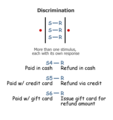
Sometimes, you need to distinguish between different stimuli that each call for a different response. That’s a discrimination.
Remember, this is a step in a larger process. In the example, the previous step might have been "receipt from purchase" and the response might have been "identify form of payment."
What you’re discriminating among here are the different possibilities for form of payment. I left some out because the image would get too large, but you’d put in as many stimuli as exist: check, debit card, form not legible, and so on.
The third kind of behavior is generalization: you have more than one stimulus and they all lead to the same response.
Section 3: So what?
For me, paradigming offers several payoffs:
It’s a great way to track down loose ends and uncertainties in a complicated process.
It ensures that I don’t forget about something that puzzled me.
It magically becomes the scaffold for job aids.
I’ll create an example or two of paradigming in action, and of that scaffolding, in another post.
The posts in this series:
Figuring things out (the plodding edition) (that's this post) Analyzing tasks with paradigming
Dave Ferguson
.
Blog
.
<span class='date ' tip=''><i class='icon-time'></i> Aug 19, 2015 05:21pm</span>
|
|
I was thinking the other day:
Chan eil mòran lochd ’s an crìdh a bhios a gabhail òran.
There’s not much guile in a heart that’s always singing songs.
You caught me—that’s Gaidhlig (Scottish Gaelic), not Gaeilge (Irish Gaelic, often just "Irish"). No matter; the Scots are the Irish who found boats. (The Australians are the Irish who got caught.)
As part of my ongoing Guile-Reduction Project, I wanted to share a handful of songs connected somehow to Ireland. I’m posting early so you have a chance to get music like this over the weekend.
The Rambles of Spring
Tommy Makem and Liam Clancy, singing at Bunratty Castle in 1981. Especially good if you’re still recovering from late-winter snow.
My Own Dear Native Land
A favorite (as if the others aren’t) not just because I’m a fan of Cherish the Ladies, but also because the singer is Detroit-born Cathie Ryan.
Mo Ghile Mear
Assembling the list, I didn’t expect to find this bunch of all-stars singing an Irish classic about a Scottish icon-Bonnie Prince Charlie. (Lyrics and translation here.)
‘Sé mo laoch, mo Ghile Mear,
‘Sé mo Chaesar, Ghile Mear,
Suan ná séan ní bhfuaireas féin
Ó chuaigh i gcéin mo Ghile Mear.
He is my hero, my dashing darling
He is my Caesar, dashing darling
I’ve had no rest from forebodings
since he went away, my darling…
The Green Fields of Canada
Mary Dillon’s acapella version of the emigrant song.
The sheep run unsheared and the land’s run to rushes
The handyman’s gone, and the winder of creels
Away across the ocean go journeyman tailors
And fiddlers that flicked out the old mountain reels…
(You can hear a lengthier version sung by Heidi Talbot, and I encourage you to; the site has ads you can avoid by shutting your eyes.)
Brid Óg Ní Mháille
Some might choose to advance to the 45-second mark to skip the intro and get right to the Corrs’ version (in Irish) of about a lost love. Still, the video maker did include English and Spanish translations.
Oh, Bridget O’Malley, you’ve left my heart breaking
You sent the death pangs of sorrow to pierce my heart sore
A hundred mean are craving for your breathtaking beauty
For certain, you’re the fairest of maidens in Oriel…
The Foggy Dew
Sinéad O’Connor and the Chieftains with perhaps the best-known song about the 1916 Rising in Dublin.
The bravest fell, and the requiem bell
Rang mournfully and clear
For those who died that Easter-tide
In the springing of the year.
An Mhaighdean Mhara
Mairéad Ní Mhaonaigh of Altan sings an old lament, The Mermaid. (Irish lyrics and English translation here.)
The Spanish Lady
Maighread and Triona Ni Dhomhnaill singing a ballad filled with Dublin place names-and with numbers.
Raglan Road
More Dublin place names in Patrick Kavanagh’s song. Performers include Donal Lunny on bouzouki (nearly as Irish as the bodhran), Liam O’Flynn on the uillean pipes, Sean Keane on fiddle, and vocals from Mark Knopfler.
Jimmy Mo Mhíle Stór (Jimmy, My Thousand Treasures)
Cara Dillon singing an English version of this song about (yet another) far-away sailor. You get her rendition of The Verdant Braes of Skreen at no extra charge.
You can compare Dillon’s Jimmy with this one, more traditional and in Irish, by Kathleen Macinnes. Or with this one which I really like (despite the anime video someone inflicted on the sound track). The band’s the Chieftains, and the singers are Cookie, Heather, and Raylene Rankin. Cape Breton girls, from Mabou, about twenty miles from my home town, so of course we’re related. Their dad was my fourth cousin.
Finnegan’s Wake
The Clancy Brothers and Tommy Makem perform the Dublin street ballad in which James Joyce saw "the entire cycle of life, death, and resurrection…" From their iconic Carnegie Hall concert.
Song for Ireland
Mary Black was the first singer on Mo Gile Mear, above. Here she sings Dick Gaughan’s song. You should listen.
Talking all the day
With true friends who try to make you stay
Telling jokes and news
Singing songs to pass the night away
Watching Galway salmon run
Like silver dancing, darting in the sun…
The Parting Glass
A sendoff from The Wailin’ Jennys.
Slán abhaile, slán go fóill (safe home, good luck).
Dave Ferguson
.
Blog
.
<span class='date ' tip=''><i class='icon-time'></i> Aug 19, 2015 05:21pm</span>
|
|
If making good connections were easy, then when you checked Amazon, you wouldn’t get this:
One problem stems from discrimination hidden in the word "connection"—we use it for different and sometimes conflicting kinds of relationships.
My professional connections used to happen via ISPI, inmy local chapter or at the annual conference, which I’ve attended at least a dozen times. I’d be nearly paralyzed by potential—smart people working on challenging projects, eager to talk about what they’d learned (and even what they couldn’t figure out).
Lately my connections start with meeting virtually. First my blog, then my Facebook presence, and now Twitter have opened doors I’d never have expected.
I’m still figuring this stuff out. That ambiguity in the word "connection" is like the verb "think." When I started practicing my French in Second Life, I’d sometimes apologize for my slowness and explain (in French) that I needed to think before I spoke. I’d say, "Il me faut penser…" ("I have to think…")
Listening to my friends, I learned that they’d say "Il me faut réfléchir." In the dictionary, one translation of réfléchir is "to think," but others include "to reflect, to think about."
I suppose you could learn another language just by reading it, or just by watching video in that language-but you’ll learn faster with conscious reflection, and you’ll learn faster when you connect to people and ideas in that language.
So what’s this got to do with emoticons? Well, I had messy handwriting as a kid.
So what’s that got to do with emoticons?
The summer I was 11, I took a typing course. I type fast (especially for a male in my generation). When I first got online in the early 1980s, I liked to think I could convey my meaning in words fast; trying to type an emoticon just slowed me down.
That works well if I’m using text with highly verbal English speakers. When text-chatting in French, I now use emoticons a lot more, because I feel the need to make myself clear.
My French is mediocre and a bit erratic, so people can misunderstand me when I try to joke or tease. The emoticon ^^ — which is apparently the French equivalent of :-) — seems to portray upturned corners of a smile. (Just so you know, mon ami.)
In other words, it’s something I can use to build a connection. Strangers get to know me, and they can decide, "He’s a guy with a sense of humor." And it’s worked.
I hadn’t been using my French much. Then yesterday I spent about an hour and a half talking to someone I know, someone I’d met once, and a third person who just wandered up. It was like those hallway conversations at a conference, except one of us had green-black wings, one of us had blue skin, and all of us could fly if we felt like it.
Connecting, thinking about how I connect, reflecting on what happens afterward-this stuff works. But I’m still not going to call those things "smilies."
Dave Ferguson
.
Blog
.
<span class='date ' tip=''><i class='icon-time'></i> Aug 19, 2015 05:21pm</span>
|
|
Series: Analysis via paradigming
« Previous post in this series • Next post in this series »
This post is my contribution to the March 2009 edition of the Working/Learning Blog Carnival, a more-or-less monthly collection of posts about learning at work (how learning happens in the workplace) or working at learning (how professionals manage their own learning). Click that March link for a list of all the participants in this month’s session, or learn more about the carnival in general.
(Want to take part in a future edition? Let me know.)
In an earlier post, I described some basic elements of paradigming, a tool for task analysis that I learned from Joe Harless. Today, I’m sharing an example of using a paradigm to figure out a complex task.
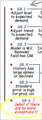
You build a paradigm out of steps. The graphic at the right shows the three kinds of steps (click to enlarge). Each step has one or more possible triggers for action (the stimulus) and at least one action to take (the response). Those three kinds of steps:
One stimulus leading to one response (the basic chain). If the stimulus is "telephone rings," the response is, "Answer and say, ‘Oligarch Lumber; how may I direct your call?’"
More than one possible stimulus, each leading to a different response (the discrimination):
If the customer asks for millwork, transfer the call to millwork.
If the customer asks for order status, transfer the call to sales.
If the customer asks about installation, transfer the call to the service desk.
More than one possible stimulus, each leading to the same response (the generalization):
If the customer has a billing question, or if the customer wants to cancel an order, transfer the call to the service manager.
You can combine these steps-in fact, that’s a key reason for paradigming: to identify the steps and decisions in a complex task. In this post, I want to show examples of this kind of analysis. Here’s a paradigm based on an actual task in a complicated inventory-management system. (You can click the image to have the full, 800-by-1200 version open in a new window.)
"Done" can be a stimulus
When you want to review and adjust any forecast exceptions:
You start from the main menu (S1 in the paradigm) and select option 2.
That displays screen QR12 (S2), where you enter the SKU and store code.
When that’s done (S3), you select option 7.
I use "done" as shorthand for the result of the previous response. Much faster than "SKU and store code entered."
What happens here? No idea.
Picking up at S3: when the SKU and store code are entered, in the Restrict Record field, you enter I2. According to the documentation, the response should be a list of forecast exceptions (S5.2 in the sample).
But what if there aren’t any exceptions?
I have no idea, and the documentation (or the subject-matter expert) hasn’t said. So I note a possible stimulus and circle it for follow up (S5.1).
Maybe there are always exceptions. Maybe there’s an error message. Maybe there are several. When we find out, we’ll update the paradigm. Now, at least we know what we don’t know.
"Decide" as a response, a decision as a stimulus
Many times a stimulus leads to a number of different actions depending on the decision or choice the performer makes, as with S6 in the sample paradigm. To underscore this, and to break out the possibilities, I often use "decide" as the response.
One principle is that a response is always a verb-and that’s true here. "Decide" is an action ("hey, Dad, watch me decide how to handle this exception forecast").
Another principle: a stimulus is always a noun. It’s a thing. S7.1, S7.2, and S7.3 (call them S7x) represent the possible choices-the things you can do-when you’re looking at an exception forecast: see the next one in the queue, see the previous one, or work with the current one.
Notice that S7.1 ( "see next" ) isn’t an action; it’s a decision, the result of the "decide" action to the left. The action that this decision triggers is "Press PF7." And S7.3 ( "work with the current forecast" ) triggers another "decide" action, which leads to the most complex discrimination in the paradigm. But first: what if there’s a loop?
Here we go again
Especially in computer applications, there’s a lot of looping back. S9.x results from trying to see either the next or the previous forecast. You can’t tell if there is a next or previous until you press the appropriate PF key. Then you either see another forecast, or you get a message (the full text: "Roll Up / Down Beyond Last Record," a model of engineering obfuscation).
In either case, you’re at the same situation as at S6: you’ve got a forecast on the screen (either a new one, or the last one you were looking at). So you have to decide what to do. For example, if you’d asked to see the next one, you now know there isn’t a next one. You can decide to work with the current one, or go back to the previous.
"Man, that’s complicated!" Yep.
S8x is a dense cluster of stimuli. It contains a three-item discrimination (S8.1, S8.2, S8.3), since each of those items leads to a different response.
S8x also contains S8.4 and S8.4, a generalization within the overall discrimination. Whether you have spiky history or large standard error, you take the same action.
(For simplicity, we’re assuming that only one of these conditions applies to any forecast. In reality, if you could have more than one of them, you’d have to figure out (a) how do I know I have more than one? and (b) what do I do?)
I’ll jump ahead a bit here: Notice that after you respond to any of the first five S8s, you will (apparently) update the forecast, and something will happen. All this time you’ve been working on the current forecast, and we know (from S6.x) that there’s a way to ask the system to show the next one.
But what happens if there isn’t a next one? My real question is: how can I tell if there aren’t any more forecast exceptions to work with?
I don’t know, and so for the time being I have a placeholder — S8.6. The question mark, the comment in parentheses, and the highlight circle all remind me, and anyone I’m working with, that this is a question we haven’t yet answered.
More loose ends
You see more unanswered questions at S11 and S12. I’m going a bit beyond simply the technique of paradigming, because the point of the post is not so much the tool as the analysis it support.
At S10, I’ve just tried one of three actions (S8.1, S8.2, or S8.3). Now I press PF9. What happens then? Does the forecast remain on the screen? Do I get a confirmation? Does the system display some other screen?
I don’t know, and so S12 is a placeholder. Even if the right answer is "Forecast Adjusted," I’ll need to know whether there are other forecasts waiting (and how to get back to them).
In the final example, the generalization that includes S8.4 and S8.5 is stated in very general terms. How large is a large spike? How high is high standard error? What do I do if I need to "adjust history and remodel?"
The answers could complicate the paradigm-I might have to provide guidance like "if standard error is over 0.8…"
The thing about complicated tasks is: sometimes they really are complicated. At the time I worked on the forecasting system, this was the way it worked. Nobody was going to become skilled at forecasting inventory on his own, except through trial and error that would be very expensive for the employer.
Developing the paradigm helped the client to understand the complexity of the job. It also convinced them that a lot of this stuff didn’t need to be learned (as in, committed to memory). In the next part of these series, I’ll talk about paradigms as potential road maps for building job aids.
The posts in this series:
Figuring things out (the plodding edition)Analyzing tasks with paradigming (that's this post) The paradigm: a road map to a job aid
Dave Ferguson
.
Blog
.
<span class='date ' tip=''><i class='icon-time'></i> Aug 19, 2015 05:21pm</span>
|
|
Series: Analysis via paradigming
« Previous post in this series •
An aside: if you need a little Irish diversion to get through the day, try last week’s side-trip post:
No ‘Danny Boy’ and Not Much Guile.
One of the most productive uses of a paradigm (the task-analysis technique this series of posts has dealt with) is to suggest the content and even the form of a job aid for the task in question.
Here’s a paradigm that was part of a large inventory-management system. The task involved setting a a code to kick off a data extract that in turn would generate an electronic data interchange form. (You can click the image for a larger version.)
There’s a simple chain, then a discrimination between four possible choices. You chose one code depending on the type of output you want. Regardless of the code you type, you press enter to put the new status to in effect (which, in the less-than-clear language of this system, meant you’ve finalized the replenishment order).
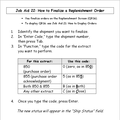
Here’s the job aid. Notice how it reflects the analysis in the paradigm. (Click for a larger version.)
The simple-chain steps become cookbook steps. The discrimination becomes a decision table (if X, then do Y).
I’m working up a more complex example based on a more complex paradigm. For the last post in this series, I’ll highlight how different patterns of activity result in different kinds of job-aid steps.
So: if you’ve got a complicated job, could you end up with lots of job aids? Sure.
It’s not a given that you’ll want to build job aids-but it’s pretty likely, and it’s more efficient (as I noted here). Doing the kind of analysis that the paradigm calls for, you learn enough about the task to look for the usual create-a-job-aid suspects:
Infrequently performed tasks,
Tasks with many steps
Tasks with complicated steps
Tasks with a high penalty for error
Tasks likely to change,
Tasks without a significant need for speed.
Job aids don’t necessarily take the cheat-sheet form you see above. In the real inventory project, yes, they did-a bunch of job aids in a spiral-bound book the inventory manager kept near the computer. They could just as easily come in digital form, like embedded, context-sensitive help.
The real point is that you can’t decide whether to teach the task (try and have people memorize the steps) or to support performance with a job aid until you know what the steps are, including discriminations and generalizations. One way to capture those is through a process like paradigming.
The posts in this series:
Figuring things out (the plodding edition)Analyzing tasks with paradigmingThe paradigm: a road map to a job aid (that's this post)
Dave Ferguson
.
Blog
.
<span class='date ' tip=''><i class='icon-time'></i> Aug 19, 2015 05:21pm</span>
|
|
I’m (still) reading Steven Pinker’s The Stuff of Thought: Language as a Window into Human Nature. In chapter 8, Games People Play, Pinker highlights a set of "cooperative principles" that people use in conversation-principles that you could follow if you wanted to collaborate more effectively with others, especially at a distance.
These principles come from the philosopher Paul Grice, in a 1975 paper, Logic and Conversation (pdf).
My personal bias is that many philosophers pay so much attention to logic that they get mired it it in a way that ordinary people don’t. To the hyper-logical, "a horse is a horse" is a tautology. As Pinker notes, though, in ordinary conversation that’s simply a way of saying "horses will act the way you expect horses to act."
Here are Grice’s principles for cooperating conversationally:
Quality:
Say no less than the conversation requires.
Say no more than the conversation requires.
Quality:
Don’t say what you believe to be false.
Don’t say things for which you lack evidence.
Manner:
Don’t be obscure.
Don’t be ambiguous.
Be brief.
Be orderly.
Relevance:
Be relevant.
This, argues Pinker, is how we converse.
Is he nuts?
No. As he says, things could be much worse ("Press 1 for English. Press 2 for tech support. Press 3 for existential despair…"). When you converse with someone, you both have these general expectations. If you ask about my new project, you’re not expecting me to start with the founding of my client’s company in 1954. And depending on the context, my update could be "pretty good," or could be a one-minute recap.
Exceptions to these principles also play a part in conversation. Politeness can act as a social lubricant or as "fictitious solidarity," as with John McCain’s constant expression, "my friends."
"People are not just in the business of downloading information into each other’s heads but are social animals concerned with the impressions they make….the literal content…and the intended message…"
Pinker underscores a point that’s easily lost in online conversation: not everyone shares the same understanding of the terms of conversation. Humor can get lost; politeness can get overlooked. That’s the point of the joke he cites:
Four people are walking down the street: a Saudi Arabian, a Russian, a North Korean, and a New Yorker.
A reporter rushes up to them and says, "Excuse me, can I get your opinion of the meat shortage?"
The Saudi Arabian says, "Shortage? What’s a shortage?"
The Russian says, "Meat? What’s meat?"
The North Korean says, "Opinion? What’s an opinion?"
The New Yorker says, "Excuse me? What’s excuse me?"
Dave Ferguson
.
Blog
.
<span class='date ' tip=''><i class='icon-time'></i> Aug 19, 2015 05:20pm</span>
|
|
The Canadian Society for Training and Development’s 2009 Symposium will be in Halifax, Nova Scotia, May 20-22. I’ll be making a presentation on getting real work done with 2.0 tools.
CSTD invited me to write an article related to my presentation. It’s just been published in the Canadian Learning Journal’s spring 2009 edition. (You can download a pdf of my article.)
I decided the best way to write the article was to ask a group of training and learning professionals what tool worked for them. I haven’t met any of these people; in fact, I’ve only spoken with one of them by phone. I know them through virtual connections: blogs, Facebook, Twitter, and similar tools.
Within 48 hours, I had seven replies. So the article wrote itself, thanks largely to:
Cammy Bean
Jeff Cobb
Tom Gram
Harold Jarche
Karl Kapp
Richard Nantel
Dean Shareski
One of the points in my presentation will be how people and organizations solve workplace problems using web 2.0 tools (as opposed to, say, raving about how cool the tools are or how cute the fail whale is). Each of these seven people had a different angle. And a bonus for those who read the article is that they can go visit each person’s web site and find a lot more than could possible fit into 1500 words.
Thanks, guys.
Dave Ferguson
.
Blog
.
<span class='date ' tip=''><i class='icon-time'></i> Aug 19, 2015 05:20pm</span>
|