Blogs
|
As many of you know, I am a BzzAgent. I get invited to try out products and services and tell people about them. I get compensated by getting the products for free (or a reduced price). Well, I recently got invited to join a campaign for Claritin RediTabs. I don't have allergies, so I almost didn't accept the invitation. But then I thought about all the times that people complain to me about their allergies at this time of year. It turns out, it is good that I did take the campaign because I am allergic to something. The last two Saturdays we have been working out in the garden, and after I came in, I took a shower. That made my contacts really dry, so I put some Visine for Contacts in my eyes and they were no longer dry. It felt great. Well, it didn't look great. The image below shows how I looked about 10 minutes after putting the drops in my eyes.I did edit the image a little because the redness wasn't showing up so that it was visible on my computer screen. It looked a lot worse in real life. It still didn't hurt, but I don't think that Visine is supposed to do that to your skin. So, I took some Claritin RediTabs, and in about 15 minutes the redness was all gone. The Claritin did not leave an aftertaste in my mouth and dissolved in 5 seconds. The first time I used the Claritin, I thought it was a fluke, but the second time, I knew that it really did work. Staci has also used these when she has had sneezing attacks. If you have allergies, try these RediTabs and let me know what you think.
Jethro Jones
.
Blog
.
<span class='date ' tip=''><i class='icon-time'></i> Aug 20, 2015 08:27am</span>
|
|
I love using Google Reader. I loved it even more when they introduced Sharing items with people that you chat with. All the time, though, I wanted to add comments to what I shared with people. Google implemented that feature a couple weeks ago. It is wonderful. I got connected with a slew of people when Google announced sharing to begin with, but I would like to get connected with more people. If you read my blog and use Google Reader, please add me to your chat list, so that we can share things we read in Reader. My email is jethro dawt jones at gmail dawt com. You are not required to chat with me, but I do love reading what people share! Have a Good Life.
Jethro Jones
.
Blog
.
<span class='date ' tip=''><i class='icon-time'></i> Aug 20, 2015 08:27am</span>
|
|
Twitter Version: I don't argue.At the end of last year, I did a couple reflection posts. Now, it is time for me to reflect on some things I learned this year.My first year of teaching, I spent a lot of time arguing with my students. At one point, the VP came and talked to one of my students outside my classroom with me. I remember so vividly the way she handled that situation. He had done something wrong, and she was lecturing him. He started a weak protest, and she said, "Sir, this is not a time for you to argue, you will listen to me now." That sounds like a harsh and unhelpful way to talk to a student, but it is really quite effective. I know there is a lot of talk about how we should treat students--they are people too, after all. I think there is a fine line you have to walk in these situations. You need to treat people like adults when they deserve. Not all students deserve that treatment, especially when they are just arguing for argument's sake.This is how I handle situations now. When a kid is goofing off or doing something wrong. I very firmly and authoritatively tell them to leave the room. When I get outside, I ask them questions like:Why are you out here?What is causing you to act like this?Why would your behaving like this make me upset?How would this behavior cause problems in the classroom?If, at any point during our conversation, they want to argue, I immediately interrupt them and tell them that they are not permitted to speak right now. They are out here to answer my questions. I never raise my voice or get angrier at them. If they continue, I calmly say something like, "M., we are not here to argue."If they still argue, I repeat the above and say, "You did X wrong, and it has created a big enough problem in class that I need to come out here to talk to you. You will have your opportunity to say your peace after you answer my questions." Invariably, their peace is, "I understand that what I did was wrong, and I am sorry."Nearly always, I give them an opportunity to say or add anything else. My belief is that if they answer my questions, I should answer theirs. Usually, this consists of them saying "Someone else started the problem" or "Why didn't you get so-and-so in trouble?"When they ask those questions, I focus them on themselves, and talk about what they did and say that I will deal with the other student as needed. Usually this works pretty well, because it is almost always the same kids that do something wrong. (Hmm, that sounds like a whole other blog post.)This method has been very effective for me this year. Students have behaved better, and even though it is the same kids goofing off, they have been goofing off less this year, and problems have been resolved quicker, and with less administrative involvement.Have a Good Life.Image: Busted (my title). Crop of IMG_2994 by Mr. Woo
Jethro Jones
.
Blog
.
<span class='date ' tip=''><i class='icon-time'></i> Aug 20, 2015 08:27am</span>
|
|
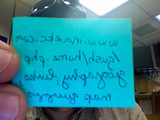
I am participating in a program by our school district called the Engaged Classroom. I (and two other teachers) are going to have a mobile lab with a bunch of other technology to use for the year, and hopefully create some good projects and learning opportunities for our students. This is exactly the type of thing that I have wanted to do for a long time, so I am glad that I now have the opportunity.Kelly and Darren are doing a great job teaching a very technologically diverse group of people about the different tools we should/will be using. They are experiencing what any other person teaching about technology will experience: sometimes, people just don't get it. Even if they say, "Yes, teacher, I understand what you are asking and I will do it from now on just like that."After learning how to use Diigo (which I finally kind of understand now, thanks), Wikis, Google Docs, and plenty of other collaborative web apps, one student wanted to share a link with another student. So, this is what she did:)You gotta love that. The image is backwards, and it is because I took it from Photo Booth and didn't have the energy to mirror the image so it came out right. Call me lazy. Honestly, the worst thing in the world to me (not really, but a close second to getting stung by a jellyfish) is writing out by hand URLs. Talk about torture!So the real question is, what is this person going to do with what she has "learned" this week? I am most certainly not mocking or poking holes in the wonderfully developed program. They have done a lot to make sure that they are following up; we must make a portfolio, attend monthly meetings, and teach others about the same things we are learning. This is a large beast to tackle for them, and I am excited to be a part of it. Have a Good Life.
Jethro Jones
.
Blog
.
<span class='date ' tip=''><i class='icon-time'></i> Aug 20, 2015 08:27am</span>
|
|
I just completed the Engaged Classroom training: a four-day course that covered a book and a bunch of social/web tools. It was pretty intense, and I think that a lot of people are overwhelmed. Below is a picture of the stuff that we got (I used Delicious Library 2 to get that all organized).I am so excited to do this. I have the tools now to do stuff. That has been the biggest hurdle for me.I am required to train two other teachers to use these tools: Matt and Melinda. Matt is a self-proclaimed technophobe, but he is coming along. I think my biggest challenge with him is the actual implementation of the tools. I think that if I work with him over the summer, he will be good to go. He just needs to start using these tools.Melinda is pretty savvy, and I think she will need direction to find what is good for her class. She is still new, and teaches a heavy curriculum, but I think that she will come along nicely, as well.The best thing is that I really like both of them. Matt and Melinda are awesome, and I am very lucky that I get to teach with them. They are both very accommodating, eager to learn, and flexible. I am really looking forward to this Engaged Classroom program.The biggest concern that I have is the time that it will take to teach the students to use these tools. Some of them will "get it" and some won't. Some will be so engrossed I will have to pry the technology away from them, and some won't care at all.I think the key is to make sure that I am not forcing them to use the tools, but making an environment that will be conducive to them learning with a lot of failures will be crucial. I think I am up to the task.This is not going to be an easy thing to do, but it will be worth it, I think.Have a Good Life.
Jethro Jones
.
Blog
.
<span class='date ' tip=''><i class='icon-time'></i> Aug 20, 2015 08:27am</span>
|
|
I spent my first 6 hours of "Internship: Summer to Remember" at ES School. I just found out this week that the beloved principal is retiring. It has been a good run, and I was able to meet the replacement today, as well. She seems very nice. Sadly, Mr. P. had to leave at about 11, so I didn't get to spend much time picking his brain.He did have to deal with a situation while I was there, and it was very interesting to see how he handled it. He said Public Relations is the biggest part of his job. It is number 1. He reminded me how important it was to take care that you think before speaking, not get defensive, and try your hardest to not pit a person against anyone else. There is a lot of careful speaking that you have to do with the teachers and parents and students and your supervisors. It seems like a principal's job is that of a peacekeeper.When Mr. P. called the parent who complained, he did a great job of calming her down, making sure she realized that he took it very seriously, then told what he did, calmed her down some more, and then told her what a great friend of the school she was. He extolled her virtues and helped her see that this really was not a big deal, and there is nothing we can do about it now. Put it behind us. She ended happy.He also mentioned how important it is to treat every concern the same. Follow up on everything that you say you will and make sure that it is done to the satisfaction (or at least as close as you can get to that) of all parties involved.Not a simple task to be sure, but a worthwhile one.Have a Good Life.
Jethro Jones
.
Blog
.
<span class='date ' tip=''><i class='icon-time'></i> Aug 20, 2015 08:27am</span>
|
|
I now understand why paperwork is the bane of principals' existence. I had to get everything in order for Mr. P. to check out at the end of the school year. There are 46 items on the checkout list for elementary principals! That is a lot. What makes it really hard is that I don't know who I need to go to to get the information that is needed. Even though it is a bit of a pain, I did enjoy seeing the progress that I made so far. I got the little, easy things done, and I am ready to move on.On the way to school this morning, two girls got in a fight and one of the city's finest caught them. They weren't on school ground, yet, and so the cops dealt with it. When we heard that the police were involved, we were sure that it was going to be a long and tiring process of trying to get everything sorted out. Luckily, however, the police officers just took care of the whole problem, so we didn't have to deal with anything. That was really nice.Also, we had a fire drill today and some of the walkie-talkies did not work. Some teachers do not plug them in so they can charge, which makes the possibility of danger in a real emergency very high. Other than that, everyone did their job quickly and well.Have a Good Life.
Jethro Jones
.
Blog
.
<span class='date ' tip=''><i class='icon-time'></i> Aug 20, 2015 08:27am</span>
|
|
When I was a kid, I wanted to be a pediatrician. When I was about 16, I threw my nephew up in the air, and he landed behind me on his back. That cut me right to the core. It was so hard to see him in pain. This morning (even though it feels like 2 weeks ago), a boy got in a fight and didn't seem to feel any remorse, until he called his dad. His dad was not happy. He started crying when he got on the phone, and I could tell that it was difficult and sad for him. That made me feel sad inside. For about two minutes. Then I realized that I would be crying if I did what he did as an elementary school student. Then I realized I can't feel too much compassion for these kids. A healthy amount is fine, but I can't get bent out of shape about it.It is a good thing I got that thicker skin because kids were in the office crying all day today. I dealt mostly with kids and their issues. I really do like solving the problems.Kids lie. Sad, but true. I need to remember that. Every single kid told a different story than the others.If they are not going to tell the truth, there is no way that I can help them. They just don't want to get in trouble.Mr. P. suggested that I write down and ask him questions that I have as they arise. I will add them on to the bottom of my blog posts with his answers. Feel free to add your responses to the questions as well.The problem I have is that all the questions I could ask are so subjective and the answer is invariably going to be "It depends." Being a principal is not a formulaic job. I can't plug X solution into Y problem and expect everything to work out. That is why I must think, prepare, plan, and carefully consider what and how I do everything.Question: What should I do when I see a kid out in the hall being "yelled" at or lectured by a teacher? Mr. P. says he just walks away unless called upon for assistance. He stressed not doing anything to undermine the authority of the teacher. The more you do to undermine it, the less authority you and the teacher have. Almost everything should be taken care of in the classroom.How do you know how far to push a kid when punishing them? Some just need a lecture, others need to go to jail--how do you know which they need? What do you do when a teacher says a student can't come back to his or her classroom? The important thing here is to make sure the teacher knows that you are the one who makes that decision. Teachers cannot say that a kid is not welcome in his or her class. Take the teacher's input, but be sure that you communicate to them it is your decision, not theirs.Have a Good Life.
Jethro Jones
.
Blog
.
<span class='date ' tip=''><i class='icon-time'></i> Aug 20, 2015 08:27am</span>
|
|
We are not just in this to educate children. We are here to help modify their behavior. -Mr. P.Although "behavior modification" sounds a little scary, the quote is true. We were talking about a teacher that was out in the hall lecturing a student in a loud manner. He told me about a friend that is implementing a card-pull system school wide, and the teachers voted that if a student gets his card pulled, he cannot earn it back. How will that kid react? He certainly isn't going to do anything to be good because it is "the right thing to do." He needs a reason to act appropriately. We will save a discussion about rewarding positive behavior or expecting it for later.Anyone who knows me will agree that I love to make things easy to do. I get so frustrated when circumstances require me to expend more effort than what I need to. Teachers need to remember to not make their jobs harder by the "punishments" they give their students. Take the card pull thing. Let's say you have a kid who just goofs off all the time, and you make him pull a card, and that card means that he has to stay in for recess. You just want to make it to recess, but it will be hard with this kid, so what do you do when he asks if he can earn back the opportunity to go to recess? Do you say (because let's face it, you are frustrated, trying to save face, and want to make him feel the pain he has caused you) "No, you lost your opportunity, so there is nothing you can do for the next hour to get to go out to recess"? Or do you say, "If you do X and Y and behave in Z manner until recess, I will put back the card, and you can go"?With the first option, you will have a kid with you at recess (keep in mind, it is a kid you probably don't want to be around, anyway) and the kid is probably not going to do what he should for the rest of the day. With the second option, however, you will be able to give him specific requirements to be able to go to recess. If he doesn't do what you require, he can't go. If he does, not only does he do X and Y and behaves Z, you also don't have to spend your time with him. You can start fresh after recess.I know there are many teachers that think this is crazy. If I punish a kid, I want him punish. But it is not about punishment. It is about behavior modification. We want that kid to change his behavior. We want him to stop acting inappropriately. If we just punish him with no thought of how to make him change his behavior, nothing will happen.If all we give them is negative responses, all we will get is negative behavior.The above examples are just one way that teachers make their jobs harder. Class behavior systems can make things hard, too. Take these two examples:The first teacher uses a point system in his class. When one student does something good, the teacher tells her to mark it down on her paper where their points are kept. When a student does something wrong, the teacher tells her to take away points. Very simple and straightforward consequence system. It is easy on the teacher because the teacher does not keep track of anything. Can the kids cheat the system with this approach? Sure, but does it matter that much?The second teacher uses a money system. When a student does something good, the teacher gives her money, and takes away money for bathroom passes, bad behavior, etc. It is also simple and straightforward. It is easy on the teacher because he doesn't have to keep track of things, either. But he does have to think about counterfeiting money. Kids will (and do) counterfeit it.Now, either one of these teachers can make their job much harder. If Misha counterfeits the money or adds points he never earned, and the teacher says, "Because you did this, you don't get any more money/points," Misha will probably continue acting poorly because he has nothing to strive towards.If they lose all their money or points for their behavior, they can at least start over. They will have a chance to act better.This whole concept brings me back to a quote that Mr. P. said today in almost the exact way Leigh VandenAkker said it last summer:If you don't have good classroom management, nothing else matters.It is true, if you can't manage your students, you are going to have a hard time teaching them. The real question of the day isHow can I teach that to my faculty?Have a Good Life.
Jethro Jones
.
Blog
.
<span class='date ' tip=''><i class='icon-time'></i> Aug 20, 2015 08:27am</span>
|
|
Ginger raised some good points in the comments yesterday. Valid points that I didn't have time to go in to. The truth isI have some students who have become master "negotiators" meaning that they misbehave, get busted, then at the last minute, so as to keep their positive rewards, will change their behavior to what is desirable. So they are in the pattern of misbehaving, making a little change, then still getting rewards.The plan should work for 95% of the kids. These other kids, the "negotiators" need something else. Not an entirely different system, but if the teacher just does a little bit more, she can really affect some change. The kids that are always right on the edge are usually the most frustrating. The point is, changing behavior at the last minute is not enough. If these kids are gaming the system and changing at the last minute, they don't get to have the rewards.This pattern is not healthy for their future decision-making skills. So while I agree, especially for elementary levels, there should not be a "punishment" atmosphere some of your teachers seem to be recommending, that after a point, the "punishment" may need to occur to keep them from getting into the pattern described above.Maybe they get to "re-direct" their own behavior for X times, but after so many of those "re-directs," the kid gets a card pulled for one recess?Or is that just a longer pattern?Great point, Ginger. I think, though, that a longer pattern is closer to no pattern that a short, 2-hour pattern. I think any teacher would rather have a longer pattern than a short pattern. Also, I don't think anyone has the silver bullet to destroy poor behavior. It is a never-ending fight. Just don't send everyone in your class down to the principal's office. Please. Have a Good Life.
Jethro Jones
.
Blog
.
<span class='date ' tip=''><i class='icon-time'></i> Aug 20, 2015 08:26am</span>
|