Blogs
|
Jethro Jones
.
Blog
.
<span class='date ' tip=''><i class='icon-time'></i> Aug 20, 2015 08:31am</span>
|
|
Below you will find the video for session 3 of TechnoThursdays. It is about 30 minutes long. We are talking about Google Video. The first part is muted, since we were watching a video, and it would just give an echo loop if I didn't mute, it, so push play here, then go watch this video on YouTube.During TechnoThursdays, we talk about how to make our lives easier as teachers. Sometimes, I feel like I am just confusing the heck out of everyone there. This was a really rough week for me. I had a LOT of stuff going on with school and work and work and family and church (yes, work was repeated twice on there, remember, I got a second job!). I didn't get to plan for this session as much as I would have liked to, and that frustrates me. I felt rushed the entire time. The majority of people did say that they didn't want TechnoThursdays to last more than an hour at the most, so I was trying to keep it relatively short. I had a lot to get through, and I think that it was difficult for them to keep up, because I was really going fast. I need to remember to slow down and make it useful for them. If I don't, nobody will want to come anymore.For the first session, I took the time to put myself in their shoes and tried to figure out the questions that they would likely ask me. This week, I just didn't do that. I forgot to ask a key question, and that made it very difficult. One teacher requested that TechnoThursdays help her use technology to more effectively teach math. When I read that comment in the survey from the first session, I thought about it briefly, but didn't put the time in that I needed to. I need to take the time to adequately prepare. (Hopefully, she doesn't read this and see that I am screwing up already!!!)Next week I am going to talk about blogs. I am going to talk about them as a way for teachers to update their students, or remind their students what they did in class. My team science teacher has a blog that she updates regularly for her students. I will use that one as an example. I am going to suggest that they include some extra credit assignments on there to help kids get in the habit of checking. Blogs also function as a great communication tool with parents. Parents could leave comments on the blog and ask questions or make a mockery of the teacher (let's hope not, right?).I will also mention using blogs as a reflective tool, like a journal. I don't know which is harder: writing a blog as a journal, or as an informational piece. What do you think? I use this blog as a reflective journal, so I am not surprised at all if nobody reads or comments. I do believe that a blog can be a very effective way for a person to reflect. I think that putting it out there where someone could stumble upon it forces you to think about what you are writing.Well, here is to wishing that session 4 will be better than session 3.Have a Good Life.
Jethro Jones
.
Blog
.
<span class='date ' tip=''><i class='icon-time'></i> Aug 20, 2015 08:30am</span>
|
|
Last week my principal came into my room to ask me if I would be interested in attending a Principal's Academy conference with him where Rick and Becky DuFour would be speaking. For the uninitiated, Rick and Becky DuFour are the big names in Professional Learning Communities (PLC). A PLC is a collaborative community of school personnel that works together to ensure that not only does every child learn, but also that when they don't learn, there is a systematic process in place to help them learn. Aside from technology integration in schools, this is what education should be all about. I would even say that if I had to choose between the two, I would take PLCs without even thinking about. When I served as director of Academic Activities at BYU-Idaho, I started on this path. Though I didn't have the same words for these ideas way back then, the idea of a PLC and collaboration amongst teachers is what pushed me over the edge to become a teacher. If you would like more info about PLCs, please go to AllThingsPLC.info.Rick DuFour has a great sense of humor, and it showed in his book, and in this presentation today. He jumped into different accents on numerous occasions and told humorous anecdotes to get his point across. I would try to reproduce one verbatim here, but I would only butcher it, and if I can find a recording or even the written anecdote, I will certainly post it.Briefly, he talked about an eye surgeon giving his sister a painful and dangerous operation to fix her vision that would take a year to complete for both eyes. Then he wanted his eyes fixed just 7 years ago. The doctor had Lasik eye surgery by then and said he would be zapped a couple times with lasers, and then be at 20/20 vision in just 72 hours. DuFour said that if the doctor had done the same procedure that was done to his sister, he probably could have sued him for malpractice, since the technology and skills and best practices had been discovered by this time. He likened that to teaching: the research shows that collaborative teams show significant gains in student achievement--as a teacher, do not commit malpractice by not doing what research shows is the best thing to do to help kids learn.Here are the Big ROCKS that I got from the meeting today:Teachers need time to stop and think. (Much of the following will come if teachers can actually stop and think about what they are doing.)What we teach is the same across our grade level teamHow we teach it is and must be individualIntended curriculum is what the state (or other body) wants us to teachImplemented curriculum is what actually gets taught. There is a difference!!!Teachers need to commit to being actively involved and doing what needs to be done in a PLC. (In the words of my principal, "we aren't just going to have people 'mail it in.'"Say NO to averagesExtra help and tutoring for struggling students is no longer optional (build it in to the time they are at school. No more after-school tutoring! AMEN!)Celebrating is like voting: do them both early and often."The one thing leaders of any organization must know to be effective is the importance of clarity--communicating clearly and consistently:the purpose of the organization,the primary clients it servesthe future it is creatingthe indicators of progress it will track, andthe specific actions members can take immediately to achieve its long-term purpose and short-term goals." -Marcus BuckinghamAt the end of the conference, my principal asked, "Are you truly willing to let this impact your classroom practice and be a leader and an example to others at our school to push us the rest of the way toward a PLC?"Yes, I will.Have a Good Life.
Jethro Jones
.
Blog
.
<span class='date ' tip=''><i class='icon-time'></i> Aug 20, 2015 08:30am</span>
|
|
I had a spiritual experience in my first period English class today.We read Touching Spirit Bear in my 7th grade English class this quarter, and I didn't think the students were getting much out of it. It was my first time teaching it, and I didn't do a very good job teaching it. They mostly read it by themselves with little discussion about it. I should have done a better job. I will do a better job next year, Department Chair.For the totem pole assignment at the end, the kids needed to draw a totem pole and write about it. I didn't give my first period class much instruction about it, and then gave the other periods more instruction. The things these 1st period students turned in were amazing.One girl wrote about how her dad used to be an alcoholic and how he has not had a drink for 3 years. Then she started crying. She was not crying because she was embarrassed, she was crying because she was so proud of her dad. She let me read the rest of her paper later, and she had so many great things in there.Another student read his, he drew the World Trade Center and told about how they thought his dad died there. Then, he said his dad didn't die, but friends did die there. Then he said, "I just want to ask God to bless all those heroes and victims of 9/11." It was so heartfelt and honest; it was not part of his written explanation.These two students were just part of the whole class doing an amazing job. I didn't think that they really understood a lot of the book. They showed me that they did.Have a Good Life.
Jethro Jones
.
Blog
.
<span class='date ' tip=''><i class='icon-time'></i> Aug 20, 2015 08:30am</span>
|
|
TechnoThursdays wiki for this session.You can watch the video at the link above, if you choose. Please fill out the survey, too.This week's session was way better than last week's. I felt really rushed last week, and the class didn't go very well. I think Google Docs takes a mental shift. I don't think most of them were ready for it. I am frustrated with myself for not being aware that it would be difficult. I should have known.This week we did blogs. We set up blogs so that the teachers could post updates to their blogs each day about what they did in class. I think this is a great because they can make their lives easier. Students who need assignments from the previous day can get it there.What made tonight's TechnoThursday really successful?I was very prepared.I was teaching them something they could use right away.As a teacher of adults, I need to be prepared. As a teacher of adults, I need to teach them something that they can meaningfully use right away.Have a Good Life.
Jethro Jones
.
Blog
.
<span class='date ' tip=''><i class='icon-time'></i> Aug 20, 2015 08:29am</span>
|
|
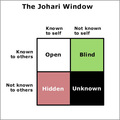
Pete over at LeaderTalk posted a good example of how important it is to be aware of what you are doing right and what you don't even know you are doing. I have experienced similar problems where people around you get upset about something and you don't realize that anything is wrong. The Johari Window explains this situation very well.Image Credit: Road to Well BeingI think Johari's window is pretty self-explanatory. The "Not known to self" section is what needs to be uncovered. You can uncover this by surveying other people, doing self-inventories, and studying. I hope that as a leader, I will be able to uncover the things that are currently hidden from me.Have a Good Life.
Jethro Jones
.
Blog
.
<span class='date ' tip=''><i class='icon-time'></i> Aug 20, 2015 08:29am</span>
|
|
Taylor the Teacher posted about leadership today, probably because she feels her leadership is this way. This is definitely an authoritarian approach, and sometimes the situation warrants this kind of leadership (of course without the cutting off the head part). Sometimes, you really need to chop down on this. I remember one experience that I had as a leader where I needed to be strong. There was a topic that we could not talk about. If we did, it would have eroded our unity and all that we had worked so long and hard to make. This was the same basic approach that I needed to take with those that I led. I laid down the law and said, "We will not talk about this."Here is the clip Taylor used (Warning: It has bad language and a guy gets his head chopped off.)I haven't ever seen this movie, but I like that Taylor related this clip to leadership--very clever.Have a Good Life.
Jethro Jones
.
Blog
.
<span class='date ' tip=''><i class='icon-time'></i> Aug 20, 2015 08:29am</span>
|
|
I love the semi-colon! This rocks! Though, I don't know if this really makes much sense. You Are a Semi-ColonYou are elegant, understated, and subtle in your communication.You're very smart (and you know it), but you don't often showcase your brilliance.Instead, you carefully construct your arguments, ideas, and theories "" until they are bulletproof.You see your words as an expression of yourself, and you are careful not to waste them.You friends see you as enlightened, logical, and shrewd. (But what you're saying often goes right over their heads.)You excel in: The ArtsYou get along best with: The ColonWhat Punctuation Mark Are You?Have a Good Life.
Jethro Jones
.
Blog
.
<span class='date ' tip=''><i class='icon-time'></i> Aug 20, 2015 08:29am</span>
|
|
TechnoThursdays went great. We didn't have as many people there, but I think that I got the video to work better this time. We talked about blogs and everyone was able to keep up well. One of the other teachers couldn't make it, so she watched the session today. Last week I talked about going slow and providing something useful. I didn't plan as much today, and I think that made it a lot better. I took my time and didn't feel rushed.I enjoy seeing everyone posting to their blogs. Right now they are just posting assignments for students, but someday I hope to get them more involved in the blogosphere. We will see.Have a Good Life.
Jethro Jones
.
Blog
.
<span class='date ' tip=''><i class='icon-time'></i> Aug 20, 2015 08:29am</span>
|
|
One of the more important things that I teach my 7th graders is persuasive writing, and I think that I do a pretty good job, considering my lack of experience and skill. The way I teach it really seems to make sense to my students, and I know that it makes sense to me.First of all, I go to this website called PocketMod, which is basically a place where you can create and print out your own mini-book that needs no staples or tape to work. You can even convert PDFs to this small form factor and have your reading fit in your pocket (I must admit this came in handy when I had to read so many PDFs for a few of my grad classes). I make a book like the one below and print it out.This method requires half a period (our periods are 45 minutes) to teach introduction, one whole period to teach supporting paragraphs, and half a period to teach conclusion.I have the paper above on an opaque projector (or as a transparency on an overhead) and write on it just like they do. That way, they can see exactly where things need to go. I tell them they only have to write what I write on the paper like theirs, so all our other discussion and comments don't go there. They get a very specific formula to follow.I give a blank one to each of my students and pitifully try to explain to them what to number the pages. I do this so that they can have a point of reference for the next steps, which need some reference points.When this book is folded, each page represents a new paragraph in a persuasive essay (also known as a five paragraph essay). These are 7th graders, so they like it simple and wrapped in a nice package. The anticipation of being able to eventually cut the paper and fold it kills them. I do everything I can to delay that gratification. It is good for them, right?So, on each "page" I take them through what is required for each paragraph in the essay. I let them do most of the teaching--that is, they call things out and I write it on the board off to the side while we discuss what should go where. Some of them have some background knowledge so this is a good way for me to get an idea of where they are at. Typically, though, we move through this pretty quickly. They give suggestions of what should be in each paragraph, and then I eventually tell them what should go there, and they suggest what should be written. It is all pretty straightforward, and they can easily make sense out of the words that I give them. They usually give an answer very close to the "correct" answer (correct in this instance means, worded the way I like it to be worded).The other thing that makes this work well, is I give them a guide for what they can use when they are writing papers for me. I give them keywords and key phrases that trigger what is supposed to come next.Key for the image below:Black text: The important parts that will be in every persuasive essay they write until the day they die!Blue Text: The explanation of the black text, just in case you ever forget.Red Text: Keywords they can use to start that section/sentence/paragraph/whatever.Why do I teach persuasive organization like this?Simple plug-and-play types of writing that are different enough (as this one is) will help them score well enough on their big important writing tests.Middle school kids are all over the place when it comes to organization (and I am sure that has something to do with their out-of-control bodies).It is much easier to grade them for their organization skills when they all follow this same pattern and use the same words.It is much easier for them to focus on the other five traits if organization, the trait that can hold them up, is very easy to do.I enjoy seeing them feel like they are writing a good paper (even if it is not) because it is well organized.This works. My students' writing scores were much better last year than the year before, and I had a lot of ELL (or ESL or LAL or whatever other names there are for kids who don't speak English at home).When they know what goes where, the rest of the good writing practices will comeIt doesn't take that long to teach, and the rest is just practice (it takes 2 full 45-minute periods, but I do the intro paragraph on the first day, and then have them write two or three to practice their hooks--then the middle paragraphs on day 2, and about 15 minutes on the conclusion).I do really enjoy teaching them to write a persuasive essay in this manner. This method gives them enough help that even the really poor writers can write a decent paper at the end.If you have anything that I should add to the lesson, please let me know so I can include it for next year.Have a Good Life.
Jethro Jones
.
Blog
.
<span class='date ' tip=''><i class='icon-time'></i> Aug 20, 2015 08:29am</span>
|