Blogs
|
Which type of video is best for your class?Matthew Robinson, Instructional Designer for UTO, shared best practices for both videos in the studio, and at your desk. Some key themes were:Research studies show students stop watching videos around 6 minutesShowing the professor talking is better than just slides and audio, and having two or three people in the video interacting is even better!"Cut the filler, maximize the THRILLER!"- cut out repeated information and stick to the key information that you can be enthusiastic about. Spontaneous and casual videos are a great way to communicate announcements and give feedback to students. Matthew shared the steps (see handout) for creating these using the Blackboard/YouTube tool and how to set up your webcam for the best look. Next semester, we are looking to do an 'advanced' video webinar that can address some issues for making videos more interactive, and adding closed-captioning and transcripts!Resources:Video recording of session: https://connect.asu.edu/p5vma8ovt52/Files:PowerPoint: https://dl.dropboxusercontent.com/u/12594701/Tech_Session.pdfAudio/Video Options at ASU: https://dl.dropboxusercontent.com/u/12594701/AudioVideoTechnologiesatASU.pdfHow to Create Videos with Blackboard: https://dl.dropboxusercontent.com/u/12594701/VideosInBlackboard%2Bdocx.pdfResearch on Engaging students with Videos: http://onlinelearninginsights.wordpress.com/2014/04/28/mooc-design-tips-maximizing-the-value-of-video-lectures/Examples:Standard studio video: http://youtu.be/i89tdW5zDVkDialogue Ex1: http://youtu.be/kqwdJ9Ku1C4Dialogue Ex2: http://youtu.be/W1nl4i6fwaAWebcams: http://youtu.be/ZELl3h1Fq88If you have other suggestions for videos, please feel free to share them by clicking on the "Pencil" icon below.
Amy Pate & Peter Van Leusen
.
Blog
.
<span class='date ' tip=''><i class='icon-time'></i> Aug 23, 2015 02:19pm</span>
|
|
This week's Guest Blogger is Christina Burden . Christina Burden is a doctoral degree candidate in the Interdisciplinary Graduate Program in Neuroscience. She has a strong interest in innovative teaching and making time in the classroom effective for students with all learning styles. Her research focuses on the molecular mechanisms of learning and memory in honey bees and how toxic chemicals disrupt these processes. One of the strengths of active learning is the potential for helping students bridge the gap between a library of facts they must memorize and a conceptual understanding how those facts fit into a working biological system, like a neuron generating an action potential. I do not have a magical formula for creating active learning exercises that morph students’ understanding of a concept from a "mental fact library" to a "mental IMAX." But, I will share three principles I use to help me avoid some common mistakes that can reduce the effectiveness of active learning exercises.Emphasize the correct building blocksProblem: When beginning an exercise, students are grappling with a lot of new information and may have trouble identifying the relevant information for the exercise.Solution: Help students over this hurdle and build the factual foundation for the rest of the exercise, without directly identifying the relevant pieces of information out of their mental fact library, by using a series of review-style questions.From baby steps to dancing - it doesn’t happen overnightProblem: Many students have not developed the critical thinking skills required to move from a mental fact library to working concepts, so when they are presented with a problem that requires integration they respond with merely a conglomeration of facts they think may be relevant.Solution: Begin with simpler straightforward application problems. As the students get more familiar with the material and accustomed to more integrative activities, increase the problem difficulty and the amount of information they must integrate to find the solution. This encourages critical and integrative thinking skills development through out the term.Note: When challenging students with difficult problems, give them opportunities to learn from their mistakes and not just be penalized by them. One way I accomplish this is giving them the opportunity to resubmit questions they answered incorrectly with an explanation of what the correct answer is and why it is correct. If their answer is satisfactory, I give them partial credit for that question. This turns each mistake into a learning opportunity.Keep it simple to keep the focusProblem: It is easy to build elaborate exercises that lose the original focus or try to accomplish too much at one time. At least, this is true for me. Students can easily to get lost in the complexity of the exercise or the details of using the technology and miss the concept I was trying to teach.Solution: When designing an active learning exercise, I ask myself what form of exercise will best illustrate the concept I want students to grasp. Some concepts are best taught with just a simple series of questions leading the students through the concept building process. Other concepts require videos, simulations or other technology for me to get the point across. Regardless of the format or technology I use, I keep every element of the exercise simple and focused on the main concept.What ideas and principles help you design active learning exercises?
Amy Pate & Peter Van Leusen
.
Blog
.
<span class='date ' tip=''><i class='icon-time'></i> Aug 23, 2015 02:19pm</span>
|
|
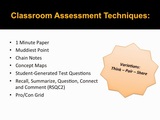
In our latest Teach T@lk webinar, we focused on student-centered Classroom Assessment Techniques (CATs). These popular and quick activities allow instructors to receive feedback about lesson effectiveness and student understanding. While CATs were developed by Thomas Angelo and Patricia Cross (1993) with face-to-face teaching in mind, these easy-to-use and often non-graded techniques can be easily adapted to the online or hybrid setting. You might have heard about CATs, such as Minute-Paper, Muddiest Point, or Pro-Con Grids, but did you know these are just three of 50 CATs which instructors can use to gauge student understanding?Check out the following helpful resources to get started with CATs. Please do not hesitate to contact us for . Webinar Materials:recording (56 min.)webinar slides (PDF) ASU TeachOnline Blog: Gauging Student Understanding: CATs are puuuuur-fect Are my students really getting it? CATs will show you the way.Books: Angelo, T. A., & Cross, K. P. (1993). Classroom assessment techniques: A handbook for college teachers. San Francisco: Josey-Bass. Barkley, E. F., Cross, K. P., & Major, C. H. (2004). Collaborative learning techniques: A handbook for college faculty. Wiley.com. Bonk, C. J., & Zank, K. (2008). Empowering online learning: 100+ activities for reading, reflecting, displaying, and doing. Jossey-Bass.
Amy Pate & Peter Van Leusen
.
Blog
.
<span class='date ' tip=''><i class='icon-time'></i> Aug 23, 2015 02:19pm</span>
|
|
Most faculty hate the end of the semester, when students start asking them if they could come in and "discuss" their grades. We all know this usually means "Can you give me a better grade?" Many faculty will flat out say that they "Don't negotiate". Others add bolded, underlined, red statements in their syllabi in order to set expectations about grade changes. With that said, we know that students today are being brought up in a world where everything is negotiable, some cultures encourage it, and it doesn't hurt to ask. I’ve found that using some best practices from the business industry, help me get through these difficult situations. In its most simple form, a negotiation is a bargain, where both parties take a side, sometimes meet in the middle, and usually leave the table frustrated. Bargaining in a class means that a student does C level work, but asks for an A. You get frustrated, and to agree to give them a B just to get them out of your office. But it doesn't have to be this 'win/lose' solution.I prefer an approach called "mediation", where both sides can leave the table feeling satisfied. Here are some tips for what I do: Set Up The Meeting: Agree to meet with the student, but begin set a specific time limit. My suggestion is 20 minutes. Make sure you let students know that you will do a hard stop at the end of 20 minutes, and make your final decision. Once that decision is made, you will not be meeting with them again on this subject.Do your "Prep" Work: Take a few minutes to look over their grades, read their email, and become familiar with the issue. I write down a couple of questions for the student. Businesses take time to decide if they feel the relationship is worth building, or if it is a one-time transaction. Faculty need to think about the long term relationship with the student. Is the student going to take future classes in the department, are they going to be doing innovative research, would they make a good TA next year? Is this a relationship that would be good to continue?Focus, Trust, and Clear Expectations: Tell students this is a good faith effort to see if the issue can be resolved. Be sure to portray an open, friendly and respectful tone. Do not be distracted by emails, calls, or others waiting to see you. Help students understand the consequences of this meeting not going well. How will it affect them in the future? Ask them "What outcome beyond the grade would they like to see?" or "What they would do in your situation?" Let them know that you value this opportunity to know them better.Listening is Critical. You should let the student do most of the talking. Allow them to vent their frustrations in a constructive way without you getting defensive or too quickly disagreeing. You will not be successful if you appear to humiliate, intimidate, or pound the desk to get a point across. Try to stay in a neutral position, not agreeing or disagreeing with their statements.Look for Connections. Find opportunities to agree with the student, compliment them, and comment on shared interests.Use Open-ended Questions. Just like in the classroom, here are some types of questions that may be helpful:Clarifying- get a student to discuss specific evidence and examples to support their claims. "Based on what you know, what were the objectives of this assignment?"Probing- Get to the heart of the issue and what they were feeling. "When you received the low score on your test, what actions did you take?"No Tangents. Keep the student focused on the specific issue. If they start going off course, or are not allowing you to inject comments, ask them a closed question (yes or no) that stops them for a second, and allows you to guide them in a different directions.Summarize It is critical that you stop and summarize what you heard them say, what the issue is, and what they would like you to do. Confirm that you have that information correct before proceeding.Decide. Make a clear decision, and give students a compliment.Example "I've heard your comments, I appreciate your desire to get a better grade, but I'm not going to change the grade because you are not able to show me that you are proficient in this topic. I believe that you and I share some common interests... and I look forward to seeing you in future classes. You have a lot to offer, and I'd like to be able to help you reach your goals here." This technique takes some practice, and won’t always go smoothly. I’ve had students come to me later, and thank me for taking this approach with them. I use it for selfish reasons. It gives me an organized approach for dealing with these stressful situations. Now it’s your turn....How do you approach these meetings? What are some tips you have for these situations?
Amy Pate & Peter Van Leusen
.
Blog
.
<span class='date ' tip=''><i class='icon-time'></i> Aug 23, 2015 02:18pm</span>
|
|
Last week we had a small workshop on how to create videos for your class. There are a variety of technologies available to use, but before you start make sure to know what your objective is in creating a video. We talked about 3 types of videos as:Spontaneous- videos with content that won't be kept more than 1 semester, used for feedback to the class, calling on specific students, or deadlines. They are instantly available to students.Step-by-Steps- screen captures that show a student a process, software, steps to complete a lab, etc. These are instantly available to students.Core Content- "rich" videos that are meant to be used multiple times, or in multiple courses. The production is more intensive, but the quality is better, and more professional. They may take 1-3 weeks to produce, but can include interviews, groups, special graphics and videos.For instant "at home" videos, technologies include Adobe Connect, Blackboard and Camtasia Relay. For more professional videos, faculty can work with the CPCOM studio for support.Finally, we discussed some best practices, like using a case study, or narrative to engage students in a story, and adding 'pop-up' quizzes to be sure students are actively watching the videos.Thanks to Matt Robinson and Peter Van Leusen for some of the great resources we shared:MOOC study - How Video Production Affects Student Engagement: An Empirical Study of MOOC Videos (Guo, Kim & Rubin, 2014) PowerPoint SlidesVideos in Blackboard
Amy Pate & Peter Van Leusen
.
Blog
.
<span class='date ' tip=''><i class='icon-time'></i> Aug 23, 2015 02:18pm</span>
|
|
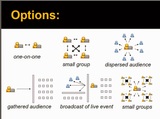
Different formats for Web-conferencingDuring last week's TeachT@lk webinar on Web-Conferencing: Engaging Your Students in Real Time, Peter van Leusen, PhD and Amy Pate discussed best practices and "demoed" how to engage students in active learning exercises. We focused on Adobe Connect, as it is available to all ASU faculty for free, and fully supported by UTO.Among other educational applications, web-conferencing allows for:Class discussionsVirtual office hoursScreen/software demonstrationGroup workGuest presentationsSupplementary course materialsLecture RecordingsMini lessons with audio and visualsStudent-created contentAssessmentOverview of Web-Conferecing tools at ASUBelow are some of the resources mentioned during the webinar, along with the slides and recording. If you have questions, or are interested in trying out web-conferencing for your class, please contact me at amy.pate@asu.edu.Webinar Recording (57 minutes)Webinar SlidesEducause article: 7 Things You Should Know About Video CommunicationASU Adobe Connect Site: Adobe Connect OverviewASU Vidyo Site: Vidyo Desktop ConferencingExamples:ASU’s Vidyo’s Education in Biological Diversity Penn State’s Adobe Connect Use Cases ASU TeachOnline Student Success with Video Chats To Register for future TeachT@lk Webinars: http://utotraining.eventbrite.comAs always, feel free to make comments to this post, and share your experiences! (Also SHARE the blog, and help us get the word out!)
Amy Pate & Peter Van Leusen
.
Blog
.
<span class='date ' tip=''><i class='icon-time'></i> Aug 23, 2015 02:18pm</span>
|
|
Sarah Dalrymple, PhDOur guest blogger this week is Dr. Sarah Dalrymple. Sarah got her Ph.D. in Population Biology, but is currently a postdoctoral scholar in Biology Education at the University of Tennessee. This summer she will join the SoLS faculty at ASU as an Academic Professional. Her primary interest is in teaching and exploring new ways to make learning more fun and effective. She also works with grad students and faculty to help them improve their teaching and is interested in the factors that determine whether or not instructors adopt evidence-based teaching practices.Clicker systems are an interactive technology used by many instructors in large lecture courses to get immediate feedback on student understanding. When used properly, clickers can increase student engagement and learning in a course. However, instructors have the ability to enhance or impede these effects by the way they deliver and review clicker questions. The following three tips on how to use clickers more effectively are based on educational research and my own personal experiences using clickers in my classes. 1. Let students talk while answering and give specific discussion prompts. Unless you are specifically trying to assess individual student knowledge, you should consider allowing students to talk to one another as they choose their answers. Students learn more from explaining their reasoning to peers than they do by simply choosing the right answer (Smith et al., 2009). In addition, research has shown that the prompt instructors use when delivering the question influences the quality of student discussion (Knight, Wise & Southard, 2013). Rather than just saying "Discuss the question with your neighbor," give a more directed prompt, such as:· Explain to your neighbor the reason the answer you chose is correct.· Discuss the reasons why each of the incorrect answers is wrong.· Explain how you would change the incorrect answers to make them correct.2. Review the right and wrong answers. In addition to providing feedback to instructors about student understanding, clickers can also be used to provide feedback to students. If you simply reveal the right answer and move on, the students who chose the wrong answer may never know why their answer wasn’t correct. Take the time to discuss the reasoning behind correct and incorrect answer choices. One strategy I use is to ask different students to explain to the class why each incorrect answer is wrong. This provides another opportunity for students to teach one another. In my experience, students are very interested in knowing why they got a question wrong, so they are always very attentive during this time and often ask good questions to clarify confusion.3. Know when to re-poll a question. I will often write clicker questions to reveal common misconceptions or errors that I anticipate students will make on exams. Since these questions tend to be difficult, a large number of students often choose the wrong answer (see slide below). The first time this happened to me my initial reaction was disappointment, but I now recognize these moments as rich opportunities for productive discussion and peer instruction. I don’t have a strict cutoff, but if < 50% of the class gets the answer right on the first try, I will give them another chance to answer and encourage them to talk to new people in the class. The volume of student discussion often grows louder during the re-poll and students are more engaged in discussion with one another. The result is usually that a greater number of students answer correctly on the second try. In addition, the follow-up whole class discussion is more productive than if I immediately reveal the right answer without the re-poll.Leave a comment below if you have any tips to add to this list!References and ResourcesASU's Clicker Information Page: https://ucc.asu.edu/clickers/Knight, J. K., S. B. Wise, and K. M. Southard. 2013. Understanding clicker discussions: student reasoning and theimpact of instructional cues. CBE Life Sciences Education 12:645-654.Smith, M. K., W. B. Wood, W. K. Adams, C. Wieman, J. K. Knight, N. Guild, and T. T. Su. 2009. Why peerdiscussion improves student performance on in-class concept questions. Science 323:122-124.
Amy Pate & Peter Van Leusen
.
Blog
.
<span class='date ' tip=''><i class='icon-time'></i> Aug 23, 2015 02:18pm</span>
|
|
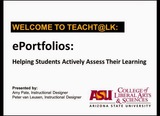
On Tuesday, April 7, we had a webinar on using eportfolios in the classroom. Below is a summary of some of the key points and resources:ePortfolios are an archive of materials created by students to showcase their skills and knowledge. They are basically a website with text, videos, images, link and files. There are 3 main types of eportfolios:Personal- includes items from an interest or hobbyShowcase- includes information and evidence of skills, often used in interviews to showcase someone's work, or for requesting funds for special projects. Learning- a collection of a students' projects and assignments for a class, used to provide evidence of whether a student met the learning objectives and how they met them. It often includes drafts of assignments to show the process, not just the final product. Students are encouraged to follow a 5 step process to build eportfolios which includes:collecting the dataselecting what to showcasereflecting on the work and how to improvepresenting it to others evaluating the feedback and improving the eportfolio. The BIO594 Adv. Scientific Teaching course was discussed as a case study for eportfolios that were created to highlight a students' experience with teaching. Some best practices from the case included:Giving the students indepth training on how to use the technologyProviding detailed instructions on what is expected, and examplesRequiring students do reflections throughout the process on ways to improve and what they learnedInclude peer reviews so students can learn to give each other constructive feedback, and learn collaborativelyDesign small progress "milestones" to keep students on track There are a number of technologies that work well with eportfolios, including Google Drive, PowerPoint, Wix, Weebly, and Blogger. ASU supports Digication, and the link is: https://asu.digication.com/ Some faculty allow students to choose their favorite, since sharing a public link it available in nearly all the technologies. "Get Started" Resources:If you would like to try eportfolios, please contact your instructional designer, or amy.pate@asu.edu.Recording of session: https://connect.asu.edu/p38z4525fi8/ Slides: https://dl.dropboxusercontent.com/u/12594701/eportfolio_040715.pptxHandouts from BIO594 eportfolio project: https://dl.dropboxusercontent.com/u/12594701/ePortfolio%20Project-2.doc
Amy Pate & Peter Van Leusen
.
Blog
.
<span class='date ' tip=''><i class='icon-time'></i> Aug 23, 2015 02:18pm</span>
|
|
Our Guest Blogger today is Dr. Erin E. Shortlidge. Erin is a postdoctoral research scholar in Dr. Sara Brownell’s Biology Education Research Lab in the School of Life Sciences at ASU. Her Ph.D. is in Biology where she studied the ecology and physiology of moss reproductive success. Her current research endeavors are in understanding the ecology of higher education. As an education researcher she is particularly interested in course-based research and in identifying what factors make for effective and impactful learning environments.What is a CURE? Course-based Undergraduate Research Experiences National reports such as Vision and Change (AAAS, 2011) and the National Research Council’s BIO2010 have called for systematic shifts in life science education - including giving all undergraduates the chance to do research. Course-based undergraduate research experiences (or CUREs) are an answer to these calls. In a CURE, research is embedded into the life science laboratory course itself, providing all students who enroll in the course the opportunity to do research. The work that undergraduates do in a CURE is different than in a traditional lab or in inquiry activities. The proposed dimensions that define a CURE are that students engage in1: scientific practices discovery-based work where the outcome is unknown broadly relevant or important research collaboration with one another and the instructor the iterative nature of science While there is much diversity in the research topics explored in CUREs, two distinct CURE models have emerged, both revealing student benefits: (1) a local model where faculty members develop and teach a CURE stemming from their own research interests (e.g. 2,3), and (2) a national model where a CURE is developed by an individual faculty member, and then is expanded and taught by a network of faculty (e.g. 4,5). A great way to develop a local CURE is for faculty, instructors, and/or advanced graduate students to identify a way to scale up their own research interests into a lab course. Here the ultimate goal is for the undergraduates to begin to understand the process of science by actually doing science - including experiencing all of the messiness and uncertainty of research- and then learn how to effectively communicate their results. Further, faculty who have developed and taught CUREs report benefits to themselves in that CUREs are a way to bridge some of the often-forced disparities between teaching and research, and that they genuinely enjoy their time in the classroom (Shortlidge et al. 2015, in review). For example, consider Tad Fukami, a Stanford University researcher who turned one of his research projects into a CURE in an introductory biology lab course: He was interested in the ecology of nectar-dwelling microbe communities in Mimulus flowers. Students collected data each week on this system, adding to a large central database, from which they drew upon to ask their own research questions. Three scientific research publications have now resulted in part from the data collected by the students in the course 6-8.For more information on CURES please visit CUREnet (http://curenet.cns.utexas.edu), and check out the referenced articles below. References 1 Auchincloss, L. C. et al. Assessment of Course-Based Undergraduate Research Experiences: A Meeting Report. CBE-Life Sciences Education 13, 29-40, doi:10.1187/cbe.14-01-0004 (2014). 2 Brownell, S. E., Kloser, M. J., Fukami, T. & Shavelson, R. Undergraduate biology lab courses: comparing the impact of traditionally-based "cookbook" and authentic research-based courses on student lab experiences. Journal of College Science Teaching (2012). 3 Rhode Ward, J., Clarke, H. D. & Horton, J. L. Effects of a Research-Infused Botanical Curriculum on Undergraduates’ Content Knowledge, STEM Competencies, and Attitudes toward Plant Sciences. CBE-Life Sciences Education 13, 387-396, doi:10.1187/cbe.13-12-0231 (2014). 4 Lopatto, D. et al. Undergraduate Research: Genomics Education Partnership. Science (New York, NY) 322, 684 (2008). 5 Jordan, T. C. et al. A broadly implementable research course in phage discovery and genomics for first-year undergraduate students. MBio 5, e01051-01013 (2014). 6 Vannette, R. L., Gauthier, M.-P. L. & Fukami, T. Nectar bacteria, but not yeast, weaken a plant-pollinator mutualism. Proceedings of the Royal Society B: Biological Sciences 280, 20122601 (2013). 7 Belisle, M., Peay, K. G. & Fukami, T. Flowers as islands: spatial distribution of nectar-inhabiting microfungi among plants of Mimulus aurantiacus, a hummingbird-pollinated shrub. Microb Ecol 63, 711-718 (2012). 8 Peay, K. G., Belisle, M. & Fukami, T. Phylogenetic relatedness predicts priority effects in nectar yeast communities. Proceedings of the Royal Society B: Biological Sciences, rspb20111230 (2011).
Amy Pate & Peter Van Leusen
.
Blog
.
<span class='date ' tip=''><i class='icon-time'></i> Aug 23, 2015 02:18pm</span>
|
|
Today's Guest Blogger is Christian Wright a postdoctoral research scholar in Dr. Sara Brownell’s Biology Education Research Lab in the School of Life Sciences as ASU. He has a Master’s in Education and a Ph.D. in Biology where he studied the interaction between physiological condition, environment, and foraging behavior of Gila monsters. His current research focuses on 1) generating a validated general biology programmatic assessment, 2) exploring potential biases in undergraduate biology classrooms as well as examining mechanisms and interventions that may explain and alleviate said biases, 3) evaluating assessments used by undergraduate biology instructors and by biology education researchers to determine if these measurement tools are indeed measuring what they intend to measure, and 4) exploring how and why instructional strategies differentially impact cohorts of students in undergraduate biology classrooms. He will be starting a position as an Academic Professional in the School of Life Sciences in June, 2015. Vision and Change: A general framework for undergraduate teaching There have been numerous calls to action by national agencies (e.g., National Science Foundation [NSF], American Association for the Advancement of Science [AAAS]) for curricular reform in undergraduate biology education, with the goal of moving students away from thinking about biology as "silos" of content and towards encouraging students to think about biology in a much more integrative way. The product of many of these discussions is the consensus Vision and Change Report (AAAS, 2011). In this report, a group of 500+ biology faculty, administrators, students, and postdoctoral scholars identified five core biology concepts: 1) evolution, 2) structure and function, 3) information flow, exchange, and storage, 4) pathways and transformations of energy and matter, and 5) systems. The report suggests that these concepts be integrated throughout an undergraduate biology curriculum in order to ensure that all students master these concepts by graduation. This report has been critical in encouraging dialogue and promoting meaningful change in the way undergraduate biology is taught nationally; however, the concepts laid out in Vision and Change were intentionally broad and thus sometimes difficult for departments and faculty members to use to directly transform biology curricula. BioCore Guide: Clarifying the Vision and Change Report Most of the work to clarify the Vision and Change core concepts has been discipline specific, therefore likely too specific for general biology majors. As such, a team of researchers took the recommendations from Vision and Change and generated the BioCore Guide as a framework for what general biology majors should know upon graduating (Brownell et al., 2014). Figure 1The BioCore Guide further articulates the core concepts in Vision and Change into a set of general principles and explicit statements situated into three biological sub-disciplines: molecular/cellular/developmental biology physiology, ecology/evolutionary biology. The BioCore Guide is currently available for use and a printable document can be found here.. Figure 1 in this blog illustrates the conceptual framework of the BioCore Guide while figure 2 illustrates the organization of the BioCore Guide. The strength of the BioCore Guide is the manner in which it was designed: it is a nationally-validated, grassroots-generated document that incorporates feedback from over 240 biologists and biology educators at a diverse range of institutions in the United States, with ultimately over 90% of responding biology faculty agreeing with the importance and scientific accuracy of the statements in the BioCore Guide (Brownell et al., 2014). As with the Vision and Change Report, the BioCore Guide is meant to be a tool for faculty and departments to use as they continue to transform their undergraduate biology curriculum. Collectively, Vision and Change and the BioCore Guide provide faculty and departments with a nationally-agreed upon framework which they can use to redesign their curriculum. Yet the question remains, how do faculty and departments ensure that their students are mastering these concepts? Figure 2Bio-MAPS: Measuring students conceptual understanding of biology Although establishing the aforementioned core concepts, principles, and statements was a critical first step in improving undergraduate biology education, it is equally important that departments assess students’ mastery of these concepts. To address this need, an NSF-funded, multi-institution collaboration is currently working to develop an assessment that can be used to measure students’ general biology conceptual understanding at multiple time points during their undergraduate career. This tool, called the GenBio-MAPS (Measuring Achievement and Progress in Science) is aligned with the statements and principles in the BioCore Guide and is designed to be implemented at multiple time points as students progress through a biology curriculum. The GenBio-MAPS test has gone through an iterative process of developing the questions, including (1) revising based on student feedback from over 150 think aloud interviews, (2) piloting to over 2500 students nationally, and (3) incorporating expert biologist feedback. The assessment is currently being revised and will be undergoing a final set of interviews and expert validation in summer 2015 followed by administration of the final version of GenBio-MAPS in the fall of 2015. The Bio-MAPS assessment team is looking for 1) courses/institutions to help pilot the test and 2) individuals to provide expert feedback on questions. Please contact Christian Wright at cdwrigh2@asu.edu if interested. References: American Association for the Advancement of Science (AAAS). Vision and Change in Undergraduate Biology Education: A Call to Action. Washington, DC; 2011. Brownell SE, Freeman S, Wenderoth MP, Crowe AC. BioCore Guide: A tool for interpreting the core concepts of Vision and Change for biology majors. CBE - Life Sciences Education 2014; 13: 200 - 211.
Amy Pate & Peter Van Leusen
.
Blog
.
<span class='date ' tip=''><i class='icon-time'></i> Aug 23, 2015 02:17pm</span>
|