Blogs
|
Inspired by @ianchia and his two awesome girls, we’ve been making iBooks for our son Jackson because we’re so dissatisfied with what’s in the App Store. I’m sharing them with the world in a Google Docs collection. The collection will continually be added to, and you will also find instructions on how to do the terribly unintuitive syncing of ePubs onto your device of choice. Feel free to download our books if your kid is obsessed with ninjas too!
Click here for the Familylee iBooks collection.
How to get an ePub (aka iBook) into your iBooks app.
Royan Lee
.
Blog
.
<span class='date ' tip=''><i class='icon-time'></i> Aug 23, 2015 05:44pm</span>
|
|
CC licensed photo shared by Michael 1952
We all know that the classroom where students are predominantly in rows, working privately, and assessed only by the teacher is not the best way to learn.
Or do we?
I feel as though this is a practice that, like adultery or excessive gambling, we speak about in admonishing tones, yet flock to like seagulls at a beach picnic. In staff rooms, conferences, and lecture halls the world over educators nod their heads and appear to require very little clarification as to why the quiet class/staffroom isn’t necessarily the learning one. After all, there is a dearth of research supporting this model of learning. Then our actions do the real talking and we revert to the quiet classroom faster than an arm reacting to a funny bone hit.
There is a mountain of literature supporting the dynamic, collaborative, and purposely noisy classroom, but my simple mind wants to observe the issue with a plain question:
When’s the last time you had an interesting, never mind profound, learning experience with your fellow humans in which you couldn’t talk to one another?
Royan Lee
.
Blog
.
<span class='date ' tip=''><i class='icon-time'></i> Aug 23, 2015 05:44pm</span>
|
|
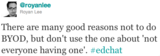
While participating in an interesting discussion on BYOD (Bring Your Own Device: students bringing their own personal technology into school for learning) in tonight’s #edchat, I tweeted this:
Was I trying to ignore socio-economic disparities in society? No.
I would, however, like for someone to show me the graph with a straight line correlating income and technology ownership. I would also like to see us simultaneously examine the overflowing examples of similar ‘inequities’ that we tolerate in our systems simply because those processes have been normalized in the hegemony of schooling.
Here are some of the real reasons you shouldn’t do BYOD:
Social media does not have a place in your school.
You have not set up a tool (such as Google Apps for Ed., Ning, Edmodo, etc.) to compliment multi-platform use.
Your staff does not understand why or how someone might use personal technology for learning, collaboration, creativity, communication, organization, and productivity.
Your curriculum focusses heavily on knowledge transmission.
Your assessment and evaluation theory and practice are from a bygone era.
You are test-driven, in a traditional, standardized sense.
You have rigid and punitive technology policies.
You don’t have ubiquitous wifi.
Your leaders don’t get it.
You do not have enough school devices to supplement students who do not own their own.
You don’t actively promote all stakeholders as being co-learners.
What are your thoughts on this?
Royan Lee
.
Blog
.
<span class='date ' tip=''><i class='icon-time'></i> Aug 23, 2015 05:44pm</span>
|
|
CC licensed photo shared by Flickr user Digitalnative
"What do I do now?"
"Just press stuff and see what happens."
When I am working with adults, teens, or young children that call themselves novices at technology use, the biggest commonality I observe is their fear of making mistakes. I know what this is like because I feel the same way when someone pops the hood of a car, asks me to look at my interest rate, or when I need to iron a shirt.
One thing I always say is, "Just press stuff and see what happens." For, unlike my stunningly complex minivan, mortgage, or favourite 100% cotton Italian shirt, it is nearly impossible to do much damage just by pressing buttons.
It’s when everyone starts pressing buttons and talking to each other about it that we are then able to stop talking about the tech we’re using and start talking about the learning we’re doing with it.
Royan Lee
.
Blog
.
<span class='date ' tip=''><i class='icon-time'></i> Aug 23, 2015 05:43pm</span>
|
|
It’s been great for me to reflect on one of my latest blog posts. In particular, the feedback and comments I’ve received in regards to it. In the post, I argue that BYOD (students being able to Bring Your Own Device to school for learning) is not for everyone and that certain conditions or foundational pieces should be put into place before even considering it.
I also clearly state my misgivings with the notion that BYOD is a socio-economic issue. As someone who grew up in a low-income, immigrant family myself, and as person who travels in social circles where I regularly encounter social welfare and marginalization, I question the claim that technology (especially of the mobile variety) is an exclusivity reserved for the middle class and up (whether they have dental care, job stability, life insurance, savings for retirement etc. is another question altogether). As @mbteach says in her recent article "A New Understanding of the Digital Divide":
As studies suggest, the problem isn’t access, it’s the kind of access [her italics].
In a near-decade of teaching, I’ve been at the front of the class with a wide spectrum of socio-economic groups. Currently I teach in an upwardly mobile, middle-class demographic. In our large school, I have yet to encounter a family without computers and mobile technology at home, yet only about 20% of the 250 students I have taught in the past three years of inviting BYOD actually accept the proposition.
Also, I feel that some of my critics have actively avoided reading my post, because I clearly state that you should not invite BYOD if:
You do not have enough school devices to supplement students who do not own their own.
Should the income level of your school community not be an issue when contemplating BYOD? Of course not. Should it be the variable that determines a yes or a no response to BYOD? I don’t think so.
The comments on the post really got me thinking hard, perhaps more so than any post I’d written before. I had to delete a few trolls because they were starting to attack me personally and were doing so anonymously. One of them suggested I was undemocratic and was not interested in engaging in dialogue. If this were true, I’m not quite sure why I would a) be blogging publicly and openly about it; b) inviting unmoderated comments on the post; or c) ending my post by asking people what they thought about my opinions.
I have no problem admitting that there was a certain tone to my post. I know I could have called it ’10 Things Schools Should Consider Before Doing BYOD’ or something like that, but I was intentionally trying to be a bit more provocative. I feel comfortable enough as a blogger now (and feel I have gained the trust of my readership enough) to do this. I will also admit that it comes from a personal place of exasperation for me. As a proud leader of literacy and technology in my district, people often ask me implicitly for quick fixes or templates that can be applied in their schools or classrooms. There is no quick fix. I have no magic bullet. I can tell you of my experience, give you feedback on yours, and support you along the way. And then everything I said I was doing yesterday could be different tomorrow.
I wish we could all get more comfortable with the idea that something can work with huge success in one place and be a monumental failure in another. Or that something which works a certain way in this location needs to be modified slightly or heavily in that one. We talk a good game when it comes to appreciating context, but we still run like wolves to One Size Fits All. BYOD works in my class. It doesn’t work in another classroom down the hall. And it might not work next year for me either, or in another school I may teach in down the line.
I was in a great webinar session recently with some stupendous minds led by @willrich45 and @snbeach. We were tossing around our thoughts on the meaning of ’21st Century Learning’. Sure, maybe we are reifying or overly aggrandizing the concept a bit, but it’s still worth contemplating and engaging in dialogue about. I wish I’d remembered to say one thing.
Perhaps I am grossly wrong about this, but I feel that our current time in education is one that demands more of an appreciation of paradox and contextual difference than ever. We may live in a globalized, even standardized, world, but customization is simultaneously the rule of the day, as is the skill of navigating a multitude of contexts on an almost a daily basis. Cognitive dissonance rears its beautiful/ugly head every day in our time.
Developing common language and nonnegotiables are often a great tool for local collaboration and leadership, but it can be very problematic, or even destructive, when used in a more global sense.
I’m really hoping we can get to the stage where we can read a blogpost, listen to a keynote, or attend a workshop where someone tells the story of success, and not feel that the person is simultaneously calling for a new template to be applied as an all-encompassing panacea.
As some of my favourite hip-hop MCs would say, can you feel me?
Royan Lee
.
Blog
.
<span class='date ' tip=''><i class='icon-time'></i> Aug 23, 2015 05:43pm</span>
|
|
CC licensed photo shared by svintus2010
I can’t imagine being an educator without blogging. It’s taken my ability to reflect, collaborate, and lead to another level. If you’re someone who struggles with the process, or is thinking of starting a professional reflective blog, here’s something I do that may or may not help you.
I try my best to go from birth of idea to published in as little time as possible. My ideal is 12 hours max. The longer the timespan is from spark to online, the more likely it is I will:
lose the reflective moment;
forget why the idea/message was important to me;
focus more on reader perception than personal reflection;
over-think it;
become paralyzed by analysis.
A blog is not the same thing as a peer-reviewed journal. It does not need to be vetted a million times. Sure, you don’t want to post in a flippant or overly impulsive manner, but it’s still important to remember that you should…
Just post it.
Time of idea: 10pm-ish, October 31 2011
Time of post: 9:16am, November 1, 2011 (on my prep at school)
Time of writing: 15 minutes.
Royan Lee
.
Blog
.
<span class='date ' tip=''><i class='icon-time'></i> Aug 23, 2015 05:43pm</span>
|
|
Are we proud? Amazed? Blown away? All of the above.
Click here or here to find the book online for purchase.
Click here to read me and my students’ chapter (with permission from David Booth himself).
Royan Lee
.
Blog
.
<span class='date ' tip=''><i class='icon-time'></i> Aug 23, 2015 05:43pm</span>
|
|
There are few people I admire or look upon as a co-learners more than @gcouros and @neilstephenson. These two exceptional leaders are spearheading a very special event.
In May 2012, a new annual Canadian educational conference is starting and the Calgary Science School has been asked to be the first host! This exciting event will be taking place at the school May 25-27, 2012.
ConnectED Canada will be a yearly educational event that brings together teachers, administrators, students, parents and other stakeholders with the purpose of sharing innovative practices and building a national collaborative network.
Rather than traditional conferences which are usual held at hotels of off-site conference centres, ConnectED Canada will be held in different schools across the country each year . The purpose of hosting the event in a school is to allow participants to experience living examples of innovative practices and classrooms. Hosting it in a school also allows for a student voice to be included - a key element of ConnectED Canada.
Additionally, as opposed to more presentation-driven professional conferences, ConnectED Canada will be built around conversations and discussions. The event will provide time and space for educators, students and parents to discuss various topics, share current practices and ideas and built relationships that will extend beyond the three days.
Are you interested in hosting a discussion?
Right now they are collecting proposal for conversation topics that attendees would like to facilitate. If you are interested in facilitating a discussion, please complete this form.
ConnectED Canada will be accepting proposals until December 8th, 2011. Those who submit proposals will be notified by December 22nd.
General registration for the event will begin on December 22nd. Due to the limited size of our school, we are capping the event at 300 participants.
For more information contact George Couros or Neil Stephenson.
And be sure to spread the word!
See you in May (hopefully I will find some way of getting there myself)!
Royan Lee
.
Blog
.
<span class='date ' tip=''><i class='icon-time'></i> Aug 23, 2015 05:42pm</span>
|
|
It’s been so much fun to be part of this little meme started by @shareski. We’re all sharing what we’ve started using this amazing new tool ifttt for. I’m in the early stages of playing with it. Currently, I’m using it to basically send everything to my social bookmarking tool of choice, Diigo. I’ve always wanted every link I ever post/favourite/bookmark/star to be archived, shared, and easily searchable in one place. Hallelujah.
There are two ‘tasks’ or ‘recipes’ (as ifttt so ingeniously calls them) I’m dying for. One is for my pics that I tweet to end up on my Flickr stream. The other is for a way to cross post on Twitter and Google+.
Here are the tweeps riding the meme at the moment:
Will Richardson
Danika Barker
Doug Peterson
Royan Lee
Jim Pedrech
Brian Ball
Join our ifttt meme!
Royan Lee
.
Blog
.
<span class='date ' tip=''><i class='icon-time'></i> Aug 23, 2015 05:42pm</span>
|
|
One of my favourite blogs in the world is @shareski‘s Ideas and Thoughts. Above all else, the thing I love most about it is Dean’s ability to be so honest, transparent, and vulnerable in his reflections. He doesn’t wait until he feels he is ‘right’ or ‘expert’ about a topic. Rather, he often throws ideas out for contemplation and discussion in a way that always probes and inspires me.
In one of his most provocative posts (I urge you to take a break from this post and read his here), Dean ruminates on whether or not we really need to vet every paradigm shift we seek in education with each and every stakeholder. Wondering whether people even know what they don’t know, he reminds us that innovators such as Apple don’t ask their customers what new device should be invented, and that constantly involving laypersons in decision-making is a comment on how educators are often not regarded with the same professionalism afforded other vocations.
Below is my cross-posted comment on his post:
I agree that it is problematic (and in some cases, even a cop-out) to group-think every decision that could be made with all stakeholders. This is a case where the wisdom of the crowd usually leads to the inertia of the crowd, or, worse yet, an amplification of unreasonable but loud voices. Educators are professionals. Democracy is not about ‘voting’ on everything. What’s next, permission forms for pedagogy?
I would say, however, that it is absolutely vital that parents and the community are actively brought along the ride of change and process of learning. Just yesterday I had a meeting with a parent who expressed reservations with what I see as an innovative and transformative approach to learning in my class. I invited them in for a classroom observation and had a long talk with them about their child, learning, and the ‘whys’ of what is happening in our room (and beyond).
I have had to do this sort of thing quite a few times in my relatively young career.
There have been moments where I felt resentful, thinking to myself, "Here I am, trying so hard to make change and make as dynamic a learning environment as possible for my students, and I’m having to continually justify my position to all manner of stakeholder, while some others rarely have to do so. Maybe I should just swim downstream like some others. Maybe it’s not worth it. I’m the expert here. I’m not being subversive; I’m just trying to do everything you’re supposed to in its fullest extent. Why can’t I just say, ‘tough, live with it, I know what I’m doing’?"
The problem is that every time I’ve felt that way, it has been an emotional reaction, not necessarily a productive one. It’s so vital that we assert our professionalism and autonomy in everything we do, but I do think the work we do is different than technological/scientific innovation or, the common comparison, medicine. Our students’ parents really are the experts of their own kids.
Those parents I speak of left my class expressing gratitude and trust for my role in their child’s life. They just needed to fill in some gaps of understanding. The more I see this happen, the more I’m thinking they are, in fact, the key, and that it is a small flapping of a butterfly’s wings which leads to bigger things.
And, to top it all off, I received this amazing email on the same day from a parent who also expressed trepidation about my program at the beginning of the year:
Dear Mr. Lee,
As my technology education journey improves, I feel I am no longer a techi immigrant. I owe that to my daily check-ins to [your] Website. I learn so much from [you] just by looking it over. I am so impressed with the upcoming video project. What a way to incorporate procedural writing into the students real world. As a parent, words cannot express my gratitude to what this school and staff are teaching me and [my daughter]. Keep up the superb work.
It was one of the greatest days of my teaching life yesterday.
I don’t know if it’s so much that we need to give parents, students, or other community members the proverbial 50% of the business. It’s more that they have to be part of the learning, and be nurtured to become the biggest advocates of whatever change we are seeking, not because they read it in a book or watched it on the news, but because they literally see the effect it is having on the thing they love more than anything else in the whole world - their children.
Thanks, Dean, for always pushing my thinking in new directions. I’m humbled and honoured to be a co-learner with ya.
Royan Lee
.
Blog
.
<span class='date ' tip=''><i class='icon-time'></i> Aug 23, 2015 05:42pm</span>
|