Blogs
|
Back in 2007, I got curious about SCORM 2004 adoption and pulled some metrics about how people were using SCORM. Well, I got curious again, but this time I took it to the next level. We’ve just published a feed of SCORM Stats that will be updated nightly. For SCORM geeks like us, these stats present a useful snapshot into how the real work is using SCORM. Go ahead and bookmark it and come back every now and then to see how things evolve.
Let’s take a look at SCORM then and now.
SCORM Versions
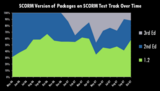
SCORM Versions Then
SCORM Versions Now
Then: SCORM 2004 made up about 50% of the content that was being uploaded into Test Track.
Now: SCORM 2004 makes up about 30-35% of the content uploaded into SCORM Cloud.
Conclusion: SCORM 2004 remains relevant for a significant population, but it’s adoption and usage has not increased over the years. Adoption appears to be flat. The decrease since 2007 is probably related to the more mainstream adoption of SCORM Cloud vs the early adopters using SCORM Test Track in 2007.
SCORM Versions By User
SCORM Versions By User Then
SCORM Versions By User Now
Then: About 40% of users were uploading SCORM 2004 content.
Now: About 40% of users are uploading SCORM 2004 content.
Conclusion: SCORM 2004 adoption remains flat.
Users
SCORM Test Track Users Then
SCORM Cloud Users Now
Then: About 3000 people cared enough about SCORM to try out our little application.
Now: 21,000 people have given SCORM Cloud a whirl.
Conclusion: Our little SCORM Test Track experiment was a hit. That’s nice for us, but for the broader SCORM community it show just how widespread SCORM’s adoption is. Twenty-one THOUSAND people are deep enough into SCORM to use an application like SCORM Cloud, with 500 more signing up every month. SCORM’s adoption is broader than I think anybody realizes. It is the industry workhorse.
Some other stats in that vein:
About 20,000 unique visitors visit scorm.com every month…that’s 20,000 more people every month who are interested in SCORM enough to go read about it.
About 12,000 courses are imported into SCORM Cloud every month. Twelve thousand courses, that is a lot of SCORM content being tested!
Realizing the -ilities (multiple SCOs)?
Then: Use of Multi-SCO content
Now: The use of multi-SCO content
Now: Number of SCOs in Courses
Then: About 35% of SCORM 2004 content took advantage of multiple-SCO functionality.
Now: The percentage of content using more than one SCO has increased dramatically with each new edition of SCORM 2004.
Conclusion: The improvements in each SCORM 2004 Edition have been useful in making sequencing easier to use and more effective. Or, conversely, the people who use sequencing most heavily tend to gravitate to the latest edition with the most robust functionality.
Realizing the -ilities (use of sequencing)?
Then: Use of Sequencing
Now: Use of Sequencing
Conclusion: The use of sequencing remains similar, but it increases with the later SCORM 2004 Editions….consistent with the conclusions above.
Rustici Software
.
Blog
.
<span class='date ' tip=''><i class='icon-time'></i> Aug 26, 2015 07:39am</span>
|
|
We write about working here more often than we ever post that we’re hiring. Small company, only so many slots to fill, yada, yada, yada. Seriously, when you have a great place to work, who wants to leave?
So now’s your chance. We’re hiring. Developer types. All sizes. Bonus points if you can beat Tim at ping pong.
Why you want to work here. (Well most of why. It doesn’t mention the cookies.)
How to make it happen
Some background on how we look at hiring.
Rustici Software
.
Blog
.
<span class='date ' tip=''><i class='icon-time'></i> Aug 26, 2015 07:39am</span>
|
|
The Challenge
LINGOs is a consortium of over 60 international humanitarian relief, development, conservation and health organizations. They provide the latest learning technologies and courses from industry leading partners so their non-profit members can increase the skill levels of their employees, thereby increasing the impact of their programs.
While LINGOs provides a robust, hosted platform to administer the courseware, some members have additional needs that require using other LMS solutions. For those organizations, LINGOs needed a way to deliver their course library to the member’s external LMS, while still controlling access to the content.
Enter SCORM Cloud with Dispatch
LINGOs partnered with Rustici Software to manage the delivery of the content. By using the Dispatch feature within SCORM Cloud, LINGOs member organizations can access the LINGOs course library within their own SCORM-compliant LMS while LINGOs continues to retain control of distribution and access to the content.
"Rustici Software has been tremendously supportive of LINGOs and SCORM Dispatch has been an invaluable tool for us. It has enabled us to maintain control of the intellectual property that has been generously made available by our corporate partners, while allowing our members to make independent decisions regarding the LMS that best suits their needs. SCORM Dispatch allows us to accommodate those decisions without costly and time-intensive custom interfaces." — Eric Berg, Executive Director, LINGOs
Get the full story on LINGOs and see how their members are using SCORM Dispatch to enhance their learning initiatives.
Click here to see how SCORM Cloud and Dispatch can help you manage your content distribution.
Rustici Software
.
Blog
.
<span class='date ' tip=''><i class='icon-time'></i> Aug 26, 2015 07:38am</span>
|
|
Saw this great info-graphic today from Knewton. There are plenty of reasons to be discouraged by the state of e-learning today, but when you take a look at the bigger picture there are plenty of reasons for exuberant optimism as well.
Want to be part of this growing industry? We’re at the center of it and we’re hiring, come join us.
Created by Knewton and Column Five Media
Rustici Software
.
Blog
.
<span class='date ' tip=''><i class='icon-time'></i> Aug 26, 2015 07:38am</span>
|
|
Moodle has long been a stalwart open source LMS. In fact, they just celebrated their 9th birthday. In that time their platform has matured and progressed from version 1.0 to the most recent release which now starts with a ‘2’.
When we launched SCORM Cloud, we pre-built a few integrations we thought made sense, including a Moodle mod. Well that was back in the early days of 1.9. For those running 1.9, the SCORM Cloud mod allows you to play SCORM 2004 content on your Moodle site.
In v2.0 Moodle revised their plugin architecture. Until now, there wasn’t a mod for the 2.0 platform that could support SCORM 2004.
You asked (and asked again), and we listened. The updated SCORM Cloud mod for Moodle 2.x is ready and now available. Follow the steps listed here to get started.
Can’t stand the wait next time? The SCORM Cloud integrations we’ve created are all open source and freely available on Github.
Rustici Software
.
Blog
.
<span class='date ' tip=''><i class='icon-time'></i> Aug 26, 2015 07:38am</span>
|
|
On Wednesday, we learned of a security vulnerability in the SCORM Cloud WordPress Plugin we developed. WordPress has a code auditor that picked it up and flagged the plugin. Thanks to their quick notification, we were able to fix the vulnerability and have published an updated plugin. If you are using the WordPress SCORM Cloud plugin, we recommend that you get the latest version (1.0.7) ASAP.
If you ever notice a security problem in any of our software, please let us know so we can get it patched up. Also, all of the SCORM Cloud Apps we’ve developed are open source and publicly available on Github for you to enhance…don’t feel like you need to wait for us if there is something you need.
Details of the vulnerability.
Rustici Software
.
Blog
.
<span class='date ' tip=''><i class='icon-time'></i> Aug 26, 2015 07:38am</span>
|
|
SCORM is over 10 years old. A while ago, ADL (the keepers of SCORM) asked us to research what the next-generation e-learning specification could/should look like.
We’ve been gathering information from the entire e-learning community about what you’d like to see in the next specification. Many of you already know about this, and many of you have participated.
We have our solution — it’s the Tin Can API.
The Tin Can API solves a lot of problems that older specifications suffered from, but it also adds new capabilities, new business cases, and new ways of handling content. The Tin Can API fuses a decade of collective e-learning experiences with a decade of technological advances.
We’ve created a place for you to go and tell us what we got right and what we missed. Click on the video below to learn more about the Tin Can API.
See how the Tin Can API works and what it can do.
Rustici Software
.
Blog
.
<span class='date ' tip=''><i class='icon-time'></i> Aug 26, 2015 07:38am</span>
|
|
We put a lot of effort into making scorm.com a useful and informative site. We want to be THE place that people go to for help with SCORM, be they paying customers or not.
Last month, we published some stats from SCORM Cloud showing the thousands of people who use it to test SCORM content every day.
Today we noticed a metric that’s even more fun…since we started tracking visits in Google Analytics, scorm.com has served over 1 Million visitors!
Thanks to everybody for stopping by!
Rustici Software
.
Blog
.
<span class='date ' tip=''><i class='icon-time'></i> Aug 26, 2015 07:37am</span>
|
|
We get asked all the time, "What is an LMS?" So, here’s a challenge… express it as simply, as elementally as you can. Here’s my effort:
A tool that authenticates students, connects them to a topic, as well as each other, and provides the tools to efficiently deliver, track and assess the learning process.
- (Think you can do it better using only 140 characters? Step up and leave a comment…)
We’ve been pondering different applications and how they apply to that definition. And I can’t stop coming back to Facebook as a great candidate for an LMS of the future.
A tool that authenticates students…
…connects them to a topic…
…as well as each other…
This is where SCORM Cloud comes in. Courses could be hosted on SCORM Cloud and delivered via Facebook.
…and provides the tools to efficiently deliver, track and assess the learning process.
Assessments and tracking could also be integrated:
Thinking about what could be is something we do a lot… Lately several of us have often discussed what SCORM Cloud + Facebook could be. I thought it’d be a good idea to expand the discussion and bring our followers into the mix.
Apps in Facebook are nothing new, and they’re the future of the platform:
The next five years will be defined by apps and the depth of social engagement.
-Mark Zuckerberg at F8 2011
The social learning platform has created thousands of successful virtual farms and Vills. While many of the popular apps currently on Facebook are games, the Facebook population seems to be underutilized for eLearning. Students and Facebook have a healthy relationship — the site’s popularity was born from college students. I’m willing to make the argument that the blend of eLearning and the Facebook environment would be a useful marriage.
Facebook advantages:
800+ million users (and growing)
Easy to manage people and groups
Users are loyal, familiar and comfortable with Facebook
Streamlined registration and management process
Frequent log-ins, easily accessible across platforms and devices
Every month, more than 500 million people use an app on Facebook or experience Facebook Platform on other websites
More than 7 million apps and websites are integrated with Facebook
By using Facebook to facilitate learning with students and instructors, developers could create a fast and intuitive way to group students and deploy courses. Learning within Facebook provides a platform students are comfortable and familiar with. Relationships formed via a Facebook-based experience could continue past the life of the course, creating a more genuine social experience than traditional eLearning has been able to give. The possibilities of a Learning App within Facebook are exciting to imagine and one I think could become the next big movement of eLearning.
Arguably, this rush to manage learners within Facebook will start soon, and I’m excited to see it begin. We’ve built our SCORM Cloud to be flexible and adaptable with this scenario in mind. We’ve seen several integrations of our SCORM Cloud. So far it has been blended into Moodle, Sakai, Dokeos, Ilias, WordPress and Google Apps. Instead of reinventing the learning platform, just plug our SCORM Cloud into Facebook and move on.
Facebook is the next step, and one we’re excited to see someone take. Our SCORM Cloud can relieve the pain of hosting content, managing courses, tracking assessments and reporting grades. Facebook will manage students — all a developer needs to do is plug the two together. We’re open to ideas on how we can make this process easier.
Group discussions, wall posts, notifications, real-time chat with classmates, leader boards… the Facebook platform offers plenty of elements that can be combined to create something cool. What could be within this solution keeps my mind racing. I hope that some momentum for this develops soon.
So the logical question is, "If an e-learning Facebook app is such a great idea, why not do it yourself?" We have built the toolkit that can make this app possible… we’ve got a lot of development projects in cue. We’ve made it obvious we’re hiring, great ideas like SCORM Cloud + Facebook are why. If this sounds cool and you’d like to jump in and create a Facebook integration, go for it. Where it goes from here is up to you. Are you willing to take the leap and become the first to navigate these waters?
We know this process takes time and effort. We’re willing to lend a hand, let’s discuss what that could look like by dropping a comment. If you’re interested in working with us to make this happen, email me — chris.tompkins@scorm.com.
Some images from: benstein & FindYourSearch
Rustici Software
.
Blog
.
<span class='date ' tip=''><i class='icon-time'></i> Aug 26, 2015 07:37am</span>
|
|
There’s a new TV show "Around the World in 80 Ways" that challenges 2 guys to use 80 different modes of transportation to circumnavigate the globe. We’re not trying to do that, but we do want to see our SCORM solutions adopted around the world and eliminate the hurdles that come with internationalization.
Shortly after we launched SCORM Cloud, we began to get questions from our friends in Europe about whether we were Safe Harbor compliant. As the requests grew, it prompted us to do 2 things- find out what the heck the European Commission’s Directive on Data Protection is and why we need to be safe from it, and to take a closer look at where our customers are located. Here’s what we found:
In a nutshell, Safe Harbor certification ensures that U.S. companies comply with the EU directives on the protection of personal data. We take data security and privacy very seriously- regardless of where our users are, so going through the certification process was a no-brainer. And as of last week we are officially certified as Safe Harbor compliant. For more details, check out our privacy policy and Safe Harbor compliance.
Looking at where our customers are and the ways we support them uncovered some interesting stats. We were surprised to have so many friends around the world- 82 countries represented. Below is a breakdown of where most of our SCORM Cloud users live.
Supporting a global customer base can be challenging- especially when you consider language complexities. We recently updated our website to support 17 translations, and our SCORM Engine now supports over 16 languages. Chinese? Yep- 2 versions.
So, the world of SCORM continues to grow and the complexities on delivering our services grow too. We’re up for the challenge and invite you to join us in our travels.
Rustici Software
.
Blog
.
<span class='date ' tip=''><i class='icon-time'></i> Aug 26, 2015 07:37am</span>
|