Blogs
|
by Shelly Blake-PlockToday at beginning of class...Student 1: "Where can I find a picture of the baseball field?"Student 2: "Google."Student 3: "Look: here it is on a Google Map."Student 2: "What did people do before Google?"Student 3: "Yahoo."Student 4 (completely with not a trace of irony or sarcasm): "What's Yahoo?"
Shelly Blake-Plock
.
Blog
.
<span class='date ' tip=''><i class='icon-time'></i> Aug 26, 2015 12:31pm</span>
|
|
by Shelly Blake-PlockOur AP Euro class is currently discussing the French Revolution. And, of course, a topic of interest has been similarities and dis-similarities to what has been happening in Egypt since Jan 25.Below is a brief outline of what we're doing in class today. We would love readers to leave comments and questions for us to think about and discuss. We'd also love to talk to people on the ground in Egypt about what they are experiencing right now. Please get in touch @TeachPaperless on Twitter.***We are going to be looking for similarities and dis-similarities between the French Revolution and the current revolution in Egypt.French Revolution // Egyptian RevolutionEssentials:1. Compare / Contrast Louis XVI and Mubarak.2. In each case, WHY were the people protesting? (Cite primary sources).3. What role did women play?4. What concerns are their about the current situation in Egypt? How might they relate to the days following the fall of Louis XVI?5. How did/are people express(ing) their views?6. Are the current protests violent?7. What do people on the ground in Cairo think is going to happen now? (Directly contact reporters and bloggers in Egypt via Twitter during this class period).8. Based on your study of the French Revolution and your current observations of the situation in Egypt, what do you think are possible outcomes? How are the possible outcomes in Egypt alike or different with outcomes in France -- both in the short and long term.Sources:Sources on French Revolutionhttp://www.fordham.edu/halsall/mod/modsbook13.htmlSources on EgyptAl Jazeerahttp://english.aljazeera.net/http://blogs.aljazeera.net/middle-east/2011/02/10/live-blog-feb-11-egypt-protestsNew York Timeshttp://www.nytimes.com/http://thelede.blogs.nytimes.com/2011/02/11/latest-updates-on-day-18-of-egypt-protests/?hpNPRhttp://www.npr.org/?refresh=truehttp://www.npr.org/blogs/thetwo-way/2011/02/11/133675132/live-blog-latest-on-events-in-egyptCNNhttp://www.cnn.com/?refresh=1NBChttp://www.msnbc.msn.com/http://worldblog.msnbc.msn.com/egyptTwitter Searchhttp://search.twitter.com/search?had_popular=true&q=%23Egypt&result_type=recent
Shelly Blake-Plock
.
Blog
.
<span class='date ' tip=''><i class='icon-time'></i> Aug 26, 2015 12:29pm</span>
|
|
by Mike KaecheleIn the U.S. (everywhere?) tomorrow is commonly celebrated as Valentines Day. Not sure how an honoring of saints who were martyred got transformed into a holiday celebrating love but I'm sure that Hershey's, Hallmark, and florists were involved. Like all most holidays the emphasis is on buying something and food/candy. I am sure some economist can tell us how much Valentines Day means to the economy.Tonight I came across another "holiday" happening tomorrow: Generosity Day. The idea comes from Sasha Dichter who is Director of Business Development at Acumen Fund, a global non-profit venture fund that invests in enterprises that fight poverty in the developing world. He spent a month being generous and saying "yes" to everyone who asked of him-beggars, email, or friends raising money. The point was made in the comments that when we are logical and try to analyze the validity or worthiness of our donation that we loose the emotional part of our brain. So Sasha and some other bloggers are proclaiming tomorrow Generosity Day and challenging us all to say "yes" to everyone for one day no matter what. You can participate and spread the word via blogs or Twitter with the hashtag #generositydayI'm in. So do you want to join? We know Valentines Day will be trending tomorrow. Let's see if we can make this trend too and be generous for one day. Who knows maybe we won't want to stop.I'm going to share this with my students tomorrow. I will invite them to participate too. How about your students?
Shelly Blake-Plock
.
Blog
.
<span class='date ' tip=''><i class='icon-time'></i> Aug 26, 2015 12:29pm</span>
|
|
by David Andradehttp://educationaltechnologyguy.blogspot.com/ "Beyond Textbooks" is a well used mantra by educational technology companies and districts who are moving away from traditional print textbooks to digital media and resources.I don't use a textbook with my Physics classes for many reasons: the textbooks are old and outdated (but in good physical condition), the textbooks are hard to read, they are heavy, and they don't have any way to get help or expand on the material.I use a variety of materials with my Physics classes in place of the textbooks. I use Blogger and Google Sites to create a class blog and class website. The blog is where I post assignments, information, reminders, and more and the site has links, downloads, and other information. For class materials that replace a textbook, I use:Handouts with summary of concept, example problems, and problem sets for students to complete. These go into their notebooks for them to keep.They are also available on the class website in case anyone forgets or loses theirs. Physics Classroom - this is an excellent resource for physics students. It has topic explanations, demonstrations and animations, multimedia movies, example problems and more. Online resources from different publishers. Many textbook publishers allow free access to their online materials. My students use the Glencoe Physics site to do practice tests. The site automatically grades them and sends me the student's score. There are also other textbook sites that have resources and links. PhET Physics Simulations - this site is hosted by the University of Colorado at Boulder. The site has animations and virtual labs for physics, chemistry, earth science, biology, and math. There are even lesson plans and assignments with most of the simulations, created by teachers. Online and downloadable, free Physics "textbooks" - I give my students links to three free physics "textbooks" - The Physics Study Guide, Motion Mountain Free Downloadable Physics Textbook, and FHSST Physics online physics textbook. These are free, accessible from anywhere, and are well written with examples, links, and good explanations of concepts. Physics Central - great site with lesson resources, physics in action, physics in everyday life, and much more. Discovery Education - I use a variety of Discovery Education resources with my physics classes. Some of the videos on DE Streaming are excellent. They are not long (average 25 min) and explain concepts very well. I also use some other DE resources as projects and research with my students. Discovery Education News, Science of Everyday Life, and Science Fair Central are some of the ones I use. Multimedia Science School - this is software our district purchased a few years ago that has multimedia lesson in Biology, Chemistry and Physics. The guided lessons include videos, animations, virtual labs and more and are a great resource for science teachers. For my AP Physics class, I also use Learn AP Physics which has videos, lectures, example problems, study tips, and problem solving tips. Projects and Labs - I do a lot of projects and labs with my students. The resources listed above, along with Google, give them access to information and assistance on topics. They also interact with me via email and the class blog. The projects and labs we do are where they get to apply their conceptual knowledge and learn even more about a topic. I have no need for a physics textbook because of all of these resources. I must also point out that I have 7 student computers in my room, so I don't need to worry about scheduling in the computer lab or signing out the laptop cart. My students work on the projects and labs in groups and except for the Multimedia Science School software, have access to all of these resources at home. I've even had students access some of the resources on their smartphones while working on a project or lab, which I think it awesome.These resources are free (except for MSS and DE Streaming), accessible from anywhere, constantly updated, interactive, multimedia, and explain the concepts very well. Why do I need 150 copies of a textbook, at $100 each, that will be outdated before they get to me, can get damaged or lost, can't update, and have no links or activities?These kinds of resources exist for all subjects and grade levels, not just high school science. There are a million different resources to use in your classroom besides a textbook. What resources do you use in place of, or in addition to, textbooks?Cross posted at Educational Technology Guy and via Twitter. David Andrade is a Physics Teacher and Educational Technology Specialist in Connecticut. He is the author of the Educational Technology Guy blog, where he reviews free educational technology resources for teachers, discusses ways to use technology to improve teaching and learning, and discusses other issues in education. He is also a professional development trainer and presenter at conferences, helping educators learn new and innovative ways to educate students. He is also a Discovery Education STAR Educator and member of the CT DEN Leadership Council.Disclaimer: The information shared here is strictly that of the author and does not reflect the opinions or endorsement of his employer.
Shelly Blake-Plock
.
Blog
.
<span class='date ' tip=''><i class='icon-time'></i> Aug 26, 2015 12:29pm</span>
|
|
by Steven W. AndersonIt has been an interesting past few weeks around the world. First the govenerment in Tunisia was brought down. Then a similar situation in Egypt. And now people are taking to the streets in Bahrain, Iran and other places. For whatever the reason the people in these countries were upset with their government and protest to the point where they brought down governments, some that had been in place for 30+ years.Now, I am not a political expert. I don't know each situation and why the people where unhappy. I have some knowledge but I don't want to speculate. But I do know that there is one common thread in each of these situations that is worth taking a look at.Social MediaOn Sunday 60 Minutes profiled the man credited with starting the revolution in Egypt. Wael Ghorim works for Google and started a Facebook page for Egyptians to post their experiences with police. And it is from that Facebook page and from Twitter posts organize protests that topiled a government. It was a great interview and you can watch it below.The events in Tunisia, Iran, Bahrain, and other places and trace their beginnings to the use of social media by the residents in those countries. Facebook, Twitter and other social networking sites allowed residents to organize in non-traditional ways to get their message out. Many of the governments don't know how to handle these new voices, so they knee-jerk react, send out the military to quiet the crowds. But they just get louder and louder and larger and larger. And in the case of Egypt and Iran, they attempted to keep control by shutting down Internet traffic for several days.Any of this sound familiar?Leadership is afraid of a new medium and how powerful it is. So they put up blocks, downplay it's effectiveness, and bury their heads in the proverbial sand.When is our revolution in education when it comes to Social Media and the use of these tools in the classroom? Think about how powerful it could be if students in a high school social studies class in Nebraska could look at the Facebook page started by Wael. But, they can't because the district feels Facebook is a time suck, provides no educational value and they block it.Or what about being able to look at the Tweets organizing the protests and have a discussion about why the people in these places feel the way they do and how their situations compare to those locally and nationally.Those of us who know the power of Social Media and the value it can provide to learning are, sometimes, seen in the same way as many of the organizers of these revolutions. We are disruptive. We want to destroy the current system. Really? We just want change. We understand how these tools can be used to enhance, change and ultimately make learning better for students.Maybe it is wrong of me to compare these events in these countries where many of the citizens have been mistreated for many, many years. But again, isn't the same true for our kids? Sitting in rows, drill and kill, teaching in isolation. Maybe that is mistreatment....What do you think? When is our education revolution? Are their parallels? Or are the situations different? Leave some comments below.
Shelly Blake-Plock
.
Blog
.
<span class='date ' tip=''><i class='icon-time'></i> Aug 26, 2015 12:29pm</span>
|
|
Reader Bellafiore comments:The revolution has begun in Wisconsin. Teachers are fighting back at the cutbacks and political situation right now. See this article for details on what is happening right now.http://www.nytimes.com/2011/02/18/us/18wisconsin.html?_r=1&hp Facebook and Twitter have been instrumental in getting the word out to educators to fight for our rights. The teachers union has organized polls and communications on Facebook which have allowed not just teachers but all citizen of WI to weigh in. This is an instance where the social media has helped mobilize a movement against the governor and for teacher rights. One of my favorite signs in Madison, WI rally was one that said: Welcome to Cairo!
Shelly Blake-Plock
.
Blog
.
<span class='date ' tip=''><i class='icon-time'></i> Aug 26, 2015 12:28pm</span>
|
|
By Steve KatzThe other place I blog.My students have digital textbooks for several of their classes, including my social studies class. These texts are basically pdf files of the book, with a much more confusing navigation. I'm not a big fan of textbooks, and we rarely use them in class. I prefer to have my students doing their own research, or creating a product, rather than reading a textbook.Today I asked them what they think a digital text should include. These were some of their ideas:VideoLinks to sources (My students want the author's sources so they can check the reliability of the textbook, or do further investigation.)Activities they can downloadIntuitive navigation (like a web page)Loads quicklyCustomizable fontsAdjustable page size ColorfulSearchableLinks to sites of experts on the topicQuestion and answer section where they can post and respondLive chat with other students and recognized expertsRollover of terms to see the definitionLinked table of contentsPrintable pagesVoice controls (They are 7th graders.)These ideas would make the text more of an interactive web site than a text book.Note to publishers: That is a good thing.
Shelly Blake-Plock
.
Blog
.
<span class='date ' tip=''><i class='icon-time'></i> Aug 26, 2015 12:28pm</span>
|
|
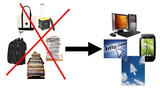
By David Andradehttp://educationaltechnologyguy.blogspot.com/It always amazes me at the amount of stuff some teachers seem to carry home every night and back into school the next day. They also are amazed at the fact that 95% of the time, I'm not carrying anything either way (except maybe my lunch). Two teachers asked me about this the other day and were shocked at why I don't have to carry things home to work on. I decided I'd also share that explanation here.Most of what teachers are carrying with them is their grade book, lesson plan book, student work to grade, lesson resources, textbooks, and the like. I've been able to escape all of that because of my use of technology. Technology has saved me from carrying lots of things around (which is good since I have two herniated discs in my back - too many years as a paramedic). It's also part of my quest for going paperless, which is only hampered by student computer access.Here's my list of tools, resources, and reasons why I don't have to carry stuff back and forth between home and school:1. I teach science and use project based learning - there isn't much paper work for me to grade from my students. The only thing they don't do electronically is their problem sets and those I check in class. Their tests are paper based, but I correct those after school before going home. In rare occasions, tests are what I would be carrying home to finish grading. The lab reports, online work, and projects are all written up electronically and send to me either by email, DropItToMe or through another system. I can access this work anywhere, including on my smartphone, to review, grade and give feedback.2. I don't use a textbook with the class, instead using online resources - I use digital resources with the class -Google Docs, Discovery Education, web sites, and class blogs. I have access to all of my lesson resources online. I do have some textbooks that I use for reference, but I have electronic versions, which have the textbook and all instructor resources in PDF form (thanks Glencoe and Holt!). I also have a hard copy of multiple physics textbooks at home that I can access if need be.3. Cloud based computing and file storage - All of my resources are electronic. If they weren't created electronically, or available electronically, I scan them and save them as PDF files. I use Dropbox, Sugarsync, and Zumodrive to have all of my files and resources available to me at school, at home, via smartphone, or from any computer. I can grade work and give feedback, check and take notes, work on lesson plans, and much more from anywhere.4. Cloud based apps - I rarely use computer based software anymore. I do have desktop versions of many things at home, but at school I use mostly web based apps. I use Evernote, Google Docs, Blogger, Google Sites, Gmail, TweetDeck and more to do my work. I can access my files and do my work anywhere, from any computer or smartphone. Evernote has my lesson plans, web clippings, notes from meetings, notes and ideas for lessons, reference information from school, and more. I scan in memos and documents and store many of them in Evernote for easy access and searching. I even take pictures of posters, notes on white boards, and such and upload the photo into Evernote for storage, accessibility, and searching.5. Smartphone - I have a Palm (now HP) Pre+ smartphone. I love it. The calendar and contacts automatically sync with my Google Calendar and Contacts so I'm always updated. I can go online to any website for access to my data or to search the web. I have access to all three of my email accounts. Apps let me get tons of things done: Dropbox, Twitter, Google, Evernote, DocsToGo, and much more all allow me to do with my smartphone what I do with a computer. This means I don't need a notebook, date book, lesson planner, or grade book. Since all of those things are online, I can access them through apps on my smartphone or through a website. I can access student info, take notes in meetings, look up my schedule, answer a student question via email, and so much more. All with a device that fits in my pocket.So, everything I use is available online, anywhere I go. 90% of student work is done and submitted electronically. All my resources are electronic and available to me anytime. Instead of carrying pounds of notes, books and student work with me, I carry a 138.5 gram (4.89 oz ) smartphone and let the internet carry everything else.
Shelly Blake-Plock
.
Blog
.
<span class='date ' tip=''><i class='icon-time'></i> Aug 26, 2015 12:28pm</span>
|
|
by Mike KaecheleWe have mid-winter break this weekend so my family went over to Detroit and visited the Henry Ford Museum. Although I have lived in Michigan my whole life somehow I had never been there before. It is a huge place that emphasizes American advances in technology. Much of the technology is of the transportation variety with large exhibits of planes, trains, and automobiles but they also show changes in farm equipment, homes, furniture, culture, and huge steam engines. The subject matter is vast from science and technology to civil rights, American history, architecture, culture, and art. The technology really tells the story of the culture and history of America and the world.My kids enjoyed looking at the thousands of items, but their favorite parts by far were the interactive parts. They ran to climb into any exhibit that they could.Listening and sitting in same bus seat as Rosa ParksThey generated electricity.They loved making these simple crayon rubs of exhibits.They even enjoyed playing in an empty shack representing George Washington Carver's childhood home. We spent the longest time playing with K'Nex and drawing.We built cars to go down bumpy ramps. After an hour we had to force the kids to go on to see the rest of the museum.The temporary exhibit was on George Washington Carver. He was an amazing artist, philosopher, scientist, and educator. I was struck by how his holistic ideas of crop rotation and using natural remedies are just now being implemented and appreciated. He was a man before his time in so many aspects. His school was a working school that required students to be in the fields and woods exploring nature. They discovered by doing not by lectures in a classroom.That is when it hit me. We don't need any new type of education. We need to use hands-on, problem-solving, student centered learning that has been around for over a hundred years. Museums are not divided by core subjects but are integrated by topics such as transportation or culture. Most of all, learning needs to be interactive. Reading good books counts as interactive too. Textbooks, not so much. The internet and online tools are just another development in hands-on learning.Our classrooms should look more like museums with interesting things to touch, smell, taste, build, break, and play with. I think that is why students like science with aquariums filled with interesting creatures, birds nest, pine cones, etc. All classrooms should be filled with objects that cause students to ask what is this? What is it for? There is good pedagogy to be found in the design and items in a kindergarten classroom. That is why students love to use computers. They are hands-on too.I have a few artifacts in my classroom that students are always interested in. I think I have a new goal to find some more. So what is the strangest thing that you have in your classroom to inspire curiosity?
Shelly Blake-Plock
.
Blog
.
<span class='date ' tip=''><i class='icon-time'></i> Aug 26, 2015 12:27pm</span>
|
|
by John T. SpencerMy son colored ten pages in his coloring book. He improved in shading and in understanding the colors of shapes. Beyond that, though, he didn't learn much. It was a decent escape and a lot of fun, but it wasn't particularly creative. Most of the deeper thinking had been manufactured in advance. Yesterday he drew monsters: hairy monsters, angry monsters, lonely and misunderstood monsters. Some had three eyes or four eyes and one had none eyes and had learned how to see by feeling the temperature of things around him. The monsters had names and stories and occasionally a setting or two. Mostly plot, though. The monsters were actively engaged in creating and destroying and saving and losing. Joel shifted from creative thought to analytical thought in a constant ebb and flow that simply doesn't happen on a coloring book. The monsters weren't as pretty as the coloring books. I guess monsters aren't supposed to be pretty, so it's okay. They were raw and honest and unfiltered. The coloring book felt like Celine Dion. The monsters felt like Iron and Wine. * * *My friend Javi asked his class last year to brainstorm a list of social issues within the Maryvale community. Students began tracing their hands, drawing big bubbles and trying their best to remember how they were supposed to brainstorm. A list would have worked well. What he didn't need was a bunch of hands or bunnies or boxes. "They were recreating worksheets, John. And that was the problem. Teachers had heard about graphic organizers, so they started trying to find as many as possible and so many of them were simply worksheets. Nothing that engages the learner in actually thinking. The creative and critical thinking had been done for them." I'm not against graphic organizers. However, the litmus test of a graphic organizer should be:Does it provoke students to think deeper about the subject?Does it enable students to organize their own thoughts without having to learn a new structure?If the answer is no to either question, I won't use the graphic organizer in my class. Sometimes I think the most hyped-up technology seems to be a computerized version of a coloring book. Xtranormal videos are neat, but sock puppet theater might actually provoke deeper thought. Wordle has its place, but asking students to analyze word count on a spreadsheet might force them to be a little more analytical. Prezis can be pretty, but if there aren't the right inquiry questions, it simply becomes an online version of a poster board. It's not that any of those tools are inherently bad. However, they often fail to lead to learning, because the the program has already done the thinking for the students. Sometimes a shared document, a podcast, a from-scratch video (using cameras) might look a little less flashy, but they empower students to take ownership of their own learning. Something as uncool as a spreadsheet can be powerful, because it reduces the time spent on rote skills and allows students to analyze data. A concept map might not buzz and beep and talk to the students, but it mirrors the way we make mental connections. Ultimately, the question guiding all technology integration should be, "How does this change the way students think?"If the organizing and creating are all prefabricated, it's a worksheet and a coloring book - sometimes a very slick version, but still a coloring book. If, however, the medium allows students to think deeper about life than it's worth using.
Shelly Blake-Plock
.
Blog
.
<span class='date ' tip=''><i class='icon-time'></i> Aug 26, 2015 12:27pm</span>
|