Blogs
|
I’m realizing that a major theme of my work and the revolution is that what we do in organizations, and what we do as L&D practitioners, is not aligned with how we think, work, and learn. And to that extent, we’re doomed to failure. We can, and need to, do better.
Let’s start with thinking. The major mismatch here is that our thinking is done rationally and in our head. Results in cognitive science show, instead, that much of our thinking is irrational and is distributed across the world. We use external representations and tools, and unless we’re experts, we make decisions and use our brains to justify them rather than actually do the hard work.
What does this mean for organizations and L&D? It means we should be looking to augment how we think, with tools and processes like performance support, helping us find information with powerful search. We want to have open book learning, since we’ll use the book in the real world, and we want to avoid putting it ‘in the head’ as much as possible. Particularly rote information. We should expect errors, and provide support with checklists, not naively expect that people can perform like robots.
This carries over to how we work. The old view is that we work alone, performing our task, and being managed from above with one person thinking for a number of folks. What we now know, however, is that this view isn’t optimal. The output is better when we get multiple complementary minds working together. Adaptation and innovation work best when we work together.
So we don’t need isolation to do our work, we need cooperation and collaboration. We need ways to work together. We need to give people meaningful tasks and give them space to execute, with appropriate support. We need to create environments where it’s safe to share, to show your work, to work out loud.
And our models of learning are broken. The trend to an event comprised of information dump and knowledge test we know doesn’t work. Rote procedures are no longer sufficient for the increasing ambiguity and unique situations our learners are seeing. And the notion that "practice ’til they get it right" will lead to any meaningful change in ability is fundamentally flawed.
To learn, we need models to guide our behavior and help us adapt. We need to identify and address misconceptions. We need learners to engage concretely and be scaffolded in reflection. And we need much practice. Our learning experiences need to look much more like scenarios and serious games, not like text and next.
We’re in an information age, and industrial models just won’t cut it. I’m finding that we’re hampered by a fundamental lack of awareness of our brains, and this is manifesting in too many unfortunate and ineffective practices. We need to get better. We know better paths, and we need to trod them. Let’s start acting like professionals and develop the expertise we need to do the job we must do.
#itashare
Clark
.
Blog
.
<span class='date ' tip=''><i class='icon-time'></i> Nov 22, 2015 04:57am</span>
|
|
In thinking through what makes experiences engaging, and in particular making practice engaging, I riffed on some core elements. The three terms I came up with were Challenge, Choices, & Consequences. And I realized I had a nice little alliteration going, so I’m going to elaborate and see if it makes sense to me (and you).
In general, good practice is having the learner make decisions in context. This has to be more than just recognizing the correct knowledge option, and providing a ‘right’ or ‘wrong’ feedback. The right decision has to be made, in a plausible situation with plausible alternatives, and the right feedback has to be provided.
So, the first thing is, there has to be a situation that the learner ‘gets’ is important. It’s meaningful to them and to their stakeholders, and they want to get it right. It has to be clear there’s a real decision that has outcomes that are important. And the difficulty has to be adjusted to their level of ability. If it’s too easy, they’re bored and little learning occurs. If it’s too difficult, it’s frustrating and again little learning occurs. However, with a meaningful story and the right level of difficulty, we have the appropriate challenge.
Then, we have to have the right alternatives to select from. Some of the challenge comes from having a real decision where you can recognize that making the wrong choice would be problematic. But the alternatives must require an appropriate level of discrimination. Alternatives that are so obvious or silly that they can be ruled out aren’t going to lead to any learning. Instead, they need to be ways learners reliably go wrong, representing misconceptions. The benefits are several: first, you can find out what they really know (or don’t), and you have the chance to address them. Also, this assists in having the right level of challenge. So you must have the right choices.
Finally, once the choice is made, you need to have feedback. Rather than immediately have some external voice opine ‘yes’ or ‘no’, let the learner see the consequences of that choice. This is important for two reasons. For one, it closes the emotional experience, as you see what happens, wrapping up the experience. Second, it shows how things work in the world, exposing the causal relationships and assists the learner understanding. Then you can provide feedback (or not, if you’re embedding this single decision in a scenario or game where other choices are precipitated by this choice). So, the final element are consequences.
While this isn’t complete, I think it’s a nice shorthand to guide the design of meaningful and engaging practice. What do you think?
Clark
.
Blog
.
<span class='date ' tip=''><i class='icon-time'></i> Nov 22, 2015 04:57am</span>
|
|
In a conversation I had recently, specifically about a community focused on research, I used the term ‘community of improvement’, and was asked how that was different than a community of practice. It caused me to think through what the differences might be. (BTW, the idea was sparked by conversations with Lucian Tarnowski from BraveNew.)
First, let me say that a community of practice could be, and should be, a community of improvement. One of the principles of practice is reflection and improvement. But that’s not necessarily the case. A community of practice could just be a place where people answer each other’s questions, collaborate on tasks, and help one another with issues not specifically aligned with the community. But there should be more.
What I suggested in the conversation was that a community should also be about documenting practice, applying that practice through action or design research, and reflecting on the outcomes and the implications for practice. The community should be looking to other fields for inspiration, and attempting experiments. It’s the community equivalent of Schön’s reflective practitioner. And it’s more than just cooperation or collaboration, but actively engaging and working to improve.
Basically, this requires collaboration tools, not just communication tools. It requires: places to share thoughts; ways to find partners on the documentation, experimentation, and reflection; and support to track and share the resulting changes on community practices.
Yes, obviously a real community of practice should be doing this, but too often I see community tools without the collaboration tools. So I think it’s worth being explicit about what we would hope will accompany the outcomes. So, where do we do this, and how?
#itashare
Clark
.
Blog
.
<span class='date ' tip=''><i class='icon-time'></i> Nov 22, 2015 04:57am</span>
|
|
So, I found an interesting inconsistency. I had to submit my deck for my DevLearn workshop on Cognitive Science for Learning Design last week, but oddly, for every thing I was recommending I had a diagram, except for the notion of using models. This is ironic, since diagrams can be used to convey models. It bugged me, so I pondered.
And then I remembered that I gave a presentation years ago specifically on diagrams. Moreover, in that presentation I had a diagram for a process for creating a diagram (Department of Redundancy Department). So, I finally got around to trying to apply my own process to my lack of a model. And voilà:
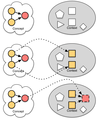
The process is to identify the elements, and the relationships, and then additional dimensions. Then you represent each, place them (elements first, relationships second, dimensions last), and tune.
Here the notion is that you have a mental model of a concept, capturing elements and causal relationships. When you see a situation, you select a model where you can map the elements in the model to elements in the context. Then you can use the model to predict what will happen or explain what happened. Which gives you a basis for making decisions, and adapting decisions to different contexts in principled ways.
Models are a powerful concept I’ve harped on before, but now I’ve an associated diagram. And I like diagrams. I find mapping the conceptual dimensions to spatial dimensions both helps me get concrete about the models and then gives a framework to share with others. Does this make sense to you, both the concept behind it, and the diagram to represent it?
I’ll be presenting this in the workshop, amongst many other implications from how our brains work (and learn) to the design of learning experiences. Would love to see you there.
Clark
.
Blog
.
<span class='date ' tip=''><i class='icon-time'></i> Nov 22, 2015 04:57am</span>
|
|
It actually happened a while ago, but I was pleased to learn that Designing mLearning has been translated into Korean. That’s kind of a nice thing to have happen! A slightly different visual treatment, presumably appropriate to the market. Who knows, maybe I’ll get a chance to visit instead of just transferring through the airport. Anyways, just had to share ;).
Clark
.
Blog
.
<span class='date ' tip=''><i class='icon-time'></i> Nov 22, 2015 04:56am</span>
|
|
A continued bane of my existence is the ongoing requirements that are put in place for a variety of things. Two in particular are related and worth noting: accreditation and compliance. The way they’re typically construed is barking mad, and we can (and need to) do better.
To start with accreditation. It sounds like a good thing: to make sure that someone issuing some sort of certification has in place the proper procedures. And, done rightly, it would be. However, what we currently see is that, basically, the body says you have to take what the Subject Matter Expert (SME) says as the gospel. And this is problematic.
The root of the problem is that SMEs don’t have access to around 70% of what they do, as research at the University of Southern California’s Cognitive Technology group has documented. However, of course, they have access to all they ‘know’. So it’s easy for them to say what learners should know, but not what learners actually should be able to do. And some experts are better than others at articulating this, but the process is opaque to this nuance.
So unless the certification process is willing to allow the issuing institution the flexibility to use a process to drill down into the actual ‘do’, you’re going to get knowledge-focused courses that don’t actually achieve important outcomes. You could do things like incorporating those who depend on the practitioners, and/or using a replicable and grounded process with SMEs that helps them work out what the core objectives need to be; meaningful ones, ala competencies. And a shoutout to Western Governors University for somehow being accredited using competencies!
Compliance is, arguably, worse. Somehow, the amount of time you spend is the important determining factor. Not what you can do at the end, but instead that you’ve done something for an hour. The notion that amount of time spent relates to ability at this level of granularity is outright maniacal. Time would matter, differently for different folks, but you have to be doing the right thing, and there’s no stricture for that. Instead, if you’ve been subjected to an hour of information, that somehow is going to change your behavior. As if.
Again, competencies would make sense. Determine what you need them to be able to do, and then assess that. If it takes them 30 minutes, that’s OK. If it takes them 5 hours, well, it’s necessary to be compliant.
I’d like to be wrong, but I’ve seen personal instances of both of these, working with clients. I’d really like to find a point of leverage to address this. How can we start having processes that obtain necessary skills, and then use those to determine ability, not time or arbitrary authority! Where can we start to make this necessary change?
Clark
.
Blog
.
<span class='date ' tip=''><i class='icon-time'></i> Nov 22, 2015 04:56am</span>
|
|
In an insightful article, Ken Majer (full disclosure, a boss of mine many years ago) has written about the need to have the right culture before executing strategy. And this strikes me as a valuable contribution to thinking about effective change in the transformation of L&D in the Revolution.
I have argued that you can get some benefits from the Revolution without having an optimized culture, but you’re not going to tap into the full potential. Revising formal learning to be truly effective by aligning to how we learn, adding in performance support in ways that augment our cognitive limitations, etc, are all going to offer useful outcomes. I think the optimal execution stuff will benefit, but the ability to truly tap into the network for the continual innovation requires making it safe and meaningful to share. If it’s not safe to Show Your Work, you can’t capitalize on the benefits.
What Ken is talking about here is ensuring you have values and culture in alignment with the vision and mission. And I’ll go further and say that in the long term, those values have to be about valuing people and the culture has to be about working and learning together effectively. I think that’s the ultimate goal when you really want to succeed: we know that people perform best when given meaningful work and are empowered to pursue it.
It’s not easy, for sure. You need to get explicit about your values and how those manifest in how you work. You’ll likely find that some of the implicit values are a barrier, and they’ll require conscious work to address. The change in approach on the part of management and executives and the organizational restructuring that can accompany this new way of working isn’t going to happen overnight, and change is hard. But it is increasingly, and will be, a business necessity.
So too for the move to a new L&D. You can start working in these ways within your organization, and grow it. And you should. It’s part of the path, the roadmap, to the revolution. I’m working on more bits of it, trying to pull it together more concretely, but it’s clear to me that one thread (and as already indicated in the diagrams that accompany the book) is indeed a path to a more enabling culture. In the long term, it will be uplifting, and it’s worth getting started on now.
Clark
.
Blog
.
<span class='date ' tip=''><i class='icon-time'></i> Nov 22, 2015 04:56am</span>
|
|
I’m recognizing that there’s an opportunity to provide more support for implementing the Revolution. So I’ve been thinking through what sort of process might be a way to go about making progress. Given that the core focus in on aligning with how we think, work, and learn (elements we’re largely missing), I thought I’d see whether that could provide a framework. Here’s my first stab, for your consideration:
Assess: here we determine our situation. I’m working on an evaluation instrument that covers the areas and serves as a guide to any gaps between current status and possible futures, but the key element is to ascertain where we are.
Learn: this step is about reviewing the conceptual frameworks available, e.g. our understandings of how we think, work and learn. The goal is to identify possible directions to move in detail and to prioritize them. The ultimate outcome is our next step to take, though we may well have a sequence queued up.
Initiate: after choosing a step, here’s where we launch it. This may not be a major initiative. The principle of ‘trojan mice‘ suggests small focused steps, and there are reasons to think small steps make sense. We’ll need to follow the elements of successful change, with planning, communicating, supporting, rewarding, etc.
Guide: then we need to assess how we’re doing and look for interventions needed. This involves knowing what the change should accomplish, evaluating to see if it’s occurring, and implementing refinements as we go. We shouldn’t assume it will go well, but instead check and support.
Nurture: once we’ve achieved a stable state, we want to nurture it on an ongoing basis. This may be documenting and celebrating the outcome, replicating elsewhere, ensuring persistence and continuity, and returning to see where we are now and where we should go next.
Obviously, I’m pushing the ALIGN acronym (as one does), as it helps reinforce the message. Now to put in place tools to support each step. Feedback solicited!
Clark
.
Blog
.
<span class='date ' tip=''><i class='icon-time'></i> Nov 22, 2015 04:56am</span>
|
|
Last Friday’s #GuildChat was on Agile Development. The topic is interesting to me, because like with Design Thinking, it seems like well-known practices with a new branding. So as I did then, I’ll lay out what I see and hope others will enlighten me.
As context, during grad school I was in a research group focused on user-centered system design, which included design, processes, and more. I subsequently taught interface design (aka Human Computer Interaction or HCI) for a number of years (while continuing to research learning technology), and made a practice of advocating the best practices from HCI to the ed tech community. What was current at the time were iterative, situated, collaborative, and participatory design processes, so I was pretty familiar with the principles and a fan. That is, really understand the context, design and test frequently, working in teams with your customers.
Fast forward a couple of decades, and the Agile Manifesto puts a stake in the ground for software engineering. And we see a focus on releasable code, but again with principles of iteration and testing, team work, and tight customer involvement. Michael Allen was enthused enough to use it as a spark that led to the Serious eLearning Manifesto.
That inspiration has clearly (and finally) now moved to learning design. Whether it’s Allen’s SAM or Ger Driesen’s Agile Learning Manifesto, we’re seeing a call for rethinking the old waterfall model of design. And this is a good thing (only decades late ;). Certainly we know that working together is better than working alone (if you manage the process right ;), so the collaboration part is a win.
And we certainly need change. The existing approaches we too often see involve a designer being given some documents, access to a SME (if lucky), and told to create a course on X. Sure, there’re tools and templates, but they are focused on making particular interactions easier, not on ensuring better learning design. And the person works alone and does the design and development in one pass. There are likely to be review checkpoints, but there’s little testing. There are variations on this, including perhaps an initial collaboration meeting, some SME review, or a storyboard before development commences, but too often it’s largely an independent one way flow, and this isn’t good.
The underlying issue is that waterfall models, where you specify the requirements in advance and then design, develop, and implement just don’t work. The problem is that the human brain is pretty much the most complex thing in existence, and when we determine a priori what will work, we don’t take into account the fact that like Heisenberg what we implement will change the system. Iterative development and testing allows the specs to change after initial experience. Several issues arise with this, however.
For one, there’s a question about what is the right size and scope of a deliverable. Learning experiences, while typically overwritten, do have some stricture that keeps them from having intermediately useful results. I was curious about what made sense, though to me it seemed that you could develop your final practice first as a deliverable, and then fill in with the required earlier practice, and content resources, and this seemed similar to what was offered up during the chat to my question.
The other one is scoping and budgeting the process. I often ask, when talking about game design, how to know when to stop iterating. The usual (and wrong answer) is when you run out of time or money. The right answer would be when you’ve hit your metrics, the ones you should set before you begin that determine the parameters of a solution (and they can be consciously reconsidered as part of the process). The typical answer, particularly for those concerned with controlling costs, is something like a heuristic choice of 3 iterations. Drawing on some other work in software process, I’d recommend creating estimates, but then reviewing them after. In the software case, people got much better at estimates, and that could be a valuable extension. But it shouldn’t be any more difficult to estimate, certainly with some experience, than existing methods.
Ok, so I may be a bit jaded about new brandings on what should already be good practice, but I think anything that helps us focus on developing in ways that lead to quality outcomes is a good thing. I encourage you to work more collaboratively, develop and test more iteratively, and work on discrete chunks. Your stakeholders should be glad you did.
Clark
.
Blog
.
<span class='date ' tip=''><i class='icon-time'></i> Nov 22, 2015 04:55am</span>
|
|
One of my arguments for the L&D revolution is the role that L&D could be playing. I believe that if L&D were truly enabling optimal execution as well as facilitating continual innovation (read: learning), then they’d be as critical to the organization as IT. And that made me think about how this role would differ.
To be sure, IT is critical. In today’s business, we track our business, do our modeling, run operations, and more with IT. There is plenty of vertical-specific software, from product design to transaction tracking, and of course more general business software such as document generation, financials, etc. So how does L&D be as ubiquitous as other software? Several ways.
First, formal learning software is really enterprise-wide. Whether it’s simulations/scenarios/serious games, spaced learning delivered via mobile, or user-generated content (note: I’m deliberately avoiding the LMS and courses ;), these things should play a role in preparing the audience to optimally execute and being accessed by a large proportion of the audience. And that’s not including our tools to develop same.
Similarly, our performance support solutions - portals housing job aids and context-sensitive support - should be broadly distributed. Yes, IT may own the portals, but in most cases they are not to be trusted to do a user- and usage-centered solution. L&D should be involved in ensuring that the solutions both articulate with and reflect the formal learning, and are organized by user need not business silo.
And of course the social network software - profiles and locators as well as communication and collaboration tools - should be under the purview of L&D. Again, IT may own them or maintain them, but the facilitation of their use, the understanding of the different roles and ensuring they’re being used efficiently, is a role for L&D.
My point here is that there is an enterprise-wide category of software, supporting learning in the big sense (including problem-solving, research, design, innovation), that should be under the oversight of L&D. And this is the way in which L&D becomes more critical to the enterprise. That it’s not just about taking people away from work and doing things to them before sending them back, but facilitating productive engagement and interaction throughout the workflow. At least at the places where they’re stepping outside of the known solutions, and that is increasingly going to be the case.
Clark
.
Blog
.
<span class='date ' tip=''><i class='icon-time'></i> Nov 22, 2015 04:55am</span>
|