Blogs
|
I’ve been part of several online communities for some years now, and one just blew up. From the reasons why, I think that there are lessons to be had that go beyond personal to implications for L&D.
The thing that was critical to the success of the group was trust; you could trust it was safe to share opinions, seek out others’ help, etc. People ‘let it all hang out’, and that was a good thing. While it was risky, it worked because everyone was open and honest. Or so we thought.
Then something happened that broke the trust. What had been safe no longer was. And that undermined the very basis upon which the group had been valuable. If what was said wasn’t safe, the group couldn’t be used to share and learn from.
The bigger implication, of course, is that trust is a critical part of a learning culture, one where the best outcomes come from. And trust is a fragile thing. It only takes one violation to make it hard to rebuild. And if you can’t share, you can’t benefit from working out loud, showing your work, and more. It’s back to the Miranda organization, where anything you say can and will be held against you.
The take-home here is that it’s hard to build a learning culture, and easy to undermine. It takes committed leadership. The upside is of considerable value, but you have to get buy-in, and walk the walk. It’s doable, and even recoverable in many instances, but it won’t happen without work. I’ll suggest that it’s worth it; what say you?
Clark
.
Blog
.
<span class='date ' tip=''><i class='icon-time'></i> Nov 22, 2015 05:00am</span>
|
|
My colleague Jane Hart dobbed me (and several other colleagues) in for the #blimage challenge. I usually resent when someone publicly asks me to do something, but fortunately this is easy and, well, it is Jane ;). She presented the following image and our task is to blog about it:
So my take is how things grow in a nurturing environment. Here plants are flourishing under the energy of the sun. This to me is a metaphor for the benefits of creating a culture in which learning can flourish. I’ve earlier detailed what the research says about the elements of a learning organization, and it’s clear that you need a culture with several elements.
First, learning independently has to be enabled. The resources to learn need to be there, as does the time for learning. Further, the ability to learn on one’s own shouldn’t be taken for granted; identify, model, evangelize, and develop these abilities.
In addition, learning is social. The possibilities to learn together need to be facilitated. There need to be ways to find individuals with complementary skills to learn together. This in particular means collaboration: learning while innovating on solving new problems, devising new solutions, and more. It also means being willing to share. It has to be safe to ‘show your work’! Again, don’t assume skills for learning together, but scaffold the development of these abilities.
It is really important that leadership reinforces learning, both by supporting and more importantly by practicing visibly! There’s evidence that when leadership doesn’t share, others won’t truly believe it’s valued.
So there’s my blog on the image. Two colleagues also were challenged with this image and have replied; you can see what they came up with:
Jane Bozarth
Charles Jennings
Rather than dob in anyone in particular, I will simply recommend that you take your own stab, and here’s a proposed image:
I hope to hear what you come up with; drop a link in the comments if you do!
Clark
.
Blog
.
<span class='date ' tip=''><i class='icon-time'></i> Nov 22, 2015 05:00am</span>
|
|
Learning is the new business imperative. It is now an indisputable business reality: companies must become more nimble and agile. As things move faster, new processes arise, and the time to copy a new business approach drops, it becomes clear that continual innovation is the only way to not just survive, but thrive. And this doesn’t, can’t, come from the status quo.
And if the answer isn’t known, as is inherent in situations like problem-solving, trouble-shooting, new product/service creation, and more, then this, too, is a form of learning. But not the type addressed by training rooms or eLearning courses. They serve a role, but not this new one, this needed approach, We need something new.
What we need are two things: effective collaboration and meta-learning. Innovation comes, we know, from collaboration. Collaboration is the new learning, where we bring complementary strengths to bear on a problem in a process structured to be optimally aligned with how our brains work. And we need to create a culture and set of skills around continually learning, which means understanding learning to learn, aka meta-learning.
Accelerating the development of these capabilities means doing things different and new. It means sowing the seeds by instigating a learning process that develops not only some specific needed capabilities, but also the meta-learning and collaboration skills. It means understanding, valuing, and explicitly developing the ability of people to learn alone and together. It means making it safe to share, to ‘work out loud’. And finally it means scaling up from small success to organizational transformation.
This is a doable, albeit challenging move, but it is critical to organizations that will excel. Learning is no longer a ‘nice to have’, or even an imperative, it is the only sustainable differentiator. The question is: are you ready? Are you making the new learning a strategic priority?
Clark
.
Blog
.
<span class='date ' tip=''><i class='icon-time'></i> Nov 22, 2015 05:00am</span>
|
|
I had lunch recently with Paul Signorelli, who’s active in helping libraries with digital literacy, and during the conversation he talked about his vision of the future of the library. What I heard was a vision of libraries moving beyond content to be about learning, and this had several facets I found thought-provoking.
Now, as context, I’ve always been a fan of libraries and library science (and librarians). They were some of the first to deal with the issues involved in content organization, leading to information science, and their insight into tagging and finding is still influencing content architecture and engineering. But here we’re talking about the ongoing societal role of libraries.
First, to be about learning, it has to be about experience, not content. This is the crux of a message I’ve tried to present to publishers, when they were still wrestling with the transition from book to content! In this case, it’s an interesting proposition about how libraries would wrap their content to create learning experiences.
Interestingly, Paul also suggested that he was thinking broader, about how libraries could also point to people who could help. This is a really intriguing idea, about libraries becoming a local broker between expertise and needs. Not all the necessary resources are books or even print, and as libraries are now providing video and audio as well as print, and on to computer access to resources beyond the library’s collection, so too can it be about people.
This is a significant shift, but it parallels the oft-told story of marketing myopia, e.g. about how railroads aren’t about trains but instead are about transportation. What is the role of the library in the era of the internet, of self-help.
One role, of course, is to be the repository of research skills, about digital literacy (which is where this conversation had started). However, this notion of being a center of supporting learning, not just a center of content, moves those literacy skills to include learning as well! But it goes further.
This notion turns the role of a library into a solution: whether you need to get something done, learn something, or more, e.g. more than just learning but also performance support and social, becoming the local hub for helping people succeed. He aptly pointed out how this is a natural way to use the fact that libraries tend to exist on public money; to become an even richer part of supporting the community.
It’s also, of course, an interesting way to think about how the locus of supporting people shifts from L&D and library to a joint initiative. Whether there’s still a corporate library is an open question, but it may be a natural partner to start thinking about a broader perspective for L&D in the organization. I’m still pondering the ways in which libraries could facilitate learning (just as trainers should become learning facilitators, so too should librarians?).
Clark
.
Blog
.
<span class='date ' tip=''><i class='icon-time'></i> Nov 22, 2015 04:59am</span>
|
|
There have been a couple of recent proposals about the relative role of cooperation and collaboration, and I’m trying to make sense of them. Here are a couple of different approaches, and my first take at teasing them apart.
Dion Hinchcliffe of Adjuvi tweeted a diagram about different types of working together that shows his take. He has coordination as a subsidiary to cooperation and on to collaboration. So coordination is when we know what needs to be done, but we can’t do it alone. Cooperation is when we’re doing things that need to have a contribution from each of us, and requires some integration. And collaboration is when we’re working together with a goal but not clear how we’ll get there. I think what’s core here is how well defined the task is and how much we contribute.
In the meantime, Harold Jarche, my ITA colleague, as a different take. He sees collaboration as working together to achieve a goal that’s for the organization, whereas cooperation goes beyond. Cooperation is where we participate and assist one another for our own goals. It’s contribution that’s uncoupled from any sense of requirement, and is freely given. I see here the discussion is more about our motives; why are we engaged.
With those two different takes, I see them as different ways of carving up the activities. My initial reaction is closer to Dion’s; I’ve always seen cooperation as willingness to assist when asked, or to provide pointers. To me collaboration is higher; it’s willing to not just provide assistance in clearly defined ways such as pointers to relevant work, answering questions, etc, but to actively roll up sleeves and pitch in. (Coordination is, to me I guess, a subset of cooperation.) With collaboration I’ve got a vested interest in the outcome, and am willing to help frame the question, do independent research, iterate, and persist to achieve the outcome.
I see the issue of motivation or goal as a different thing. I can cooperate in a company-directed manner, as expected, but I also can (and do) cooperate in a broader sense; when people ask for help (my principles are simple: talk ideas for free; help someone personally for dinner/drinks; if someone’s making a quid I get a cut), I will try to assist (with the Least Assistance Principle in mind). I can also collaborate on mutual goals (whether ITA projects or client work), but then I can also collaborate on things that have no immediate outcome except to improve the industry as a whole (*cough* Serious eLearning Manifesto *cough*).
So I see two independent dimensions: one on the effort invested, just responding to need or actively contributing; and the other on the motivation, whether for a structured goal or for the greater good.
Now I have no belief that either of them will necessarily agree with my take, but I’d like to reconcile these interpretations for the overall understanding (or at least my own!). That’s my first take, feedback welcome!
Clark
.
Blog
.
<span class='date ' tip=''><i class='icon-time'></i> Nov 22, 2015 04:59am</span>
|
|
If, indeed, learning is the new business imperative, what does that mean we need to learn? What are the skills that we want to have, or need to develop? I reckon they fall into two categories; those we do for our own learning, and those for learning with and through others.
When we learn on our own, we need to address what information we want coming in and how we process it. This falls under Harold Jarche’s Personal Knowlege Mastery of Seek - Sense - Share. To me there are two main components: what you actively seek, and what comes to you.
What you actively seek really is your searching abilities. Several things come into play. One is knowing where to look. When do you google, when do you do an internal search, when do you check out a book? And how to look is also a component. Do you know how to make a good search string? Do you know how to evaluate the quality of the responses you get? I see too often that people aren’t critical enough in looking at purveyed information.
Then, you also want to set up a stream of information that comes to you. Who to follow on social media? What streams of information? How do you find what sources others use? How do you track what’s happening in your areas of interest and responsibility without getting overwhelmed? This is personal information management, and it requires active management, as sources change. And there are different strategies for different media, as well.
Note that this crosses over into social, but people don’t necessarily know you’re following them. While there may be a notification, they don’t know how much attention you’re paying. I’ve talked about ‘stealth mentoring’, where you can follow someone’s tweets and blog posts, and they can serve as a mentor for you without even knowing it!
There’s some processing of that information, too. What do you do with it? How do you make sense of it? If you hear X over here, and Y over there, you should try to actively reconcile it (e.g. as I did here with collaboration and cooperation). Do you diagram, write, make a video, ?
Of course, if you do process it, do you share it? Now we’re crossing over into the social space more proactively. There’re good reasons to ‘show your work’; in terms of helping others understand where you’re at in your process and for them to offer help. And sharing your thinking can help others. Your thoughts, even interim, can help you and others sort out your thinking. There are some skills involved in figuring out how to systematically share, and of course some diligence and effort is required too, at least before it becomes a habit.
And, of course, there is explicitly asking for help. There are ways to ask for help that aren’t effective! Similarly, there are ways to offer help that won’t necessarily be taken up. So there are skills involved in communicating.
Similarly, collaboration shouldn’t be taken for granted. Do you know different ways to collaborate on documents, presentations, and spreadsheets? Hint: there are better ways than emailing around files! How do you manage a collaboration process so that it maximizes the outcome? For instance, there are nuances to brainstorming.
There are lots of skills involved, and not only should you develop your own, but you should consider the benefits to the organization to developing them systematically and systemically. So, what did I miss? Wondering if I should try to diagram this…
Clark
.
Blog
.
<span class='date ' tip=''><i class='icon-time'></i> Nov 22, 2015 04:59am</span>
|
|
We’ve heard about learning engineering and while the focus is on experience design, the pragmatics include designing content to create the context, resources, and motivation for the activity. And it’s time we step beyond just hardwiring this content together, and start treating it as professionals.
Look at business websites these days. You can customize the content you’re searching for with filters. The content reacts to the device you’re on and displays appropriately. There can even be content that is specific to your particular trace of action through the site and previous visits. Just look at Amazon or Netflix recommendations!
This doesn’t happen by hardwired sites anymore. If you look at the conferences around content, you’ll find that they’re talking industrial strength solutions. They use content management systems, carefully articulated with tight definitions and associated tags, and rules that pull together those content elements by definition into the resulting site. This is content engineering, and it’s a direction we need to go.
What’s involved is tighter templates around content roles, metadata describing the content, and management of the content. You write into the system, describe it, and pull it out by description, not by hard link. This allows flexibility and rules that can pull differentially by different contexts: different people, different role, different need, and different device. We also separate out what it says from how it looks, using tags to support rendering appropriately on different devices rather than hard-coding the appearance as well as the content and the assembly.
This is additional work, but the reasons are several. First, being tighter around content definitions provides a greater opportunity to be scientific about the role the content plays. We’re too lax in our content, so that beyond a good objective, we don’t specify what makes a good example, etc. Second, by using a system to maintain that content, we can get more rigorous in content management. I regularly ask audiences whether they have outdated legacy content hanging around, and pretty much everyone agrees. This isn’t effective content governance, and content should have regular cycles of review and expiry dates.
By this tighter process, we not only provide better content design, delivery, and management, but we set the stage for the future. Personalization and customization, contextualization, are hampered when you have to hand-configure every option you will support. It’s much easier to write a new set of rules and then your content can serve new purposes, new business models, and more.
If you want to know more about this, I hope to see you at my session on content at DevLearn!
Clark
.
Blog
.
<span class='date ' tip=''><i class='icon-time'></i> Nov 22, 2015 04:58am</span>
|
|
I’m increasingly realizing that the ways we design and develop content are part of the reason why we’re not getting the respect we deserve. Our brains are arguably the most complex things in the known universe, yet we don’t treat our discipline as the science it is. We need to start combining experience design with learning engineering to really start delivering solutions.
To truly design learning, we need to understand learning science. And this does not mean paying attention to so-called ‘brain science’. There is legitimate brain science (c.f. Medina, Willingham), and then there’s a lot of smoke.
For instance, there’re sound cognitive reasons why information dump and knowledge test won’t lead to learning. Information that’s not applied doesn’t stick, and application that’s not sufficient doesn’t stick. And it won’t transfer well if you don’t have appropriate contexts across examples and practice. The list goes on.
What it takes is understanding our brains: the different components, the processes, how learning proceeds, and what interferes. And we need to look at the right levels; lots of neuroscience is not relevant at the higher level where our thinking happens. And much about that is still under debate (just google ‘consciousness‘ :).
What we do have are robust theories about learning that pretty comprehensively integrate the empirical data. More importantly, we have lots of ‘take home’ lessons about what does, and doesn’t work. But just following a template isn’t sufficient. There are gaps where have to use our best inferences based upon models to fill in.
The point I’m trying to make is that we have to stop treating designing learning as something anyone can do. The notion that we can have tools that make it so anyone can design learning has to be squelched. We need to go back to taking pride in our work, and designing learning that matches how our brains work. Otherwise, we are guilty of malpractice. So please, please, start designing in coherence with what we know about how people learn.
If you’re interested in learning more, I’ll be running a learning science for design workshop at DevLearn, and would love to see you there.
Clark
.
Blog
.
<span class='date ' tip=''><i class='icon-time'></i> Nov 22, 2015 04:58am</span>
|
|
It’s time for another game of Where’s Clark? As usual, I’ll be somewhat peripatetic this fall, but more broadly scoped than usual:
First I’ll be hitting Shenzhen, China at the end of August to talk advanced mlearning for a private event.
Then I’ll be hitting the always excellent DevLearn in Las Vegas at the end of September to run a workshop on learning science for design (you should want to attend!) and give a session on content engineering.
At the end of October I’m down under at the Learning@Work event in Sydney to talk the Revolution.
At the beginning of November I’ll be at LearnTech Asia in Singapore, with an impressive lineup of fellow speakers to again sing the praises of reforming L&D.
That might seem like enough, but I’ll also be at Online Educa in Berlin at the beginning of December running an mlearning for academia workshop and seeing my ITA colleagues.
Yes, it’s quite the whirl, but with this itinerary I should be somewhere near you almost anywhere you are in the world. (Or engage me to show up at your locale!) I hope to see you at one event or another before the year is out.
Clark
.
Blog
.
<span class='date ' tip=''><i class='icon-time'></i> Nov 22, 2015 04:58am</span>
|
|
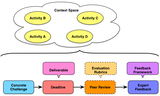
I’m working on the learning science workshop I’m going to present at DevLearn next month, and in thinking about how to represent the implications of designing to account for how we work better when the learning context is concrete and sufficient contexts are used, I came up with this, which I wanted to share.
The empirical data is that we learn better when our learning practice is contextualized. And if we want transfer, we should have practice in a spread of contexts that will facilitate abstraction and application to all appropriate settings, not just the ones seen in the learning experience. If the space between our learning applications is too narrow, so too will our transfer be. So our activities need to be spread about in a variety of contexts (and we should be having sufficient practice).
Then, for each activity, we should have a concrete outcome we’re looking for. Ideally, the learner is given a concrete deliverable as an outcome that they must produce (that mimics the type of outcome we’re expecting them to be able to create as an outcome of the learning, whether decision, work product, or..). Ideally we’re in a social situation and they’re working as a team (or not) and the work can be circulated for peer review. Regardless, then there should be expert oversight on feedback.
With a focus on sufficient and meaningful practice, we’re more likely to design learning that will actually have an impact. The goal is to have practice that is aligned with how our learning works (my current theme: aligning with how we think, work, and learn). Make sense?
Clark
.
Blog
.
<span class='date ' tip=''><i class='icon-time'></i> Nov 22, 2015 04:58am</span>
|