



All Resources
The Six Levels of Sexual Harassment
Welcome to the employee version of the Stop Sexual Harassment Now video series. This is the fifth video lesson in a series of seven and provides levels and terms that will everyone can use to speak the same language, including targets, offenders, supervisors and investigators. Sexual harassment is against the law and occurs when there are "…unwelcome sexual advances, requests for sexual favors, or other verbal or physical harassment of a sexual nature." Harassment may be prevalent in the workplace. But it doesn’t have to be prevalent in YOUR workplace. This video series will help you learn how to STOP IT NOW.
Sexual Harassment — the "TAKEAWAY" for Managers™
Sexual Harassment — the "TAKEAWAY" for Managers™ is a conversational, easy-to-use program for managers that defines sexual harassment according to the law and explains why it’s important to take a proactive approach to this serious problem. This concise program is both comprehensive and simple to understand, with short vignettes that illustrate and dramatize the material presented. The 12-minute program focuses on four key learning points and their "takeaways," or sentence-long summations, to help managers prevent, identify, document, and stop sexual harassment in the workplace. The program explains the difference between quid pro quo and hostile work environment harassment, and the importance of good documentation to protect organizations and managers from legal liability. Sexual Harassment — the "TAKEAWAY" for Managers™ is a stand-alone program, which may also be used in conjunction with the rest of the series The "TAKEAWAY" for Managers™: Discipline, Documentation, & Termination ; "Can I Ask That?" Legal Interviewing; FMLA in a Nutshell; Diversity, Respect, & Legal Compliance; and ADA in a Nutshell
Ethics Episode 5: How To Avoid Sexual Harassment In Under Four Minutes!
This video is part of the Ethics Video series, Part 3: How to Deal with (and avoid) Discrimination and Sexual Harassment. Every year, ethical violations cost companies millions (and sometimes billions) of dollars in fines, legal fees, and lost revenue. In an increasingly transparent world, maintaining ethical business standards is increasingly important. The only problem is that ethics training is usually about as exciting as watching someone watch paint dry. Fortunately for you, we’ve found a way to make it fun! Who would have known that videos and workbooks about ethics could be so amazing?

Ethical Expectations: Code of Conduct and Compliance Training (Section 5)
This course provides basic business ethical decision-making strategies and code of conduct information. It functions as a foundational, general ethics course targeted to all employees. This course introduces participants to various ethical decision-making models and then expands to cover common code of conduct topics. The emphasis of this course is to help employees develop solid ethical decision-making skills in the context of learning specific codes of conduct. This section of the course include the topics of antitrust laws, exchanging competitive information, proper communications, ethical responsibilities, and reporting and assistance.

Creating an Ethical Workplace for Managers
Welcome to the Ethics video series. This is the seventh video lesson in a series of seven and discusses how you should set up and encourage an ethical workplace and how to follow up with any ethics concerns you see, or hear about from your team. If there’s one thing just about everyone in the working world can agree with, it’s that people need to be ethical. Every large company has a Code of Conduct that people have to read and sign every year. This video series will help learners understand that ethical behavior begins with you and how to make that happen. Please note that the first six video lessons are designed for all employee levels. The final video lesson is designed specifically for all levels of management.
Handling Ethics Situations
Welcome to the Ethics video series. This is the sixth video lesson in a series of seven and discusses what to do when an ethical situation arises and how the earlier you catch an ethical problem, the better it is for everyone. If there’s one thing just about everyone in the working world can agree with, it’s that people need to be ethical. Every large company has a Code of Conduct that people have to read and sign every year. This video series will help learners understand that ethical behavior begins with you and how to make that happen. Please note that the first six video lessons are designed for all employee levels. The final video lesson is designed specifically for all levels of management.
Getting Organized (First 5 Lessons Available to Basic Members & Above)
Welcome to our Time Management series. This is the seventh video in a series of eight and is designed to help you organize your workspace so that hours of productivity per day aren’t wasted searching for missing information. You only have a finite amount of time to spend in your life so you need to ask yourself, how am I going to use the time that I have? This eight-part series will get you to stop procrastinating, help you create plans and inspire you to implement your plans for productivity. So are you going to make things happen, or are you going to watch things happen? The series list is included as a reference to the suggested viewing order.

Types of Work Teams
There are several types of teams in Project Management. Jeff Crow discusses different types of work groups and places them in five broad categories. He also details how these groups become one kind or another and their relative strengths and weaknesses.
Identifying Personal Priorities
Welcome to the ‘Setting and Managing Priorities’ series of video lessons meant to teach you how to prioritize amid the constant barrage of responsibilities of daily life. This video lesson, ‘Identifying Personal Priorities,’ is the third in a series of six. While watching the lesson, you will gain a sense of the different ways your personal factors shape what you prioritize. A few examples include professional goals and deadlines, as well as how much you enjoy doing a particular task. While describing these factors, the lesson also explains how sometimes personal factors generate false priorities, based on attitude rather than smart business tactics. After viewing this lesson, learners will have a better sense of how to balance their personal priorities in a beneficial way.
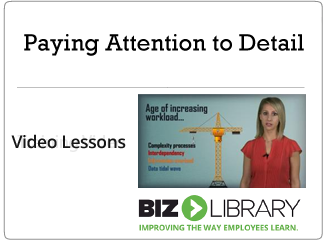
Paying Attention to Detail
Welcome to the All About Details programs. This is the first video in a program of two and covers the issues that arise when you don’t pay attention to detail. The failure to anticipate or correct some small problem up-front escalates, until it can ultimately result in a major catastrophe. This two-part program will help you understand how to best concentrate on the task at hand and provide tips on how not to miss details in the future. The program list is included as a reference to the recommended viewing order.

Cutting Edge Communication: Achieving SMART Goals
Learn the SMART formula and set specific, measurable goals that are relevant and achievable within a time frame. This video explains the differences between short-term and long-term goals and introduces the goal acronym: SMART. Please Note: These videos are designed to provoke discussion and response. They are fast paced, short, character-driven TV style comedies that take a new approach to reaching today's learners. By laughing, discussing, sharing outrage, and reacting to the behaviors on screen, we can use the resulting feelings and thoughts to develop a clearer shared view of how we want our teams to behave and to better manage these types of situations. These programs partner well with the Switch On and/or Workplace Excellence series, also by Seven Dimensions.

Corporate Culture: Don’t Just Survey It – Teach It!
Training Matters… but what about culture? Corporate culture drives results and longevity; "good" cultures create engaged employees, higher retention, and more flexible organizations. This sounds great, yet too often the next step in this line of thinking is an all-hands survey, one that ends up recommending things like monthly birthday parties and brighter conference room paint.

8 Training Games
For classroom, online, webinar and blended learning. Upgrade your Membership to MembershipPlus and own these 8 Training Games, PLUS all of the additional benefits of MembershipPlus.

How to Engage Your Leadership on Engagement!
Deloitte’s Global Human Resources Trends indicates that employee engagement (and culture) is the number one challenge facing business leaders. But they sadly claim, that organizations are only ‘somewhat ready’ for this challenge.
Five Levels of Leadership: A Game Plan for Leadership Development
The 5 Levels of Leadership webinar will provide a complete framework for developing influence for yourself and others inside your organization. This program covers the upsides and downsides of leadership, as well as the key beliefs and behaviors that a leader must practice in order to advance to the next level.

The Five Question Leader: Work Less Hard, Have More Impact
Managers and leaders find themselves stuck in three vicious circles. They’re frustrated by teams who have become overdependent on them. They’re overwhelmed by the amount of work they have to do. And they’re disconnected from their own Great Work - the work that has impact, the work that has meaning.
Sound familiar?
Rev Up Your Ramp Up: Making Employee Onboarding More Efficient
Everyone is looking to develop employee onboarding that gets new recruits up and running faster than the competition, whether it’s closing their first deal, conducting their first client meeting, or managing their first high-profile project. But how?
From Boss to Coach: Turning Great Sales Managers into Great Coaches
Belief drives behavior! Success in sales doesn’t just happen because someone follows a mechanical set of process-driven rules. It begins within the head and heart of the salesperson. The challenge today is that most sales managers aren’t equipped to understand or address these internal drivers/barriers, much less engage in a meaningful conversation about them with their reps. Unfortunately, that can lead to sales leaders to ignore the emotional side of selling and end up with an anemic sales team or a revolving door of talent.
The Best eLearning Assets. For The Best eLearning Authors. Simple, Fast and Free!
Wouldn’t it be great if you could create training material quickly and easily without having to spend a whole lot of time and money designing your assets from scratch or having someone do them for you?
Discoveries from the New Strategic L&D Best Practice Survey
As senior business leaders focus on shrinking performance gaps and skill shortages to execute upon business strategies, they’re also driving their L&D functions to be more strategic. In September and October 2015, TRAINING Magazine and Wilson Learning Worldwide conducted a research study to examine what it means for L&D to be more strategic, best practices of those organizations that lead the way, and what organizations aren’t doing but should do to be recognized as a strategic L&D leader.
Abracadabra: De-Mystifying Adult Learning Techniques!
Fairly new to training and still trying to figure out this Adult Learning Stuff?
We’ve got you covered!

7 Behaviors of Fierce Leaders
In today’s complex business environment, the ability to create meaningful and collaborative connections with colleagues and clients is more essential than ever.
In this webinar, Beth Wagner, Fierce Master Facilitator, will deep dive into seven core behaviors that will help you achieve greater effectiveness in your everyday interactions. Our tools will enable you to create positive organizational change and give you a new way to relate to people at work, home, and in every area of your life.
Cultivating a Training Project Sponsor
The Project Sponsor’s role on a project is the single most critical predictor of project success. That said, many if not most Project Sponsors have no idea what they are supposed to be doing. Imagine Captain Pickard from Star Trek - "Make it so!" That’s the extent of the contribution for most organizational Sponsors. It’s up to you as the Project Manager to cultivate the Project Sponsor. For you project to be successful, you must make sure the Project Sponsor is successful.
The Nuts and Bolts of Creating an Engaging Training Program
Organizations that leverage learning beyond traditional on-boarding and compliance training reap the rewards of a more engaged, more skilled and more productive workforce. But, getting today’s distracted, impatient and busy learners to participate in learning activities isn’t easy. In fact, according to Bersin, 64% of employees aren’t even aware of what is available in their LMS.

