Blogs
|
Thursday, March 24, 201110:00 AM PST | 11:00 AM MST | 12:00 PM CST | 1:00 PM EST Both mobile devices and social media are having a profound effect on how sales training takes place. Traditional methods of sales training include classroom instruction and role playing, supervised calling of prospects, and practice selling with more experienced sales staff. With the rapid growth of social media, buyers are now much more able to communicate with each other and exchange opinions and stories about you as a salesperson, and about the good and bad aspects of your product. This exchange is not happening from a fixed place, but from any location where a consumer is texting or blogging and is inspired to offer an opinion of what or how you are selling. These comments can be amplified by others offering additional comments or passing the information on to others. At the same time, a mobile salesperson is better equipped to answer questions as they are asked, with instant information available anytime, anywhere. Learning to sell requires a new set of competencies that includes blogging, tweeting, and attracting lots of "friends" or "followers." As well, new technology is being developed that allows live mentoring in the field and the ability to educate potential customers with mobile video presentations in the process of closing a sale. In this one-hour presentation by Dr. Gary Woodill, learn how mobile learning and social media are transforming the world of selling and sales training.Sign up for webinar
Debbie Richards
.
Blog
.
<span class='date ' tip=''><i class='icon-time'></i> Dec 04, 2015 08:04pm</span>
|
|
You might notbe able to teach a snake to fetch your paper, but people do keep them as pets.People keep other reptiles, too, like turtles - as well as frogs and otheramphibians. But the Centers for Disease Control and Prevention says reptilesand amphibians can carry Salmonella bacteria - and thousands of people a yearget infected from them.Check it out: http://www.cdc.gov/Features/SalmonellaFrogTurtle/
Debbie Richards
.
Blog
.
<span class='date ' tip=''><i class='icon-time'></i> Dec 04, 2015 08:04pm</span>
|
|
Speaker: Judy Brown, Mobile Learning Strategic Analyst, Advanced Distributed LearningDate: Thursday, July 28, 2011Time: 10:00AM Pacific / 1:00PM Eastern (60 Minute Session)The ADL Mobile Learning Team recently released a mobile version of their mLearning Guide on the web and in various mobile platform stores. Join the webinar for discussion on the single development for deployment on multiple devices and choices made in development. Lessons learned will be shared.... moreThe ADL Mobile Learning Team recently released a mobile version of their mLearning Guide on the web and in various mobile platform stores. Join the webinar for discussion on the single development for deployment on multiple devices and choices made in development. Lessons learned will be shared.Check it out: http://www.trainingmagnetwork.com/welcome/judybrown_july28
Debbie Richards
.
Blog
.
<span class='date ' tip=''><i class='icon-time'></i> Dec 04, 2015 08:03pm</span>
|
|
Heard the term Augmented Reality and wondered how it could be used in learning? Attend this free webinar hosted by Rapid Intake and featuring Craig Weiss, author of the E-Learning 24/7 blog
Date: Tuesday, August 16th, 2011ime: 1:00pm-2:00pm ETRegister at: http://www.rapidintake.com/augmented-reality-webinar/?utm_source=rapidintake&utm_medium=email&utm_campaign=110816
Augmented Reality can take any situation, location, environment, and experience to a new level of edutainment. In this day and age, people want to be informed, engaged, and entertained in an immediate, pro-active and social way. In this webinar, you will learn how this emerging technology is changing the way people engage and learn. It will present you with possibilities and mobile devices best suited for this new technology.
How Augmented Reality Works: http://www.commoncraft.com/video/augmented-reality
Cool example: http://ge.ecomagination.com/smartgrid/
Debbie Richards
.
Blog
.
<span class='date ' tip=''><i class='icon-time'></i> Dec 04, 2015 08:03pm</span>
|
|
Tom Peters has distilled down thousands of slides from over 2,500 presentations that he has done on organizational and personal excellence into 23 separate presentations that you can download. Peters say, "Use this material as you wish and please 'steal' all you want." Includes both a PDF and PPT - he is releasing one a week so you'll want to bookmark the site and go back! Check it out: http://excellencenow.com/
Debbie Richards
.
Blog
.
<span class='date ' tip=''><i class='icon-time'></i> Dec 04, 2015 08:03pm</span>
|
|
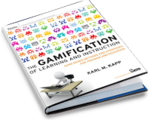
Karl Kapp’s new book "The Gamification of Learning and Instruction" launched this week - I was able to preview the book. It’s available on the ASTDBook store and Amazon. Make sure to use your Chapter Code when ordering the book to support your local ASTD Chapter - the Houston ASTD Code is CH7032.From the book - The engagement achieved through games means that gamification is a concept that needs to be a part of every learning professional's tool box. Games provide meaning and context to learners, they provide a set of boundaries within a "safe" environment to explore, think and "try things out".The four themes in the book are:1. Describe and define the concept of gamification, dissect games to determine the elements that provide the most impact for the players and why these elements are critical to the success of the game.2. Research and theoretical basis for the use of games and game-based thinking.3. Matching game results with game design.4. Actual design and development of the gamification of learning and instruction.Full disclosure - I'm still working my way through the book. What I’m appreciating through the book is the depth of the material, examples, and key takeways. I came into the book with my own ideas about gamification and what it means. I’m getting a clear picture of the true power of game-based thinking including engagement, storytelling, visualization of characters and problem solving. We’ve been using these elements in learning for a long time. I don’t think we’ve considered them gamification. One example given is "The Binary Game" from Cisco (http://forums.cisco.com/CertCom/game/binary_game_page.htm). This is a arcade game. The idea is to teach people the basis of binary numbers. The player leans the concepts while playing. The patterns and strategies in game provide the ability to think in binary. I think this book will help anyone who wants to understand how to bring "gamification" into their toolbox -finding methods to improve learning, retention and application of knowledge. I’ll circle back with more thoughts once I complete the book! Karl presented to the Houston ASTD chapter yesterday on this topic - his slides can be found at http://www.slideshare.net/kkapp/what-research-tells-us-about-games-gamification-and-learning.
Debbie Richards
.
Blog
.
<span class='date ' tip=''><i class='icon-time'></i> Dec 04, 2015 08:02pm</span>
|
|
The eLearning Atlas is a comprehensize free list of elearning and LMS providers - brought to you by Rustici Software, LLC. One interesting feature is the ability to select a product type and then narrow down the choices to those who have specific specification support - such as authoring tools that support the Tin Can API. The list is being updated on a regular basis.Check it out: http://www.elearningatlas.com/
Debbie Richards
.
Blog
.
<span class='date ' tip=''><i class='icon-time'></i> Dec 04, 2015 08:02pm</span>
|
|
A Facebook friend shared an excellent link today to an article in The Economist on a new study about the most effective ways to serve the homeless:
Broadway tried a brave and novel approach: giving each homeless person hundreds of pounds to be spent as they wished. According to a new report on the project by the Joseph Rowntree Foundation, a think-tank, it worked—a success that might offer broader lessons for public-service reform and efficiency.
The charity targeted the longest-term rough sleepers in the City, who had been on the streets for between four and 45 years (no mean achievement when average life expectancy for the long-term homeless is 42). Instead of the usual offers of hostel places, they were simply asked what they needed to change their lives.
One asked for a new pair of trainers and a television; another for a caravan on a travellers’ site in Suffolk, which was duly bought for him. Of the 13 people who engaged with the scheme, 11 have moved off the streets. The outlay averaged £794 ($1,277) per person (on top of the project’s staff costs). None wanted their money spent on drink, drugs or bets. Several said they co-operated because they were offered control over their lives rather than being "bullied" into hostels. Howard Sinclair of Broadway explains: "We just said, ‘It’s your life and up to you to do what you want with it, but we are here to help if you want.’"
It occurs to me that asking people what they need to change their lives is a powerful question to be asked in many contexts.
It's powerful because it implies that people have the self-efficacy to know what they need. And by supporting that self-efficacy, we can help them feel a sense of control over their own lives, the first step in supporting change.
I wonder what would happen if we asked this question in other situations, such as at work or school? We often think we know what's good for others and spend a great deal of time providing it. But would we get better results if we asked people, "What do you need to change your life?"
What if we asked that question of ourselves?
Michele Martin
.
Blog
.
<span class='date ' tip=''><i class='icon-time'></i> Dec 04, 2015 07:53pm</span>
|
|
"Frames are mental structures. As a result, they shape the goals we seek, the plans we make, the way we act, and what counts as a good or bad outcome of our actions. Reframing is changing the way the public sees the world. . . . Because language activates frames, new language is required for new frames. Thinking differently requires speaking differently."
--George Lakoff, Don't Think of an Elephant
I first encountered the idea of "frames" when I was reading George Lakoff's Don't Think of an Elephant. I've thought about them more since I've spent time with appreciative inquiry and its premise that "words create worlds," and was reminded again while reading Monoculture: How One Story is Changing Everything by F.S. Michaels over the holidays.
Frames are our mental constructs--the ways we view the world. They often act on us subconsciously, which makes their power all the more insidious.
One simple frame I've written about before is the idea of training and development as either a cost or an investment.
If we see development as a "cost," then when it's time to "cut costs," training will be on the chopping block. If it's an "investment," then we need to consider what our return is and whether or not we need to make a greater investment at certain times.
Another potential career frame that can be controlling our stories is thinking of our current job as either a prison or a home base. When it is a prison, then we are powerless and have no control--other people are controlling what we do and how we do it. We have no choices and can't get out. But if it's a "home base," then it can be a space from which we explore other options. It's something that provides a level of stability while we seek change.
You see, then, that if we change the frame, we change how we see the situation. We also change the options that are available to us.
One of the things that I think is helpful when we think about our careers is trying to find the underlying "frame" for our story and seeing if there's another frame that could be more useful to consider. How could playing with different metaphors open up new possibilities?
What happens, for example, if I think of my career as a garden, in which I plant seeds and nurture plants to maturity, a garden where the crops are rotated in order to keep the soil healthy and rich? How does this change how I approach my career?
Or what if I think of conversations at work as being relational, rather than transactional? In other words, what if I approach my conversations as a way to build up a rich network of relationships, rather than as simply a way to get things done? How does that change what I do?
What if "failures" are "learning opportunities"? What if "problems" are "possibilities"? What if "I'm stuck," is "I'm resting" or "I'm lost" is "I'm on an adventure"?
Writing a new career story means finding new frames and new language to describe our journey. One of the most powerful things we can do is to identify and change those frames that are no longer working for us.
When we feel stuck or confused or disheartened, we need to find the new frames that will let us write a better story.
What career frames help or hinder you? How could you change your frames to help you create something new?
______________________________________________________________
If you'd like a chance to look at your current career story and create a new one, sign up for the Career Clarity Camp, starting Monday, January 9. You can join a great group of people from all over the world who will be working on co-creating their own new stories. Information and sign-up is here.
Michele Martin
.
Blog
.
<span class='date ' tip=''><i class='icon-time'></i> Dec 04, 2015 07:53pm</span>
|
|
Change is hard--or so we believe. But what if it isn't? What if we just make it that way because that's what we believe?
Yesterday I was reading this post by Megan Thom who writes about how burnt out she was in her work. Until she had an epiphany that for change to happen she must make it joyful and bring to it her authentic self:
In my burnt-out, disappointed and thoughtful state, I resolved that henceforth all activism I engaged in would involve at least one of my favourite activities: growing food, cooking food, eating food, bicycling and singing. All of these activities are inherently change-making in that they all have positive effects on our ecological, social and emotional environments. All of these activities are also fun. I figured that if I focused on these fun activities I would be both an effective agent of change and also a happy person. In fact, I would argue that one cannot be the former without also being the latter.
One of the things I tell people when they are exploring their next career moves is to "follow the energy." By this I mean to stay alert to those activities and interactions that feel inspiring, engaging, joyful and fun. Identifying these moments and then intentionally bringing more of them into your work is one of the basic activities of career exploration and change.
What I'm finding, though, is that we have a hard time with this. Somehow if it doesn't feel like "work"--that is, if it doesn't feel like a struggle and a challenge and something we have to make ourselves do--then we dismiss it. And asking someone to purposely bring more joy and fun to what they do? Let's just say I spend a lot of time trying to talk people into believing that this isn't "frivolous" or "impossible."
I understand this because by nature, I am not playful. I am more serious than I'd like to be and have a tendency to see the struggle, not the joy. But I'm realizing more and more that for change to happen and for work to have real meaning to me, I need to find the joy--to find how I can bring fun and play and my best self to what I do. I need to do this not only for me, but also for the people I work with. If I think that change is hard and act accordingly, then how will they be able to see it another way themselves?
So lately I'm asking myself, what would happen if I saw change as easy and joyful? How would changing this frame change for me what is possible? How would it change the tools I use and the ways that I interact with people? How could I build joy and play and fun into what I do and how can I help others find that joy and play in themselves?
Right now these are questions for me. The answers are still hidden. But they feel like worthwhile questions to explore. While change can be hard in the sense that we are transforming habits and ingained behaviors, one thing I've learned is that I cannot beat myself up in order to transform. Real change only happens when we act from inspiration, not desperation, when we use joy and fun to motivate ourselves to move in a different direction.
How can you change joyfully? How can you tap into what most deeply engages and interests you to transform your life and career? I'd love to hear your thoughts and comments on this.
Michele Martin
.
Blog
.
<span class='date ' tip=''><i class='icon-time'></i> Dec 04, 2015 07:52pm</span>
|