Blogs
|
When is a poem not a poemAnd verse runs into prose?When is a home not a homeAnd strife contemptuous grows?The Differential CalculusDefines the least derivativeOf increments too small for usIn subtle terms definitive,But the myriad seeds of change that fallBy each gradation's measureDifferentiate the large from tall,The enjoyment from the pleasure;If this sonnet is not proved true,I've never judged, nor yet have you.Kim Cofino is a twenty-first century literacy specialist at the International School Bangkok in Thailand. In her post What Is Literacy, she speaks of attempts to understand the "shift in literacy, especially considering that many people still believe that literacy is solely being able to read and write in printed form."She cites the Becta reports and the McArthur Report as concrete research-based examples "that would help people outside the educational technology field better understand this shift." She also asks for our thoughts on the concept of literacy.I put a comment against her post:We go round in circles with this today - but one could say, 'twas ever thus.When I was taught (English) literacy in the 60s, we had a teacher who honestly believed that if a word was not to be found in the dictionary, it didn't exist. Many English teachers (of the old school) believed this.I was not very well educated in those days (that's why I was at school) but even I could figure that the words in the dictionary weren't always like that - we were taught this in the English class! Shakespeare, for instance, used a strange diction and some strange words. My question was, 'whatever happened to those?'Today we have all sorts of problems with examination authorities who eschew mobile text language, especially in English examinations. And I wonder.Recently I re-read The Mother Tongue by Bill Bryson and was again delighted to find reference to a book that I'd read, 40 years ago, by Simeon Potter, Our Language (first published in 1950).In both books the message was clear: language, and the ways that it is communicated, are living things. They react sometimes slowly, sometimes rapidly, like swarms of bees, always on the move.Literacy clearly has an association with symbolism. I think it is a far cry to say that literacy is only to do with the power of speech or the skills associated with that. Yet, without speech, the symbolism of 'literature', whether it is Shakespeare's script, or a text message using the symbols of that medium, would have no relevance.Sign language, no less a language than any other, also has its base in symbolism - involving signs and actions. But it is really more like the spoken language, for it is not designed to represent the written words and often simply does not follow those.Literacy is bound to the spoken language AND the written symbolisms that represent the language. A person who is incapable of writing, because of some physical disability, is no less literate than someone who is not disabled but who does not know how to write. But you would agree that there may be a difference. For instance, the able person who does not know how to write may not be able to read either. Not necessarily the person with the disability who cannot write.So literacy can have many facets. We need to define these more explicitly. I gather that the visions we may have of these definitions change as much as language does.It eventually comes down to opinion, either that of the individual or of the authorities. And to have any acceptable measure of literacy, by whatever means it is metered, requires standards.Unfortunately, this is where it becomes set in a way that doesn't really fit the nature of language. So standards must be continually revised to meet the needs of society and its understanding of literacy.Which brings us back to the question. My gut feeling is that we are chasing a moving spot of light. As quickly as we have defined where it is and mapped its shape, it has moved on.The Moving Finger writes; and, having writ,Moves on: nor all your Piety nor WitShall lure it back to cancel half a Line,Nor all your Tears wash out a Word of it.from Edward Fitzgerald's 'Rubaiyat of Omar Khayyam'.
Ken Allan
.
Blog
.
<span class='date ' tip=''><i class='icon-time'></i> Dec 04, 2015 10:13pm</span>
|
|
Manish Mohan has only recently written a post about trust. He made me think about this, and the decisions that I may have to make when I read a blog post.I thank Manish for making me ponder deeply about this matter. He prompted me to leave a comment on his post that carried a weighty and profound question: Do You Trust Corporate Blogs? It went something like this:Trust is a strange human emotion. It is deep-rooted in our instinctive mechanisms for survival. When the reason for a decision based on trust is analysed, it is often found to be highly complex. The nature of the complexity is often found to be meshed with a whole raft of subliminal things: hunches, preferences, likes and dislikes, gut feelings, undefined reasons.It is rarely cut and dry - rarely logical.So when you ask, "Do you trust corporate blogs?" I think about trust, and what it is based on.You could say, "do you trust blogs?" Many people don't trust blogs - never mind the corporate bit.And so we move on to ask questions like, "what is it about a particular blog that you trust?" You could also say, "why trust blogs at all?"A more in-depth analysis of trust (associated with blogs or any other Internet sites) will yield other questions. Questions like, "how can you tell that a site is trustworthy? (Never mind the 'blog' or the 'corporate' bit).For me, all sites have to be tested by my baloney detector, whether corporate or not. As naive as it may seem, I apply exactly the same detection kit to all blogs that I read (and all posts for that matter).Trust is a movable feast. The occurrences on sites permit me to decide whether to trust them or not. There are some sites that I used to trust, and now trust no longer. I don't visit these sites anymore - at least, if I happen to come across them, I don’t comment on them. It's a bit like the people I meet in everyday life.I recently received a request from a company (which I won't name here) to post articles on my blog. Effectively I was being asked to host articles.The email included a couple of links to company sites. I looked at the sites. They were corporate and commercial. The advertising that would come with the articles I might agree to host contravened my comment guidelines. I immediately treated the request (which incidentally was written like a personal email) as spam. End of story.Did I trust the request? Yes. Did I trust the attendant sites? No.So, do I trust corporate sites? The answer is, it depends.I am no more likely to 'trust' a corporate site than any other site that I come across. Every site I read is judged (by me) on its own merits.( 5 ) << - related posts - >> ( 3 ) ( 2 ) ( 1 )
Ken Allan
.
Blog
.
<span class='date ' tip=''><i class='icon-time'></i> Dec 04, 2015 10:12pm</span>
|
|
Trust is a strange and capricious emotion. Its composition is built on experience from the moment of birth. The bonding between parent and child is a fabric woven out of the intimacy and trust within that relationship.It manifests itself in the early school years when relationships are fashioned within groups of children. A child’s learning is influenced by the trust placed in the teacher, and likewise the trust the teacher has for the learner. A foundation of partnerships:Trust is the foundation of partnerships, whether in friendship, marriage, business, or trade and exchange. The lack of it can preclude the formation of any of those alliances and can lead to disputes, fights, battles and wars.People in business, and in sales in particular, are aware of the reliance of success on trust between vendor and client, or between agents in partnerships. Britt Watwood’s post, The Trust Factor, discusses trust from the point of view of trustworthiness as a quotient. At that time he had been introduced to a web device designed to assess a trust quotient.Trust in blogs:Recently, interest has been centred on people’s trust in blogs, and particularly though not exclusively in company blogs, fuelled by the latest report by Forrester Research Inc.Tony Karrer’s recent post, No Trust, is a reflective take on this, and the opinions expressed by others. I left a comment, and he responded:Often we don't have time to get to know someone. Rather we have to make snap judgements based on little pieces of information. There are lots of great resources from libraries about this problem of evaluation. Most of us have our patterns figured out. But what's interesting is to hear other people's likely patterns. Oh, this is a blog by someone I don't know - I don't trust this information.Tony is right, of course. Often there is no time to form a trust of a situation or of a person. But with a blog, there are other emotions that can arise within the reader. Time is less urgently associated with the decision-making.The power of the blog:There is a complex mix of emotions, conceptions, misconceptions and beliefs that may well lead to diversity in how people view blogs. The wonderful thing about blogs for unprejudiced minds is that they can permit discussions to unfold.Our discussion brought us to a consensus, and demonstrated the power that the blog post has to bring about accord. Isn’t that what it’s all about? I’d like to think so. I am grateful to Tony, and to blogging, for the opportunity to share our opinions across the globe.My comment to Tony was much along the following lines:There may well be a need to distinguish between not trusting a person/company/blog and saying that person/company/blog is untrustworthy.I am clearly not going to 'trust' a person that I've never met before (why should I trust them?) BUT it would be libel for me here to say that person is untrustworthy. My experience is that some people cannot tell the difference between not trusting, and untrustworthy.Distrust in blogs:I can understand the distrust that readers have when they come across a blog for the first time. I believe it's a similar emotion that prevents a lot of people from ever putting a comment on a post. Some people just 'don't trust' the Internet. They may even think that it's untrustworthy.There are many examples of this (type of) distrust. For instance, when telephone banking was first introduced, people distrusted that system.When Internet banking became a reality, people distrusted it for the same reason - they needed time to gather more information about it, to hear of successful use, to meet people they knew who used it successfully. What would not reinforce their trust in the systems would be reports of Internet fraud or other things going wrong.A mix of emotions:There is a mix of emotions that most people experience when they have to put their trust in something or in someone. The transactional analysis of such a situation indicates that the would-be-participant has a degree of lack of confidence that explains their unwillingness to trust.So I’d say that it is logical for someone to say, "Oh, this is a blog by someone I don't know - I don't trust this information."Acquiring trust is a process:The process of gaining trust is cyclical, with an indeterminate period. Observations are checked against a list of criteria. The list may be a defined checklist or it may simply be a list of doubts in the mind of the observer. In most instances it’s a list of doubts.People who are duped by a person/company/blog have not utilised their cognitive abilities to the best, and some would just say that they were "too trusting".The snap decision:In business circles, snap decisions are being made all the time - you will know this. Sometimes the decisions made, purportedly based on trust, are the wrong ones. I would say that in any snap decision, there is not sufficient time for it to be based on trust, for it takes time for the iterative cycle to permit trust to be established.So when a person comes across a person/company/blog for the first time, they make a snap decision based on what they know. It requires an analytical mind to know what to do to validate their first formed opinion, to verify their doubts.A few home truths:Let me share a few home truths with you, for I am the most trusting person I know. :-)If my experience was that I was often duped through interaction with people/companies/blogs, or I’d heard of the same happening among my friends, I might be disinclined to have anything to do with people/companies/blogs. I’m not like that of course.Some would say that I was a very distrusting person. I’d tend to refute that statement and say that I am discerning and analytical.I try to verify, almost unequivocally, any first formed opinion that I may have (of trust OR distrust) before I make any significant decision, other than transactional ones.Unfortunately (either for me or others) most people aren’t like me. It's probably why I’m in the minority sector of society who reads blog posts and comments on them, never mind blogging about it.related posts - >> ( 4 ) ( 3 ) ( 2 ) ( 1 )
Ken Allan
.
Blog
.
<span class='date ' tip=''><i class='icon-time'></i> Dec 04, 2015 10:10pm</span>
|
|
I’ve just set up our new computer. Hooray! It’s taken me most of my spare time yesterday and a good few hours today sorting out Net connections (again), getting email started, setting up Firefox, sorting set-ups etc - and there’s still a bit to get done, and how.I’m really pleased with the replacement. We had a rather world weary PC with Windows 2000 on it with an equally world weary 13 inch CRT monitor. I must say that we were nevertheless grateful for the machine, a gift from my son, and the good service it gave to the family over the years - it has done its dash.Shiny new machine:But now we have a brand new HP 2 Duo CPU E4700 @ 2.60 GHz with a 19 inch LCD. The family think it’s rather swish, and I must admit that, apart from the extremely tinny audio from the screen (which can be easily rectified with some decent speakers) it all has a good feel to it. Fast as, I can get writing a blog post within 30 seconds of switching it on. I just love the automatic spell checking when writing a post or comment.With the help of a good friend, I have been using Winternals to lift some of the files off our dead machine. Images are all fine. Word files - no problem. Even a few old educational games (.exe files) that my daughters still enjoy, carried across and work well, including some of Grey Olltwit’s brilliant creations, such as the complete works of William Shakespeare in an easy to use search and find suite.Cut the losses:There are a few losses though. I can’t retrieve the PhotoShop software, which is to be expected, as well as some other proprietary software including PowerPoint. Nothing to complain about there. I'll miss the PhotoShop until I can get it replaced.But the software packages that we had on CD and that should have been useful cannot be installed or run on Vista. These include a suite of SIMS, and Sid Meier’s Civilization III. All the software was gifted by my son as it happens.UPDATE 11 April: I have since located dll files that are absent in Vista and that are required for several installations to function as well as an extraordinary fix on CIV III involving an unwanted file to do with fonts of all things. We now have CIV III installed and running on Vista. The Outlook pst files that are intact and carry our archived email, though transferable, cannot be accessed on the new machine. They remain 150 Mb of impenetrable, inaccessible data. It appears that such files die with the machine, for even if our old machine was still operable there is little that can be done to transfer the emails across in any useful form, other than by taking text dumps of the individual files.Considering the need for fortitude and resourcefulness in these days of a strained global economy, I can’t help feeling that there are several lessons to be learnt here.When I’ve completed the retrieval of all that can be salvaged from our old PC, I shall take great care to ensure that, dead though it may be, it is appropriately recycled along with its twentieth century monitor. I'm into green computing.
Ken Allan
.
Blog
.
<span class='date ' tip=''><i class='icon-time'></i> Dec 04, 2015 10:09pm</span>
|
|
Change has come up a lot in the blogosphere recently.Andrea Hernandez prompted me to write one of my post-type comments against her recent post on agents of change:Seeds, Serendipity, Sustainability.I thank her for the opportunity for that reflection. Part of my comment to her ran something like this:Always, when I learn about change being brought about, I ask questions. I ask why we are changing and I listen. The reply I get allows me to decide whether the change that's proposed is something I'd support.If I am confronted with the question, "Don't you support change?" my knee-jerk reaction is always to ask again, "What change or changes am I being asked to support?"If I get back nothing but an argument on change, I become suspicious that the goal of the agent for change is simply to change, without recourse to why, how, or if a proposed change is for a real benefit.There is always the possibility that change could mean a retrograde shift - moving back to what was - or moving to situations that are of no real benefit or worse. Yet it is always assumed that 'change' is good and that it means moving forward.Why do I think like this?Much of the change that I have been coerced into accepting in education over many years has not been thought through beforehand. It is only years, months or even weeks later, when in hindsight, it's seen that the enacted change was not needed, or was falsely initiated, or that there was a political agenda.So it was for me with the introduction of unit standards to New Zealand secondary education in the mid-90s and with the introduction of NCEA this century.When I heard of the proposed introduction of national standards to primary education in New Zealand, I experienced powerful déjà vu.I had a dizzy sinking feeling, and something inside my head shouted, "Here we go again!"When I hear John Hattie speak about the introduction of national standards, I think, "John! You’ve got it right mate!"Video - John Hattie, Education Leaders Forum, Rotorua, October 2009
Ken Allan
.
Blog
.
<span class='date ' tip=''><i class='icon-time'></i> Dec 04, 2015 10:08pm</span>
|
|
The latest OECD (Organisation for Economic Co-operation and Development) result is that computers don't help student learning.In a recent paper by Peter Evans-Greenwood, Kitty O’Leary, Peter Williams, Deloitte, 18 Sept 2015, the authors write, "(E)ducators need to turn their attention to creating environments and platforms where students can learn what they need to learn when they need to, and instilling in them the habits of mind, attitudes and behaviours that will enable them to thrive in today’s (and tomorrow’s) knowledge-rich environment."Food for thought?
Ken Allan
.
Blog
.
<span class='date ' tip=''><i class='icon-time'></i> Dec 04, 2015 10:07pm</span>
|
|
I'm reading this article by Clayton Christensen, Michael Horn and Curtis Johnson in Forbes drawn from their book and they are saying some good things.
"A powerful tool to help
reach this goal is online learning technology, which offers students
the ability to learn in ways that match their intelligence types in the
places and at the pace they prefer. But with the shift to
student-centric learning, assessment--the art and science of testing
children to determine what they have learned--can and should change, as
well."OK. I'm good with that, in fact right on!Then there is this: "When students learn through
student-centered online technology, assessment and individualized
assistance can be interactive and woven into the instruction rather
than tacked on at the end of the process. Software makers can also use
the feedback loop to learn how to improve their products for different
kinds of learners."Sure. You bet. Now I'm thinking though that I need to read the book - the article jumps back and forth between a corporate training example and how K-12 online assessment could change and that left me a bit confused. I also want to see if the book says anything about game-based learning because the feedback loop that they describe and the constancy and immediacy of feedback could have come from a game design textbook.
Mark Oehlert
.
Blog
.
<span class='date ' tip=''><i class='icon-time'></i> Dec 04, 2015 10:07pm</span>
|
|
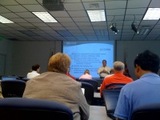
So I spent most of last week at the LETSI/SCORM 2.0 Workshop in Pensacola, FL. I used CoverItLive to do a running set of notes of the workshop and that's available here. I don't want to go over all the stuff in my notes but I did want to be sure and point out that the workshop developed and is currently refining about 30 use cases for SCORM 2.0. This is in addition to the 100+ white papers that have been written and submitted to LETSI on SCORM 2.0 topics.
All that tells me is that there is considerable intellectual firepower being directed at this issue of what SCORM should/would or could be in the future. It also tells me that the LETSI leadership is serious about creating an open and transparent process and being as inclusive as possible. Kudos. It doesn't tell me if the efforts will be successful -I think that a large part of that success will depend on how well LETSI can research, evaluate and leverage existing work being done in terms of SOAs, Web services and so on...and how fast LETSI can move....and how the market reacts to LETSI's biz model. I just had this thought - could LETSI be hamstrung by the market it serves?
What I mean is that the e-learning industry - or whatever you want to call it - over the past ten years, hasn't exactly been keeping pace with the pace of tech advances...I think KM has probably done better but still not great...but services that have their own conferences like ECM (enterprise content management) have also been progressing but as an industry, I don't think e-learning has exactly done a great job at integrating the advances in these other areas. I wonder if part of this is due in part to an out-moded model of instructional design than is focused on industrial-era units of learning like courses and isn't built from an architectural standpoint, to handle the idea of people actually learning vis systems like IM, wikis, blogs, etc.
I will say this...whether or not LETSI or SCORM 2.0 succeeds or not - it will not be because it lacks great,
dedicated people. I met a lot of great folks like "Hey I think I'm drinking with Robert Scoble" look-alike Lang Holloman, or my new Twitter-based best friend and brother from another mother Aaron Silvers, Dapper Dan Young, Angelo "Have I told you about the flood" Panar, Tom "former guy who really ran Macromedia" King, Av "The Host with the Most" Barr, Allyn "G'day mate" Radford, Eric "Socrates was an idiot and I taught Piaget everything he knew" Roberts, Mike "BAQON Bits" Rustici, Nina "The Hammer" Pasini Diebler, Ellen "The Maestro" Meiselman and a cast of dozens. I should also thanks to the IHMC for a TERRIFIC hosting job and a great chef. So let's get out there and get all mavericky and see if we can see Russia from our house or maybe just a way forward.
Mark Oehlert
.
Blog
.
<span class='date ' tip=''><i class='icon-time'></i> Dec 04, 2015 10:06pm</span>
|
|
Mark Oehlert
.
Blog
.
<span class='date ' tip=''><i class='icon-time'></i> Dec 04, 2015 10:06pm</span>
|
|
Mark Oehlert
.
Blog
.
<span class='date ' tip=''><i class='icon-time'></i> Dec 04, 2015 10:06pm</span>
|