Blogs
|
Are you in the
market for new performance management software?
See our newly published "What Works Brief: The
Guide to Performance Management Software:
2015."[1]
A free synopsis of the longer study, this brief covers the main trends in the
changing world of performance management and the progress that software vendors
are just starting to make to support that change.
In addition
to the software solutions covered, we included data from our recent Bersin by
Deloitte study of the buying community - you folks who are seeking to replace
outdated systems. We learned that of companies purchasing new talent management
software this year, 67 percent were planning to purchase performance management
software, either for the first time or as a replacement for existing solutions.[2]
[3]
Why? There are several factors:
Performance
management is increasingly deemed critical in today’s organizations and the
historical systems are not perceived as adequately supporting next-generation
practices;
The current installed
systems are aging;
Companies may have
multiple different systems and seek to consolidate into one corporate-wide platform.
Of those
replacing existing software, 75 percent sought to replace a standalone
performance management application with an integrated suite solution.[4]
The majority
of organizations we surveyed (74 percent) use one software solution for their
performance management system, but respondents reported that as many as ten or
more systems are used inside their organizations today. Twelve percent of the
population surveyed noted that they did not have a formal performance
management process at all.[5]
41 percent of
respondents reported that their performance management solutions are
self-developed; 38 percent are provided by a vendor (often a suite vendor,
although the module may be stand-alone) and 21 percent use modules that are
within their core HR systems.
In 19 percent
of organizations, the software in use is aging -- seven or more years old. This
is especially the case with large organizations, where 29 percent of
organizations with more than 25,000 employees have owned their performance
management system for more than 7 years.
Reliance on home-grown, self-developed solutions for
performance management may well be part of the reason for the interest in
procuring new applications in the near future; the lack of any technology solution,
as noted by 15 percent of respondents may be another.
Coaching In,
Ranking Out
Our research demonstrates that organizations with
higher levels of support for coaching see stronger talent outcomes.[6]
As it has become increasingly important in the management of performance
overall, some applications include tips for how to enhance the effectiveness of
the coaching process. These programs
provide a just-in-time approach to coaching assistance, dependent on the area
on which the manager is coaching.
Across the
solutions studied, 21 percent provide automated coaching tools and 55 percent
supported the assignment of a coach within the performance management system;
38 percent provide links to on-demand coaching information, related to the area
of interest at hand. 52 percent provide workflows to track coaching and
mentoring conversations and activities, an important feature in coaching
management.
The growth of coaching as a performance support mechanism has led
to support by vendors to maintain records of managers’ one-on-one coaching
sessions. These provide employees with a record of the discussions and
employers with evidence these discussions occurred. The goal of such tools enables managers to
track their ongoing meetings with employees to review and track goals and
development plans, and discuss a variety of other organizational or
employee-specific topics. It also relates the frequency and impact the meetings
are having on performance ratings, engagement scores and turnover.
This publication contains
general information only and Deloitte is not, by means of this publication,
rendering accounting, business, financial, investment, legal, tax, or other
professional advice or services. This publication is not a substitute for such
professional advice or services, nor should it be used as a basis for any
decision or action that may affect your business. Before making any decision or
taking any action that may affect your business, you should consult a qualified
professional advisor.
Deloitte shall not be
responsible for any loss sustained by any person who relies on this
publication.
As used in this document,
"Deloitte" means Deloitte Consulting LLP, a subsidiary of Deloitte
LLP. Please see www.deloitte.com/us/about for a detailed description of the
legal structure of Deloitte LLP and its subsidiaries. Certain services may not
be available to attest clients under the rules and regulations of public
accounting.
Copyright © 2015 Deloitte
Development LLC. All rights reserved.
[1] The Guide to
Performance Management Software: 2015 --A
Roadmap to Performance Management and the Solutions that Support it." Katherine Jones, Stacia Sherman Garr, and
Sally-Ann Cooke. Bersin by Deloitte. 2015.
[2] Investments in Human Capital Management Systems
2014: What Technology Users Have and
What They Will Buy in the Year Ahead. Katherine Jones. Bersin by Deloitte.
April 2014.
[3] The
four application areas most often sought as an integrated via a suite rather
than have as standalone solutions are recruiting, onboarding, learning and
performance management.
[4]
Op.Cit. Investments in Human Capital Management
Systems: 2014.
[5] Investments in Human Capital Management Systems
2014: What Technology Users Have and
What They Will Buy in the Year Ahead. Katherine Jones. Bersin by Deloitte.
April 2014.
[6]
Ibid.
Bersin Analyst Blogs
.
Blog
.
<span class='date ' tip=''><i class='icon-time'></i> Dec 04, 2015 11:56pm</span>
|
|
Numbers matter. And in HR numbers are beginning to matter
more and more.
The ability for HR professionals to easily access financial
data has become a more pronounced need, recently. True analytics (not just
"reporting") requires access to cost data such as that traditionally found only
in the financial applications.
The ERPS of the ‘90s provided both "personnel" and financial
data, but as new SaaS HR solutions and talent management applications hit the
market, often the financial data was left behind. (One exception is Workday,
which added financial applications to its HRIS to answer just such questions).
Without integration to financials, it is difficult for HR
and staffing organizations to answer questions such as:
Will it be a better financial decision to hire a
salaried employee to fill a current skill gap or a shorter term contingent
worker?
Will it cost us more in the long term to hire a
data scientist than to upskill our current HR staff on analytics and
statistics?
At what point will our external spend on
recruiting be better spend on in-house efforts?
It is access - easy access—to financial data that can help
HR answer these questions. In this
light, last week Cloud HR and talent provider Ultimate Software announced a strategic alliance with Cloud ERP provider NetSuite.
Primarily targeted at companies looking for integrated ERP and HR/talent
solutions, the partnership will provide NetSuite’s financials,
supply chain, customer relationship management (CRM) and Ultimate Software’s
payroll, HR, benefits, time and labor management,
performance, compensation, and succession management.
While this clearly goes beyond the
need for access to financial data that HR professionals need for decision
making, it can solve that requirement and help manage the entire business
cycle. Areas such as integration of point
of sale information from NetSuite into HR or performance management data may be
anticipated.
The two vendors report dozens of joint
deployments of Ultimate Software’s UltiPro and NetSuite today, integrated with
solutions from Informatica. While
Informatica will continue to be marketed for integration, the two companies plan
on creating and providing out-of-the-box packaged integration.
Neither company is a
newcomer to Cloud delivery of its
solutions: 25 year old Ultimate Software made the move from on-premise to
software-as-a-service and now has 19 million people "systems of record" in the cloud. NetSuite, a Cloud company since its inception
in 1998 (as NetLedger) has to approximately 24,000 companies and subsidiaries
using its business solutions such as finance, sales, marketing, services, supply
chain, fulfillment, ecommerce, inventory and order management, and more.
NetSuite acquired TribeHR,
a solution it positions for SMB companies; the Ultimate Software solution is
targeted at middle market and larger organizations.
Alliances are only as
strong as the ongoing commitment of both partners in making them work; this
alliance, however, provides both companies with solid solutions that they do
not have today. Adding the ERP -
especially the financial -- component to UltiPro’s HCM solution will potentially
allow HR professionals to make sounder business decisions. After all, numbers
do matter.
This publication contains
general information only and Deloitte is not, by means of this publication,
rendering accounting, business, financial, investment, legal, tax, or other
professional advice or services. This publication is not a substitute for such
professional advice or services, nor should it be used as a basis for any
decision or action that may affect your business. Before making any decision or
taking any action that may affect your business, you should consult a qualified
professional advisor.
Deloitte shall not be
responsible for any loss sustained by any person who relies on this
publication.
As used in this document,
"Deloitte" means Deloitte Consulting LLP, a subsidiary of Deloitte
LLP. Please see www.deloitte.com/us/about for a detailed description of the
legal structure of Deloitte LLP and its subsidiaries. Certain services may not
be available to attest clients under the rules and regulations of public
accounting.
Copyright © 2015 Deloitte
Development LLC. All rights reserved.
Bersin Analyst Blogs
.
Blog
.
<span class='date ' tip=''><i class='icon-time'></i> Dec 04, 2015 11:55pm</span>
|
|
Infor hosted industry analysts last week at an Innovation Summit
in its decidedly upscale digs in New York. Celebrating its most successful nine
month period in the history of the company, President Duncan Angove reported a five
percent year to date increase in license revenue growth, driven by sales of SaaS subscriptions and perpetual license growth that
exceeded 30 percent. Its booming SaaS business grew nearly five times
year to date, and Human Capital Management platform sales have nearly doubled, in
part fueled by an uptake in health care companies of their HCM solution. Angove
cited 3100 new customers in the last nine months—totally new to Infor, not
upgrades from their legacy products.
It is their business proposition that is resonating in
today’s ERP market: business solutions created for microverticals (See Figure
1), with the very explicit features needed in what might to other vendors be
niche markets not worth dedicated development work. The horizontal solutions,
such as HCM and customer relationship management (CRM), can run in concert with
any of its ERPs, or sold separately. Interestingly in a day of increasing
standardization in software, the company also provides solutions and services
to vertical-specific customization, recognizing that one size indeed does not
fit all.
Figure 1. Infor’s Cloud Microverticals
Source: Infor Inc.,
2015.
The bane of any newly fledged Cloud company is the extent of
its installed base, on on-premise legacy systems. This is especially
challenging for Infor, as it was originally a virtual hodge-podge of ERP,
financial, and other software acquisitions (such as Baan, Lawson Software,
Infinium, System 21, and many more). Now, while dated, the legacy products are
still supported by Infor, with migration paths available whenever the customer
is ready. One new program, called UpgradeX,
is designed to ease - and perhaps hasten—that move in the customer base.
With 2750 cloud customers globally, Infor serves 35 million
users. The
number of multi-tenant solutions they have will expand to 33 by the end of this
year and the company reports that users in more than 90 countries are accessing
Infor products in the Cloud.
Part of the value proposition for customers is the deep
level of very specific vertical functionality - the kind that is often bolted
on a more generic ERP. Examples are fund accounting for public sector, nurse
scheduling and staffing for healthcare, catch weight for food industries, and
kit generation by quantity size breakdown for the fashion industries.
Let’s not forget innovation.
An innovative face on what might appear stodgy old manufacturing may
seem a disconnect - but Infor has innovation labs staffed with creative engineers in a culture
where they can experiment; its Hook and Loop designers also develop custom solutions for
their customers. The efforts of their
creativity is apparent in their user interfaces, their mobile apps for NYPD,
and other solutions.
Last year the analysts told Infor execs that they may be the
ERP market’s best kept secret—and they listened. Over the past year, the
company has invested in marketing, print ads, airports posters, and begin
making a name for themselves in sponsoring charitable events in the
metropolitan area. While not the business equivalent of a household word yet,
the company is likely a future force to be reckoned with.
This publication contains
general information only and Deloitte is not, by means of this publication,
rendering accounting, business, financial, investment, legal, tax, or other
professional advice or services. This publication is not a substitute for such
professional advice or services, nor should it be used as a basis for any
decision or action that may affect your business. Before making any decision or
taking any action that may affect your business, you should consult a qualified
professional advisor.
Deloitte shall not be
responsible for any loss sustained by any person who relies on this publication.
As used in this document,
"Deloitte" means Deloitte Consulting LLP, a subsidiary of Deloitte
LLP. Please see www.deloitte.com/us/about for a detailed description of the
legal structure of Deloitte LLP and its subsidiaries. Certain services may not
be available to attest clients under the rules and regulations of public
accounting.
Bersin Analyst Blogs
.
Blog
.
<span class='date ' tip=''><i class='icon-time'></i> Dec 04, 2015 11:54pm</span>
|
|
To kick off the second day of Deloitte’s CHRO Academy event last week, Lisa Weber highlighted many of the challenges facing today's HR leaders. If you don’t know Lisa, she previously served as Chief Human Resources Officer, Chief Administrative Officer, and President of one of the largest operations at MetLife. We are lucky to have her as an advisor to Deloitte.
A few of the key themes from Lisa’s presentation are as follows.
The Bold, Business-savvy CHRO
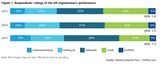
Lisa provided data showing that turnover among CHROs in F100 companies is high: 39% over the past two years, in fact. Many of these roles have been filled with leaders from outside of HR - executives from marketing, finance, operations, or lines of business. The turnover isn't that surprising, given that only 5 percent of respondents in our global survey rated their organization’s HR performance as excellent (see Figure 1.)
Driven by the need to deliver greater business impact and drive innovation, the CHRO role is changing. The need for CHROs with strong business and financial acumen is more pressing than ever. CHROs need to understand where the business is going and how the business makes money. Most HR leaders have only a fleeting glimpse of what really drives the business.
There is also tremendous pressure these days to be data-savvy. Data and analytics can help CHROs to see new directions and can bring better perspectives. But Lisa commented that the data alone is not enough. CHROs need to take those insights from the data and apply foresight - using their experience, wisdom, and judgment. With this combination, great things can happen.
So CHROs need to be business-savvy and data-savvy, but they also need to be bold. What does "bold’ look like? Bold is advocating a point of view on the company’s critical growth areas and how to get there. Bold is identifying where the company is weak and proposing solutions. If your company is thinking of opening a facility in a new location, for example, speak up on the talent implications: Can we find the right talent there? How long will it take us to recruit? What are the local labor laws and practices? Is this a wise move from a talent perspective?
A bold CHRO is also proactive in identifying trouble spots and creating talent initiatives in response. During the keynote, an HR leader at a cosmetics company shared an initiative that originated from his CHRO. In response to flagging sales numbers, the organization built a sales capability COE within HR to help recruit and retain high performers. The CEO commented on how impressed he was that HR was proactively taking steps to increase sales - independently, without being asked or pressured. It reminded me of a conference I attended a few months ago where one business leader said in exasperation, "I don’t want my CHRO waiting for me to tell her what to do. I want her to tell me what we should be doing."
Know Your Strengths
A recurring theme at the event was "play to your strengths." Each person on the leadership team has a role to play, and by capitalizing on everyone’s particular skill sets, the team can be more effective. So work closely with others with complementary skills, such as your CIO, CFO, and CMO. Leverage their expertise and perspectives in combination with your talent management prowess.
Too often we fixate on our (and our employees') weaknesses and spend countless hours trying to bolster these deficiencies. By focusing on what people do well, and understanding and leveraging the strengths of others, we have much greater potential to add value to the organization.
Within my own workgroup we are using Gallup’s StrengthsFinder to discover our individual talents. As an example, one of my strengths is that of an "Activator," which Gallup describes as "someone who can make things happen by turning thoughts into action." Activators can bring energy and clarity to others’ ideas and bring concepts to market; these individuals should team up with people with complementary skills, such as "Futurists." By learning our strengths and sharing them with each other, we hope to get greater productivity out of our team.
Team members who understand each other’s abilities have greater trust and respect for each other. And they can selectively spend their time in certain areas, while leaving other areas to their teammates with other strengths. The team is therefore more efficient as well as effective.
Focus on What Matters
CHROs have a never-ending to-do list. Many try to do too much and end up working on things that don’t bring much value to the organization. Lisa’s advice: Be decisive about how you spend your time. Look at your to-do list and prioritize the most important items, then leave the rest.
This advice reminded me of similar comments made by Marissa Mayer, Yahoo’s CEO, who said in an interview that if you are completing everything on your to-do list, you’ve probably spent time on some relatively unimportant tasks.
One priority for your to-do list: building relationships with business and functional leaders. In fact, Lisa recommended that 20% of your time should be spent networking. Oftentimes we let our calendars get filled up with meetings. Lisa’s advice: Don’t let your schedule manage you - you need to manage your schedule. Decide what meetings are critical and politely decline the rest.
And if you’re in a new HR leadership role, it’s important to get focused early. It can be a lot easier to make changes when you are fairly new in your role. Get to know the business and landscape first and then make some bold changes in the first year. If you wait too long, the opportunity for change may pass you by.
Be Mindful
Lisa talked about the importance of being mindful, or being present and fully aware. How many of us have this level of presence at work, or in our personal lives, for that matter? As Lisa pointed out, "It’s hard to be mindful when your mind is full." Most of us are running at hyper-speed. So take some time to reflect, to bring focus to your thoughts, and to be fully present in the moment. You will likely see your judgment, decision-making, and relationships with others radically improve.
Oftentimes CHROs feel they have to have the answer to everything. "I don’t know" or " I would like to think about that" are perfectly acceptable answers. We are much more effective when we respond, rather than react. Mindfulness helps us to respond.
Success is Deliberate
Finally, one of the things I loved about Lisa’s talk was her quote, "Success is deliberate." You need to decide to succeed and go after it. Pick just a few things and over-deliver on those. Then prioritize the next set of deliverables. Many CHROs feel the need to say ‘yes’ to everything and then get caught up doing busywork all day. It’s easy to lose perspective when you are doing too much.
The job of the CHRO requires hyper-prioritizing. But prioritizing often isn’t popular, and you will likely get pushback from other executives and business leaders, who are irritated that you’re not focusing on their requests. Be clear but firm about what you are working on and why. And by all means - deliver!
Bersin Analyst Blogs
.
Blog
.
<span class='date ' tip=''><i class='icon-time'></i> Dec 04, 2015 11:53pm</span>
|
|
I’m excited to announce that the highly-anticipated Talent Acquisition Factbook 2015: Benchmarks and Trends in Spending,
Staffing, and Key Recruiting Metrics was published today.[1]
This research report is particularly timely for contemporary Talent Acquisition
(TA) leaders. With the job market continuing its recovery, TA leaders are
applying a laser-focus on how they attract and engage the talent they seek.
Why, you might ask, is this
different than any another time? It boils down to this—candidates are not simply
coming along for the recruiting ride—they’re driving the car now that the
Internet has revolutionized candidates’ ability to search for jobs and market
their skills. Potential candidates can learn detailed information about an
organization just by performing a quick Internet search. Candidates
can find open positions located anywhere in the world, and those with critical
skills in scarce supply can easily find organizations willing to pay them more
money to switch employers. Further, with the advent of social media came the
ubiquitous ability to passively look for jobs (even when happily employed) by
posting one’s employment experience on a social or professional networking site
Of course, this is not new news. We
have spent the past several months researching ways for recruiters to become
more effective—from focusing on improving the candidate
experience, recruiting the long-term unemployed, to maximizing campus recruiting efforts, implementing veteran hiring initiatives (publishing
in May), and developing stronger relationships with hiring managers (publishing
in July). So, where does the TA leader begin today?
The Talent Acquisition Factbook 2015 should help TA leaders determine
where they need to focus and may help them build a credible business case for
further investment. This research helps answer the big questions TA leaders have
regarding cost per hire, sources of hire, time to fill, and new hire voluntary
turnover, e.g.,
In 2014, U.S. companies increased their average talent acquisition costs 7% from 2013, driven in part by an increase to nearly $4,000 cost per hire in 2014.
Professional networking sites went from 4% of the
recruiting budget in 2011 to 12% on average in 2014. By contrast, agencies and
third-party recruiters took a hit, claiming 18 percent of the recruiting budget in 2014, down
from 38 percent in 2011.
Despite the increased spending on professional networks, the research
shows that company websites drive more hires than other sources, followed by
job boards, and internal candidates.
Overall, companies are finding it takes 52 days on average to fill open
positions—up from 48 days in 2011.
High-impact TA functions have 40 percent lower
new-hire turnover and are able to fill vacancies 20 percent faster than
companies with more tactical recruiting functions.
Interested in learning more? Download the complimentary WhatWorks
Brief and join Jennifer
Krider and me for an online webinar, "Benchmarking
Talent Acquisition: The Shift to Candidate-Driven Recruiting," on June 9th
at 2 p.m. EDT/19:00 BST.
As always, feel free to add a comment below, connect with me on Twitter
@RAEricksonPhD, or by email at rerickson@deloitte.com
P.S. Bersin’s annual conference, IMPACT,
is being held next week in Miami. The conference is sold out but you can follow
the hashtag #IMPACTHR on Wednesday
and Thursday, April 29-30, to hear Bersin by Deloitte analysts present new
research and in-depth case studies by practicing corporate leaders
[1] For more information, Talent Acquisition Factbook 2015, Bersin by Deloitte / Jennifer Krider, Karen O’Leonard, and Robin Erickson, Ph.D., April 2015. Available to research members at www.bersin.com/library
This publication contains general
information only and Deloitte is not, by means of this publication, rendering
accounting, business, financial, investment, legal, tax, or other professional
advice or services. This publication is not a substitute for such professional
advice or services, nor should it be used as a basis for any decision or action
that may affect your business. Before making any decision or taking any action
that may affect your business, you should consult a qualified professional
advisor.
Deloitte shall not be responsible
for any loss sustained by any person who relies on this publication.
Bersin Analyst Blogs
.
Blog
.
<span class='date ' tip=''><i class='icon-time'></i> Dec 04, 2015 11:53pm</span>
|
|
Ninety percent
of American adults have a cell phone and 58 percent have a smartphone,[1]
generally defined as a cellular phone that performs many of the
functions of a computer. A smartphone likely has a touchscreen interface, can
access the Internet rather than just the cell network, and has an operating
system capable of running downloaded applications.
In addition to the
communication support (voice, email, and text) prevalent in mobile devices, and
ignoring for the moment the camera and video technology generally included, smart
phones provide users with a great many transactional or operational tools. One can pay a bill or scan a check, book a
car service, secure a boarding pass, monitor one’s home security system, and much
more. What about at work—and those transactions relevant to talent and HR?
Increasingly many of applications are tied to human capital management
solutions: 93 percent of the HCM solution providers in our recent study supported
mobile applications. Significantly, many reported "developing for mobile
first," meaning that their new product development targeted mobile devices,
then were moved "backward" to laptops and PCs.
The vendors
tell us that the functionality they offer is increasingly being enabled and
used by their customers. These always-handy, "in-your-pocket" applications can
provide immediacy and 24x7 accessibility to both managers and employees. For
Kronos, as an example, 98 percent of client applications within talent
acquisition have mobile apps enabled.[2]
SuccessFactors’ monthly active users increased 95 percent year of over year.[3] Workday reports that it has experienced a 400
percent increase in transaction volume coming from mobile devices.[4]
Today’s
vendors offer mobile solutions well-equipped to provide a positive experience
for job applicants in seeking positions and applying for them with their mobile
devices. These solutions can streamline the application process, potentially
providing a positive experience for HR and the hiring managers as well. It is
the ease of use, tabulation of relevant metrics, and efficiencies gained that
can make a business impact through the use of smartphones.
Onboarding
is a critical ingredient in enculturation and new hire engagement. Tools that
ease that early path to job productivity are also often viewed as instrumental
in reducing unwanted attrition. Not surprisingly, onboarding support was the
area of greatest projected growth in smartphone app use in our recent study of
end users and their plans for smartphone use in HR and talent in the year ahead.[5]
HR professionals are likely to find increasingly more
sophisticated apps in the future, covering many aspects of HR that are
currently managed and used on "tethered" technology—such as desk-bound
technology. Indeed, as the market is inundated with smaller, different devices
such as smart-watches and other wearables, smartphone use for human capital
management is likely to be just the first step into more portable, accessible,
and lower cost workforce management.
Join
me on June 16, 2:00 p.m. ET / 19:00
BST for a web seminar entitled Getting
Smart with Smartphones: Solutions for Human Capital Management for
further discussion.
This publication contains
general information only and Deloitte is not, by means of this publication,
rendering accounting, business, financial, investment, legal, tax, or other
professional advice or services. This publication is not a substitute for such
professional advice or services, nor should it be used as a basis for any
decision or action that may affect your business. Before making any decision or
taking any action that may affect your business, you should consult a qualified
professional advisor.
Deloitte shall not be
responsible for any loss sustained by any person who relies on this
publication.
As used in this document,
"Deloitte" means Deloitte Consulting LLP, a subsidiary of Deloitte
LLP. Please see www.deloitte.com/us/about for a detailed description of the
legal structure of Deloitte LLP and its subsidiaries. Certain services may not
be available to attest clients under the rules and regulations of public
accounting.
Copyright © 2015 Deloitte
Development LLC. All rights reserved.
[1] http://www.pewinternet.org/fact-sheets/mobile-technology-fact-sheet/
- Pew Mobile Technology Fact Sheet. Pew Research Center. January, 2014
[2] Source: Kronos, 2015.
[3] Source: SuccessFactors (SAP), 2015.
[4] 3 Things to Expect from Workday’s New Mobile Experience
November 4, 2014 by Joe
Korngiebel
http://blogs.workday.com/3_things_to_expect_from_workdays_new_mobile_experience.html?campid=ussm_tw_a_co_14.1431
[5]
Smartphones for the Workforce: What HR
Practitioners Tell Us About Planned Use. Katherine Jones, Bersin by Deloitte.
In Press.
Bersin Analyst Blogs
.
Blog
.
<span class='date ' tip=''><i class='icon-time'></i> Dec 04, 2015 11:52pm</span>
|
|
HR organizations got a boost in investment in 2014, with budgets up an average of 4% over the prior year. Much of the extra money went to increased headcount, with HR staffing up 3%, on average. Another big area of investment was HR technology, with one-fifth organizations saying they increased their spending on HR systems during 2014.
So how are these investments paying off? Unfortunately, for most organizations, not very well.
In Deloitte’s newly-released study, just 36% of organizations rated their HR team's performance as either "good" or "excellent." And these ratings are not significantly better than in past years (see Figure 1.)
So for many organizations, the additional investments in HR technology, staffing, programs, and other intiatives have not paid off.
But some HR groups are different, and HR leaders would do well to learn some lessons from these organizations.
Our research describes a growth model in the maturity of HR capabilities. Most HR organizations start out as "compliance-driven" functions, focused on primary services such as payroll and benefits and meeting legal requirements. Over time, HR organizations need to expand their scope of initiatives and business alignment. At the highest stage of maturity, the "business-integrated" HR organization helps drive the business through workforce strategies and people data. These business-integrated HR functions do spend more than their less mature counterparts - $4,434 per employee, on average, as compared with just $2,112 among compliance-driven HR functions.
But the difference is, their efforts are paying off.
As evidence, business-integrated HR organizations have lower involuntary turnover compared to compliance-driven HR organizations (8% vs. 11%)—and each percentage point drop in turnover can be worth millions to a large organization. In addition, companies with business-integrated HR organizations have higher promotion rates, creating solid talent pipelines that enable them to take a long-term view of roles and future needs.
So when HR organizations look at their budgets, they need to ensure their spending is helping to enhance their effectiveness. The Deloitte study recommends the following to help organizations get started:
Design the HR organization to deliver solutions: For many businesses, it is time to redesign HR with a focus on consulting and service delivery, not just efficiency of administration. HR business partners must become trusted business advisors with the requisite skills to analyze, consult, and resolve critical business issues.
Create business-integrated "networks of excellence." High-impact HR teams have different staffing models, relying more in specialists embedded in the business. Recruitment, development, employee relations, and coaching are all strategic programs that should be centrally coordinated but locally implemented. When specialists in these areas live and work close to the business, their impact is greatly enhanced.
Make HR a talent and leadership magnet: How do people get HR jobs in your company? If they accidentally move into HR, this may be holding you back. Create rigorous assessments for top HR staff and rotate high performers from the business into HR to create a magnet for strong leaders.
Invest in HR development and skills as if the business depended on it: Invest in professional development to make sure your HR team is constantly sharpening its own saw and developing the necessary skills to survive. Analytical skills are becoming a must for HR professionals, but many lack the ability to interpret data and communicate findings based on analytics. Other capabilities to focus on include business acumen, consulting skills, and organizational design and change management.
For more information, see Human Capital Trends 2015 and HR Factbook 2015.
Bersin Analyst Blogs
.
Blog
.
<span class='date ' tip=''><i class='icon-time'></i> Dec 04, 2015 11:51pm</span>
|
|
I attended the SAPinsider HR conference in Las Vegas this
last week - and the energy of the audience was contagious. Let me share nuggets
of what I gleaned from attendees:
If your production environment is on-premise,
you will not be planning any rip and replace strategies in the near term; while
aspects of an ERP may in fact be more cumbersome than desired, that working business
infrastructure is not up for replacement.
If, on the other hand, your talent management applications
(learning or hiring management, for example) are on-premise, you are not only
possibly ripe for replacement, but very likely seeking a Cloud-based solution
rather than on-premise software.
If you are part of the 44 percent[1]
who are planning to replace an HRIS system this year, you are seriously
investigating a Cloud solution.
Payroll is generally scary. If users have a working solution today that
covers their global payroll needs, they are unlikely to replace it. Two
scenarios, however, lead to payroll replacement: companies that are replacing an older
on-premise system that had embedded payroll, and those simply contemplating a
change of payroll providers; these seem "up for grabs," as the saying goes.
What does all this mean?
First, the understanding of what software-as-a-service (AKA
Cloud computing) has grown exponentially. Today’s HRIS/HRIT professionals in
general exhibit solid understanding of the concept, the advantages and
sometimes-radical changes that may emanate from cloud computing.
Second, the two fears about Cloud computing -"Is my data
safe? Can I keep employee data private?"
are oh-so yesterday. Today’s buyers are in
the main comfortable with both the security of HR and talent management in the
Cloud, and the ability to keep it private via multi-tenant solutions.
The SAP HR Future
SAP CEO Mike Ettling stated in his keynote that the company
would support its on-premise HCM solution until 2025, giving its 14,000+ users
ten years to consider a move to the Cloud-based Employee Central, the product
that SAP is putting its longer-term Core HR development Euros into.
Today’s HR and HRIT
professionals at the conference seem to be very serious in their commitment to
the concept of talent management. They are also savvy buyers—and looking at the
SuccessFactors’ Cloud solutions in many cases as a replacement for on-premise
learning, as one prominent example.
Will the Cloud be a solution for everyone? Absolutely not.
There are reasons why an organization might not be bounding to the Cloud. For
example:
The company currently has extra capacity in its
data center and an internal IT staff which is not utilized 100 percent.
The organization is a highly complex setting
with rigid compliance requirements.
It is an environment that require extensive
customization to meet its business needs.
It is an extremely high-secure environment (for
example, federal security or top-secret defense sites).
The company is located in as region with a
highly unreliable communications infrastructure.
Our research shows that 52 percent of buyers planned on
using Cloud-delivery as a criteria in the next HCM purchase; 41 percent
indicated that their HR strategy had shifted to such Cloud support.[2] These statistics were borne out in the views
of conference attendees.
This
publication contains general information only and Deloitte is not, by means of
this publication, rendering accounting, business, financial, investment, legal,
tax, or other professional advice or services. This publication is not a
substitute for such professional advice or services, nor should it be used as a
basis for any decision or action that may affect your business. Before making
any decision or taking any action that may affect your business, you should
consult a qualified professional advisor.
Deloitte
shall not be responsible for any loss sustained by any person who relies on
this publication.
As used in
this document, "Deloitte" means Deloitte Consulting LLP, a subsidiary
of Deloitte LLP. Please see www.deloitte.com/us/about for a detailed
description of the legal structure of Deloitte LLP and its subsidiaries.
Certain services may not be available to attest clients under the rules and
regulations of public accounting.
Copyright ©
2015 Deloitte Development LLC. All rights reserved.
[1] Investments
in Human Capital Management Systems 2014. Katherine Jones, Ph.D. Bersin by
Deloitte. 2014.
[2]
Ibid.
Bersin Analyst Blogs
.
Blog
.
<span class='date ' tip=''><i class='icon-time'></i> Dec 04, 2015 11:51pm</span>
|
|
We just published the major study Deloitte Global Human Capital Trends 2015, and the results are striking.
Today, driven by shifts in both work ethos and the transparency of the job market, employee retention and engagement are now the #1 problems companies face. (3,200 respondents from over 100 countries)
This is the third year we've done this study, and we looked at more than ten different trends in the research. The results show that 87% of companies now rate "retention, engagement, and culture" as an important imperative and 50% rate it "urgent." The #2 trend, the need to build a global leadership pipeline, was a close second.
As you will read about in the report, companies are struggling with their culture because of a variety of factors. First, millennials now make up the largest part of the workforce, and they demand flexibility, mobility, and accelerated development like never before. Second, every company's employment brand is now "on the internet," so if you have weak management or a poor working environment, people know about it (we call this "the naked organization"). Third, companies have not kept up with their leadership development and performance management practices - so often management itself is not driving the right behaviors to make people want to stay.
(For more on the whole topic of Culture, please read the article Culture: Why It's the Most Important Topic in Business Today.)
One of the biggest factors may be learning. Our research shows that the #3 priority issue is the need to revamp and improve employee learning. This is not only a problem of skills development, but also one of engagement. The research shows that companies with high performing learning environments rank in the top for employee engagement - demonstrating how important learning is to engaging and empowering people.
Another major finding is that HR skills remain a challenge. 80% of companies believe HR skills are an issue and 39% rate this problem urgent. This means we, as HR professionals, owe it to our organizations and ourselves to take the time and money to develop ourselves. Rotational assignments, bringing non-HR people into the function, and training are all part of the solution.
Analytics was rated a high priority, as we may expect, but the progress is slow. And companies are very focused on fixing performance management, with almost 60% already in the process of re-engineering the process. We've been studying performance management for almost ten years now, and our research clearly shows why and how it should be simpler, more agile, and more developmental in nature.
Speaking of simple, let me conclude with a few comments on that issue. Last year we talked about "the overwhelmed employee" and how important it was for companies to make life easier at work. This year we found that one of the biggest new trends it "The Simplification of Work" - something we can all relate to. More than 60% of companies believe their work environment is too complex and now is the time to strip away clutter and get more focused. As I discuss in "The De-Cluttering of HR" - simplicity does not mean being simplistic. It is a tough effort to shift your culture away from "edge cases" and helping people focus on the basics. We in HR have much to learn in this respect!
I look forward to talking about all this with you at IMPACT this year. I'm going to be talking about Bold HR - and now is definitely the time to be bold. This report, which is filled with good information and insights, tells me (and hopefully you) that the bar is being raised for all of us. Now is the time for us to take charge, innovate, and lead our organizations to be more fulfilling, engaging, and focused.
I look forward to seeing many of you in April, and I hope you really enjoy reading this research!
Bersin Analyst Blogs
.
Blog
.
<span class='date ' tip=''><i class='icon-time'></i> Dec 04, 2015 11:50pm</span>
|
|
Are you in the
market for new performance management software?
See our newly published "What Works Brief: The
Guide to Performance Management Software:
2015."[1]
A free synopsis of the longer study, this brief covers the main trends in the
changing world of performance management and the progress that software vendors
are just starting to make to support that change.
In addition
to the software solutions covered, we included data from our recent Bersin by
Deloitte study of the buying community - you folks who are seeking to replace
outdated systems. We learned that of companies purchasing new talent management
software this year, 67 percent were planning to purchase performance management
software, either for the first time or as a replacement for existing solutions.[2]
[3]
Why? There are several factors:
Performance
management is increasingly deemed critical in today’s organizations and the
historical systems are not perceived as adequately supporting next-generation
practices;
The current installed
systems are aging;
Companies may have
multiple different systems and seek to consolidate into one corporate-wide platform.
Of those
replacing existing software, 75 percent sought to replace a standalone
performance management application with an integrated suite solution.[4]
The majority
of organizations we surveyed (74 percent) use one software solution for their
performance management system, but respondents reported that as many as ten or
more systems are used inside their organizations today. Twelve percent of the
population surveyed noted that they did not have a formal performance
management process at all.[5]
41 percent of
respondents reported that their performance management solutions are
self-developed; 38 percent are provided by a vendor (often a suite vendor,
although the module may be stand-alone) and 21 percent use modules that are
within their core HR systems.
In 19 percent
of organizations, the software in use is aging -- seven or more years old. This
is especially the case with large organizations, where 29 percent of
organizations with more than 25,000 employees have owned their performance
management system for more than 7 years.
Reliance on home-grown, self-developed solutions for
performance management may well be part of the reason for the interest in
procuring new applications in the near future; the lack of any technology solution,
as noted by 15 percent of respondents may be another.
Coaching In,
Ranking Out
Our research demonstrates that organizations with
higher levels of support for coaching see stronger talent outcomes.[6]
As it has become increasingly important in the management of performance
overall, some applications include tips for how to enhance the effectiveness of
the coaching process. These programs
provide a just-in-time approach to coaching assistance, dependent on the area
on which the manager is coaching.
Across the
solutions studied, 21 percent provide automated coaching tools and 55 percent
supported the assignment of a coach within the performance management system;
38 percent provide links to on-demand coaching information, related to the area
of interest at hand. 52 percent provide workflows to track coaching and
mentoring conversations and activities, an important feature in coaching
management.
The growth of coaching as a performance support mechanism has led
to support by vendors to maintain records of managers’ one-on-one coaching
sessions. These provide employees with a record of the discussions and
employers with evidence these discussions occurred. The goal of such tools enables managers to
track their ongoing meetings with employees to review and track goals and
development plans, and discuss a variety of other organizational or
employee-specific topics. It also relates the frequency and impact the meetings
are having on performance ratings, engagement scores and turnover.
This publication contains
general information only and Deloitte is not, by means of this publication,
rendering accounting, business, financial, investment, legal, tax, or other
professional advice or services. This publication is not a substitute for such
professional advice or services, nor should it be used as a basis for any
decision or action that may affect your business. Before making any decision or
taking any action that may affect your business, you should consult a qualified
professional advisor.
Deloitte shall not be
responsible for any loss sustained by any person who relies on this
publication.
As used in this document,
"Deloitte" means Deloitte Consulting LLP, a subsidiary of Deloitte
LLP. Please see www.deloitte.com/us/about for a detailed description of the
legal structure of Deloitte LLP and its subsidiaries. Certain services may not
be available to attest clients under the rules and regulations of public
accounting.
Copyright © 2015 Deloitte
Development LLC. All rights reserved.
[1] The Guide to
Performance Management Software: 2015 --A
Roadmap to Performance Management and the Solutions that Support it." Katherine Jones, Stacia Sherman Garr, and
Sally-Ann Cooke. Bersin by Deloitte. 2015.
[2] Investments in Human Capital Management Systems
2014: What Technology Users Have and
What They Will Buy in the Year Ahead. Katherine Jones. Bersin by Deloitte.
April 2014.
[3] The
four application areas most often sought as an integrated via a suite rather
than have as standalone solutions are recruiting, onboarding, learning and
performance management.
[4]
Op.Cit. Investments in Human Capital Management
Systems: 2014.
[5] Investments in Human Capital Management Systems
2014: What Technology Users Have and
What They Will Buy in the Year Ahead. Katherine Jones. Bersin by Deloitte.
April 2014.
[6]
Ibid.
Bersin Analyst Blogs
.
Blog
.
<span class='date ' tip=''><i class='icon-time'></i> Dec 04, 2015 11:49pm</span>
|