Blogs
|
One of the things I enjoy the most
about being an analyst is the opportunity to speak with Bersin members about
the Talent Acquisition issues they’re facing. Last spring, we started getting a
lot of questions about campus recruiting programs, e.g., How should we
structure our campus recruiting program? Do you have any frameworks, metrics,
or other guidance for developing a campus recruiting strategy? What metrics
should we use to measure program success?
In response to this member demand, I’m
excited to announce that we’re publishing a new research report today, Developing an Effective Campus
Recruiting Program,
that answers these questions and more.
Why should organizations invest the
time and resources in a campus recruiting program? Campus hires can provide
organizations with a consistent pool of workers in today’s talent-constrained
global business world, with 73 percent of large organizations hiring interns to
fill full-time positions.[1] Campus
programs boast high retention rates with 69 percent of campus hires remaining
with an organization after five years.[2]
This is good news, given that employee turnover can be costly.
Campus
recruiting can deliver additional strategic benefits by helping organizations
manage talent gaps and elevate their profiles as potential employers on
campuses. It also can bring fresh and diverse perspectives to the organization on
topics ranging from technology to contemporary workplace policies.
To
help organizations assess the current state of their campus recruiting programs
and identify opportunities to develop a strategic approach, the report outlines
six critical steps:
·
Create a compelling business
case. Present convincing
business reasons for increased investment and commitment to campus programs,
such as how they can tap rich talent pools, reduce turnover, and help build
leadership pipelines. Presenting a clear vision for your recruiting efforts is
critical to creating an effective program.
·
Identify stakeholders and
decision-makers.
A large number of individuals need to champion, support and ultimately manage
program development and implementation. Executive buy-in and support are likely
to contribute to the overall success of a campus program.
·
Develop strategy and tactics. A campus recruiting program
may satisfy a variety of needs, from traditional internships and cooperative
programs to entry-level positions and even experienced hiring. Organizations
should align their campus recruiting initiatives with their overall talent
acquisition strategy and develop a work plan.
·
Determine a budget. Some campus recruiting
programs fail to launch due to lack of financial support from leadership. Set a
realistic budget and look for ways to optimize efforts by using niche job
posting sites, hosting virtual job fairs, and partnering with local
universities.
·
Align resources. As the need to hire more
skilled entry-level staff and interns in competitive fields grows, organizations
should look to individuals from the business, former interns, and college
alumni networks to help align campus strategies and program execution.
·
Ensure sustainability. Delivering a sustainable program
requires anticipating emerging business needs and continued identification of
the successes and shortcomings of a current campus recruiting program.
Assessing ROI and the value of the program will be the truest measure of a
program’s success.
Interested
in learning more? Download the complimentary WhatWorks®
Brief and join
Denise Moulton and me for an online webinar, Going Back to School: Developing
a More Effective Campus Recruiting Program, on February 24,
2015 2:00 p.m. ET.
As always, feel free to add a comment below, connect with me
on Twitter @RAEricksonPhD, or by email at rerickson@deloitte.com
This publication contains general
information only and Deloitte is not, by means of this publication, rendering
accounting, business, financial, investment, legal, tax, or other professional
advice or services. This publication is not a substitute for such professional
advice or services, nor should it be used as a basis for any decision or action
that may affect your business. Before making any decision or taking any action
that may affect your business, you should consult a qualified professional
advisor.
Deloitte shall not be responsible for
any loss sustained by any person who relies on this publication.
[1] Source: "Infographic: Internships Survey
and 2014 Internship Trends," Internships.com, January 23, 2014, http://www.internships.com/eyeoftheintern/news/idc-news/internships-survey-2014-internship-trends/
.
[2] Source:
"2014 Internship & Co-op Survey," National Association of Colleges and
Employers, April 2014, http://www.naceweb.org/uploadedFiles/Content/static-assets/downloads/executive-summary/2014-internship-co-op-survey-executive-summary.pdf
.
Bersin Analyst Blogs
.
Blog
.
<span class='date ' tip=''><i class='icon-time'></i> Dec 05, 2015 12:24am</span>
|
|
HR organizations got a boost in investment in 2014, with budgets up an average of 4% over the prior year. Much of the extra money went to increased headcount, with HR staffing up 3%, on average. Another big area of investment was HR technology, with one-fifth organizations saying they increased their spending on HR systems during 2014.
So how are these investments paying off? Unfortunately, for most organizations, not very well.
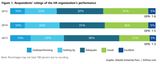
In Deloitte’s newly-released study, just 36% of organizations rated their HR team's performance as either "good" or "excellent." And these ratings are not significantly better than in past years (see Figure 1.)
So for many organizations, the additional investments in HR technology, staffing, programs, and other intiatives have not paid off.
But some HR groups are different, and HR leaders would do well to learn some lessons from these organizations.
Our research describes a growth model in the maturity of HR capabilities. Most HR organizations start out as "compliance-driven" functions, focused on primary services such as payroll and benefits and meeting legal requirements. Over time, HR organizations need to expand their scope of initiatives and business alignment. At the highest stage of maturity, the "business-integrated" HR organization helps drive the business through workforce strategies and people data. These business-integrated HR functions do spend more than their less mature counterparts - $4,434 per employee, on average, as compared with just $2,112 among compliance-driven HR functions.
But the difference is, their efforts are paying off.
As evidence, business-integrated HR organizations have lower involuntary turnover compared to compliance-driven HR organizations (8% vs. 11%)—and each percentage point drop in turnover can be worth millions to a large organization. In addition, companies with business-integrated HR organizations have higher promotion rates, creating solid talent pipelines that enable them to take a long-term view of roles and future needs.
So when HR organizations look at their budgets, they need to ensure their spending is helping to enhance their effectiveness. The Deloitte study recommends the following to help organizations get started:
Design the HR organization to deliver solutions: For many businesses, it is time to redesign HR with a focus on consulting and service delivery, not just efficiency of administration. HR business partners must become trusted business advisors with the requisite skills to analyze, consult, and resolve critical business issues.
Create business-integrated "networks of excellence." High-impact HR teams have different staffing models, relying more in specialists embedded in the business. Recruitment, development, employee relations, and coaching are all strategic programs that should be centrally coordinated but locally implemented. When specialists in these areas live and work close to the business, their impact is greatly enhanced.
Make HR a talent and leadership magnet: How do people get HR jobs in your company? If they accidentally move into HR, this may be holding you back. Create rigorous assessments for top HR staff and rotate high performers from the business into HR to create a magnet for strong leaders.
Invest in HR development and skills as if the business depended on it: Invest in professional development to make sure your HR team is constantly sharpening its own saw and developing the necessary skills to survive. Analytical skills are becoming a must for HR professionals, but many lack the ability to interpret data and communicate findings based on analytics. Other capabilities to focus on include business acumen, consulting skills, and organizational design and change management.
For more information, see Human Capital Trends 2015 and HR Factbook 2015.
Bersin Analyst Blogs
.
Blog
.
<span class='date ' tip=''><i class='icon-time'></i> Dec 05, 2015 12:24am</span>
|
|
I attended the SAPinsider HR conference in Las Vegas this
last week - and the energy of the audience was contagious. Let me share nuggets
of what I gleaned from attendees:
If your production environment is on-premise,
you will not be planning any rip and replace strategies in the near term; while
aspects of an ERP may in fact be more cumbersome than desired, that working business
infrastructure is not up for replacement.
If, on the other hand, your talent management applications
(learning or hiring management, for example) are on-premise, you are not only
possibly ripe for replacement, but very likely seeking a Cloud-based solution
rather than on-premise software.
If you are part of the 44 percent[1]
who are planning to replace an HRIS system this year, you are seriously
investigating a Cloud solution.
Payroll is generally scary. If users have a working solution today that
covers their global payroll needs, they are unlikely to replace it. Two
scenarios, however, lead to payroll replacement: companies that are replacing an older
on-premise system that had embedded payroll, and those simply contemplating a
change of payroll providers; these seem "up for grabs," as the saying goes.
What does all this mean?
First, the understanding of what software-as-a-service (AKA
Cloud computing) has grown exponentially. Today’s HRIS/HRIT professionals in
general exhibit solid understanding of the concept, the advantages and
sometimes-radical changes that may emanate from cloud computing.
Second, the two fears about Cloud computing -"Is my data
safe? Can I keep employee data private?"
are oh-so yesterday. Today’s buyers are in
the main comfortable with both the security of HR and talent management in the
Cloud, and the ability to keep it private via multi-tenant solutions.
The SAP HR Future
SAP CEO Mike Ettling stated in his keynote that the company
would support its on-premise HCM solution until 2025, giving its 14,000+ users
ten years to consider a move to the Cloud-based Employee Central, the product
that SAP is putting its longer-term Core HR development Euros into.
Today’s HR and HRIT
professionals at the conference seem to be very serious in their commitment to
the concept of talent management. They are also savvy buyers—and looking at the
SuccessFactors’ Cloud solutions in many cases as a replacement for on-premise
learning, as one prominent example.
Will the Cloud be a solution for everyone? Absolutely not.
There are reasons why an organization might not be bounding to the Cloud. For
example:
The company currently has extra capacity in its
data center and an internal IT staff which is not utilized 100 percent.
The organization is a highly complex setting
with rigid compliance requirements.
It is an environment that require extensive
customization to meet its business needs.
It is an extremely high-secure environment (for
example, federal security or top-secret defense sites).
The company is located in as region with a
highly unreliable communications infrastructure.
Our research shows that 52 percent of buyers planned on
using Cloud-delivery as a criteria in the next HCM purchase; 41 percent
indicated that their HR strategy had shifted to such Cloud support.[2] These statistics were borne out in the views
of conference attendees.
This
publication contains general information only and Deloitte is not, by means of
this publication, rendering accounting, business, financial, investment, legal,
tax, or other professional advice or services. This publication is not a
substitute for such professional advice or services, nor should it be used as a
basis for any decision or action that may affect your business. Before making
any decision or taking any action that may affect your business, you should
consult a qualified professional advisor.
Deloitte
shall not be responsible for any loss sustained by any person who relies on
this publication.
As used in
this document, "Deloitte" means Deloitte Consulting LLP, a subsidiary
of Deloitte LLP. Please see www.deloitte.com/us/about for a detailed
description of the legal structure of Deloitte LLP and its subsidiaries.
Certain services may not be available to attest clients under the rules and
regulations of public accounting.
Copyright ©
2015 Deloitte Development LLC. All rights reserved.
[1] Investments
in Human Capital Management Systems 2014. Katherine Jones, Ph.D. Bersin by
Deloitte. 2014.
[2]
Ibid.
Bersin Analyst Blogs
.
Blog
.
<span class='date ' tip=''><i class='icon-time'></i> Dec 05, 2015 12:23am</span>
|
|
We just published the major study Deloitte Global Human Capital Trends 2015, and the results are striking.
Today, driven by shifts in both work ethos and the transparency of the job market, employee retention and engagement are now the #1 problems companies face. (3,200 respondents from over 100 countries)
This is the third year we've done this study, and we looked at more than ten different trends in the research. The results show that 87% of companies now rate "retention, engagement, and culture" as an important imperative and 50% rate it "urgent." The #2 trend, the need to build a global leadership pipeline, was a close second.
As you will read about in the report, companies are struggling with their culture because of a variety of factors. First, millennials now make up the largest part of the workforce, and they demand flexibility, mobility, and accelerated development like never before. Second, every company's employment brand is now "on the internet," so if you have weak management or a poor working environment, people know about it (we call this "the naked organization"). Third, companies have not kept up with their leadership development and performance management practices - so often management itself is not driving the right behaviors to make people want to stay.
(For more on the whole topic of Culture, please read the article Culture: Why It's the Most Important Topic in Business Today.)
One of the biggest factors may be learning. Our research shows that the #3 priority issue is the need to revamp and improve employee learning. This is not only a problem of skills development, but also one of engagement. The research shows that companies with high performing learning environments rank in the top for employee engagement - demonstrating how important learning is to engaging and empowering people.
Another major finding is that HR skills remain a challenge. 80% of companies believe HR skills are an issue and 39% rate this problem urgent. This means we, as HR professionals, owe it to our organizations and ourselves to take the time and money to develop ourselves. Rotational assignments, bringing non-HR people into the function, and training are all part of the solution.
Analytics was rated a high priority, as we may expect, but the progress is slow. And companies are very focused on fixing performance management, with almost 60% already in the process of re-engineering the process. We've been studying performance management for almost ten years now, and our research clearly shows why and how it should be simpler, more agile, and more developmental in nature.
Speaking of simple, let me conclude with a few comments on that issue. Last year we talked about "the overwhelmed employee" and how important it was for companies to make life easier at work. This year we found that one of the biggest new trends it "The Simplification of Work" - something we can all relate to. More than 60% of companies believe their work environment is too complex and now is the time to strip away clutter and get more focused. As I discuss in "The De-Cluttering of HR" - simplicity does not mean being simplistic. It is a tough effort to shift your culture away from "edge cases" and helping people focus on the basics. We in HR have much to learn in this respect!
I look forward to talking about all this with you at IMPACT this year. I'm going to be talking about Bold HR - and now is definitely the time to be bold. This report, which is filled with good information and insights, tells me (and hopefully you) that the bar is being raised for all of us. Now is the time for us to take charge, innovate, and lead our organizations to be more fulfilling, engaging, and focused.
I look forward to seeing many of you in April, and I hope you really enjoy reading this research!
Bersin Analyst Blogs
.
Blog
.
<span class='date ' tip=''><i class='icon-time'></i> Dec 05, 2015 12:22am</span>
|
|
Are you in the
market for new performance management software?
See our newly published "What Works Brief: The
Guide to Performance Management Software:
2015."[1]
A free synopsis of the longer study, this brief covers the main trends in the
changing world of performance management and the progress that software vendors
are just starting to make to support that change.
In addition
to the software solutions covered, we included data from our recent Bersin by
Deloitte study of the buying community - you folks who are seeking to replace
outdated systems. We learned that of companies purchasing new talent management
software this year, 67 percent were planning to purchase performance management
software, either for the first time or as a replacement for existing solutions.[2]
[3]
Why? There are several factors:
Performance
management is increasingly deemed critical in today’s organizations and the
historical systems are not perceived as adequately supporting next-generation
practices;
The current installed
systems are aging;
Companies may have
multiple different systems and seek to consolidate into one corporate-wide platform.
Of those
replacing existing software, 75 percent sought to replace a standalone
performance management application with an integrated suite solution.[4]
The majority
of organizations we surveyed (74 percent) use one software solution for their
performance management system, but respondents reported that as many as ten or
more systems are used inside their organizations today. Twelve percent of the
population surveyed noted that they did not have a formal performance
management process at all.[5]
41 percent of
respondents reported that their performance management solutions are
self-developed; 38 percent are provided by a vendor (often a suite vendor,
although the module may be stand-alone) and 21 percent use modules that are
within their core HR systems.
In 19 percent
of organizations, the software in use is aging -- seven or more years old. This
is especially the case with large organizations, where 29 percent of
organizations with more than 25,000 employees have owned their performance
management system for more than 7 years.
Reliance on home-grown, self-developed solutions for
performance management may well be part of the reason for the interest in
procuring new applications in the near future; the lack of any technology solution,
as noted by 15 percent of respondents may be another.
Coaching In,
Ranking Out
Our research demonstrates that organizations with
higher levels of support for coaching see stronger talent outcomes.[6]
As it has become increasingly important in the management of performance
overall, some applications include tips for how to enhance the effectiveness of
the coaching process. These programs
provide a just-in-time approach to coaching assistance, dependent on the area
on which the manager is coaching.
Across the
solutions studied, 21 percent provide automated coaching tools and 55 percent
supported the assignment of a coach within the performance management system;
38 percent provide links to on-demand coaching information, related to the area
of interest at hand. 52 percent provide workflows to track coaching and
mentoring conversations and activities, an important feature in coaching
management.
The growth of coaching as a performance support mechanism has led
to support by vendors to maintain records of managers’ one-on-one coaching
sessions. These provide employees with a record of the discussions and
employers with evidence these discussions occurred. The goal of such tools enables managers to
track their ongoing meetings with employees to review and track goals and
development plans, and discuss a variety of other organizational or
employee-specific topics. It also relates the frequency and impact the meetings
are having on performance ratings, engagement scores and turnover.
This publication contains
general information only and Deloitte is not, by means of this publication,
rendering accounting, business, financial, investment, legal, tax, or other
professional advice or services. This publication is not a substitute for such
professional advice or services, nor should it be used as a basis for any
decision or action that may affect your business. Before making any decision or
taking any action that may affect your business, you should consult a qualified
professional advisor.
Deloitte shall not be
responsible for any loss sustained by any person who relies on this
publication.
As used in this document,
"Deloitte" means Deloitte Consulting LLP, a subsidiary of Deloitte
LLP. Please see www.deloitte.com/us/about for a detailed description of the
legal structure of Deloitte LLP and its subsidiaries. Certain services may not
be available to attest clients under the rules and regulations of public
accounting.
Copyright © 2015 Deloitte
Development LLC. All rights reserved.
[1] The Guide to
Performance Management Software: 2015 --A
Roadmap to Performance Management and the Solutions that Support it." Katherine Jones, Stacia Sherman Garr, and
Sally-Ann Cooke. Bersin by Deloitte. 2015.
[2] Investments in Human Capital Management Systems
2014: What Technology Users Have and
What They Will Buy in the Year Ahead. Katherine Jones. Bersin by Deloitte.
April 2014.
[3] The
four application areas most often sought as an integrated via a suite rather
than have as standalone solutions are recruiting, onboarding, learning and
performance management.
[4]
Op.Cit. Investments in Human Capital Management
Systems: 2014.
[5] Investments in Human Capital Management Systems
2014: What Technology Users Have and
What They Will Buy in the Year Ahead. Katherine Jones. Bersin by Deloitte.
April 2014.
[6]
Ibid.
Bersin Analyst Blogs
.
Blog
.
<span class='date ' tip=''><i class='icon-time'></i> Dec 05, 2015 12:21am</span>
|
|
Most HR organizations have been slow to adopt analytics - too slow, in fact, in the minds of many impatient business leaders. Our research conducted last year showed that just 14% of HR organizations in the U.S are using advanced or predictive analytics to make talent decisions. These companies have created strong analytics teams with a diversity of skill sets and have established data governance processes for data quality and integration.
Despite the prognostications that 2014 would be "the year of predictive talent analytics," things haven’t changed all that much. I keep hearing the same questions from HR leaders over and over again: "How do I get started with analytics?" "How do we clean and integrate our data?" "How do we upskill our staff to be more data savvy?"
If HR continues to drag its feet, it risks losing control over its data, and its chance to gain some real power within the organization.
Witness the articles in support of CFOs owning analytics within corporate America. CFOs understand the value of data and are already using analytics to help them understand and predict margins, pricing models, and potential new revenue streams. For decades Finance has been using analytics to better understand where the business is strong and where it needs improvement.
CFOs could be a natural fit to lead analytics across the organization - taking over responsibility for HR analytics, marketing analytics, and operational analytics. Most CFOs are in a position of power within their organizations. They already control much of that data on company financials and operations. They have credibility and are seen (in many companies) as the source of truth. They understand data and know how to use it.
In many organizations, HR falls short on all of the above. Which is why HR risks losing control of its talent data to CFOs, who may be looking to further expand their leadership roles and spheres of influence throughout the company - and who are tired of waiting for HR leaders to "get it" when it comes to analytics.
I’ve already talked with several companies over the past two months that have centralized their analytics across functions. In a some cases, the CFO is running the analytics organization. In others, it falls under the COO or CIO. This should be a wake-up call for HR leaders. The battleground over corporate data is threatening to heat up, and HR can’t throw up the white flag and lose its stake in the one area that promises to bring it credibility with executives and power over talent and business decisions.
If your HR organization is still new to analytics, here is one thing you can do: Find a business leader who is willing to partner on an analytics project to solve a problem (e.g. reducing turnover, improving engagement, reducing accidents/theft/leakage, etc.) Put together a skunks works team, borrowing talent from another department if necessary or partnering with a university or external supplier, and look to get a small ‘win.’ After that, evangelize the results and find another internal stakeholder or two to partner with on another, slightly larger, project.
After you have a few small wins and have built some credibility with business leaders, you can ask for some additional resources and start building an analytics team. Many HR people say, "I can’t get the funding for analytics," and it's no wonder...since they haven’t proven the value and their credibility yet.
So start small - look for a supportive business leader with a pain point - and grow from there. Any don’t wait too long, or before you know it, your CFO may be managing your talent data.
Bersin Analyst Blogs
.
Blog
.
<span class='date ' tip=''><i class='icon-time'></i> Dec 05, 2015 12:21am</span>
|
|
Competencies are the language of talent management. They provide guidance to managers and direct reports alike on the behaviors that are expected. They also are a way to assess those behaviors, whether for the purpose of hiring, development, or performance appraisal.
Yet, for all that can potentially be right about competencies, so much can also potentially be wrong. In many organizations we talk to, competencies are too numerous, ill-defined, or too complex. The result is the competencies are infrequently used and ultimately cast aside.
Therefore, we have to ask ourselves, "Are competencies dead?"
We are currently in the midst of a new research initiative on this question (and we’d like your help on it - see details below). Our initial research reveals, no, competencies are not dead - in many organizations they are alive and well, working as intended. In the organizations that are not using them effectively, though, the competencies seem to be collapsing under their own weight, dying a very slow death. These organizations have "zombie competencies" - or "zompetencies," if you like.
So, how do leaders keep their organizations from creating zompetencies? Here are a few suggestions:
Design for criticality: Focus on what is essential to success - not every competency necessary for doing a job.
Design for impact: Focus on competencies that align to the organization’s business strategy and greatest areas of need. If your organization is making a major transformation from one focused on execution to one focused on innovation, competencies should be a part of the bedrock of the change effort.
Design for simplicity: Constantly ask yourself if the competencies are necessary or can be expressed more simply. Further, in an effort to reduce competencies, do not combine two competencies into one. "Visionary leadership and tactical execution" is not one competency.
Design for acceptance: Avoid the trap of developing competencies in a vacuum. Competencies need to be broadly socialized and amended as they are developed, to ensure both broad understanding and agreement on their content.
Ultimately, managers and direct reports need to understand the competencies, what they mean, and how to use them - and integrate them into how they talk about talent on a regular basis.
How does your organization keep competencies alive and well? Or how has it gotten rid of zompetencies in the past? We are currently looking for examples of effective approaches to competency models and how they support talent management. Please email me at sgarr@deloitte.com if you have any examples from your or other organizations you can share.
Special thanks to Joe Folkman and Candace Atamanik for their contribution to some of the concepts in this blog.
Bersin Analyst Blogs
.
Blog
.
<span class='date ' tip=''><i class='icon-time'></i> Dec 05, 2015 12:20am</span>
|
|
Impressive this year is the software creator’s mantra
"develop for mobile first." Our survey of providers indicated that solutions
are created and in the market for every area of talent: learning, rewards, performance management and
appraisal approval, succession and hiring management and many more. Even core HR. Even content authoring tools.
There is employee self-service and managerial self-service, and for hourly
workers, the ability to clock in and clock out—all on their mobile phones.
And the applications available for mobile use in HR vary in
both number and sophistication. Oracle offers a company directory, Organization
Navigator, predictive analytics, goal management, talent profile, and a personalizable
dashboard on mobile devices. SumTotal offers a Smartphone app for every one of
the 18 content areas we surveyed. Close
to 70 percent of the providers surveyed have mobile learning management
capabilities today. Nine of 48 support the ability to supervise people and take
notes on the experience for sharing later.
Mobile apps are pretty much everywhere. But are companies
actually using them for human capital management? We decided that would be an interesting
question to pursue!
What is your company’s stance on HCM apps on
Smartphones? Do you use them today? Will
you add mobile apps in the year ahead? Or
do you have no need nor plans to deploy mobile HR apps in the future? Whatever
your stance, please let us hear from you!
Take this short
survey (just a few minutes, promise!) on use and intended use of human
capital related apps on Smartphones by clicking on the link below.
This publication contains
general information only and Deloitte is not, by means of this publication,
rendering accounting, business, financial, investment, legal, tax, or other
professional advice or services. This publication is not a substitute for such
professional advice or services, nor should it be used as a basis for any
decision or action that may affect your business. Before making any decision or
taking any action that may affect your business, you should consult a qualified
professional advisor.
Deloitte shall not be
responsible for any loss sustained by any person who relies on this
publication.
As used in this document,
"Deloitte" means Deloitte Consulting LLP, a subsidiary of Deloitte
LLP. Please see www.deloitte.com/us/about for a detailed description of the
legal structure of Deloitte LLP and its subsidiaries. Certain services may not
be available to attest clients under the rules and regulations of public
accounting.
Copyright © 2014 Deloitte
Development LLC. All rights reserved.
Bersin Analyst Blogs
.
Blog
.
<span class='date ' tip=''><i class='icon-time'></i> Dec 05, 2015 12:20am</span>
|
|
How is your week going? If you are anything like many of the people I have spoken with this week, you are having one of the most productive weeks of the year. Your focus is like a laser, your to-do list is pared back, and your eyes are on the prize: to finish up the most critical items before the end of the year. So, I have to ask you: why is every week not more like this one?
The likely answer is that in other weeks you lack the goal clarity that is helping you focus now. Our new research, High-Impact Performance Management: Using Goals to Focus the 21st-Century (Not a Bersin member? Click here for the summary), which we launched yesterday, supports this hypothesis: that many employees lack the clarity they need. Here are a few findings from the study:
Though 76 percent of organizations cascade goals, only 36 percent of organizations have a standard, enterprise-wide approach, which often results in inconsistencies in approach and, potentially, the goals themselves.
While more than half (51 percent) of senior leaders convene a series of meetings throughout the year to discuss goals with business leaders, only six percent of team managers / middle managers receive their goals in the same way, which can result in inconsistent goal messaging.
Though nearly 60 percent of organizations said senior leaders revise their goals during the course of the year, only 36 percent of respondents indicated middle managers make similar revisions to align to new directions being defined by their supervisors. This can result in the organization’s leaders thinking the company is headed in one direction, but the day-to-day actions of employees taking it in an entirely different one.
Our research finds that having that goal clarity - both at the start of the year and on a continuous basis - is a critical factor in predicting business performance. Specifically, we found that employees with a high level of goal clarity were four times more likely to score in the top quartile of business performance. Further, organizations that have employees revise or review their goals quarterly or more frequently were three-and-a-half times more likely to score in the top quartile of business performance.
This new research summarizes the current state of goal-setting and management, including an overview of common goal-setting practices; a review of the academic debate around goals; our analysis of the challenges of modern goal-setting and management; current trends in goal-setting and revising; and the three key principles and seven related practices that our data indicate are critical to effective goal management (see Figure 1).
Figure 1: Three Principles and Seven Practices for Effective Goal Management
Source: "High-Impact Performance Management: Using Goals to Focus the 21st-Century," Stacia Sherman Garr / Bersin by Deloitte, December 2014.
I hope that if you are taking some time off in the coming weeks, that you have an opportunity to unplug and reflect. When you come back to set your goals - and help your organization set its goals - for 2015, I suggest analyzing your organization’s current goal setting approach and asking yourself:
To what extent does your organization’s goal setting process enable you and your employees to have that "end-of-year" clarity on your goals and objectives?
To what extent do your organization’s systems, processes, and culture support continued clarity?
What can you and your organization do differently to enable greater goal clarity, both in January and throughout the year?
If you are able to move the dial on any of these elements, you truly will have given yourself and your employees a gift - the gift of clarity.
Bersin Analyst Blogs
.
Blog
.
<span class='date ' tip=''><i class='icon-time'></i> Dec 05, 2015 12:19am</span>
|
|
My colleague Robin Erickson, Ph.D. and I just completed a webinar
called "Get Ready for 2015: Ten Top Actionable Talent Acquisition Trends." In
the question and answer period at the end, one of the almost 1,000 registrants
asked about the ability to actually apply for a job via a smartphone: Will it make the recruiter’s job harder or
easier?
It’s a good question, isn’t it? Is ease in applying for a job a goal? If it is really easy, will recruiters just be
flooded with junk applications? Or
should the act of applying be laborious enough that only the truly committed
apply? Is it different by industry? By age
group?
A poll during the webinar showed that over a quarter of participants
used mobile in the recruiting process—but we really don’t know how many
supported the ability to apply with a mobile phone. And this moves us to the broader
consideration—how do we in human capital management (HCM) plan to use
smartphones with not only applicants but also with our existing employees?
What is your company’s stance on HCM apps on smartphones? Do you use them today? Will you add mobile aps
in the year ahead? Please let us hear
from you! Take this short survey (just a
few minutes, promise!) on use and intended use of human capital related apps on
Smartphones by clicking on the link below.
https://bersin.qualtrics.com/SE/?SID=SV_4Oe9ZKgWotNWEVT&Source=BLG
This publication contains
general information only and Deloitte is not, by means of this publication,
rendering accounting, business, financial, investment, legal, tax, or other
professional advice or services. This publication is not a substitute for such
professional advice or services, nor should it be used as a basis for any
decision or action that may affect your business. Before making any decision or
taking any action that may affect your business, you should consult a qualified
professional advisor.
Deloitte shall not be
responsible for any loss sustained by any person who relies on this
publication.
As used in this document,
"Deloitte" means Deloitte Consulting LLP, a subsidiary of Deloitte
LLP. Please see www.deloitte.com/us/about for a detailed description of the
legal structure of Deloitte LLP and its subsidiaries. Certain services may not
be available to attest clients under the rules and regulations of public
accounting.
Copyright © 2014 Deloitte
Development LLC. All rights reserved.
Bersin Analyst Blogs
.
Blog
.
<span class='date ' tip=''><i class='icon-time'></i> Dec 05, 2015 12:19am</span>
|