Blogs
|
Keays' Class
.
Blog
.
<span class='date ' tip=''><i class='icon-time'></i> Dec 05, 2015 10:08am</span>
|
|
Keays' Class
.
Blog
.
<span class='date ' tip=''><i class='icon-time'></i> Dec 05, 2015 10:08am</span>
|
|
Keays' Class
.
Blog
.
<span class='date ' tip=''><i class='icon-time'></i> Dec 05, 2015 10:08am</span>
|
|
I had a great lesson planned today on using writing exemplars to deconstruct procedural writing. It was one of those humdinger lessons that make you feel all good after teaching it. Nevermind. There was something better to do.
As class began, one of my ardent students asked me if he could use his laptop to Skype with his dad today. He told me that he misses his dad a lot because he travels all around the world for work. At the moment, dad was in Mexico. The look in his eye when he talked about his dad nearly broke my heart.
"And maybe, Mr. Lee, we could, like, Skype with the whole class!"
I felt like saying, Listen dude, you have no idea how much you just said that to the right teacher. Instead, I held back my sheer exuberance, nodded my head and said, "Go set it up on the projector."
My students were utterly gripped. They started spontaneously lining up to try and ask dad a question. What’s more, they asked such interesting questions complety without my provocation.
Do you get to enjoy yourself in Mexico or is it mostly work?
Has it been hard to adjust to a different culture?
What do you think of us using iPads and iPods in the classroom?
It was incredible.
My student was on cloud nine. Brimming with pride about his dad and bursting with love for the guy. You know when you have a collective learning moment with the students and you just feel as though you are transcending space and time? Ding.
I can do that really cool lesson tomorrow.
Royan Lee
.
Blog
.
<span class='date ' tip=''><i class='icon-time'></i> Dec 05, 2015 10:07am</span>
|
|
There are innumerable ways that instruction, collaboration, higher-order thinking, and assessment are enhanced by having handheld communication devices in the classroom. Many have written about this topic, but it’s not something I want to get into now.
What I want to talk about is what the devices cannot do.
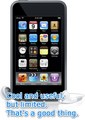
Despite news and blog headlines to the contrary, iPods can’t change the world. They do not take social action. When you turn the little wheely thingy and press the middle button, there is no option for ‘instant innovation’. You can’t send a text message which eloquently persuades an audience to fight for democracy. The app store is a store. It sells products. Period.
But this is not why we should keep our omnipresent devices out of our classrooms. Rather, it’s the very reason we should let them bring them in. If the machines were powerful enough to take the place of what we expect of students themselves, then we should fear them. Keep them out. I agree.
Pedagogically, I am discovering that it is all the little, almost invisible things these devices allow for that truly make them empowering. What is more, putting the internet and/or a wireless network into the hands of students means you cannot control them any longer. You can try all you want to pre-determine Point A and Point B and pave every step of the path that leads from the former to the latter, yet it won’t work. They simply stop looking to you the teacher as the director of the play, let alone the beacon of knowledge.
Royan Lee
.
Blog
.
<span class='date ' tip=''><i class='icon-time'></i> Dec 05, 2015 10:07am</span>
|
|
I took this shot with my iPhone and aptly put the ’1962′ setting on it using my Camera Bag app. My students were stunned this morning to discover I had ‘EQAOed’ (their words) our room. Anchor charts down, coloured wallpaper kaput, desks separated in rows facing the front, SMART Board put away. Not to mention me telling them the following:
No wireless devices.
No talking.
No backchanneling.
No asking questions.
(Funny how most instructions for standardized testing start with the word ‘No’.)
I was so proud when they rolled their eyes and got sarcastic on my ass. They have absolutely razor sharp senses of humour:
Mr. Lee, I thought we were, like, all about the 21st Century?
So this whole technology thing wasn’t working, eh Mr. Lee?
Yup, back to chalky hands and worksheets for us. Pheeeyew.
So you’re telling me I can’t google what decimeter means?
It was fun while it lasted.
Take a picture of us Mr. Lee!
Ya, with our hands on our faces in shame!
Seriously. This is how crazy uproarious my students are. I love them to death.
Royan Lee
.
Blog
.
<span class='date ' tip=''><i class='icon-time'></i> Dec 05, 2015 10:07am</span>
|
|
Here’s a sample of a twitter conversation @slouca11 and my student’s are having on their own time in the evenings:
Royan Lee
.
Blog
.
<span class='date ' tip=''><i class='icon-time'></i> Dec 05, 2015 10:06am</span>
|
|
My students spent the past two days using a Twitter backchannel to communicate, share ideas and resources during a math test. Here’s a taste of what it looked like:
It doesn’t seem all that interesting when you look at this little sample, but I saw some wonderful things in the classroom.
I saw students very quiet in a setting that needed to be, yet still communicating through the backchannel. I witnessed them interested in responding to tweets for help, and sharing advice or strategies through the twitter stream. Most importantly, I saw students focussing on feedback and improvement during a ‘test’, rather than on their grade or what ranking they would be assigned as compared to the standard.
Afterwards, we had a class discussion where I asked the students a) Is this cheating? b) what is challenging about leaving the backchannel open? and c) in what ways did the backchannel help you? Here are a sample of their responses:
Is this cheating?
At first I thought it was, but then I realized it’s not cheating because it doesn’t help just to get an answer.
It’s not cheating because we’re just trying to help each other get better.
Some people would call it cheating but it just helped me get the math better.
What is challenging about having the backchannel open?
It’s so weird being allowed to do it that it’s kind of distracting at first, but then you learn to use it only when you need it.
Sometimes it’s distracting.
So many people say so many different things that I don’t understand it sometimes.
In what ways did the backchannel help you?
It let me talk but still stay quiet.
It made the test fun.
It helped me focus.
It helped me compare my thinking to other people.
At first I was embarrassed to ask questions, but then I saw some people like S—- who are good at math asking questions so I thought ‘Fine, it’s OK.’
Royan Lee
.
Blog
.
<span class='date ' tip=''><i class='icon-time'></i> Dec 05, 2015 10:06am</span>
|
|
http://voicethread.com/book.swf?b=2308036
Royan Lee
.
Blog
.
<span class='date ' tip=''><i class='icon-time'></i> Dec 05, 2015 10:05am</span>
|
|
I may not live in the USA, but SOPA is of great concern to me nevertheless. It should be to you too.
From DYN.com:
Are you familiar with the Great Firewall Of China? Sometimes referred to as the Golden Shield project, it’s a Chinese government censorship and Internet surveillance project kicked off in 1998 and put into action in 2003. Simply put, it enables the government to restrict what content its citizens can read and view via IP blocking and DNS filtering. If they don’t like a site request a user makes, it won’t get viewed.
Many dismiss what’s happening in China and chalk to up to their communist political system. That could never happen in a free speech-driven, rights for all society like we have in the United States, right?
If the Stop Online Piracy Act (SOPA) introduced this week gets enacted into law, things could change negatively for Americans which is why Dyn opposes the bill.
If you’d like to learn more about the outrageously undemocratic lunacy that is SOPA check out my modest little diigo list. To sign the petition against it, check out stopcensorship.org.
Royan Lee
.
Blog
.
<span class='date ' tip=''><i class='icon-time'></i> Dec 05, 2015 10:05am</span>
|