Blogs
|
You can find no shortage of classic films to watch on Open Culture. (See our collection: 725 Free Movies Online: Great Classics, Indies, Noir, Westerns, etc..) But what we haven’t given you is a toolkit for engaging in a more formal study of these films. Enter The Columbia Film Language Glossary, developed at the Center for New Media Teaching and Learning at Columbia University.
The free/open resource uses a combination of text, film clips, and audio commentary to explain terms essential to the study of film — words like Cinema Verité, Montage, and Mise-en-Scène. And it also defines a lot of nuts-and-bolts concepts like Aspect Ratio, High-Angle Shot and Long Take.
The Columbia Film Language Glossary "is available to any student of film. Definitions and audio commentary are written and narrated by faculty at Columbia University." You can dive in right now, right here.
h/t Peter Kaufman
Dan Colman is the founder/editor of Open Culture. Follow us on Facebook, Twitter, Google Plus and LinkedIn and share intelligent media with your friends. Or better yet, sign up for our daily email and get a daily dose of Open Culture in your inbox.
Related Content:
A Visual Introduction to Soviet Montage Theory: A Revolution in Filmmaking
Hitchcock on the Filmmaker’s Essential Tool: The Kuleshov Effect
Alfred Hitchcock’s Seven-Minute Editing Master Class
Columbia U. Launches a Free Multimedia Glossary for Studying Cinema & Filmmaking is a post from: Open Culture. Follow us on Facebook, Twitter, and Google Plus, or get our Daily Email. And don't miss our big collections of Free Online Courses, Free Online Movies, Free eBooks, Free Audio Books, Free Foreign Language Lessons, and MOOCs.
Open Culture
.
Blog
.
<span class='date ' tip=''><i class='icon-time'></i> Dec 07, 2015 12:30am</span>
|
|
A couple years ago, we brought you a post on the history of the "Amen Break," six seconds of sampled drums from a gospel instrumental that—since sampling began in the 80s—has became a ubiquitous rhythmic element in virtually every popular genre of rhythm-based music, from hip-hop, to drum and bass, to EDM. While the technology that enabled the "Amen Break" may be unique to the digital era, the sample’s endless iterations show us something timeless about how music evolves.
Picking up on Richard Dawkins’ 1976 coining of the term "meme," Susan Blackmore argued in The Meme Machine that "what makes us different" from other animals "is our ability to imitate…. When you imitate ssomeone else, something is passed on. This ‘something’ can then be passed on again, and again, and so take on a life of its own." In this theoretical schema, the meme is a fundamental unit of culture, and the "Amen Break" is indeed a perfect example of how such units guide cultural evolution. So is another very widely imitated melodic element in jazz and rock and roll. Variously transcribed as "Doo Ba Doo Pee Dwee Doo Ahh" or "Doo ba dih bee dWee doo daah" or other nonsense syllabic sequences, it is just as often referred to simply as "The Lick."
Licks are, in general, part of the standard vocabulary of every musician. They come in all forms, writes saxophonist, composer, and music theorist Joe Santa Maria—"Cool, Skanky, Soft, Crunchy, Salty, Dirty, Screamin’, Sultry, Tasty"—and they get repeated again and again. But there is one lick in particular, as you can see and hear in the supercut above, that—like the "Amen Break"—has managed to seed itself everywhere. "The Lick," it seems, "pervades music history." It shows up in Stravinsky’s "Firebird," Player’s "Baby Come Back," Christina Aguilera’s "Get Mine, Get Yours." Writes Santa Maria, "Everyone from Coltrane to Kenny G has put this hot lick to the test." It even has its own Facebook page, where users submit example after example of appearances of "The Lick."
Unlike the "Amen Break," which can be definitively traced to a single source (the B-side of a 1969 single called "Color Him Father"), no one seems to know where exactly "The Lick" came from. At some point, its origin ceased to matter. While certain licks are played very self-consciously, Santa Maria admits, "to wow and mystify," or "entrance groupies like the pied piper," the archetypal, definitively named "The Lick" seems to have worked itself so deeply into our musical unconscious that many players and composers likely have no idea they’re reproducing a musical quotation. For whatever reason, and your guess is as good as mine, "The Lick" has become a genuine musical meme, a "unit of imitation" that propagates musical culture wherever it lands.
via Twisted Sifter
Related Content:
The "Amen Break": The Most Famous 6-Second Drum Loop & How It Spawned a Sampling Revolution
A History of Rock ‘n’ Roll in 100 Riffs
Cab Calloway’s "Hepster Dictionary," A 1939 Glossary of the Lingo (the "Jive") of the Harlem Renaissance
Josh Jones is a writer and musician based in Durham, NC. Follow him at @jdmagness
A Great Compilation of "The Lick" Found in Music Everywhere: From Coltrane & Stravinsky, to Christina Aguilera is a post from: Open Culture. Follow us on Facebook, Twitter, and Google Plus, or get our Daily Email. And don't miss our big collections of Free Online Courses, Free Online Movies, Free eBooks, Free Audio Books, Free Foreign Language Lessons, and MOOCs.
Open Culture
.
Blog
.
<span class='date ' tip=''><i class='icon-time'></i> Dec 07, 2015 12:29am</span>
|
|
Many of us keep a record of the movies we watch. Few of us, however, lead the free world. As the reliable sales numbers of presidential biographies (no matter how thick) attest, the actions of the President of the United States of America, no matter who that President may be and no matter what sort of actions that President takes, always draw interest. For instance, you may have seen that Paleofuture‘s Matt Novak recently went through Jimmy Carter’s diaries to draw up a list of every single movie Carter watched during his Presidency.
"Part of my fascination with the movies that presidents watch is just cheap voyeurism," Novak writes. "But the other part is an earnest belief that popular culture influences things in the real world. President Nixon was obsessed with the film Patton during the Vietnam War. President Reagan urged Congress to take computer security seriously after seeing War Games in 1983." And you can learn what else they watched by pulling up What Nixon Saw and When He Saw It by Nixon at the Movies author Mark Feeney, and the list of films Mr. and Mrs. Reagan viewed from the Ronald Reagan Presidential Library.
Nixon watched several depictions of hard-bitten heroes (and antiheroes) toughing out their troubles: not just Patton, but Bullitt, True Grit, Ice Station Zebra, Our Man in Havana, The Treasure of the Sierra Madre, Spartacus, and Lawrence of Arabia — with the occasional Paint Your Wagon or Auntie Mame thrown in there as well. Carter hewed a bit closer to the overall American cinematic zeitgeist, watching such era-defining films as Rocky, Network, Star Wars, Airport ’77, Annie Hall, Animal House, The Last Picture Show, Apocalypse Now, Alien, and 10.
Reagan, famously a film actor himself, watched all sorts movies, though his list shows a certain preference for military-themed spectacles like Gallipoli, Inchon, Das Boot, Firefox, Red Dawn, Iron Eagle, and Top Gun, as well as sports pictures like Breaking Away, The Winning Team, and even Knute Rockne, All American, in which he himself portrayed football player George Gipp, a role that anointed him with the nickname that would stick until the end.
The Freedom of Information act assures us that we’ll have the chance to study the in-office viewing habits of many presidents to come. Novak, in fact, has already put in a request for the lists from George H.W. Bush, Bill Clinton, and George W. Bush: "They said I can expect the list in 46 months." Well, the wheels of government do grind slowly, after all — we’ve learned that from the movies.
Below you can find a list of the first 10 films each president watched upon taking office. The difference in their cultural sensibilities immediately leaps out.
Nixon (list of 528 films here):
The Shoes of the Fisherman
The Sound of Music
The Sand Pebbles
Play Dirty
Doctor Zhivago
Where Eagles Dare
Camelot
A Man for All Seasons
Mayerling
Twisted Nerve
Carter (list 403 films here):
All the President’s Men
One Flew Over the Cuckoo’s Nest
Network
Rocky
The Godfather
The Magic Christian
Buffalo Bill and the Indians
The Bad News Bears
The Shootist
Butch Cassidy and the Sundance Kid
Reagan (list of 363 films here)
Tribute
Nine to Five
Black Stallion
Breaking Away
Oh God, Book II
Tess
Being There
The Competition
Bloodline
The Mirror Crack’d
via PaleoFuture
Related Content:
Portraits of Vice Presidents with Octopuses on Their Heads — the Ones You’ve Always Wanted To See
Watch a Witty, Gritty, Hardboiled Retelling of the Famous Aaron Burr-Alexander Hamilton Duel
Pres. Obama Releases a Free Playlist of 40 Songs for a Summer Day (Plus 6 Books on His Summer Reading List)
Lyndon Johnson Orders New Pants on the Phone and Requests More Room for His … Johnson (1964)
Colin Marshall writes elsewhere on cities, language, Asia, and men’s style. He’s at work on a book about Los Angeles, A Los Angeles Primer, the video series The City in Cinema, and the crowdfunded journalism project Where Is the City of the Future? Follow him on Twitter at @colinmarshall or on Facebook.
The 2,000+ Films Watched by Presidents Nixon, Carter & Reagan in the White House is a post from: Open Culture. Follow us on Facebook, Twitter, and Google Plus, or get our Daily Email. And don't miss our big collections of Free Online Courses, Free Online Movies, Free eBooks, Free Audio Books, Free Foreign Language Lessons, and MOOCs.
Open Culture
.
Blog
.
<span class='date ' tip=''><i class='icon-time'></i> Dec 07, 2015 12:28am</span>
|
|
It’s a pity writer Virginia Woolf (1882-1941) drowned herself before the advent of the Internet.
Industrialization did not faze her.
It’s less clear how the great observer of "the Modern Age" would’ve responded to the proliferation of Mommy bloggers.
Their sheer numbers suggest that perhaps female writers do not need a "room of one’s own" (though presumably all of them would be in favor of such a development.)
Woolf’s name is an enduring one, inspiring both the title of a classic American play and a doggy day care facility. Its owner passed away nearly 75 years ago, yet she remains a perennial on Women’s Studies’ syllabi.
Ergo, it’s possible for the general public to know of her, without knowing much of anything about her and her work. (Find her major works on our lists of Free eBooks and Free Audio Books).
The latest animated installment in The School of Life humanities series seeks to remedy that situation in ten minutes with the video above, which offers insight into her place in both the Western canon and the ever-glamorous Bloomsbury Group, and celebrates her as a keen observer of life’s daily routine. And that by-now-familiar cut-out animation style takes full advantage of the author’s best known head shots.
Arrange whatever pieces come your way.
- Virginia Woolf
Related Content:
Download 55 Free Online Literature Courses: From Dante and Milton to Kerouac and Tolkien
Watch Patti Smith Read from Virginia Woolf, and Hear the Only Surviving Recording of Woolf’s Voice
Virginia Woolf and Friends Dress Up as "Abyssinian Princes" and Fool the British Royal Navy (1910)
Virginia Woolf’s Handwritten Suicide Note: A Painful and Poignant Farewell (1941)
Ayun Halliday is an author, illustrator, and Chief Primatologist of the East Village Inky zine. Follow her @AyunHalliday
An Animated Introduction to Virginia Woolf is a post from: Open Culture. Follow us on Facebook, Twitter, and Google Plus, or get our Daily Email. And don't miss our big collections of Free Online Courses, Free Online Movies, Free eBooks, Free Audio Books, Free Foreign Language Lessons, and MOOCs.
Open Culture
.
Blog
.
<span class='date ' tip=''><i class='icon-time'></i> Dec 07, 2015 12:28am</span>
|
|
From the Future Of StoryTelling video series comes an animation featuring Margaret Atwood meditating on how technology shapes the way we tell stories. Just like the Gutenberg Press did almost 600 years ago, the recent advent of digital platforms (the internet, ebooks, etc.) has created new ways for us to tell, distribute and share stories. And Atwood hasn’t been afraid to explore it all, writing stories on Wattpad and Twitter. Atwood will appear at The Future of Storytelling Summit on October 7 and 8.
via Matthias Rascher
Dan Colman is the founder/editor of Open Culture. Follow us on Facebook, Twitter, Google Plus and LinkedIn and share intelligent media with your friends. Or better yet, sign up for our daily email and get a daily dose of Open Culture in your inbox.
Related Content:
700 Free eBooks for iPad, Kindle & Other Devices
Kurt Vonnegut Diagrams the Shape of All Stories in a Master’s Thesis Rejected by U. Chicago
Writing Tips by Henry Miller, Elmore Leonard, Margaret Atwood, Neil Gaiman & George Orwell
700 Free Audio Books: Download Great Books for Free
An Animated Margaret Atwood Explains How Stories Change with Technology is a post from: Open Culture. Follow us on Facebook, Twitter, and Google Plus, or get our Daily Email. And don't miss our big collections of Free Online Courses, Free Online Movies, Free eBooks, Free Audio Books, Free Foreign Language Lessons, and MOOCs.
Open Culture
.
Blog
.
<span class='date ' tip=''><i class='icon-time'></i> Dec 07, 2015 12:27am</span>
|
|
If you’re from a fading rock n roll generation, here’s maybe a way to make peace with today’s pop music scene. Just take Taylor Swift hits and hear them sung in the style of The Velvet Underground.
That’s what folk singer-songwriter J. Tillman — otherwise known as Father John Misty — did for us, perhaps inadvertently, when he recorded VU-style versions of "Blank Space" and "Welcome to New York." Today, not coincidentally, marks the release of Ryan Adams’s own ballyhooed album that covers Taylor Swift’s 1989, which you can also hear down below.
Ryan Adams’ Covers
via Consequence of Sound
Follow us on Facebook, Twitter, Google Plus and LinkedIn and share intelligent media with your friends. Or better yet, sign up for our daily email and get a daily dose of Open Culture in your inbox.
Taylor Swift Songs Sung in the Style of The Velvet Underground by Father John Misty is a post from: Open Culture. Follow us on Facebook, Twitter, and Google Plus, or get our Daily Email. And don't miss our big collections of Free Online Courses, Free Online Movies, Free eBooks, Free Audio Books, Free Foreign Language Lessons, and MOOCs.
Open Culture
.
Blog
.
<span class='date ' tip=''><i class='icon-time'></i> Dec 07, 2015 12:27am</span>
|
|
A generation grew up watching and re-watching Jim Henson’s Labyrinth. Now, their fond memories of that musical fantasy—featuring not just Henson’s signature puppets but live actors like Jennifer Connelly and David Bowie—have got them trying to turn their own children on to the movie’s wonders. Some now regard Labyrinth as a goofy, flamboyant novelty suitable for no other audience but children, but that gives short shrift to the considerable craft that went into it. To get a sense of that, we need only take a look at Jim Henson’s Red Book.
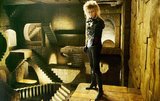
Henson kept the Red Book, a kind of diary written one line at a time, until 1988, not long after Labyrinth‘s release, and it captures intriguing details of the film’s production. On its site, the Jim Henson Company has supplemented the Red Book’s entries with other materials, such as the making-of clip above, which shows what went into the scene where "Bowie’s character Jareth taunts Sarah (Jennifer Connelly) as she tries to get to her brother Toby (Toby Froud) in an elaborate set inspired by the art of Dutch artist and illustrator M.C. Escher."
Henson and his team wanted to bring into three dimensions "Escher’s images of seemingly impossible architecture where stairs seemed to lead both up and down at the same time. The inability of the viewer to recognize what is and is not real was a theme the permeated some of Jim’s experimental works in the 1960s and was explored at length in the film." You can watch the still-convincing final product, in which Bowie sings the song "Within You" while stepping and leaping from one perspective-defying platform or stairway to another, just above. Special credit for pulling all this off goes to the film’s production designer Elliot Scott. But from which member of the team should we demand an explanation for, by far, the most bizarre visual aspect of Labyrinth — David Bowie’s hair?
Related Content:
David Bowie Paper Dolls Recreate Some of the Style Icon’s Most Famous Looks
Watch The Surreal 1960s Films and Commercials of Jim Henson
Jim Henson’s Original, Spunky Pitch for The Muppet Show
Jim Henson’s Zany 1963 Robot Film Uncovered by AT&T: Watch Online
Colin Marshall writes elsewhere on cities, language, Asia, and men’s style. He’s at work on a book about Los Angeles, A Los Angeles Primer, the video series The City in Cinema, and the crowdfunded journalism project Where Is the City of the Future? Follow him on Twitter at @colinmarshall or on Facebook.
David Bowie Sings in a Wonderful M.C. Escher-Inspired Set in Jim Henson’s Labyrinth is a post from: Open Culture. Follow us on Facebook, Twitter, and Google Plus, or get our Daily Email. And don't miss our big collections of Free Online Courses, Free Online Movies, Free eBooks, Free Audio Books, Free Foreign Language Lessons, and MOOCs.
Open Culture
.
Blog
.
<span class='date ' tip=''><i class='icon-time'></i> Dec 07, 2015 12:27am</span>
|
|
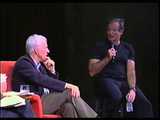
Back in 2002, Stanford University mathematics professor Robert Osserman chatted with comedian and banjo player extraordinaire Steve Martin in San Francisco’s Herbst Theatre. The event was called "Funny Numbers" and it was intended to deliver an off-kilter discussion on math. Boy did it deliver.
The first half of the discussion was loose and relaxed. Martin talked about his writing, banjos and his childhood interest in math. "In high school, I used to be able to make magic squares," said Martin. "I like anything kind of ‘jumbly.’ I like anagrams. What else do I like? I like sex."
Then Robin Williams, that manic ball of energy, showed up. As you can see from the five videos throughout this post, the night quickly spiraled into comic madness. They riffed on the Osbournes, Henry Kissinger, number theory, and physics. "Schrödinger, pick up your cat," barks Williams at the end of a particularly inspired tear. "He’s alive. He’s dead. What a pet!"
When Martin and Williams read passages from Martin’s hit play, Picasso at the Lapin Agile Williams read his part at different points as if he were Marlon Brando, Peter Lorre and Elmer Fudd.
At another time, Williams and Martin riffed on the number zero. Williams, for once acting as the straight man, asked Osserman, "I have one quick question, up to the Crusades, the number zero didn’t exist, right? In Western civilization." To which Martin bellowed, "That is a lie! How dare you imply that the number zero…oh, I think he’s right."
The videos are weirdly glitchy, though the audio is just fine. And the comedy is completely hilarious and surprisingly thought provoking.
via Metafilter
Related Content:
Steve Martin Writes Song for Hymn-Deprived Atheists
Robin Williams (1951-2014) Performs Unknown Shakespeare Play in 1970s Standup Routine
Listen as Albert Einstein Reads ‘The Common Language of Science’ (1941)
Einstein Explains His Famous Formula, E=mc², in Original Audio
Jonathan Crow is a Los Angeles-based writer and filmmaker whose work has appeared in Yahoo!, The Hollywood Reporter, and other publications. You can follow him at @jonccrow. And check out his blog Veeptopus, featuring lots of pictures of vice presidents with octopuses on their heads. The Veeptopus store is here.
Steve Martin & Robin Williams Riff on Math, Physics, Einstein & Picasso in a Heady Comedy Routine (2002) is a post from: Open Culture. Follow us on Facebook, Twitter, and Google Plus, or get our Daily Email. And don't miss our big collections of Free Online Courses, Free Online Movies, Free eBooks, Free Audio Books, Free Foreign Language Lessons, and MOOCs.
Open Culture
.
Blog
.
<span class='date ' tip=''><i class='icon-time'></i> Dec 07, 2015 12:26am</span>
|
|
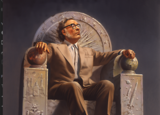
Isaac Asimov’s hugely influential science fiction classic The Foundation Trilogy will soon, it seems, become an HBO series, reaching the same audiences who were won over by the Game of Thrones adaptations. We can expect favorite character arcs to emerge, perhaps distorting the original narrative; we can expect plenty of internet memes and new ripples of influence through successive generations. In fact, if the series becomes a reality, and catches on the way most HBO shows do—either with a mass audience or a later devoted cult following—I think we can expect much renewed interest in the field of "psychohistory," the futuristic science practiced by the novels’ hero Hari Seldon.
This is no small thing. Foundation has inspired a great many science fiction writers, from Douglas Adams to George Lucas. But it has also guided the careers of people whose work has more immediate real-world consequences, like economist Paul Krugman and fervent advocate of positive psychology Martin Seligman. "The trilogy really is a unique masterpiece," writes Krugman," there has never been anything quite like it." The fictional science of psychohistory inspired the experimental predictive techniques Seligman developed and described in his book Learned Optimism:
In his impossible-to-put-down Foundation Trilogy—I read it in one thirty-hour burst of adolescent excitement—Asimov invents a great hero for pimply, intellectual kids…. "Wow!" thought this impressionable adolescent…. That "Wow!" has stayed with me all my life.
If you’re thinking that the epic scale of Asimov’s sprawling trilogy—one he explicitly modeled after Edward Gibbon’s multi-volume History of the Decline and Fall of the Roman Empire—will prove impossible to realize on the screen, you may be right. On the other hand, Asimov’s prose has lent itself particularly well to an older dramatic medium: the radio play. As we noted in an earlier post on a popular 1973 BBC adaptation of the trilogy, Ender’s Game author Orson Scott Card once described the books as "all talk, no action." This may sound like a disparagement, except, Card went on to say, "Asimov’s talk is action."
Today, we bring you several different radio adaptations of Asimov’s fiction, and you can hear the many ways his fascinating concepts, translated into equally fascinating, and yes, talky, fiction, have inspired writers, scientists, filmmakers, and "pimply, intellectual kids" alike for decades. At the top of the post, hear the entire, eight-hour BBC adaptation of Foundation from start to finish. You can also stream and download individual episodes on Spotify and at Youtube and the Internet Archive. Below it, we have classic sci-fi radio drama series Dimension X‘s dramatizations of "Pebble in the Sky" and "Nightfall," both from 1951.
Also hear two Asimov’s stories "The ‘C’ Chute" and "Hostess"—both produced by Dimension X successor X Minus One. These series, wrote Colin Marshall in a previous post, "showcase American culture at its mid-20th-century finest: forward-looking, temperamentally bold, technologically adept, and saturated with earnestness but for the occasional surprisingly knowing irony or bleak edge of darkness."
Not to be outdone by these two programs, Mutual Broadcasting System created Exploring Tomorrow, a "science fiction show of science-fictioneers, by science-fictioneers and for science-fictioneers" that ran briefly from 1957 to 1958. Below, they adapt Asimov’s story "The Liar."
These old-time radio dramas will certainly appeal to the nostalgia of people who were alive to hear them when they first aired. But while their production values will never come close to matching those of HBO, they offer something for younger listeners as well—an opportunity to get lost in Asimov’s complex ideas, and to engage the imagination in ways television doesn’t allow. Whether or not Foundation ever successfully makes it to the small screen, I would love to see Asimov’s fiction—in print, on the radio, on screen, or on the internet—continue to inspire new scientific and social visionaries for generations to come.
Related Content:
Isaac Asimov’s Favorite Story "The Last Question" Read by Isaac Asimov— and by Leonard Nimoy
Isaac Asimov’s Foundation Trilogy: Hear the 1973 Radio Dramatization
Dimension X: The 1950s SciFi Radio Show That Dramatized Stories by Asimov, Bradbury, Vonnegut & More
X Minus One: More Classic 1950s Sci-Fi Radio from Asimov, Heinlein, Bradbury & Dick
Josh Jones is a writer and musician based in Durham, NC. Follow him at @jdmagness
Hear Radio Dramas of Isaac Asimov’s Foundation Trilogy & 7 Classic Asimov Stories is a post from: Open Culture. Follow us on Facebook, Twitter, and Google Plus, or get our Daily Email. And don't miss our big collections of Free Online Courses, Free Online Movies, Free eBooks, Free Audio Books, Free Foreign Language Lessons, and MOOCs.
Open Culture
.
Blog
.
<span class='date ' tip=''><i class='icon-time'></i> Dec 07, 2015 12:25am</span>
|
|
Pity the man who has everything. Satisfaction is but fleeting.
One wonders if rock god Mick Jagger might know a thing or two about the condition. He doesn’t seem to know all that much about acting, as evidenced by his turn in The Nightingale episode of Shelley Duvall’s Faerie Tale Theatre series.
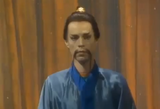
No matter. His artlessness is part of the charm. As the spoiled emperor of Cathay, he makes no effort to alter his Mockney accent. He also keeps his famous strut under wraps, weighted down by his royal robes (and top knot!).
The 1983 episode cleaves closely to the Hans Christian Andersen original that inspired it. To summarize the plot:
The emperor demands an audience with a nightingale, after hearing tell of its song, but the toadies who comprise his court are too rarified to locate one in the forest.
A lowly kitchen maid (Barbara Hershey, on the brink of stardom) is the only one with the know how to deliver.
But the emperor is fickle - it isn’t long before his head is turned by a jewel encrusted, mechanics facsimile…a common enough rock n’ roll pitfall.
A large part of Faerie Tale Theater’s magic was the juxtaposition of high wattage stars and extremely low production budgets. There’s an element of student film to the proceedings. The videotape on which it was shot flattens rather than flatters. This is not a criticism. It makes me awfully fond of the big shots who agreed to participate.
In addition to Jagger and Hershey, look for Angelica Huston, Edward James Olmos, and Jagger’s then girlfriend, Jerry Hall, in smaller roles. There’s also Bud Cort of Harold and Maude, flapping around the sparsely decorated forest like a visitor from an entirely different story, nay, planet.
A curious enterprise indeed.
Related Content:
Stephen Fry Reads Oscar Wilde’s Children’s Story "The Happy Prince"
Mr. Rogers Introduces Kids to Experimental Electronic Music by Bruce Haack & Esther Nelson (1968)
Andy Warhol’s 85 Polaroid Portraits: Mick Jagger, Yoko Ono, O.J. Simpson & Many Others (1970-1987)
Ayun Halliday will be appearing at the Brooklyn Book Festival in New York City this weekend.. Follow her @AyunHalliday
Mick Jagger Acts in The Nightingale, a Televised Play from 1983 is a post from: Open Culture. Follow us on Facebook, Twitter, and Google Plus, or get our Daily Email. And don't miss our big collections of Free Online Courses, Free Online Movies, Free eBooks, Free Audio Books, Free Foreign Language Lessons, and MOOCs.
Open Culture
.
Blog
.
<span class='date ' tip=''><i class='icon-time'></i> Dec 07, 2015 12:25am</span>
|