Blogs
|
2013 was brilliant.
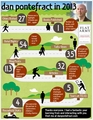
It was so much fun, I decided to develop an infographic that depicts (some of) the year.
Thanks for dropping by. My network is my net worth.
See you in 2014.
Ancora Imparo.
If you’d like to share the infographic, feel free to.
Embed Link
<img src="https://s3.amazonaws.com/easel.ly/all_easels/255255/dpyearinreview/image.jpg" alt="dpyearinreview title="easel.ly" />
easel.ly
Web Link
https://s3.amazonaws.com/easel.ly/all_easels/255255/dpyearinreview/image.jpg
Dan's Related Posts:An Infographic Depicting Learning & Collaboration in ActionThere is Nothing More to Say in 2011 … but ThanksEnter to WIN a Free Signed Copy of Flat ArmyThe Remarkable Leadership Story of Conner & Cayden LongMy Network is my Net Worth - Part II
Dan Pontefract
.
Blog
.
<span class='date ' tip=''><i class='icon-time'></i> Jul 14, 2015 10:46am</span>
|
|
Lynda.com has announced an Essential Training course on Adobe Captivate 8 by Aaron Quigley. It’s a great course for beginners and intermediate users to explore the Captivate authoring workflow and capabilities, and learn how to use the new features introduced in Adobe Captivate 8. This course is also very useful for folks who want to […]
Pooja Jaisingh
.
Blog
.
<span class='date ' tip=''><i class='icon-time'></i> Jul 14, 2015 10:45am</span>
|
|
In 2014, I will …
Write a better book
Find a new publisher (that believes in me)
Convince HBR to feature me more than once
Re-read more Handy and Drucker
Be invited to speak at the Drucker Forum
Visit Europe at least three times
Reach out to those I’ve dearly missed
Respond to more tweets without including the original one (ie. just converse)
Reveal more of my true personality publicly
Stop using 2.0 after anything
Become more conscious of where I buy things from
Continue donating money and time to those in need
Accept my weaknesses & celebrate my natural strengths
Temper my ‘quick to judge’ tendencies
Enjoy the opportunity of launching a start-up consulting outfit in an $11 billion company
Read at least twelve books
Tell better stories when I’m speaking
Shift ten pounds of weight around
Learn to take stunning photographs
Pay it Forward more than I did in 2013
Answer every comment on this blog
Assist Denise through her career decisions
Support the goats through yet another transition
"Live well, love always and laugh out loud every day" (© Brian Reid)
Dan's Related Posts:Video Review of Drucker Forum 2013Whose Your Brian Reid?Our Three Young Children Blog … Here’s WhyLessons Learned From a First Time AuthorInterlocutors of 2012 (the goats are better for it)
Dan Pontefract
.
Blog
.
<span class='date ' tip=''><i class='icon-time'></i> Jul 14, 2015 10:45am</span>
|
|
Personalized therapies for dementia patients can help elevate their moods and cognitive function, which leads to improved quality of live while it reduces caregiver burdens and the risk of acute incidents. With this in mind, Ceresti Health uses Adobe Creative Cloud for individuals and Adobe Captivate to create and deliver personalized web experiences that trigger […]
Pooja Jaisingh
.
Blog
.
<span class='date ' tip=''><i class='icon-time'></i> Jul 14, 2015 10:45am</span>
|
|
We aren’t even close.
It doesn’t matter what report you read, what research you cite or what anecdote you dig up … the problems remain.
Our organizations are being crippled by a combination of gale force winds and tectonic plate drifting. The leadership floor in our organizations is full of useless friction — arguably akin to continental drift — while employees continue to be blown over by colossal gusts of organizational ineptness.
This has to stop.
The time has come for harmony in our workplace.
The time has come for Communitas.
But before Communitas — my Word for 2014 — we need to discuss ‘liminality’. Derived from Latin for "a threshold", liminal stems from the work of Arnold van Gennep, a noted anthropologist from France. In 1909, while researching and penning his most famous book ‘The Rites of Passage‘, van Gennep argued rituals as part of any rite of passage were demarcated into three stages: preliminary, liminality and post-liminality. He wrote that the liminal stage was "a gap between the ordered worlds where almost anything could happen." In plain English, liminal can be thought of as a transition from one state to another.
But that’s what I want to see in our organizations in 2014. I want to see "almost anything happen" and in particular I want leaders in today’s organizations to begin the shift of leading differently. I want leaders to enter the organizational culture equivalence of liminality. I want us to finally achieve a state of transition between today’s useless friction and leadership ineptness to one of organizational harmony and achievement. It doesn’t have to be (and won’t be) solved in 2014.
And the ‘it’ I refer to is the woeful state of the disengaged and/or not engaged employee. Organizational engagement simply has to enter into a stage of transition. We might coin this stage "organizational leadership liminality".
And that’s where we pick up the ‘Word of the Year‘ trail again by introducing Victor Turner.
A British anthropologist who applied his trade as a professor at the University of Chicago, Turner delved deep into van Gennep’s work on liminality. Spending legions of his time and testing his theories with the Ndembu tribe in Zambia, Turner believed the liminal stage was a separation from ‘normal social roles’ to contemplate, reinterpret and in fact embrace alternatives to the current status quo. Turner’s definition of liminality includes the following:
During liminal periods of all kinds, social hierarchies may be reversed or temporarily dissolved, continuity of tradition may become uncertain, and future outcomes once taken for granted may be thrown into doubt.The dissolution of order during liminality creates a fluid, malleable situation that enables new institutions and customs to become established.
At its core, Turner argues that liminality represents the opportunity for a group to strip down existing structural status and customs to create new ones through both intellect and spirit. It reminds me of the "Hitachi Spirit", something I wrote about in Flat Army. The core values Hitachi developed at a point of organizational culture inflection were:
Wa (Harmony, Trust and Respect);
Makoto (Sincerity, Fairness, Honesty and Integrity); and
Kaitakusha-Seishin (Pioneering Spirit and Challenge).
But what does liminality have to do with Communitas — my 2014 Word of the Year?
Turner developed the notion of communitas as a way to define what happens to people when entering the stage of liminality. He believes a sense of solidarity emerges at the liminality stage, backed by feelings of equality, spirit, joy, belonging and overall well-being. These feelings — shared by all — lead to a better future. These feelings permit a shift to the status quo. These feelings dissolve any prior rigid obligations of the old world in favour of a new and authentic manner of behaviour in the new world. These feelings are social. These feelings are cooperative.
Communitas, for 2014 at least, will bring people together to bridge their differences into a singular, common organizational leadership framework. It demystifies hierarchy for the sake of hierarchy and reintroduces humanity into the shared values of one another and the organization. Whilst Turner argues communitas is spontaneous, I argue our organizations must enter into the liminality stage with a preordained might of those gale force winds, to eventually define and achieve a communitas state of organizational culture.
In 2014, our organizations can arrive at communitas such that the organization works as one to define how it can become more humane, more engaged, more soulful, more spirited and more productive. If it does work harmoniously as one to define the manner in which it should be operating, internal employee engagement should begin ticking upward throughout 2015 and beyond. (it might take all of 2014 to get to a state of communitas)
2014 is a transition year for the organization and leadership in general. Limanility is the stage our organizations should be entering. By doing so, we force ourselves to achieve communitas. With communitas, we act as one organization devoid of classes and hierarchies as we define a healthier way in which our organizations should be operating. It’s something Charles Handy would be proud of.
While German sociologist Ferdinand Tönnies may have coined the term Gemeinschaft — where one’s social network is built by one’s own values, beliefs and role in society — communitas is something bigger. It is our chance to bridge the gap for those that either don’t believe in organizational engagement or who are ambivalent to such a concept.
Communitas is what we ought to strive for in 2014.
Communitas is my Word for 2014.
PS. You may be interested in prior Words of the Year:
2013 - Autotelic
2012 - Interlocutor
2011 - Reciprocity
Dan's Related Posts:Steer Clear of Organizational Leadership TurbulenceHolacracy Is Not The Answer To Your Employee Disengagement IssuesKudos Jacques Godin, an Engaged Air Canada EmployeeAutotelic: The Word of 2013Flat Army Book Excerpt: Organizational Learned Helplessness
Dan Pontefract
.
Blog
.
<span class='date ' tip=''><i class='icon-time'></i> Jul 14, 2015 10:44am</span>
|
|
I recently published an interactive eBook for creating responsive eLearning courses using Adobe Captivate 8. It was showcased during the DevLearn DemoFest 2014 event and I received a Best of Show - Vendor Entry award for it. To read the eBook, follow this link on your iPad to download and install the Interactive eBooks app: […]
Pooja Jaisingh
.
Blog
.
<span class='date ' tip=''><i class='icon-time'></i> Jul 14, 2015 10:44am</span>
|
|
If you’re located in parts of North America where it’s been too cold to even blink your eyes lately, you may not have seen the news.
Holacracy is the new black.
Holacracy?
In a nutshell, Holacracy is an organizational structure — initially devised by self-described "recovering CEO" Brian Robertson of HolacracyOne — that purports to do the following:
Holacracy is a distributed authority system - a set of "rules of the game" that bake empowerment into the core of the organization. Unlike conventional top-down or progressive bottom-up approaches, it integrates the benefits of both without relying on parental heroic leaders. Everyone becomes a leader of their roles and a follower of others’, processing tensions with real authority and real responsibility, through dynamic governance and transparent operations.
In a nutshell? Holacracy is a way to operate without the classic ‘command and control’ dogma found in many of today’s organizations.
It even has a constitution you are urged to follow.
Where Did Holacracy Come From?
Holacracy burst on the Twitter water cooler scene in early 2014 mostly as a result of Zappos. At the end of 2013, Zappos CEO Tony Hsieh (never one to remain stagnant with his organization) held a town hall meeting to inform the fine folks who work there that their current organizational structure was being tossed in favour of holacracy by the end of 2014. Apparently they were running a pilot in 2013 with 150 or so employees. It worked so well Tony decided to (eventually) scrap his CEO title and all Zappos employees would do the same under holacracy . Even Twitter co-founder Evan Williams has implemented Holacracy® at his new venture Medium. (and Alexia Bowers does a fine job defining the misconceptions of Holacracy)
And the mainstream media and bloggers then went wild for holacracy. It became the new black.
Lost in the shuffle (I believe) is the origin of the term holacracy. I didn’t interview Brian, but I’d bet one of my Canucks tickets holacracy got its start back in 1967 when author Arthur Koestler penned the book "The Ghost in the Machine" and where he introduced the term holarchy. An ‘archy’ (as a suffix) is a rule or a government and a holon is both a part and a whole. Put them together and you get a connection of holons equating to what Koestler called a holarchy. Holacracy — at least how I view it — is a connection of roles and tasks (a part and a whole) in an attempt to get whatever matters accomplished in as efficient a manner as possible without the rigidity of bosses, hierarchy and other organizational infractions.
Holacracy — and what I think is its originating parent, holarchy — however will not solve your organizational disengagement issues. Don’t be fooled. Getting rid of titles, managers/bosses and spraying empowerment across your employees doesn’t fix the core issue of today particularly in long-standing organizations with a history of disengagement. Some might say it’s pouring water on a tire fire.
The core issues in today’s organization don’t require the eradication of bosses per holacracy or the creation of overlapping, self-governing circles. (ie. the holons) What it requires is for employees — bosses or not — to simply become humane.
That’s it.
Employees of any stripe, rank and colour ought to behave better with one another.
But behaviour change for any level of employee is extremely difficult when both ‘manager and subordinate’ (wow, do I loathe those terms) have been so used to the classic ‘command and control’ way of operating.
No one ever said change was easy.
Just ask President Obama about the Affordable Healthcare Act in America.
Yes, holacracy as a principle is a very cool concept — who isn’t for a healthier organization team and structure — but I wouldn’t want you to think it’s the silver bullet for you and/or your organization. (Alexia says as much in her Holacracy misconceptions post)
In particular, I don’t think you should go near Holacracy if your organization is large and/or disengaged.
Debating Holacracy
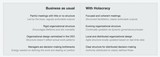
One example I’ll surface is debating what the fine folks at HolacracyOne (the ‘owners’ of Holacracy®) market on their website:
This graphic suggests to me that holacracy is the aforementioned silver bullet built to completely eradicate bad leadership and arguably poor management.
Really?
If an organization implements holacracy will employees (and thus human beings) suddenly forget that they were once territorial, anti-collaborative, close-minded and less than humane in their behaviour with other employees/humans?
I really don’t think so.
Organizations suck (and disengagement is so prevalent) because both managers and employees have forgotten what it is to be human. We don’t know how to be humane in the organization.
And it really isn’t getting any better.
Let’s professionally debunk each of the four points from the graphic above:
Can meetings be less painful without holacracy? Yes of course, and they can be led by anyone on a team if the right behaviours have been instilled into the organization on the whole to be open and transparent.
Can fiefdoms and silos be broken down without holacracy? Yes of course, but it takes organizational behaviours like collaborating, learning, sharing, participating and reciprocity for it to occur.
Can work patterns be improved across an organization outside of a CEO dominated structure without holacracy? Yes of course, if the perfect balance of push and pull, give and take or perhaps ‘flat army’ are deployed as a type of ethos that everyone adheres to.
Can managers as decision-making bottlenecks become cured without holacracy? Yes of course, and one way is to implement the Collaborative Leader Action Model from the Flat Army framework. Connect, Consider, Communicate, Create, Confirm and Congratulate … six key actions (in that order) that will lead even the most disengaged workforce into the highly engaged ranks.
I know this first-hand based on the results of where I ply my trade during the day.
In Conclusion
To be clear, I’m not against the good work that has come of the holacracy movement or what Medium or Zappos are both undertaking. I am certainly not having a go at the fine folks at HolacracyOne either. Having this type of discussion in the open is refreshing and somewhat surreal compared to the decades of prose written about top-down, rigid hierarchical management structures as the ‘way to manage’.
If you’ve made it this far, I simply wanted to get alongside the holacracy movement and suggest it may not be for your own organization.
It’s my belief organizations are disengaged today because they do not possess the open and collaborative types of participative behaviours that are necessary in today’s society. Holacracy might work for some but it doesn’t address the root issue for a disengaged employee or organization, which is … how can you and your organization become more humane?
What behaviours need to be instilled across your organization at any and all levels such that work can become a ‘work of art’.
Work can feel good even with bosses. It requires, however, a radical behaviour change for all.
Dan's Related Posts:Flat Army Book Excerpt: Organizational Learned HelplessnessApparently, Organizational Culture is CrapFuture Of Work: A Flat Army Of Open Leadership via A.G. LafleyRethinking the Work of LeadershipMy Employee Engagement Advice to a Stranger
Dan Pontefract
.
Blog
.
<span class='date ' tip=''><i class='icon-time'></i> Jul 14, 2015 10:44am</span>
|
|
Description: Responsive is what responsive does! Join Dr. Pooja Jaisingh to get an insight into authoring responsive eLearning without programming. Author once using Adobe Captivate 8 and see the content rearrange itself for the tablet and mobile views. Now you don’t need to worry which device your learner will view your eLearning course on. Use the […]
Pooja Jaisingh
.
Blog
.
<span class='date ' tip=''><i class='icon-time'></i> Jul 14, 2015 10:44am</span>
|
|
I had the chance to sit down and be interviewed by Michael Bungay Stanier, Senior Partner of Box of Crayons, a company that helps organizations do less Good Work and more Great Work.
I know, how cool is that tagline?
Michael asked if he could interview me as part of his Great Work interview series. We had a blast. Take a look below at Michael’s overview, thoughts and of course an audio version of the interview itself. Enjoy!
______________________________________
My guest today is Dan Pontefract, who’s Head of Learning of TELUS. Dan has a lot of really practical experience thinking about how to get people aligned in doing meaningful work that makes a difference. He’s also speaking at the upcoming HRPA Conference.
His new book, Flat Army: Creating a Connected and Engaged Organization, is a really powerful read that introduces five or six of Dan’s original models on how he sees the world. So we’re going to uncover some of the real issues around employee engagement and how to do things differently.
In this interview, Dan and I discuss:
The fundamental error in treating employees like numbers (or gladiators)
The need for connected leaders who are equally involved in "becoming, being and going beyond"
Why trust is crucial to organizational success
How to increase people’s capacity to trust
The role of collaboration in creating employee engagement
The 3-33 learning model
(Scroll down for more in-depth podcast notes.)
Listen to my interview with Dan Pontefract.
0:00:00: Dan outlines his background in education, and explains that one of the main things he works to change in organizations is their tendency to treat employees like mere numbers - or "gladiators" in a Roman army.
0:05:02: Michael and Dan discuss some of the few positive examples of organizational change, and note that many people are afraid to change. Dan introduces the notion of the "connected leader."
0:10:03: Dan explains that a connected leader must be equal parts "becoming, being and going beyond." They don’t just focus on execution, but also on the foundation that leads to execution, and the results of having executed. Michael asks about crucial foundational behaviours, and Dan explains that trust is at the root of organizational success. They discuss how to increase people’s capacity to trust.
0:15:00: Expanding on the importance of establishing trust within an organization, Dan and Michael discuss the need for collaboration and looking beyond the manager-subordinate relationship.
0:20:05: Dan and Michael talk about why leaders should focus on engaging people who actively want a purposeful career, rather than those who are disenfranchised by the system.
0:25:02: In response to Michael’s question about the 70-20-10 learning model, Dan explains his own 3-33 learning model. Michael wraps up by directing listeners to additional resources on Dan and his work.
Dan's Related Posts:The Simple Act of TrustingThe Flat Army Interview with Dan Pontefract’s Three Young Childrenthe FLAT ARMY cheat sheetApparently, Organizational Culture is CrapThe Fifteen Habits of a Connected Leader
Dan Pontefract
.
Blog
.
<span class='date ' tip=''><i class='icon-time'></i> Jul 14, 2015 10:44am</span>
|
|
I just heard that Project Expresso is now available for beta testing. Project Expresso is an awesome iPad app which allows you to create engaging and appealing whiteboard explainer videos using the most basic pointing device - your finger and that ubiquitous surface - the iPad tablet. Project Expresso is very simple to use. The […]
Pooja Jaisingh
.
Blog
.
<span class='date ' tip=''><i class='icon-time'></i> Jul 14, 2015 10:44am</span>
|