Blogs
|
Corporate bullies.
I’m fed up with them.
In 2006, Sarah J. Tracy, Pamela Lutgen-Sandvik and Jess K. Alberts published an influential paper entitled "Metaphors of Workplace Bullying: Nightmares, Demons, and Slaves: Exploring the Painful" in the Management Communication Quarterly.
In it the authors note:
Based on qualitative data gathered from focus groups, narrative interviews, and target drawings, the analysis describes how bullying can feel like a battle, water torture, nightmare, or noxious substance. Abused workers frame bullies as narcissistic dictators, two-faced actors, and devil figures. Employees targeted with workplace bullying liken themselves to vulnerable children, slaves, prisoners, animals, and heartbroken lovers.
I hope you weren’t drinking tea when you read that as it might now be all over your laptop or device.
Seven years later, I’m not all that certain our workplaces have completely eliminated - or even partially eliminated - workplace bullying.
To me, it’s another term for ‘command and control’.
Leaders who believe it’s their managerial right to flash the "I have a more senior title than you" card in favour of getting a decision to go in their favour are in fact corporate bullies.
Leaders who poach internal employees from your team without being proactive and discussing the opportunity or situation in advance with you are corporate bullies.
Leaders who ridicule or berate employees in open meetings - whether on a conference call or face-to-face - are corporate bullies.
Leaders who make impossible demands on deadlines, who set up their staff for inevitable failure, are corporate bullies.
Leaders who take credit for the positive results an individual or team created without said leaders involvement, are corporate bullies.
I’m in the midst of writing the second book. You can see where this is going.
Corporate bullying is a problem. We might coin these types of leaders as ‘Puppetry of the Meanest’.
60 total views, 1 views today
Related Posts:The Mysterium Tremendum LeaderWHY I Wrote Flat Army: The Flat Army Golden CircleVirtual Worlds in an Organization are not a Time Waster (andMy Network is my Net Worth - Part IIMicro-blogging can help build your organisational culture
Dan Pontefract
.
Blog
.
<span class='date ' tip=''><i class='icon-time'></i> Jul 14, 2015 11:19am</span>
|
|
Guest Blog by: Joanne Nichols, Adobe Certified Trainer and an Adobe Certified Expert in Adobe Captivate When creating eLearning it is important to ensure you keep the user engaged. By nature we are inquisitive, so why not create eLearning to capture the learner’s interest using this to our advantage. Rollovers are a great way to […]
Pooja Jaisingh
.
Blog
.
<span class='date ' tip=''><i class='icon-time'></i> Jul 14, 2015 11:19am</span>
|
|
Are you looking for a little insight into the 90,000 word version of my new book Flat Army: Creating a Connected and Engaged Organization? Perhaps a ‘try before you buy’ approach?
Fair enough.
Let me do my best and help you out in 559 words.
First off, Flat Army is aimed at three audiences:
Those in charge of the organization on the whole
Leaders with direct teams and/or teams of indirect teams
Individual contributors looking to make the leap into leadership
Second, it is a manifesto to change both the culture of your organization or team as well as the habits of leaders and teams. It aims to drive up overall employee engagement by connecting the dots between increased levels of collaboration, empowerment and participation coupled by new ways to lead, learn and share.
When employee engagement increases in your organization or team, when everyone feels as though they have both a say and an influential part to play in the objectives of the organization, productivity will increase and results will improve.
It’s a fact.
The book is broken down into seven sections:
Chapters 1, 2 and 3 are the setup. It discusses the horrific state of employee engagement, culture and command and control tactics on display in today’s organizations. It investigates why we got this way in the first place, and it outlines at a high level what we have to change in order to improve the health of our workplaces.
From there it’s a journey into the Flat Army philosophy aided by 5 key models.
Chapters 4, 5 and 6 revolves around the first of those 5 models; the Connected Leader Attributes. Think of a tree with its roots, trunk and branches. A Connected Leader is one who is becoming, being and going beyond through fifteen specific leadership attributes that will ensure you become a very engaging leader, helping your team and organization do the same along the way.
Chapter 7 surfaces what I call the Participative Leader Framework which requires leaders to employ the CARE principle (continuous, authentic, reciprocal and educating) as well as being able to both consume and contribute knowledge, ideas and content with the organization. This is coupled by the need to build out both your direct personal and professional network.
Chapter 8 is all about a daily leadership habit called the CLAM. It’s my belief that any Flat Army leader in today’s engaged organization must connect, consider, communicate, create, confirm and congratulate through all actions and initiatives.
Chapter 9 highlights the Pervasive Learning model. Quite simply, leadership and learning should always be thought of as part formal, informal and social and this chapter explains how to make it happen.
Chapter 10 cements the new Flat Army style of a leader and organization through Collaborative Technologies. Leaders need to converse, create content and provide context (the 3 C’s) to effectively become Flat.
The final and seventh component to the book (Chapters 11, 12 and the Afterword) details how each of the five models can be put into practice (individually, as a team and through the organization) such that everyone in the organization is singing from the same choir sheet, engaged and being a very productive member of the mission.
You can read Chapter 1 for free or if this has whetted your appetite enough, you can grab a copy of the book over here. (hardcover and ebook versions)
There is also a one-page Flat Army Cheat Sheet you may have interest downloading. (PDF)
Thanks for reading. Hopefully this was enough of a cheat sheet to get you somewhat interested.
253 total views, 4 views today
Related Posts:Download Chapter 1 for Free - Flat Army: Creating a…Flat Army: Chapter 11 OverviewFlat Army: Chapter 6 OverviewFlat Army: Chapter 10 OverviewFlat Army: Chapter 5 Overview
Dan Pontefract
.
Blog
.
<span class='date ' tip=''><i class='icon-time'></i> Jul 14, 2015 11:19am</span>
|
|
Twitter crunched the numbers following Comic-Con and found out what was the most popular. The post Twitter Says Star Wars Wasn’t the Most Popular Thing at Comic-Con appeared first on WIRED.
Wired Magazine
.
Blog
.
<span class='date ' tip=''><i class='icon-time'></i> Jul 14, 2015 11:19am</span>
|
|
Adobe Captivate 7 is shipped with some great looking themes to help you get started with your eLearning course creation easily. These themes help you save a lot of time that you would otherwise have to spend in creating graphical assets for your eLearning courses. These themes are bundled with multiple eLearning screen layouts to […]
Pooja Jaisingh
.
Blog
.
<span class='date ' tip=''><i class='icon-time'></i> Jul 14, 2015 11:19am</span>
|
|
Far too often I come across stories or direct examples of a leader who has surrounded herself with the same general characteristics and behaviours of the leader herself.
And not in a ‘geez, this beer tastes great’ way.
The trait I see that causes the most damage or stagnates a team and indirect teams into an endless pit of debate is the ‘no’ trait.
No, that will never work.
No, I don’t think we should pursue that.
No, it’s not something we would ever do.
These are lines a leader might say, but leaders are equally influenced by the team she is surrounded by and it’s highly likely she might be fed the ‘no’ ingredient well in advance.
It’s the ‘no’ seed planting approach. Some may call it sabotage.
A member of the team — who reports directly into the leader — is fully aware the leader is more apt to listen to the reasons why something shouldn’t be done (ie. the ‘no’) and therefore begins a proactive campaign of ‘no’ to help solidify the decision that the project should not move forward. Stakeholders from outside the team are blindsided, hurt and confused. Those external members trying to partner on the project thought things were going smoothly until the ‘no’ seed planting took shape and the leader (inevitably you might say) decried the opportunity was wrong. "No, we won’t proceed."
It’s a knot of no’s.
If a leader is aware of her own personal tendency to say ‘no’ more often than ‘yes’ or heaven forbid ‘maybe’, might she think about hiring a team (or at least a few) who can think in the spectrum of ‘yes’?
I know, I know …
123 total views, no views today
Related Posts:The Platonic Leader: Stage 3 of 5 in the Leadership Tonic…the FLAT ARMY cheat sheetThe Ironic Leader: Stage 2 of 5 in the Leadership Tonic…The 4 Traits of a High Performing TeamThe Harmonic Leader: Stage 5 of 5 in the Leadership Tonic…
Dan Pontefract
.
Blog
.
<span class='date ' tip=''><i class='icon-time'></i> Jul 14, 2015 11:19am</span>
|
|
How much cash does Apple have on hand? About as much as the value of Romania's GDP. And enough to bail Greece out---twice. The post Apple Could Have Bailed Out Greece—Twice appeared first on WIRED.
Wired Magazine
.
Blog
.
<span class='date ' tip=''><i class='icon-time'></i> Jul 14, 2015 11:19am</span>
|
|
You may never see video creation the same way. Just one click to record both your desktop and your webcam and minutes later you could be publishing professional quality videos on YouTube, to mobile devices or just about anywhere you’d like. Better yet, it’s free, it’s an App for Mac, and it’s available worldwide. Creating […]
Pooja Jaisingh
.
Blog
.
<span class='date ' tip=''><i class='icon-time'></i> Jul 14, 2015 11:19am</span>
|
|
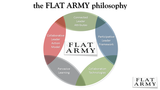
Flat Army revolves around five key frameworks that leaders and organizations need to consider if they want to improve employee engagement and business results.
They are:
Connected Leader Attributes
Participative Leader Framework
Collaborative Leader Action Model
Pervasive Learning
Collaboration Technologies
Each of the five frameworks has an associated graphic that helps depict what they’re about.
I’ve made available a short presentation on Slideshare where each of those five frameworks and the corresponding graphics are available for you to review. (You can see it below as well)
What is a FLAT ARMY? from Dan Pontefract
215 total views, 3 views today
Related Posts:It’s Time to Revolutionize Corporate LearningFlat Army: An Overview of the BookFlat Army: Chapter 4 Overviewflat army bookFlat Army: Chapter 3 Overview
Dan Pontefract
.
Blog
.
<span class='date ' tip=''><i class='icon-time'></i> Jul 14, 2015 11:19am</span>
|
|
There are a lot of fools in our organizations today.
Why else is employee engagement at deplorable levels? Why else do we see senior leaders failing to adopt social collaborative technologies inside (or outside) the organization? Why else do we see authoritative, autocratic, fear mongering and controlling leaders still operating in vast numbers? Why do we see information and knowledge hoarding?
It’s because the people who act this way are fools.
They have a fear of open leadership.
They are the FOOL.
(It’s an acronym)
Work with me.
In my book Flat Army: Creating a Connected and Engaged Organization I define open leadership as follows:
"the act of engaging others to influence and execute a coordinated and harmonious conclusion"
There are some key words and phrases in my definition that FOOL’s don’t understand nor do they action.
1) engaging others
Engage with others? Why would a FOOL like me do that? The easier thing to do is to command others and to tell others specifically what to do and by when. I don’t have time to spare, I’m important you know.
2) influence
Influence? That takes too long and it requires me to slow down my assault on my next career move up the ladder. Forget influencing, I’m going to control everything about this employee, team and any objectives that are currently in flight. I’m a lot like tupperware; I control and prevent the contents from escaping.
3) coordinated
Coordinated? You mean, like, me and the team have to be on the same page? We have to coordinate our ideas, opportunities and actions before we get anything done? I’d rather stick my tongue on frozen monkey bars. That’s what I think of coordinating.
4) harmonious
Harmonious? I’m a FOOL; I can’t even spell harmonious let alone define it for you.
If you’re in an organization replete with FOOL’s — or worse — you have a direct leader who is a FOOL, you may want to rethink your current role and place of work.
If you are a FOOL, drop me a line. I’d be happy to chat about the book with you and get you operating in a flat, open manner.
189 total views, 4 views today
Related Posts:The Harmonic Leader: Stage 5 of 5 in the Leadership Tonic…WHY I Wrote Flat Army: The Flat Army Golden Circle10 Free Copies of Flat Army … Participate to Winthe FLAT ARMY cheat sheetdan pontefract
Dan Pontefract
.
Blog
.
<span class='date ' tip=''><i class='icon-time'></i> Jul 14, 2015 11:18am</span>
|